Net Income Calculator
Calculate take-home pay after taxes • 2026 rates
Net Income Formula:
Show the calculator\( \text{Net Income} = \text{Gross Income} - \text{Taxes} - \text{Deductions} \)
Where:
- \( \text{Gross Income} \) = Total earnings before any deductions
- \( \text{Taxes} \) = Federal, state, local, Social Security, Medicare
- \( \text{Deductions} \) = Retirement contributions, insurance, other withholdings
This formula calculates the actual amount you take home after all mandatory and voluntary deductions. The calculation considers various tax brackets and deduction types that reduce your gross income to arrive at your net income.
Example: For a gross income of $60,000 with 25% total tax rate and $2,000 in additional deductions:
Taxes: $60,000 × 0.25 = $15,000
Net Income: $60,000 - $15,000 - $2,000 = $43,000
Thus, the net income would be $43,000 per year.
Income Details
Advanced Options
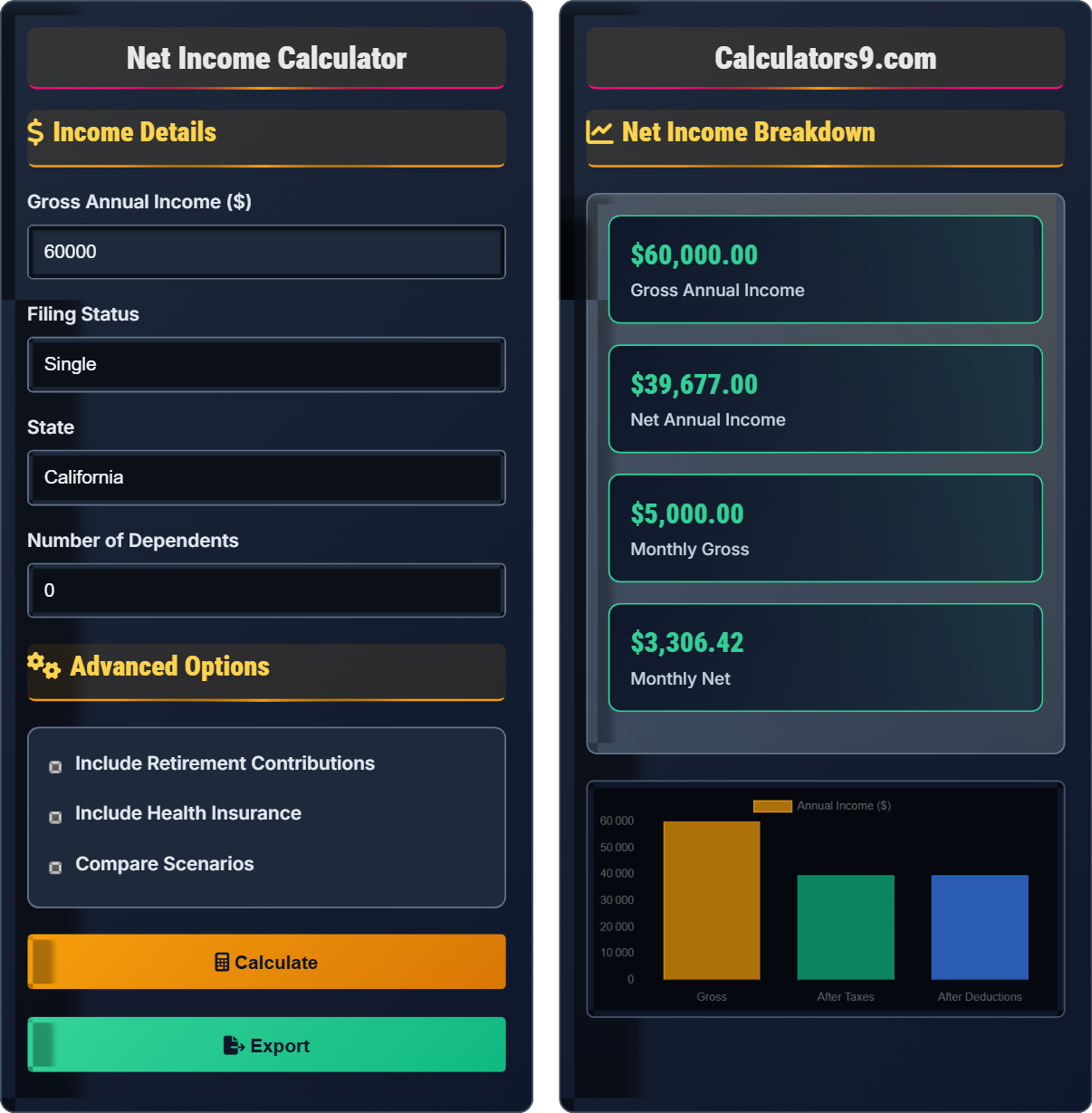
Net Income Breakdown
| Deduction Type | Amount | Percentage |
|---|---|---|
| Federal Tax | $7,500.00 | 12.5% |
| State Tax | $3,000.00 | 5.0% |
| Social Security | $3,720.00 | 6.2% |
| Medicare | $870.00 | 1.45% |
| Retirement | $3,000.00 | 5.0% |
| Health Insurance | $3,000.00 | 5.0% |
| Total Deductions | $20,000.00 | 33.3% |
| Net Income | $40,000.00 | 66.7% |
| Period | Gross | Net | Net Percentage |
|---|---|---|---|
| Weekly | $1,153.85 | $865.38 | 75.0% |
| Bi-weekly | $2,307.69 | $1,730.77 | 75.0% |
| Monthly | $5,000.00 | $3,750.00 | 75.0% |
| Annual | $60,000.00 | $45,000.00 | 75.0% |
Comprehensive Net Income Guide
Net income is the amount of money you actually take home after all mandatory and voluntary deductions have been subtracted from your gross income. This includes federal and state taxes, Social Security, Medicare, retirement contributions, health insurance premiums, and other payroll deductions. Understanding your net income is crucial for budgeting and financial planning.
The basic formula for calculating net income is:
Where:
- Gross Income: Your total earnings before any deductions
- Federal Tax: Based on your tax bracket and filing status
- State Tax: Varies by state (some states have no income tax)
- Social Security: 6.2% of income up to the annual limit
- Medicare: 1.45% of all income
- Other Deductions: Retirement, insurance, union dues, etc.
Your net income is influenced by several factors that determine how much of your gross income you actually receive:
- Tax Brackets: Higher income levels face higher tax rates
- Filing Status: Affects standard deduction and tax brackets
- Dependents: Can reduce taxable income through credits and exemptions
- Location: State and local tax laws vary significantly
- Retirement Contributions: Reduce taxable income when pre-tax
- Maximize pre-tax deductions: Contribute to 401(k), HSA, and FSA accounts
- Claim all eligible credits: Child tax credit, earned income credit, education credits
- Optimize filing status: Choose the most beneficial filing status
- Consider location: Some states have no income tax
- Review withholdings: Ensure correct amount is being withheld
Net Income Learning Quiz
Which of the following is considered a mandatory payroll deduction?
The answer is B) Federal income tax. Mandatory deductions are required by law and include federal income tax, state income tax (where applicable), Social Security tax (6.2%), and Medicare tax (1.45%). Voluntary deductions like 401(k) contributions, health insurance premiums, and union dues are chosen by the employee.
It's important to understand the difference between mandatory and voluntary deductions. Mandatory deductions are legally required and cannot be avoided, while voluntary deductions are elected by the employee. Knowing this distinction helps you understand how your net income is calculated and what portions of your paycheck are required by law versus what you've chosen to contribute to.
Mandatory Deductions: Required by law and automatically withheld
Voluntary Deductions: Chosen by the employee to support benefits
Payroll Taxes: Taxes withheld from employee's paycheck
• Federal income tax is mandatory regardless of preference
• Social Security and Medicare taxes are mandatory
• Voluntary deductions may offer tax advantages
• Remember FICA taxes (Social Security + Medicare) = 7.65%
• Federal income tax varies by income level and filing status
• Check your pay stub to identify different deduction types
• Assuming all deductions are voluntary
• Forgetting about state income tax obligations
• Confusing pre-tax and post-tax deductions
Calculate the net income for someone earning $75,000 annually with 22% federal tax, 5% state tax, 6.2% Social Security, and 1.45% Medicare. Show your work.
Step 1: Calculate federal tax = $75,000 × 0.22 = $16,500
Step 2: Calculate state tax = $75,000 × 0.05 = $3,750
Step 3: Calculate Social Security = $75,000 × 0.062 = $4,650
Step 4: Calculate Medicare = $75,000 × 0.0145 = $1,087.50
Step 5: Calculate total deductions = $16,500 + $3,750 + $4,650 + $1,087.50 = $25,987.50
Step 6: Calculate net income = $75,000 - $25,987.50 = $49,012.50
Therefore, the net income is $49,012.50 per year.
This problem demonstrates how multiple tax rates combine to reduce gross income. Each tax is calculated independently based on its own rate and then added together to find total deductions. Note that Social Security tax only applies to income up to a certain limit ($160,200 in 2023), but for this simplified calculation we applied it to all income.
FICA Taxes: Social Security and Medicare combined
Tax Bracket: Range of income taxed at a particular rate
Progressive Tax System: Higher income faces higher tax rates
• Calculate each tax separately before adding
• FICA taxes apply to all earned income
• Federal tax rates are progressive
• Remember: Social Security = 6.2% up to income cap
• Medicare = 1.45% on all income
• Federal tax rates increase with higher income
• Adding tax rates before applying to income
• Forgetting about Social Security wage base limit
• Applying flat rates to progressive tax systems
Sarah earns $60,000 annually and contributes $3,000 to her 401(k) pre-tax and $1,200 to her health savings account (HSA) pre-tax. If her tax rate is 22%, how much does she save in taxes by making these pre-tax contributions?
Step 1: Calculate total pre-tax contributions = $3,000 + $1,200 = $4,200
Step 2: Calculate tax savings = $4,200 × 0.22 = $924
Therefore, Sarah saves $924 in taxes by making these pre-tax contributions.
This example illustrates the tax advantage of pre-tax contributions. By contributing to pre-tax accounts like 401(k)s and HSAs, you reduce your taxable income, which directly reduces the amount of tax you owe. The tax savings equal the contribution amount multiplied by your marginal tax rate. This makes pre-tax contributions particularly valuable for tax planning.
Pre-tax Contribution: Deducted before tax calculation
Post-tax Contribution: Deducted after tax calculation
Marginal Tax Rate: Tax rate on the last dollar earned
• Pre-tax contributions reduce taxable income
• Tax savings = Contribution amount × Tax rate
• More valuable in higher tax brackets
• Maximize pre-tax contributions to reduce taxes
• Contribute to HSA for triple tax advantage
• Consider catch-up contributions if 50+
• Not maximizing available pre-tax accounts
• Confusing pre-tax and post-tax contributions
• Forgetting about contribution limits
Mike is considering a job offer in New York (8% state tax) vs Texas (0% state income tax). If his gross salary is $80,000 and his federal tax rate is 22%, how much more net income would he have in Texas compared to New York?
Step 1: Calculate federal tax = $80,000 × 0.22 = $17,600
Step 2: Calculate NY state tax = $80,000 × 0.08 = $6,400
Step 3: Calculate TX state tax = $80,000 × 0.00 = $0
Step 4: Calculate NY net income = $80,000 - $17,600 - $6,400 = $56,000
Step 5: Calculate TX net income = $80,000 - $17,600 - $0 = $62,400
Step 6: Calculate difference = $62,400 - $56,000 = $6,400
Mike would have $6,400 more net income in Texas compared to New York.
This demonstrates how state tax differences can significantly impact take-home pay. Some states like Texas, Florida, and Washington have no state income tax, which can provide a substantial advantage over high-tax states like California, New York, and Hawaii. When evaluating job offers, it's important to consider the total tax burden, not just the gross salary.
State Income Tax: Tax collected by state governments
No-Income-Tax States: States that don't tax income
Effective Tax Rate: Total taxes as percentage of income
• State tax rates vary widely (0% to 13%)
• Consider total tax burden when relocating
• Research state tax implications before moving
• Consider cost of living differences too
• Some states offer tax incentives for residents
• Only comparing gross salaries without taxes
• Forgetting about local taxes
• Not considering property taxes in cost comparison
Which of the following statements about Social Security tax is TRUE?
The answer is B) Social Security tax is 6.2% on income up to the annual wage base limit. For 2023, the Social Security wage base limit is $160,200, meaning that only income up to this amount is subject to Social Security tax. Any income above this threshold is not subject to Social Security tax. For self-employed individuals, the rate is 12.4% (employee and employer portions combined).
This question addresses a common misconception about Social Security tax. Unlike Medicare tax, which applies to all earned income, Social Security tax has an annual wage base limit. This means high earners pay a smaller percentage of their total income in Social Security tax compared to middle-income earners. Understanding this cap is important for accurate net income calculations.
Wage Base Limit: Maximum income subject to Social Security tax
Self-Employment Tax: Includes both employee and employer portions
Payroll Tax Cap: Limit on income subject to certain taxes
• Social Security tax = 6.2% up to wage base limit
• Medicare tax = 1.45% on all earned income
• Wage base limit changes annually for inflation
• Remember: SS tax stops at wage base limit
• Medicare tax continues on all income
• Check current year's wage base limit
• Applying Social Security tax to all income
• Forgetting about the wage base limit
• Confusing Social Security and Medicare limits
Net Income Basics
Net Income = Gross Income - All Deductions
For most employees: Net Income = Gross Income - (Federal Tax + State Tax + SS + Medicare + Other)
Based on current tax rates and standard deductions.
- Social Security tax = 6.2% up to wage base limit
- Medicare tax = 1.45% on all income
- Federal tax rates are progressive
- Pre-tax deductions reduce taxable income
Advanced Considerations
Maximize pre-tax contributions to reduce tax liability and increase net income.
- Maximize 401(k) contributions
- Utilize HSA for triple tax advantage
- Consider FSA for medical expenses
- Optimize filing status and exemptions
- State tax rates vary significantly
- Some states have no income tax
- Local taxes may apply in addition to state
- Self-employment tax is higher than employee tax
FAQ
Q: Why is my net income less than what I expected based on my tax bracket?
A: Your tax bracket represents the highest rate applied to your income, not the average rate. The U.S. uses a progressive tax system where different portions of your income are taxed at different rates.
For example, if you're single earning $60,000 in 2023, you're in the 22% bracket, but only income above $44,725 is taxed at 22%. The first $11,000 is taxed at 10%, and income from $11,001 to $44,725 is taxed at 12%.
Additionally, you pay Social Security (6.2%) and Medicare (1.45%) taxes on your income, which aren't affected by your tax bracket. These combined factors result in a lower net income than simply applying your top tax rate.
Q: Should I contribute to pre-tax or post-tax retirement accounts?
A: The choice between pre-tax and post-tax retirement contributions depends on your current and expected future tax situation:
Choose Pre-tax (Traditional 401k/IRA) when:
- You expect to be in a lower tax bracket in retirement
- You want immediate tax savings
- You're currently in a high tax bracket
Choose Post-tax (Roth 401k/IRA) when:
- You expect to be in a higher tax bracket in retirement
- You want tax-free withdrawals in retirement
- You're young and in a low tax bracket now
Many financial experts recommend diversifying between both types to hedge against future tax rate changes.