QSBS Tax Savings Calculator
Fast qualified small business stock calculator • 2026 rates
QSBS Tax Savings Formula:
Show the calculator\( TS = \min(GB, \min(10M, 10 \times AB)) \times ER \)
\( CG = GB \times TR \)
Where:
- \( TS \) = Tax Savings
- \( GB \) = Gain Before Exclusion
- \( AB \) = Adjusted Basis
- \( ER \) = Exclusion Rate (0%, 50%, 75%, or 100%)
- \( CG \) = Capital Gains Tax
- \( TR \) = Tax Rate (0%, 15%, or 20%)
Alternative formulas:
\( GE = \min(GB, \min(10M, 10 \times AB)) \)
\( NT = GB - GE \)
This formula calculates tax savings from QSBS under Section 1202 by excluding up to 100% of capital gains.
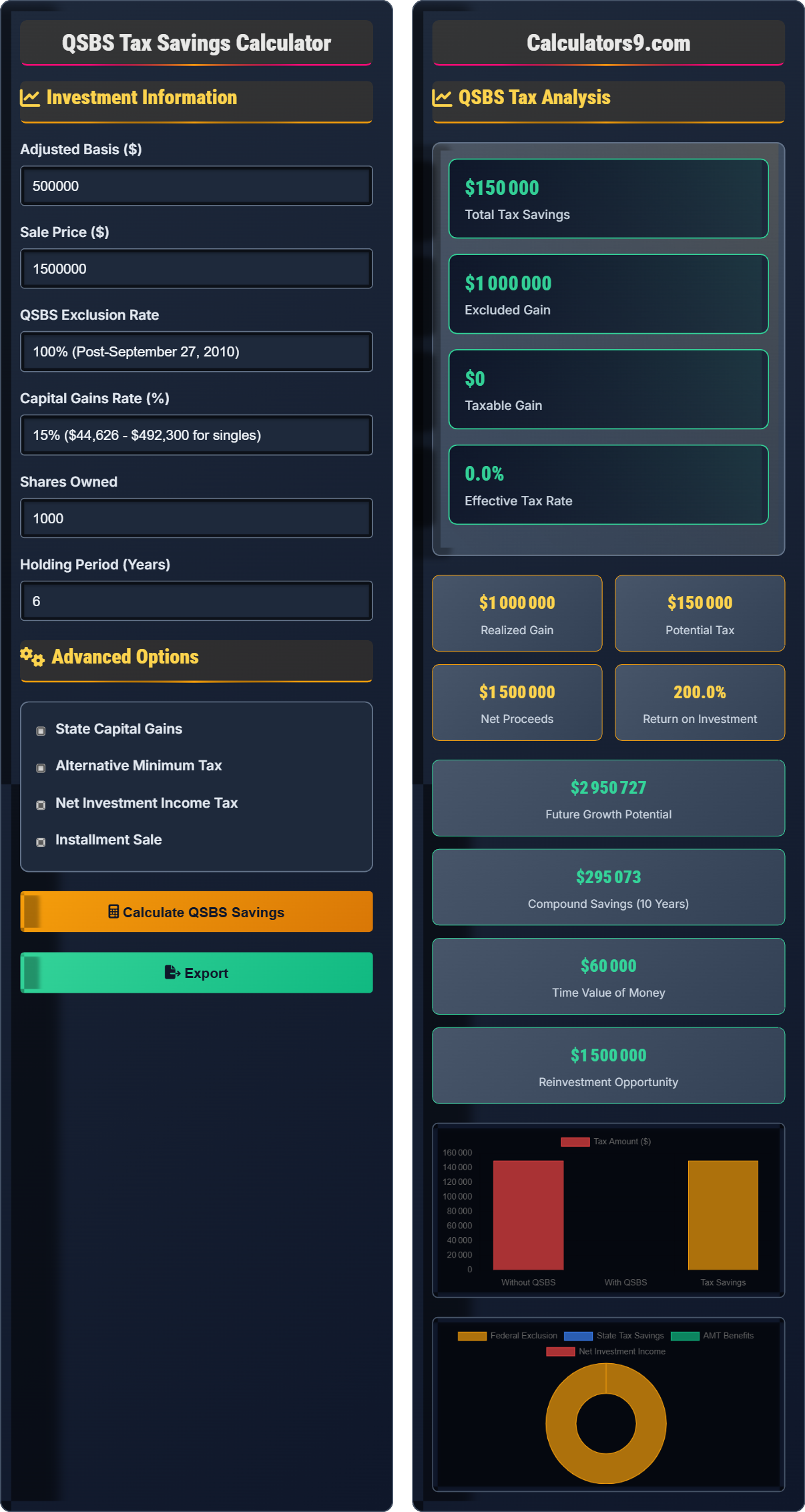
Example: Stock with $500,000 adjusted basis, sold for $1,500,000 (gain of $1,000,000):
Exclusion = min($1,000,000, min($10,000,000, 10 × $500,000)) = min($1,000,000, $5,000,000) = $1,000,000
With 100% exclusion rate, tax savings = $1,000,000 × 100% = $1,000,000
Investment Information
Advanced Options
QSBS Tax Analysis
Comprehensive QSBS Guide
Qualified Small Business Stock (QSBS) refers to stock in a C corporation that meets specific requirements under Section 1202 of the Internal Revenue Code. QSBS provides significant tax benefits, allowing investors to exclude up to 100% of capital gains from federal income tax when the stock is sold, provided certain conditions are met.
The fundamental QSBS calculation uses the following formulas:
Where:
- \(TS\) = Tax Savings
- \(GB\) = Gain Before Exclusion
- \(AB\) = Adjusted Basis
- \(ER\) = Exclusion Rate
Exclusion rates and limits vary by acquisition date:
- 100% Exclusion: Acquired after September 27, 2010
- 75% Exclusion: Acquired February 17, 2009 - September 27, 2010
- 50% Exclusion: Acquired August 6, 1997 - February 17, 2009
- Maximum Exclusion: $10 million or 10 times adjusted basis, whichever is greater
- Tax Exclusion: Exclude up to 100% of capital gains from federal tax
- Substantial Limit: Up to $10 million in exclusions per taxpayer
- Partnership Pass-Through: Partnerships can pass QSBS benefits to partners
- Portfolio Diversification: Reinvest proceeds without immediate tax consequences
- Employee Benefits: Significant advantage for startup employees with stock options
QSBS Basics
Qualified Small Business Stock - eligible for capital gains exclusion.
\( TS = \min(GB, \min(10M, 10 \times AB)) \times ER \)
Where TS=tax savings, GB=gain before exclusion, AB=adjusted basis, ER=exclusion rate.
- Must hold for 5+ years
- Only C corporations qualify
- Max $10M exclusion
Strategies
Focus on maximizing tax exclusion benefits.
- Verify QSBS qualification early
- Track holding period carefully
- Document acquisition properly
- Consider partnership structures
- Strict qualification requirements
- 5-year holding period needed
- Asset limits apply
- Proper documentation essential
QSBS Learning Quiz
What is the minimum holding period required for QSBS to qualify for the Section 1202 exclusion?
The answer is C) 5 years. To qualify for the Section 1202 exclusion, the qualified small business stock must be held for more than 5 years. This is a strict requirement, and if the stock is sold before the 5-year mark, the exclusion does not apply.
The 5-year holding period is a critical requirement for QSBS qualification. This long-term investment requirement aligns with the policy goal of encouraging investment in small businesses for sustained periods. The holding period begins on the date the stock is acquired and ends on the date of sale or exchange.
Qualification Period: Time required to meet QSBS requirements
Holding Period: Duration of stock ownership
Section 1202: IRS code section providing exclusion
• Minimum 5-year holding period required
• Begins on acquisition date
• Ends on sale or exchange date
• Track acquisition date carefully
• Plan for long-term investment
• Consider partnership structures for early employees
• Not understanding the 5-year requirement
• Assuming all startup stock qualifies
• Forgetting to track holding period
If you purchased QSBS for $200,000 and sold it for $2,000,000 after meeting all requirements, what is the maximum gain that can be excluded from tax?
Using the QSBS exclusion formula: \( GE = \min(GB, \min(10M, 10 \times AB)) \)
Given:
- Adjusted Basis = $200,000
- Sale Price = $2,000,000
- Gain = $2,000,000 - $200,000 = $1,800,000
Step 1: Calculate 10 × Adjusted Basis = 10 × $200,000 = $2,000,000
Step 2: Determine minimum of $10,000,000 and $2,000,000 = $2,000,000
Step 3: Determine minimum of $1,800,000 (gain) and $2,000,000 = $1,800,000
Therefore, the maximum gain that can be excluded is $1,800,000.
This calculation shows how the QSBS exclusion works. The exclusion is limited by three factors: the actual gain, $10 million, and 10 times the adjusted basis. In this case, the actual gain of $1.8 million is less than both the $10 million limit and the 10× basis limit ($2 million), so the full gain is excluded.
Gain Exclusion: Amount of gain that escapes taxation
Adjusted Basis: Original cost plus improvements minus depreciation
Limiting Factors: Constraints on exclusion amount
• Exclusion limited by actual gain
• Limited by $10 million cap
• Limited by 10× adjusted basis
• Calculate all three limiting factors
• Take the smallest amount
• Forgetting the $10 million limit
• Not considering 10× basis limitation
• Confusing with other tax provisions
You purchased QSBS for $1,500,000 and sold it for $15,000,000 after meeting all requirements. What is the maximum gain that can be excluded from tax, and how does the $10 million limit apply?
Step 1: Calculate gain = $15,000,000 - $1,500,000 = $13,500,000
Step 2: Calculate 10 × Adjusted Basis = 10 × $1,500,000 = $15,000,000
Step 3: Determine minimum of three values:
• Actual Gain: $13,500,000
• $10,000,000 limit: $10,000,000
• 10× Basis: $15,000,000
Step 4: Minimum value = $10,000,000
Therefore, the maximum gain that can be excluded is $10,000,000, and the $10 million limit is the binding constraint.
This example demonstrates how the $10 million limit can be the binding constraint for large gains. Even though the actual gain ($13.5M) and the 10× basis limit ($15M) are higher, the $10 million statutory limit caps the exclusion. The remaining $3.5 million would be subject to capital gains tax.
Binding Constraint: The limiting factor that determines the exclusion amount
Statutory Limit: Congressionally mandated cap
Excess Gain: Gain above exclusion limit subject to tax
• $10 million limit can bind for large gains
• Remaining gain is taxable
• Limit applies per taxpayer
• The $10M limit is per taxpayer
• Can exceed 10× basis for large gains
• Plan for excess gain taxation
• Not recognizing $10M as binding limit
• Thinking all gain is excluded for large transactions
• Forgetting excess gain is taxable
A partnership acquires QSBS and holds it for more than 5 years. The partnership has two equal partners. If the partnership sells the QSBS for a $20 million gain, how does the $10 million exclusion limit apply to each partner?
Step 1: The partnership can pass through QSBS benefits to partners
Step 2: Each partner's share of gain = $20,000,000 ÷ 2 = $10,000,000
Step 3: Each partner can exclude up to $10,000,000 under Section 1202
Step 4: Total exclusion = $10,000,000 + $10,000,000 = $20,000,000
Therefore, each partner can exclude $10,000,000 of gain, and the entire $20 million gain is excluded.
QSBS benefits can flow through partnerships to individual partners, with each partner entitled to their own $10 million exclusion limit. This is particularly valuable for startup employees who receive equity through partnership structures. Each partner's exclusion is calculated based on their share of the gain.
Pass-Through Entity: Partnership or S corp that flows income to owners
Partner-Level Exclusion: Each partner gets individual exclusion limit
Flow-Through: Income passed to individual partners
• Partners get individual $10M limits
• Sums can exceed $10M total
• Applies to each partner separately
• Partnership structure can multiply benefits
• Each partner gets separate $10M limit
• Useful for employee equity arrangements
• Thinking partnership gets single $10M limit
• Not understanding partner-level exclusions
• Confusing with corporate-level limitations
Which of the following types of corporations would qualify for QSBS treatment?
The answer is B) C Corporation. Only stock in C corporations can qualify as QSBS. S corporations, partnerships, and sole proprietorships do not issue stock that can qualify for the Section 1202 exclusion, regardless of the nature of their business activities.
This is a crucial distinction for startup founders and investors. The corporate structure matters for QSBS eligibility. Even if an S corporation later converts to a C corporation, stock acquired during the S corporation period does not qualify for QSBS treatment. The stock must be originally issued by a C corporation.
C Corporation: Corporation taxed under Subchapter C
Stock Qualification: Must be issued by C corp
Corporate Structure: Affects QSBS eligibility
• Only C corporations qualify
• S corps, partnerships don't qualify
• Must be original issuance
• Ensure startup is C corp from beginning
• Convert before equity issuance if needed
• Verify corporate structure early
• Assuming S corps qualify
• Thinking partnerships qualify
• Not verifying corporate structure
FAQ
Q: Can employees with stock options benefit from QSBS?
A: Yes, employees can benefit from QSBS if they exercise stock options and hold the stock for more than 5 years. The stock must be acquired in exchange for services, which includes exercising stock options. However, the 5-year holding period starts from the date of exercise, not the grant date.
Employees should consider the QSBS benefits when deciding when to exercise options, as the 5-year holding period is critical for qualification.
Q: What happens if I sell QSBS before the 5-year mark?
A: If you sell QSBS before the 5-year holding period, the Section 1202 exclusion does not apply. The entire gain will be subject to capital gains tax at your applicable rate (0%, 15%, or 20%).
There are no partial exclusions for early sales, so it's crucial to plan for the long-term holding period when investing in QSBS. The 5-year requirement is strict with limited exceptions.