Inflation Calculator
Historical price comparison • Future value prediction • Salary adjustment
Inflation Formula:
Show Calculator\( FV = PV \times (1 + r)^n \)
Where:
- \( FV \) = Future Value (price after inflation)
- \( PV \) = Present Value (current price)
- \( r \) = Inflation rate (as decimal)
- \( n \) = Number of years
For purchasing power calculation: \( PP = \frac{PV}{(1 + r)^n} \)
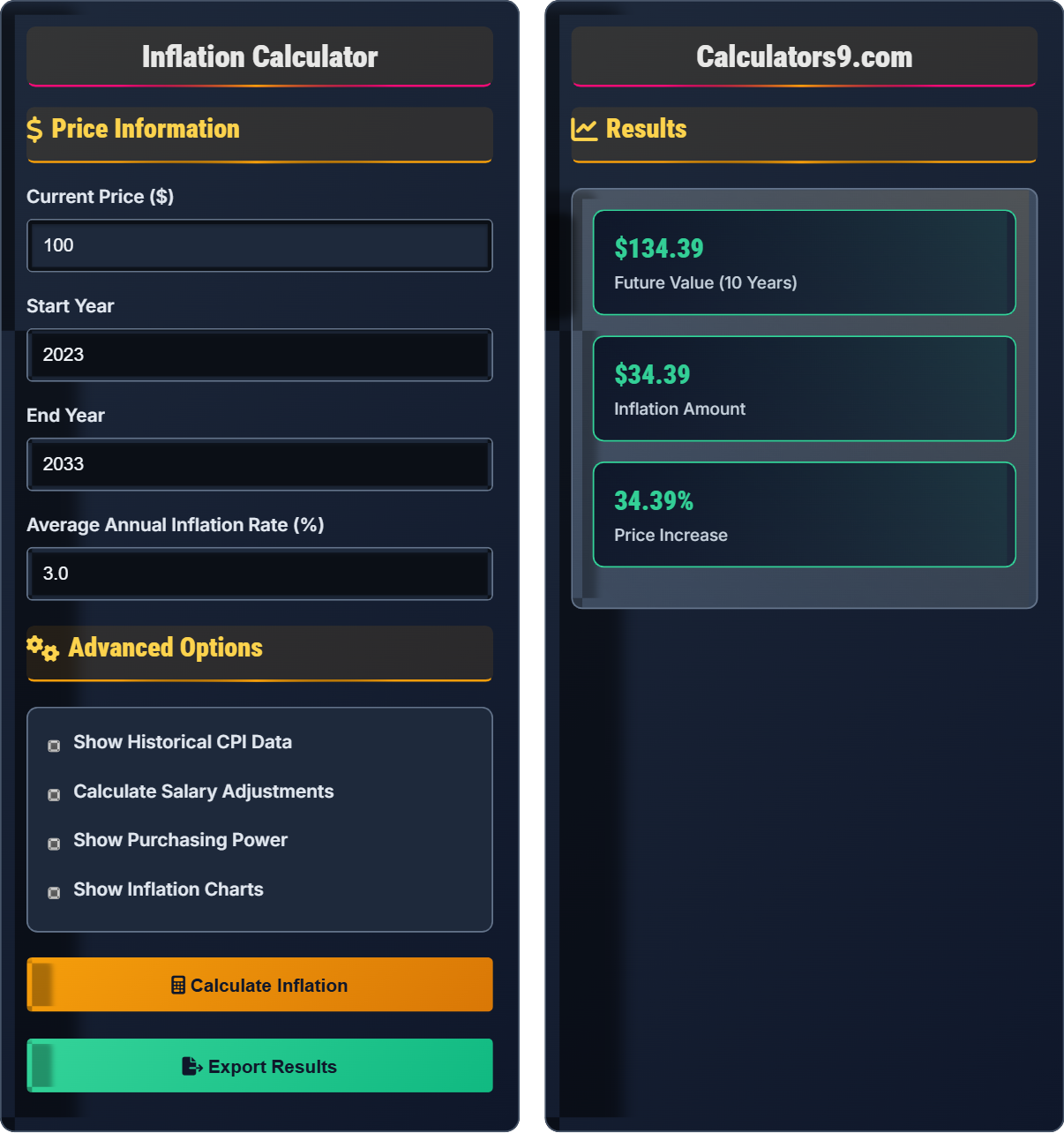
Example: If a product costs $100 today and inflation averages 3% annually for 10 years:
Future Value = $100 × (1 + 0.03)^10 = $100 × 1.344 = $134.40
So the product will cost approximately $134.40 in 10 years.
Price Information
Advanced Options
Results
Inflation Fundamentals
Inflation is the rate at which the general level of prices for goods and services rises, leading to a decrease in purchasing power. It's typically measured as an annual percentage increase in the Consumer Price Index (CPI).
Where FV=Future Value, PV=Present Value, r=rate, n=years
- Compounding effect accelerates over time
- Even low rates compound significantly
- Historical average: 2-3% annually
- Affects all price levels equally
Financial Implications
Purchasing power measures how much you can buy with a unit of currency. As inflation rises, purchasing power falls because each dollar buys fewer goods and services.
- Calculate inflation impact on current salary
- Determine required raise to maintain buying power
- Consider real vs. nominal wage growth
- Plan for long-term career advancement
- Wages don't always match inflation
- Tax brackets adjust for inflation
- Fixed incomes are most affected
- Investments should beat inflation
Inflation Learning Quiz
What happens to purchasing power when inflation occurs?
The answer is B) Purchasing power decreases. Inflation reduces purchasing power because as prices rise, each unit of currency buys fewer goods and services. For example, if inflation is 5%, $100 today will only buy what $95 bought last year.
Purchasing power is inversely related to inflation. As inflation increases, the same amount of money buys less. This is why $1 in 1950 had much more purchasing power than $1 today. The relationship can be expressed as: Purchasing Power = 1 / (1 + inflation rate). Understanding this concept is crucial for financial planning and investment decisions.
Inflation: Sustained increase in general price levels of goods and services
Purchasing Power: Amount of goods/services that can be bought with one unit of currency
Consumer Price Index (CPI): Measure tracking changes in prices over time
• Higher inflation = lower purchasing power
• Inflation compounds over time exponentially
• Fixed incomes are most vulnerable to inflation
• Remember: "Inflation erodes purchasing power"
• Use the rule of 72 to estimate doubling time: 72 ÷ inflation rate
• Assuming money maintains its value over time
• Not accounting for inflation in long-term financial planning
• Confusing nominal vs. real returns on investments
Calculate the future value of $1,000 after 20 years with an average annual inflation rate of 3.5%. Show your work and explain the significance of the result.
Using the inflation formula: FV = PV × (1 + r)^n
Given:
- PV = $1,000
- r = 3.5% = 0.035
- n = 20 years
Step 1: Calculate (1 + r) = 1 + 0.035 = 1.035
Step 2: Calculate (1.035)^20 = 1.9898
Step 3: Calculate FV = $1,000 × 1.9898 = $1,989.80
Step 4: Calculate purchasing power = $1,000 ÷ 1.9898 = $502.56
After 20 years, $1,000 will need to become $1,990 to maintain the same purchasing power. Alternatively, $1,000 in 20 years will only have the purchasing power of $503 today.
This example demonstrates the powerful compounding effect of inflation. Even at a moderate 3.5% rate, prices nearly double over 20 years. The exponential nature means that the longer the time period, the more dramatic the impact. This is why inflation protection is crucial in retirement planning and long-term investments.
Compound Growth: Growth that builds on previous growth (exponential)
Rule of 72: Approximate time to double value: 72 ÷ rate
Real Value: Value adjusted for inflation
• FV = PV × (1 + r)^n for future value calculation
• Inflation compounds exponentially over time
• Even modest inflation rates have significant long-term effects
• Use the rule of 72: 72 ÷ 3.5 ≈ 20.6 years to double
• Always consider real returns (nominal - inflation)
• Plan for inflation in long-term financial goals
• Linear thinking instead of exponential growth
• Forgetting to convert percentage to decimal
• Not accounting for inflation in investment planning
Sarah earns $60,000 annually and expects 2.8% annual inflation over the next 5 years. What salary adjustment is needed to maintain the same purchasing power? How does this affect her tax bracket if the tax brackets also adjust for inflation?
Step 1: Calculate required salary after 5 years
New Salary = Current Salary × (1 + inflation rate)^n
New Salary = $60,000 × (1.028)^5 = $60,000 × 1.1480 = $68,880
Step 2: Calculate salary increase needed
Increase = $68,880 - $60,000 = $8,880
Percentage increase = ($8,880 ÷ $60,000) × 100 = 14.8%
Step 3: Tax bracket implications
If tax brackets adjust for inflation at the same rate (2.8%), Sarah's effective tax burden remains similar. However, if brackets don't adjust, she may face "bracket creep" where she moves into a higher tax bracket despite having the same real purchasing power.
Therefore, Sarah needs a $8,880 salary increase over 5 years (14.8%) to maintain purchasing power.
This problem highlights the importance of salary negotiations in inflationary environments. Without proper adjustments, workers experience a decline in real wages. The tax bracket consideration is crucial because tax systems that don't account for inflation can inadvertently increase the tax burden on workers whose wages keep pace with inflation but don't represent real increases in purchasing power.
Real Wage: Wage adjusted for inflation (purchasing power)
Bracket Creep: Movement to higher tax bracket due to inflation
Cost of Living Adjustment (COLA): Automatic salary increases tied to inflation
• Salary must grow at least as fast as inflation to maintain purchasing power
• Tax brackets should adjust for inflation to prevent bracket creep
• COLA clauses protect against inflation in contracts
• Negotiate raises above inflation rate for real growth
• Understand your tax bracket thresholds
• Consider inflation-indexed bonds for fixed income
• Accepting raises equal to inflation (maintains status quo, no real growth)
• Not considering tax implications of salary increases
• Assuming all salaries automatically adjust for inflation
Mike wants to save $1 million for retirement in 30 years. If he expects 2.5% annual inflation, what is the real value of his $1 million goal in today's dollars? If he expects a 7% annual return on investments, will his portfolio maintain purchasing power? Explain.
Step 1: Calculate real value of $1 million in today's dollars
Real Value = Future Value ÷ (1 + inflation rate)^n
Real Value = $1,000,000 ÷ (1.025)^30 = $1,000,000 ÷ 2.098 = $476,644
Step 2: Determine if 7% return beats inflation
Real Return = Nominal Return - Inflation Rate = 7% - 2.5% = 4.5%
Step 3: Calculate actual purchasing power preservation
Since real return is positive (4.5%), Mike's portfolio will maintain and increase purchasing power over time. The 7% nominal return more than compensates for 2.5% inflation.
Step 4: Verify with future value calculation
Future purchasing power equivalent = $476,644 × (1.045)^30 = $1,811,061 in today's dollars
Therefore, Mike's $1 million will have the purchasing power of $477,000 today, but his portfolio will actually provide $1.81 million in today's purchasing power due to the excess return over inflation.
This example demonstrates the critical difference between nominal and real returns. Investors must consider real returns (returns minus inflation) to understand true wealth growth. A 7% return sounds good, but the real value depends on inflation. In this case, Mike's investment strategy is sound because the real return is positive, ensuring his purchasing power grows over time.
Nominal Return: Investment return before adjusting for inflation
Real Return: Investment return after adjusting for inflation
Purchasing Power Parity: Maintaining equivalent buying power over time
• Real Return = Nominal Return - Inflation Rate
• Investments must earn more than inflation to preserve purchasing power
• Positive real return indicates wealth growth in real terms
• Always calculate real returns, not just nominal returns
• Consider inflation-protected securities (TIPS) for fixed income
• Asset allocation should account for inflation expectations
• Focusing only on nominal returns without considering inflation
• Underestimating the impact of inflation on long-term goals
• Not adjusting investment strategies for inflation expectations
Which of the following groups is most negatively affected by unexpected inflation?
The answer is B) Creditors lending at fixed rates. When inflation is higher than expected, creditors receive payments that have less purchasing power than anticipated. The real value of the money they're repaid is lower, representing a loss for the creditor. Borrowers benefit because they repay loans with money that's worth less than expected.
This question highlights the redistributive effects of unexpected inflation. When inflation differs from expectations, it transfers wealth between parties with fixed contracts. Creditors who lend at fixed rates cannot adjust their returns if inflation rises unexpectedly, while borrowers benefit from repaying loans with devalued currency. This is why adjustable-rate loans exist to share inflation risk.
Unexpected Inflation: Inflation that differs from what was anticipated in contracts
Fixed-Rate Contract: Agreement with predetermined payment amounts
Redistributive Effect: Transfer of wealth due to economic changes
• Unexpected inflation benefits borrowers, hurts creditors
• Fixed-income recipients are most vulnerable to inflation
• Adjustable contracts help share inflation risk
• Prefer adjustable-rate loans when expecting rising inflation
• Fixed-rate loans are better when expecting falling inflation
• Consider inflation-protected instruments for lending
• Assuming inflation affects all parties equally
• Not considering the timing of inflation relative to contracts
• Overlooking the impact on fixed-income arrangements
FAQ
Q: How does inflation affect different types of investments differently?
A: Inflation affects investments differently based on their characteristics:
- Fixed Income: Bonds and CDs lose purchasing power as inflation rises since interest payments are fixed.
- Equities: Stocks generally provide some inflation protection as companies can raise prices.
- Real Estate: Property values and rents often rise with inflation.
- Commodities: Gold and oil often serve as inflation hedges.
The mathematical relationship is: Real Return = Nominal Return - Inflation Rate. To maintain purchasing power, investments must earn at least the inflation rate.
Q: How do I calculate the salary increase needed to keep up with inflation?
A: To calculate the salary increase needed to maintain purchasing power:
If your current salary is \( S_0 \) and inflation rate is \( r \), then after \( n \) years, your salary \( S_n \) should be:
\( S_n = S_0 \times (1 + r)^n \)
For example, with a $50,000 salary and 3% inflation over 5 years:
\( S_5 = 50,000 \times (1.03)^5 = 50,000 \times 1.1593 = \$57,964 \)
You'd need a $7,964 increase (15.9%) over 5 years to maintain purchasing power.