Running Pace Calculator
Marathon training tool • 2026 standards
Running Pace Formulas:
Show the calculator\( \text{Pace} = \frac{\text{Time}}{\text{Distance}} \)
\( \text{Time} = \text{Pace} \times \text{Distance} \)
\( \text{Distance} = \frac{\text{Time}}{\text{Pace}} \)
Where:
- \( \text{Pace} \) = Time per unit distance (min/km or min/mile)
- \( \text{Time} \) = Total elapsed time
- \( \text{Distance} \) = Total distance covered
These formulas are fundamental to running calculations. Pace is typically expressed in minutes per kilometer or minutes per mile. For example, a 5:00 pace means 5 minutes per unit distance.
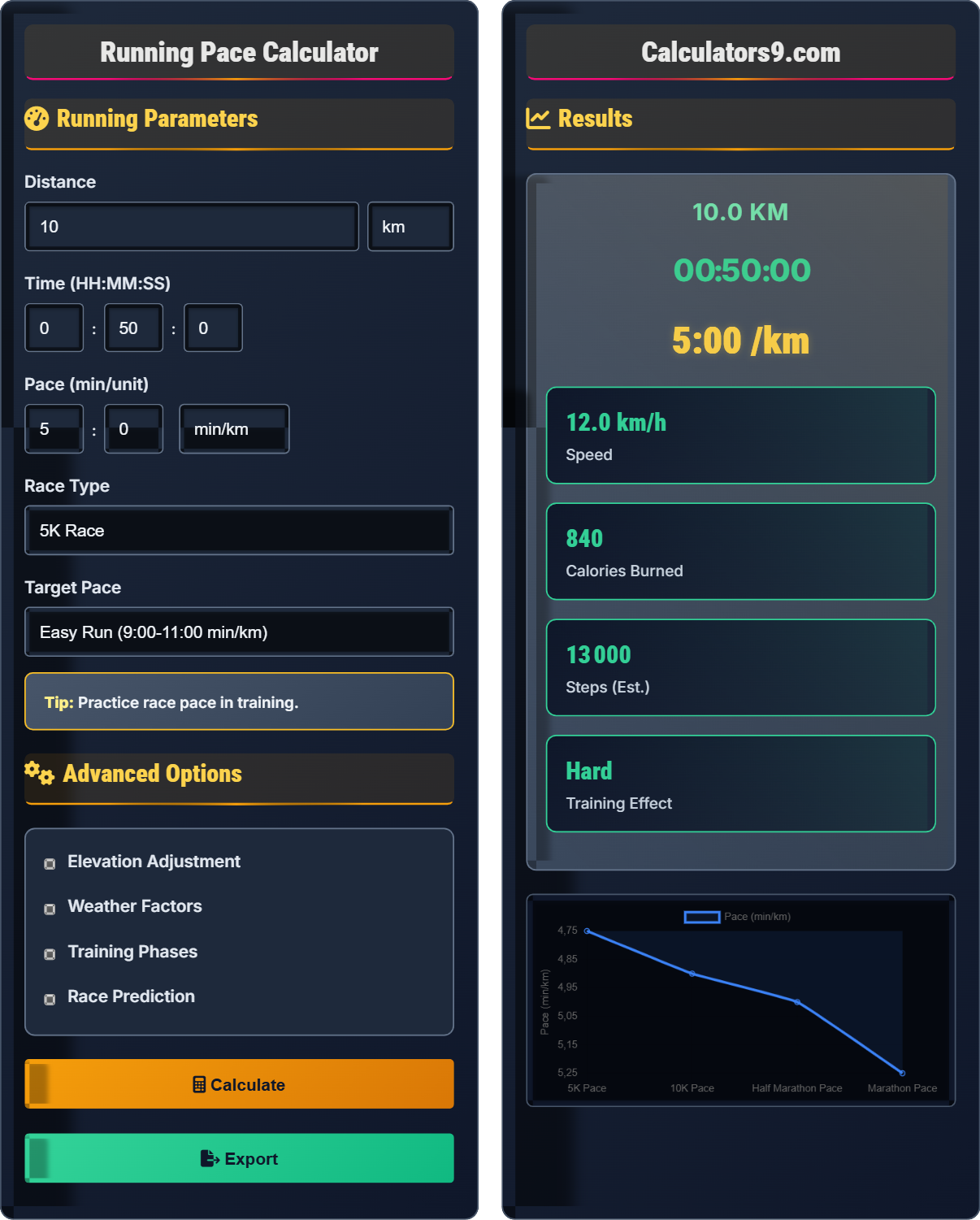
Example: To calculate pace for a 10km run completed in 50 minutes:
\( \text{Pace} = \frac{50 \text{ minutes}}{10 \text{ km}} = 5:00 \text{ min/km} \)
To find time for 15km at this pace:
\( \text{Time} = 5:00 \text{ min/km} \times 15 \text{ km} = 75 \text{ minutes} = 1:15:00 \)
Thus, the runner would finish 15km in 1 hour 15 minutes.
Running Parameters
Advanced Options
Results
| Metric | Value | Unit |
|---|
| Week | Run Type | Distance | Pace |
|---|
Comprehensive Running Pace Guide
Running pace is the time it takes to cover a unit of distance, typically expressed in minutes per kilometer (min/km) or minutes per mile (min/mile). It's the inverse of speed and is the preferred metric for runners to measure and plan their runs.
The fundamental relationships in running calculations:
Where:
- \( \text{Pace} \) = Time per unit distance
- \( \text{Time} \) = Total elapsed time
- \( \text{Distance} \) = Total distance covered
Effective training requires different paces for different workout types:
- Easy Run: 9:00-11:00 min/km (conversational pace)
- Marathon Pace: 5:30-7:00 min/km (goal race pace)
- Tempo Run: 6:30-7:30 min/km (comfortably hard)
- Threshold: 6:00-7:00 min/km (lactate threshold)
- Interval: 4:30-5:30 min/km (quality repetitions)
- Marathon Training: Practice goal pace consistently
- Progressive Runs: Start easy, finish fast
- Time Trials: Measure fitness improvements
- Goal Setting: Set realistic race targets
- Pacing Strategy: Negative split vs even pacing
Pace Fundamentals
Time per unit distance (min/km or min/mile).
\( \text{Pace} = \frac{\text{Time}}{\text{Distance}} \)
Where pace = time per unit distance.
- Lower numbers = faster pace
- Crucial for race planning
- Varies by workout type
Applications
Different speeds for different workout purposes.
- Race pace practice
- Workout planning
- Progress tracking
- Goal setting
- Course terrain
- Weather conditions
- Training phase
- Recovery needs
Running Pace Learning Quiz
What is the relationship between running pace and speed?
The answer is B) Pace is the inverse of speed. Pace measures time per unit distance (e.g., minutes per kilometer), while speed measures distance per unit time (e.g., kilometers per hour). They are mathematically inverse relationships: if pace improves (decreases), speed increases, and vice versa. For example, a pace of 5:00 min/km equals 12 km/h speed.
Understanding the inverse relationship between pace and speed is crucial for runners. A faster pace means a lower time value (e.g., 4:30 is faster than 5:00), which corresponds to a higher speed value. Runners traditionally use pace rather than speed because it's more intuitive for planning runs and races. When a runner says they ran at 5:00 pace, they mean 5 minutes per kilometer.
Pace: Time taken to cover a unit distance (min/km or min/mile)
Speed: Distance covered per unit time (km/h or mph)
Inverse Relationship: As one increases, the other decreases
• Lower pace numbers = faster running
• Pace × Speed = 60 (for min/km and km/h)
• Runners prefer pace over speed for planning
• Remember: 5:00 pace = 12 km/h speed
• To convert: Speed = 60 ÷ Pace
• Faster pace means lower time number
• Thinking higher pace numbers mean faster running
• Confusing pace with speed as the same concept
• Not understanding the inverse relationship
Calculate the pace for a runner who completes a 15km run in 1 hour and 15 minutes. Show your work.
Step 1: Convert time to minutes
1 hour 15 minutes = 60 + 15 = 75 minutes
Step 2: Apply the pace formula
\( \text{Pace} = \frac{\text{Time}}{\text{Distance}} \)
\( \text{Pace} = \frac{75 \text{ minutes}}{15 \text{ km}} = 5:00 \text{ min/km} \)
Therefore, the runner's pace was 5:00 min/km.
This calculation demonstrates the fundamental pace formula. It's important to convert time to a consistent unit (minutes) before dividing by distance. The result is expressed as minutes per kilometer. This pace (5:00 min/km) is considered quite fast for recreational runners and would translate to a 5:00 per mile pace as well if converted (approximately 3:07 min/mile).
Pace Formula: Time divided by distance
Unit Consistency: Convert time to minutes before calculation
Expression: Minutes per unit distance
• Always convert time to consistent units
• Pace = Time ÷ Distance
• Express as minutes per unit distance
• Convert hours to minutes first
• Use a calculator for complex divisions
• Check if the result makes sense
• Forgetting to convert hours to minutes
• Dividing distance by time instead of time by distance
• Misreading the result as minutes instead of min/unit
A runner wants to complete a marathon (42.195 km) in under 3 hours and 30 minutes. What average pace must they maintain throughout the race? If they maintain this pace for a 10km run, how long would it take?
Step 1: Convert target time to minutes
3 hours 30 minutes = 180 + 30 = 210 minutes
Step 2: Calculate required pace
\( \text{Required Pace} = \frac{210 \text{ minutes}}{42.195 \text{ km}} = 4.98 \text{ min/km} \approx 4:59 \text{ min/km} \)
Step 3: Calculate time for 10km at this pace
\( \text{Time for 10km} = 4.98 \text{ min/km} \times 10 \text{ km} = 49.8 \text{ minutes} \approx 49:48 \)
Therefore, the runner must maintain approximately 4:59 min/km pace to finish under 3:30, and at this pace, a 10km run would take about 49:48.
This problem demonstrates reverse engineering a pace goal from a target time. It also shows how to use a pace to predict performance at different distances. The calculations reveal that achieving a sub-3:30 marathon requires maintaining a very consistent pace throughout the race, which is challenging due to fatigue. The 10km prediction gives perspective on how this pace compares to shorter distances.
Target Pace: Required pace to achieve a goal time
Distance Prediction: Using pace to estimate time for different distances
Marathon Pace: Consistent pace maintained throughout the full distance
• Target pace = Target time ÷ Race distance
• Time at pace = Pace × Distance
• Maintain consistency for race success
• Practice goal pace in training runs
• Consider negative splits for marathons
• Account for fatigue in long races
• Not accounting for pacing strategy in marathons
• Assuming same pace applies to all distances
• Forgetting to consider race day conditions
A runner has a race pace of 5:00 min/km. Calculate the pace range for their tempo run training if tempo pace is typically 15-25 seconds per km slower than race pace. What would be the time for a 10km tempo run at the midpoint of this range?
Step 1: Calculate tempo pace range
Lower bound: 5:00 + 0:15 = 5:15 min/km
Upper bound: 5:00 + 0:25 = 5:25 min/km
Step 2: Calculate midpoint pace
Midpoint: (5:15 + 5:25) ÷ 2 = 5:20 min/km
Step 3: Calculate time for 10km at midpoint pace
Total time = 5:20 × 10 = 53:20 (53 minutes and 20 seconds)
Therefore, the tempo pace range is 5:15-5:25 min/km, and a 10km tempo run at the midpoint would take 53:20.
This problem demonstrates how training paces are calculated relative to race pace. Tempo runs are designed to improve lactate threshold and are typically run at a comfortably hard effort. The 15-25 seconds slower than race pace is a common prescription for tempo runs. Understanding these relationships helps runners structure their training appropriately for different physiological adaptations.
Tempo Run: Sustained effort at comfortably hard pace
Lactate Threshold: Intensity where lactate begins to accumulate
Training Zones: Different intensity levels for specific adaptations• Training paces are relative to race pace
• Tempo = Race pace + 15-25 sec/km
• Different zones target different adaptations
• Know your training zones by pace
• Practice different paces in training
• Use GPS watch to monitor pace
• Running tempo runs too fast or too slow
• Not understanding the purpose of different paces
• Failing to practice race pace in training
Convert a pace of 6:00 min/km to min/mile. Which of the following is closest?
To convert from min/km to min/mile, multiply by the conversion factor 1.60934 (since 1 mile = 1.60934 km).
6:00 min/km × 1.60934 = 9.656 min/mile
0.656 × 60 = 39.36 seconds ≈ 40 seconds
Therefore, 6:00 min/km = 9:40 min/mile, which is closest to option A) 9:36 min/mile.
This conversion is essential for runners who encounter pace information in different units. Since a mile is longer than a kilometer (1 mile = 1.60934 km), a pace in min/mile will be numerically larger than the equivalent pace in min/km. The conversion factor is the number of kilometers in a mile. This knowledge is valuable when reading international running publications or using GPS watches that may display pace in different units.
Unit Conversion: Changing between km and mile measurements
Conversion Factor: 1.60934 km per mile
International Standards: Different countries use different units
• Min/mile = Min/km × 1.60934
• Miles are longer than kilometers
• Pace in min/mile is numerically larger than min/km
• Memorize the conversion factor 1.60934
• Use online converters for quick checks
• Know both systems for international events
• Dividing instead of multiplying for the conversion
• Forgetting that min/mile is larger than min/km
• Not knowing the conversion factor
FAQ
Q: How do I determine my appropriate training paces?
A: Training paces are typically based on your recent race performances or time trials. Here's how to establish them:
Easy Run Pace: 90-120 seconds slower than 5K race pace. Conversational pace where you can speak in full sentences.
Marathon Pace: Your goal marathon race pace. Practice this consistently in training.
Tempo Pace: 25-35 seconds slower than 5K pace. Comfortably hard, where talking is difficult but possible in short phrases.
Threshold Pace: 15-25 seconds slower than 5K pace. The fastest pace you can maintain for 20-30 minutes.
Interval Pace: Close to 5K race pace. Quality repetitions at goal race effort.
For example, if your 5K pace is 5:00 min/km:
- Easy: 6:30-7:00 min/km
- Tempo: 5:25-5:35 min/km
- Threshold: 5:15-5:25 min/km
- Intervals: ~5:00 min/km
These paces ensure you're training at the right intensities for specific physiological adaptations.
Q: What's the difference between negative splitting and even pacing in marathons?
A: Both pacing strategies have their merits for marathon racing:
Even Pacing: Maintaining the same pace throughout the race. This theoretically optimizes energy expenditure and avoids early glycogen depletion. The mathematical approach is to maintain a consistent pace that's sustainable for the full distance.
Negative Splitting: Running the second half faster than the first half. This strategy conserves energy early and allows for a strong finish. Research shows that elite marathons are often won by negative splitters.
The physiological basis for negative splitting:
- Preserves glycogen in early miles
- Allows for better temperature regulation initially
- Reduces accumulation of metabolic byproducts early
- Provides psychological confidence for the finish
For a 3:30 marathon (4:59 min/km average), an even pace would be exactly 4:59 throughout. A negative split might be 5:05 for the first half and 4:53 for the second half, still averaging 4:59 overall.