Step Counter Converter
Activity tracking tool • 2026 standards
Step Conversion Formulas:
Show the calculator\( \text{Distance (km)} = \frac{\text{Steps} \times \text{Step Length (m)}}{1000} \)
\( \text{Calories Burned} = \text{Steps} \times \text{Calories per Step} \)
\( \text{Calories per Step} = \frac{\text{Body Weight (kg)} \times \text{MET} \times 0.0175}{\text{Steps per km}} \)
Where:
- \( \text{Steps} \) = Total number of steps taken
- \( \text{Step Length} \) = Average length of each step (typically 0.75m for adults)
- \( \text{Calories per Step} \) = Energy burned per step (varies by individual)
These formulas convert steps into meaningful metrics. The average adult step length is about 0.75m (2.5ft), though this varies by height. Walking burns approximately 0.04 calories per step for a 70kg person.
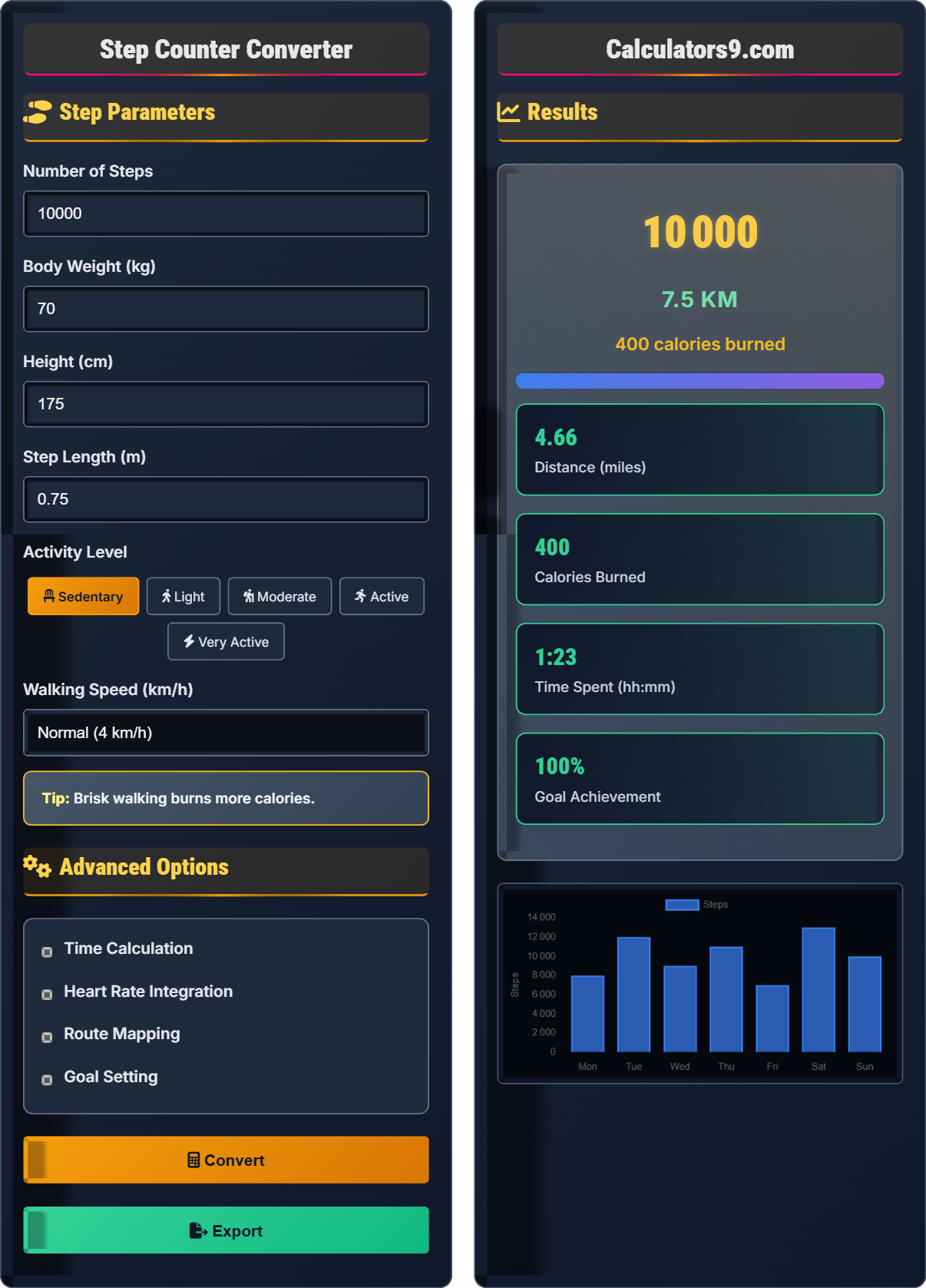
Example: For 10,000 steps with 0.75m step length:
\( \text{Distance} = \frac{10,000 \times 0.75}{1000} = 7.5 \text{ km} \)
For a 70kg person:
\( \text{Calories} = 10,000 \times 0.04 = 400 \text{ calories} \)
Thus, 10,000 steps equals 7.5 km and burns 400 calories.
Step Parameters
Advanced Options
Results
| Metric | Value | Unit |
|---|
| Day | Steps | Goal | Completion |
|---|
Comprehensive Step Tracking Guide
Step tracking is the practice of counting the number of steps taken during daily activities. Modern step tracking devices use accelerometers to detect movement patterns and estimate steps. The popular goal of 10,000 steps per day originated from Japanese pedometers in the 1960s.
Key step conversion formulas include:
Where:
- \( \text{Distance} \) = Total distance walked
- \( \text{Steps} \) = Total number of steps counted
- \( \text{Step Length} \) = Average length of each step
Calories burned per step vary by body weight:
- 50kg Person: ~0.03 calories per step
- 60kg Person: ~0.035 calories per step
- 70kg Person: ~0.04 calories per step
- 80kg Person: ~0.045 calories per step
- 90kg Person: ~0.05 calories per step
- Cardiovascular Health: Improved heart function
- Weight Management: Increased calorie expenditure
- Mental Health: Reduced stress and anxiety
- Bone Health: Strengthened bones and joints
- Muscle Tone: Improved leg and core strength
Step Tracking Fundamentals
Counting daily walking steps.
\( \text{Distance (km)} = \frac{\text{Steps} \times \text{Step Length}}{1000} \)
Where distance = total walked distance.
- Step length varies by height
- Calories depend on weight
- 10,000 steps is recommended
Applications
Daily step targets for health.
- Weight loss
- Fitness tracking
- Health monitoring
- Goal setting
- Step length accuracy
- Device calibration
- Walking speed
- Terrain factors
Step Tracking Learning Quiz
How does height affect step length?
The answer is B) Taller people generally have longer steps. Step length is directly correlated with height. Taller individuals typically have longer legs, which results in longer steps. The average step length for adults ranges from 0.65m to 0.85m, with taller people having longer steps. This is why step counters often ask for height information.
Step length is an important factor in distance calculation. The relationship between height and step length is approximately linear, with step length being about 40-45% of a person's height. This relationship allows for more accurate distance calculations when height information is provided to step tracking devices.
Step Length: Distance covered in one step
Height Correlation: Relationship between height and step length
Distance Calculation: Steps × Step Length
• Taller = Longer steps
• Average step length: 0.65-0.85m
• Height affects distance accuracy
• Enter your height in step trackers
• Calibrate devices for accuracy
• Consider gait variations
• Using average step length for everyone
• Not calibrating tracking devices
• Ignoring height in calculations
Calculate the distance walked for 8,000 steps with a step length of 0.75m. Show your work.
Step 1: Identify the formula
\( \text{Distance (km)} = \frac{\text{Steps} \times \text{Step Length (m)}}{1000} \)
Step 2: Substitute the values
\( \text{Distance (km)} = \frac{8,000 \times 0.75}{1000} \)
Step 3: Calculate
\( \text{Distance (km)} = \frac{6,000}{1000} = 6.0 \text{ km} \)
Therefore, 8,000 steps with a 0.75m step length equals 6.0 km.
This calculation is fundamental to understanding step tracking. The division by 1000 converts meters to kilometers. This simple formula allows step counters to provide meaningful distance measurements. Understanding this relationship helps interpret step tracking data more effectively.
Distance Formula: Steps × Step Length ÷ 1000
Unit Conversion: Meters to kilometers
Step Length: Distance per step
• Distance = Steps × Step Length ÷ 1000
• Always use consistent units
• Convert meters to kilometers
• Remember to divide by 1000 for km
• Use meters for step length
• Check unit consistency
• Forgetting to divide by 1000
• Using inconsistent units
• Mixing up meters and feet
A 75kg person walks 12,000 steps in a day. If they burn approximately 0.04 calories per step per kg of body weight, calculate the total calories burned. How does this compare to the recommended daily calorie expenditure for weight maintenance?
Step 1: Calculate calories per step for this person
Calories per step = 0.04 × (75 ÷ 70) ≈ 0.043 calories per step
Step 2: Calculate total calories burned
Total calories = 12,000 × 0.043 = 516 calories
Step 3: Compare to daily recommendations
The person burned 516 calories through walking, which represents about 20-25% of the typical daily calorie requirement for weight maintenance (2,000-2,500 calories for adults).
Therefore, the person burned approximately 516 calories through walking.
This problem demonstrates how body weight affects calorie expenditure during walking. Heavier individuals burn more calories per step due to the increased energy required to move their mass. Walking 12,000 steps can contribute significantly to daily calorie expenditure, supporting weight management goals.
Calorie Expenditure: Energy burned during activity
Body Weight Factor: Heavier people burn more calories
Daily Maintenance: Calories needed to maintain weight
• Calories ∝ Body Weight
• Heavier = More calories burned
• Walking contributes to daily expenditure
• Heavier people burn more calories walking
• Walking burns 0.03-0.05 calories per step
• 10,000 steps = 300-500 calories for most people
• Not accounting for body weight in calculations
• Using the same calories per step for everyone
• Underestimating walking's contribution to calorie burn
A person takes 10,000 steps with a step length of 0.75m and walks at a speed of 4 km/h. Calculate the total distance walked and the time spent walking. If they want to increase their steps to 15,000 per day, how much additional time would they need to spend walking?
Step 1: Calculate distance for 10,000 steps
Distance = (10,000 × 0.75) ÷ 1000 = 7.5 km
Step 2: Calculate time for 7.5 km at 4 km/h
Time = Distance ÷ Speed = 7.5 ÷ 4 = 1.875 hours = 1 hour 52.5 minutes
Step 3: Calculate distance for 15,000 steps
Distance = (15,000 × 0.75) ÷ 1000 = 11.25 km
Step 4: Calculate time for 11.25 km at 4 km/h
Time = 11.25 ÷ 4 = 2.8125 hours = 2 hours 48.75 minutes
Step 5: Calculate additional time needed
Additional time = 2h 49m - 1h 53m = 56 minutes
Therefore, they would need approximately 56 additional minutes to reach 15,000 steps.
This problem connects steps, distance, and time, showing the relationship between physical activity metrics. It demonstrates how increasing steps proportionally increases the time commitment required. Understanding this relationship helps with realistic goal setting and time management for physical activity.
Distance-Speed-Time: Distance = Speed × Time
Step-Pace Relationship: Steps relate to distance and time
Activity Planning: Time required for step goals
• Distance = Steps × Step Length ÷ 1000
• Time = Distance ÷ Speed
• More steps = More time needed
• Plan walking time in your schedule
• Break steps into multiple sessions
• Use walking meetings when possible
• Not accounting for time needed to achieve step goals
• Setting unrealistic step goals
• Forgetting to consider walking speed
Which of the following step counts represents an "Active" lifestyle according to health guidelines?
The answer is C) 10,000-12,499 steps per day. This range is considered "Active" according to most health guidelines. The 10,000-step daily goal is widely recommended as a minimum for maintaining good health. This level of activity provides significant health benefits including improved cardiovascular health, weight management, and reduced risk of chronic diseases.
Step count categories provide a framework for understanding activity levels. The 10,000-step goal is based on research showing health benefits at this level of activity. Understanding these categories helps individuals set appropriate goals and track their progress toward recommended activity levels.
Active Lifestyle: 10,000-12,499 steps/day
Step Categories: Ranges defining activity levels
Health Guidelines: Recommended activity levels
• 10,000 steps = Active lifestyle
• More steps = Greater health benefits
• Gradual increases recommended
• Start with current step count
• Increase gradually by 500-1000 steps
• Use multiple short walks
• Jumping to 10,000 steps immediately
• Not tracking current activity level
• Setting unrealistic goals too quickly
FAQ
Q: How accurate are smartphone step counters compared to dedicated devices?
A: The accuracy of step counting devices varies significantly:
Smartphone Step Counters: Generally 5-10% error under normal walking conditions, but can be significantly less accurate during jogging or carrying the phone differently.
Dedicated Fitness Trackers: Typically 2-5% error with proper placement and calibration.
Medical-Grade Devices: Less than 2% error under controlled conditions.
The mathematical model for step detection uses:
\( \text{Step Detection} = f(\text{Acceleration}, \text{Frequency}, \text{Amplitude}) \)
Where the algorithm analyzes vertical acceleration patterns to identify steps. Most consumer devices use machine learning algorithms trained on typical walking patterns, which can lead to inaccuracies during atypical movements.
Q: What's the relationship between steps and METs for energy expenditure?
A: METs (Metabolic Equivalent of Task) measure the energy cost of physical activities:
Walking (2.5 mph): ~2.5 METs
Walking (3.0 mph): ~3.0 METs
Brisk Walking (3.5 mph): ~3.5 METs
Fast Walking (4.0 mph): ~4.3 METs
The calorie calculation formula is:
\( \text{Calories} = \frac{\text{MET} \times \text{Weight (kg)} \times \text{Time (hours)}}{200} \)
For example, a 70kg person walking at 3.5 mph (3.5 METs) for 1.5 hours (10,500 steps at average pace) would burn approximately 1.8 calories per minute or about 270 calories.
This relationship shows that faster walking increases energy expenditure per minute, even if the total steps remain the same.