Swimming Lap Calculator
Pool training tool • 2026 standards
Swimming Lap Formulas:
Show the calculator\( \text{Laps} = \frac{\text{Distance}}{\text{Pool Length}} \)
\( \text{Time per Lap} = \frac{\text{Total Time}}{\text{Number of Laps}} \)
\( \text{Pace} = \frac{\text{Time per 100m}}{\text{Stroke Rate}} \)
Where:
- \( \text{Laps} \) = Number of lengths swum
- \( \text{Distance} \) = Total distance swum
- \( \text{Pool Length} \) = Pool length in meters
- \( \text{Pace} \) = Time per 100 meters
These formulas are fundamental to swimming calculations. A lap is one length of the pool. Pool lengths are typically 25m (short course) or 50m (long course). Stroke rate affects efficiency and speed.
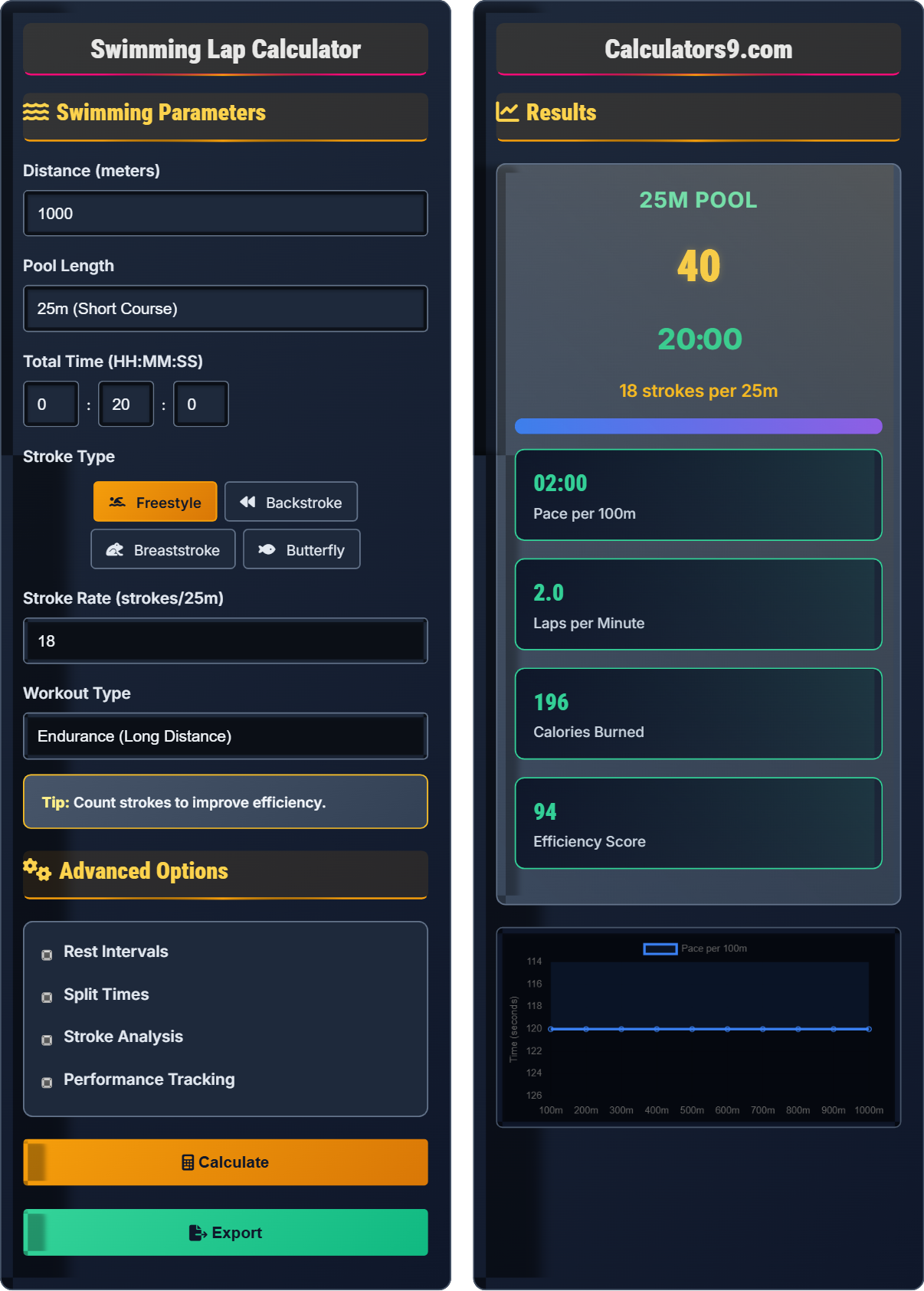
Example: To swim 1000m in a 25m pool:
\( \text{Laps} = \frac{1000}{25} = 40 \text{ laps} \)
If completed in 20 minutes (1200 seconds):
\( \text{Time per Lap} = \frac{1200}{40} = 30 \text{ seconds per lap} \)
And pace per 100m:
\( \text{Pace} = \frac{1200}{10} = 2:00 \text{ per 100m} \)
Swimming Parameters
Advanced Options
Results
| Lap | Distance | Time | Pace/100m |
|---|
| Metric | Value | Target | Status |
|---|
Comprehensive Swimming Training Guide
Swimming training involves structured workouts designed to improve technique, endurance, speed, and overall aquatic performance. Training includes various sets focusing on different aspects of swimming such as stroke efficiency, breathing control, and distance capability.
Key swimming calculations include:
Where:
- \( \text{Laps} \) = Number of lengths swum
- \( \text{Distance} \) = Total distance swum
- \( \text{Pool Length} \) = Length of the pool in meters
Typical swimming paces by ability level:
- Beginner: 2:30-3:30 per 100m freestyle
- Intermediate: 2:00-2:30 per 100m freestyle
- Advanced: 1:30-2:00 per 100m freestyle
- Elite: Sub 1:30 per 100m freestyle
- World Record: 46.91s (Caeleb Dressel)
- Endurance Building: Long distance sets
- Speed Development: Sprint intervals
- Technique Improvement: Focused stroke work
- Stroke Efficiency: Stroke count training
- Competition Preparation: Race pace sets
Swimming Fundamentals
One length of the pool.
\( \text{Laps} = \frac{\text{Distance}}{\text{Pool Length}} \)
Where laps = lengths swum.
- Pool lengths vary (25m, 50m)
- Track distance accurately
- Monitor stroke efficiency
Applications
Structured swimming workouts.
- Endurance training
- Speed development
- Technique improvement
- Competition prep
- Pool length matters
- Stroke technique
- Rest intervals
- Progressive overload
Swimming Training Learning Quiz
What is the difference between a "lap" and a "length" in swimming?
The answer is B) A length is one way, a lap is there and back. In swimming terminology, a "length" refers to swimming from one end of the pool to the other (e.g., 25m), while a "lap" typically refers to going down and back (e.g., 50m). However, in lap counters and training contexts, "lap" often refers to one length of the pool. This calculator uses "lap" to mean one length of the pool.
Swimming terminology can be confusing because different contexts use terms differently. In competitive swimming, a 100m race means swimming 4 lengths of a 25m pool. In fitness contexts, people often say "laps" when they mean lengths. For this calculator, we define a lap as one length of the pool to keep calculations straightforward.
Length: One way across the pool (e.g., 25m)
Lap: In this context, one length of the pool
Pool Length: Distance from end to end (typically 25m or 50m)
• Standard pool lengths: 25m (SCY) or 50m (LCM)
• 100m race = 4 lengths of 25m pool
• Terminology varies by context
• Always confirm pool length before calculating
• Count lengths, not turns
• Track stroke count per length
• Confusing lengths with laps
• Not knowing the pool length
• Counting turns instead of lengths
Calculate how many laps are needed to swim 1500m in a 25m pool. Show your work.
Step 1: Identify the formula
\( \text{Laps} = \frac{\text{Distance}}{\text{Pool Length}} \)
Step 2: Substitute the values
\( \text{Laps} = \frac{1500 \text{ m}}{25 \text{ m}} \)
Step 3: Calculate the result
\( \text{Laps} = 60 \)
Therefore, 60 laps are needed to swim 1500m in a 25m pool.
This calculation is fundamental to planning swimming workouts. The 1500m freestyle is a standard distance in competitive swimming (30 lengths of a 50m pool or 60 lengths of a 25m pool). Knowing how to convert distance to laps helps swimmers plan their training sets and track their progress.
Lap: One length of the pool
Distance: Total meters swum
Pool Length: Distance from end to end
• Laps = Distance ÷ Pool Length
• Always use consistent units
• Standard distances: 100m, 200m, 400m, 800m, 1500m
• Remember: 1500m = 60 laps in 25m pool
• Use multiples of 25 for easy division
• Plan sets in manageable increments
• Dividing pool length by distance instead of distance by pool length
• Forgetting to confirm the pool length
• Mixing up units (meters vs yards)
A swimmer completes 2000m in 30 minutes in a 25m pool. Calculate their pace per 100m. If they maintain this pace, how long would it take them to swim 1000m?
Step 1: Calculate total time in seconds
30 minutes = 30 × 60 = 1800 seconds
Step 2: Calculate pace per 100m
2000m contains 2000 ÷ 100 = 20 segments of 100m
Pace per 100m = 1800 ÷ 20 = 90 seconds = 1:30 per 100m
Step 3: Calculate time for 1000m
1000m contains 1000 ÷ 100 = 10 segments of 100m
Time for 1000m = 10 × 90 = 900 seconds = 15 minutes
Therefore, the pace is 1:30 per 100m, and 1000m would take 15 minutes.
Pace calculation is essential for swimmers to monitor performance and plan training. Pace per 100m is the standard measure in swimming. This calculation helps swimmers understand their speed and predict performance at different distances. Maintaining pace across distances requires consistent technique and fitness.
Pace: Time per 100 meters
100m Pace: Standard measure of swimming speed
Segment: Portion of distance used for calculation
• Pace = Total time ÷ (Distance ÷ 100)
• Standard pace measure is per 100m
• Consistent pace predicts performance
• Track 100m pace during training
• Use pace to set goals
• Monitor pace consistency
• Calculating pace per lap instead of per 100m
• Not converting time to consistent units
• Forgetting that pace is per 100m
A swimmer takes 20 strokes per length in a 25m pool and swims at a pace of 1:40 per 100m. Calculate their stroke rate (strokes per minute) and stroke length (distance per stroke). What does this tell you about their swimming efficiency?
Step 1: Calculate time per length
1:40 per 100m = 100 seconds per 100m
Time per 25m = 100 ÷ 4 = 25 seconds per length
Step 2: Calculate stroke rate
20 strokes in 25 seconds
Strokes per minute = (20 ÷ 25) × 60 = 48 strokes per minute
Step 3: Calculate stroke length
Stroke length = 25m ÷ 20 strokes = 1.25m per stroke
This swimmer has a moderate stroke rate and stroke length, suggesting room for improvement in either efficiency or power.
Stroke efficiency combines stroke length (distance per stroke) and stroke rate (frequency). Elite swimmers typically have longer stroke lengths with moderate stroke rates. The relationship between stroke length and rate affects overall speed. Finding the optimal balance between these factors is key to swimming efficiency.
Stroke Rate: Number of strokes per minute
Stroke Length: Distance traveled per stroke
Swimming Efficiency: Effective use of energy to move through water
• Speed = Stroke Length × Stroke Rate
• Efficient swimmers maximize stroke length
• Balance between length and rate is key
• Count strokes per length regularly
• Work on extending each stroke
• Find optimal stroke rate for your stroke length
• Focusing only on stroke rate, not length
• Not tracking stroke count during sets
• Confusing stroke efficiency with speed
Which of the following best describes the relationship between stroke rate and training intensity?
The answer is B) Intensity depends on both stroke rate and stroke length. Swimming speed is determined by the product of stroke length and stroke rate (Speed = SL × SR). Therefore, intensity (reflected in speed) depends on both factors. A swimmer can achieve high speed with either a long stroke length and moderate rate, or a shorter stroke length with higher rate.
Swimming intensity isn't determined by stroke rate alone. The most efficient swimmers often use fewer strokes per length (higher stroke length) but may maintain a moderate stroke rate. During high-intensity training, stroke rate typically increases, but stroke length may decrease. Understanding this relationship helps swimmers optimize their technique for different training intensities.
Stroke Rate: Frequency of arm cycles
Stroke Length: Distance covered per stroke
Training Intensity: Physiological demand of the workout
• Speed = Stroke Length × Stroke Rate
• Intensity is affected by both factors
• Optimal technique balances both
• Monitor both stroke rate and length
• Find your optimal combination
• Vary technique in different sets
• Only focusing on stroke rate during training
• Not considering stroke length
• Assuming high stroke rate always means high intensity
FAQ
Q: How do I calculate my target pace for different swimming sets?
A: Swimming paces are typically calculated as percentages of your best times or critical swim speeds:
Endurance Sets: 75-85% of 100m best time
Tempo Sets: 90-95% of 100m best time
Threshold Sets: 95-100% of 100m best time
Sprint Sets: 100-110% of 100m best time
For example, if your 100m freestyle is 1:00, then:
- Endurance pace: 1:07-1:20 per 100m
- Tempo pace: 1:00-1:03 per 100m
- Threshold pace: 1:00 per 100m
- Sprint pace: Sub-1:00 per 100m
These percentages help structure training intensity appropriately.
Q: What's the difference between SCY and LCM in swimming?
A: SCY (Short Course Yards) and LCM (Long Course Meters) refer to different pool configurations:
SCY: 25-yard pools, used primarily in the United States for winter competitions
LCM: 50-meter pools, used for summer competitions and international events
The conversion factor is approximately:
1 yard = 0.9144 meters
So 25 yards = 22.86 meters
Times in SCY pools are typically faster than equivalent LCM times due to more turns (which allow push-offs from the wall). The conversion factor between SCY and LCM times is roughly 0.898 (multiply SCY time by 0.898 to estimate LCM time).
For example, a 1:00.00 in SCY converts to approximately 1:07.00 in LCM.