Army Body Fat Calculator
Military body composition • fitness standards
Army Body Fat Calculation:
Show the calculator**US Army Body Fat Percentage Formula:**
**Men:** \( Body\ Fat\ % = 86.010 \times \log_{10}(abdomen - neck) - 70.041 \times \log_{10}(height) + 36.76 \)
**Women:** \( Body\ Fat\ % = 163.205 \times \log_{10}(waist + hip - neck) - 97.684 \times \log_{10}(height) - 78.387 \)
**Circumference Method:**
\( Body\ Fat\ % = \frac{Circumference\ Factor}{Height\ (in)} \times 100 \)
Where:
- \( abdomen \) = Abdomen circumference (cm)
- \( waist \) = Waist circumference (cm)
- \( hip \) = Hip circumference (cm)
- \( neck \) = Neck circumference (cm)
- \( height \) = Height (cm)
Army body fat standards by age and gender:
- Men (Ages 17-20): Maximum 20%
- Men (Ages 21-27): Maximum 22%
- Men (Ages 28-39): Maximum 24%
- Men (Ages 40+): Maximum 26%
- Women (Ages 17-20): Maximum 30%
- Women (Ages 21-27): Maximum 32%
- Women (Ages 28-39): Maximum 34%
- Women (Ages 40+): Maximum 36%
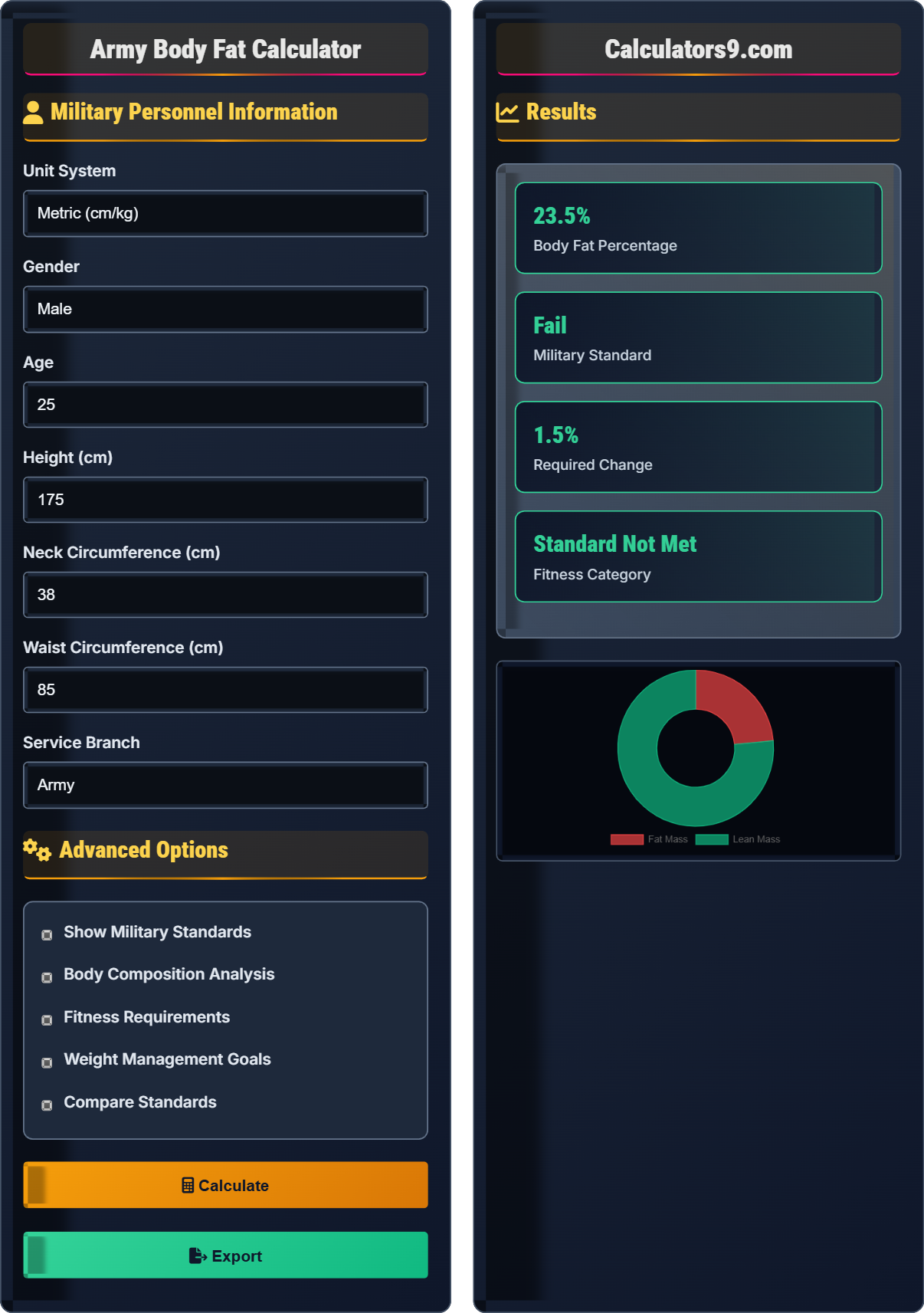
Example: For a 25-year-old male soldier, 175cm tall, with abdomen 85cm, neck 38cm:
Using Navy method: \( 86.010 \times \log_{10}(85 - 38) - 70.041 \times \log_{10}(175) + 36.76 \)
\( = 86.010 \times \log_{10}(47) - 70.041 \times \log_{10}(175) + 36.76 \)
\( = 86.010 \times 1.672 - 70.041 \times 2.243 + 36.76 \)
\( = 143.8 - 157.1 + 36.76 = 23.5\% \)
For a 25-year-old male, this 23.5% exceeds the 22% standard, making him fail the Army body fat standard.
Military Personnel Information
Advanced Options
Results
| Component | Percentage | Weight (kg) | Weight (lbs) |
|---|
| Age Group | Max Body Fat % | Your Status | Pass/Fail |
|---|
Comprehensive Army Body Fat Guide
Military body fat standards are designed to maintain physical readiness, discipline, and operational effectiveness. The U.S. Army uses the circumference method to estimate body fat percentage without requiring expensive equipment. These standards vary by age and gender to account for natural physiological differences and age-related changes in body composition.
The Army uses the following formulas for body fat percentage calculation:
Where:
- \( abdomen \) = Abdomen circumference (cm)
- \( waist \) = Waist circumference (cm)
- \( hip \) = Hip circumference (cm)
- \( neck \) = Neck circumference (cm)
- \( height \) = Height (cm)
Meeting military body fat standards is associated with improved physical performance, reduced injury risk, and better overall health outcomes:
- Physical Readiness: Maintains operational capability
- Discipline: Develops self-control and motivation
- Health: Reduces risk of obesity-related diseases
- Leadership: Sets example for subordinates
- Cardiovascular Training: Regular running, swimming, cycling
- Strength Training: Maintain muscle mass while losing fat
- Nutrition: Caloric deficit with balanced macronutrients
- Consistency: Long-term lifestyle changes over quick fixes
- Professional Guidance: Work with fitness specialists
Military Standards
Standards defined by AR 600-9 for physical readiness.
Navy method using circumference measurements.
- Men 17-20: 20% max
- Men 21-27: 22% max
- Women 17-20: 30% max
- Women 21-27: 32% max
Achieving Standards
Physical readiness for operational effectiveness.
- Cardiovascular training
- Strength conditioning
- Proper nutrition
- Consistency
- Age-based standards
- Gender differences
- Operational requirements
- Health implications
Army Body Fat Learning Quiz
What is the maximum body fat percentage allowed for a 25-year-old male soldier in the U.S. Army?
The answer is B) 22%. According to Army Regulation 600-9, the maximum body fat percentage for male soldiers aged 21-27 is 22%. This standard is designed to maintain physical readiness and operational effectiveness. Soldiers must meet these standards to remain in good standing and continue serving.
Understanding military standards is crucial for personnel compliance. The Army uses age-based standards to account for natural physiological changes that occur with aging. These standards are not arbitrary but are designed to ensure all soldiers maintain the physical readiness required for operational duties.
AR 600-9: Army Regulation governing military standards
Physical Readiness: Ability to perform military duties
Body Fat Percentage: Proportion of fat tissue in the body
• Ages 21-27: 22% max for men
• Standards vary by age and gender
• Compliance is mandatory
• Know your age group standards
• Monitor regularly
• Maintain consistent training
• Not knowing current standards
• Confusing standards by age group
• Not accounting for measurement errors
Calculate the estimated body fat percentage for a 25-year-old male soldier who is 175cm tall with an abdomen measurement of 85cm and neck measurement of 38cm. Show your work.
Using the Navy method formula for men: \( Body\ Fat\ % = 86.010 \times \log_{10}(abdomen - neck) - 70.041 \times \log_{10}(height) + 36.76 \)
Given:
- Abdomen = 85 cm
- Neck = 38 cm
- Height = 175 cm
Step 1: Calculate abdomen - neck
\( 85 - 38 = 47 \)
Step 2: Calculate log₁₀(47)
\( \log_{10}(47) = 1.672 \)
Step 3: Calculate log₁₀(175)
\( \log_{10}(175) = 2.243 \)
Step 4: Substitute into formula
\( Body\ Fat\ % = 86.010 \times 1.672 - 70.041 \times 2.243 + 36.76 \)
\( = 143.8 - 157.1 + 36.76 = 23.5\% \)
Therefore, the estimated body fat percentage is 23.5%, which exceeds the 22% standard for a 25-year-old male.
This calculation demonstrates the Navy method used by the Army for body fat estimation. The formula accounts for the relationship between body circumferences and overall body fat percentage. For a 25-year-old male, 23.5% exceeds the 22% standard, meaning this soldier would not meet Army body fat requirements.
Navy Method: Logarithmic formula for body fat estimation
Body Fat Percentage: Ratio of fat mass to total body mass
Standard Compliance: Meeting military fitness requirements
• Calculate abdomen - neck first
• Apply logarithms to both measurements
• Compare result to age/gender standard
• Use accurate measurements
• Check calculations carefully
• Compare to appropriate standard
• Incorrect measurement technique
• Arithmetic errors in calculations
• Using wrong standard for age/gender
A 30-year-old female soldier has a body fat percentage of 33%. Is she in compliance with Army standards? If not, how much does she need to reduce to meet the standard?
Step 1: Identify the applicable standard
For females aged 28-39, the maximum body fat percentage is 34%.
Step 2: Compare her percentage to the standard
Her percentage: 33%
Standard: 34%
Step 3: Determine compliance status
Since 33% is less than 34%, she is in compliance with Army standards.
Step 4: Calculate buffer
She has a 1% buffer (34% - 33% = 1%) before failing the standard.
Therefore, the 30-year-old female soldier is currently in compliance with Army body fat standards.
This example demonstrates how to apply age and gender-specific standards. For a 30-year-old female, the standard is 34%, which means she has a little flexibility in her body composition. Understanding these standards helps military personnel know exactly what they need to maintain or achieve.
Compliance: Meeting required standards
Buffer: Difference between current and maximum
Age-Based Standards: Standards that vary with age
• Check correct age group
• Use gender-appropriate standard
• Compare directly to standard
• Know your specific standard
• Monitor regularly
• Understand your buffer zone
• Using wrong age group standard
• Confusing male/female standards
• Not understanding compliance margins
Why does the Army use circumference measurements instead of other body fat assessment methods like DEXA or hydrostatic weighing?
Step 1: Consider practical factors
• Circumference measurements are portable and can be performed anywhere
• No expensive equipment required like DEXA machines
• Quick and efficient for large numbers of personnel
Step 2: Consider operational factors
• Can be performed in field conditions
• Minimal training required for administrators
• Standardized procedure across all units
Step 3: Consider cost-effectiveness
• DEXA and hydrostatic weighing are expensive
• Not practical for routine military testing
Step 4: Conclusion
The Army uses circumference measurements because they provide a practical, cost-effective method that can be implemented consistently across all military installations worldwide while maintaining reasonable accuracy for screening purposes.
This question addresses the practical considerations behind military standards. While more sophisticated methods like DEXA provide higher accuracy, the Army must balance accuracy with practicality, cost, and operational feasibility. The chosen method must work for hundreds of thousands of soldiers across diverse locations.
DEXA: Dual-energy X-ray absorptiometry
Hydrostatic Weighing: Underwater weighing method
Field Conditions: Operational environments
• Practicality over perfect accuracy
• Consistency across all units
• Operational feasibility
• Consider practical constraints
• Balance accuracy with feasibility
• Standardization is key
• Expecting perfect accuracy in all methods
• Not considering operational constraints
• Ignoring cost and logistics
Why does the Army use age-based body fat standards instead of a single standard for all ages?
The answer is B) To account for natural physiological changes with aging. As people age, their metabolism typically slows down, and they naturally experience changes in body composition including increased fat mass and decreased muscle mass. Age-based standards acknowledge these physiological realities while maintaining appropriate fitness expectations for operational effectiveness.
Age-based standards reflect scientific understanding of human physiology. The standards are not intended to excuse older soldiers from fitness requirements but rather to set appropriate, achievable goals that account for natural changes in body composition that occur with aging. This approach maintains fairness while preserving military readiness.
Physiological Changes: Natural changes in body with aging
Metabolism: Rate of energy expenditure
Operational Effectiveness: Ability to perform duties
• Standards account for aging
• Maintain operational readiness
• Scientifically based
• Understand the science behind standards
• Age affects body composition naturally
• Standards balance fairness with readiness
• Thinking standards are arbitrary
• Not understanding physiological changes
• Viewing as unfair accommodation
FAQ
Q: How accurate is the Army's circumference method compared to more advanced body fat measurement techniques?
A: The Army's circumference method (Navy method) has an average error of approximately ±3-4% compared to gold standard methods like DEXA or hydrostatic weighing. The formula is: \( Body\ Fat\ % = 86.010 \times \log_{10}(abdomen - neck) - 70.041 \times \log_{10}(height) + 36.76 \) for men.
While not as accurate as laboratory methods, the circumference method provides a reasonable estimate that is practical for military use. The trade-off is between accuracy and operational feasibility - the Army prioritizes a method that can be consistently applied across all installations worldwide while maintaining acceptable precision for screening purposes.
The Navy method has been validated across diverse populations and provides reliable estimates when proper measurement techniques are followed.
Q: What happens if a soldier fails to meet body fat standards?
A: When a soldier fails to meet body fat standards, they enter the Army Body Composition Program (ABCP). The process includes:
- Formal notification and counseling
- Development of a weight reduction plan
- Regular progress monitoring
- Access to dietitian consultations
- Additional fitness training requirements
Failure to make satisfactory progress in the ABCP can result in administrative actions including separation from service. The program is designed to assist soldiers in meeting standards while maintaining their careers.
Success in the program requires dedication to proper nutrition and regular exercise, with the ultimate goal of returning to full duty status while maintaining military bearing and physical readiness.