BMR Calculator
Basal metabolic rate • calorie needs
BMR Formulas:
Show the calculator**Mifflin-St Jeor Equation (Most Accurate):**
**Men:** \( BMR = 10 \times weight(kg) + 6.25 \times height(cm) - 5 \times age(y) + 5 \)
**Women:** \( BMR = 10 \times weight(kg) + 6.25 \times height(cm) - 5 \times age(y) - 161 \)
**Harris-Benedict Equation (Original):**
**Men:** \( BMR = 88.362 + (13.397 \times weight(kg)) + (4.799 \times height(cm)) - (5.677 \times age(y)) \)
**Women:** \( BMR = 447.593 + (9.247 \times weight(kg)) + (3.098 \times height(cm)) - (4.330 \times age(y)) \)
Where:
- \( BMR \) = Basal Metabolic Rate (calories/day)
- \( weight \) = Body weight in kilograms
- \( height \) = Height in centimeters
- \( age \) = Age in years
To calculate Total Daily Energy Expenditure (TDEE), multiply BMR by Activity Factor:
- Sedentary (little or no exercise): BMR × 1.2
- Lightly active (light exercise/sports 1-3 days/week): BMR × 1.375
- Moderately active (moderate exercise/sports 3-5 days/week): BMR × 1.55
- Very active (hard exercise/sports 6-7 days/week): BMR × 1.725
- Extra active (very hard exercise/physical job): BMR × 1.9
Example: For a 30-year-old woman, 165cm tall, weighing 60kg:
Using Mifflin-St Jeor: \( BMR = 10 \times 60 + 6.25 \times 165 - 5 \times 30 - 161 \)
\( = 600 + 1,031.25 - 150 - 161 = 1,320.25 \) calories/day
If she is moderately active, her TDEE would be: \( 1,320.25 \times 1.55 = 2,046.39 \) calories/day
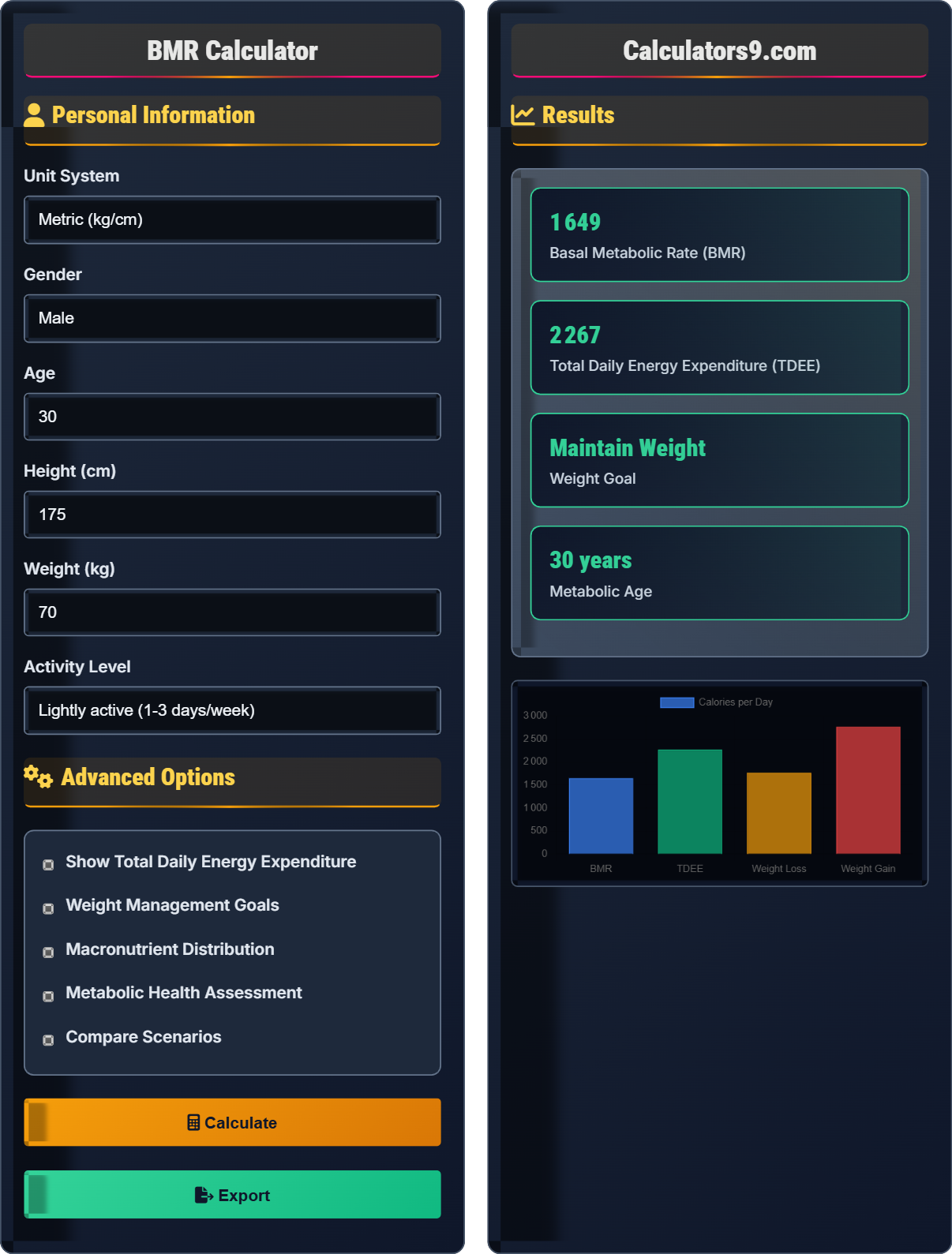
Personal Information
Advanced Options
Results
| Activity Level | Multiplier | Calories/Day |
|---|
| Goal | Calories/Day | Weekly Change |
|---|
Comprehensive BMR Guide
Basal Metabolic Rate (BMR) is the number of calories your body needs to perform basic life-sustaining functions at rest. These functions include breathing, circulation, cell production, nutrient processing, protein synthesis, and ion transport. BMR represents about 60-75% of daily calorie expenditure and varies based on age, gender, body composition, and genetics.
Several equations exist for calculating BMR, with the Mifflin-St Jeor equation being the most accurate for most people:
Where:
- \( BMR \) = Basal Metabolic Rate (calories/day)
- \( weight \) = Body weight in kilograms
- \( height \) = Height in centimeters
- \( age \) = Age in years
To determine your total daily calorie needs, multiply your BMR by an activity factor:
- Sedentary (little or no exercise): BMR × 1.2
- Lightly active (light exercise/sports 1-3 days/week): BMR × 1.375
- Moderately active (moderate exercise/sports 3-5 days/week): BMR × 1.55
- Very active (hard exercise/sports 6-7 days/week): BMR × 1.725
- Extra active (very hard exercise/physical job): BMR × 1.9
- Maintain Weight: Consume calories equal to TDEE
- Lose Weight: Create a calorie deficit of 500-1000 calories/day for 1-2 lbs/week loss
- Gain Weight: Create a calorie surplus of 300-500 calories/day
- Build Muscle: Slight surplus with strength training and adequate protein
BMR Basics
Basal Metabolic Rate - calories needed at rest for basic functions.
Mifflin-St Jeor, Harris-Benedict equations.
- Body size and composition
- Age and gender
- Activity level
- Hormones and genetics
Weight Management
Calories consumed vs calories burned determines weight changes.
- Calculate TDEE from BMR
- Create appropriate deficit/surplus
- Monitor progress
- Adjust as needed
- Safe weight loss: 1-2 lbs/week
- Extreme deficits can slow metabolism
- Muscle preservation important
- Long-term sustainability matters
BMR Learning Quiz
Which of the following has the greatest impact on Basal Metabolic Rate?
The answer is B) Body Composition. While all factors affect BMR, body composition has the greatest impact. Muscle tissue burns significantly more calories at rest than fat tissue (approximately 6 calories per pound of muscle vs 2 calories per pound of fat). Therefore, individuals with higher muscle mass have significantly higher BMRs, regardless of age, gender, or genetics.
Understanding the primary determinants of BMR is crucial for effective weight management. While age, gender, and genetics are largely fixed factors, body composition can be modified through exercise and nutrition. This makes it the most important modifiable factor for increasing metabolic rate. Strength training and maintaining muscle mass become essential for long-term metabolic health.
BMR: Basal Metabolic Rate - calories needed at rest
Body Composition: Proportion of muscle, fat, bone, and other tissues
Metabolic Rate: Speed at which body burns calories
• Muscle burns 3x more calories than fat at rest
• Body composition is modifiable
• Higher muscle mass = Higher BMR
• Strength training increases BMR
• Preserve muscle during weight loss
• Body composition matters more than weight
• Focusing only on weight, not composition
• Neglecting strength training
• Not understanding muscle's metabolic impact
Calculate the BMR for a 25-year-old woman who is 165cm tall and weighs 60kg using the Mifflin-St Jeor equation. Show your work.
Using the Mifflin-St Jeor equation for women: \( BMR = 10 \times weight(kg) + 6.25 \times height(cm) - 5 \times age(y) - 161 \)
Given:
- Weight = 60 kg
- Height = 165 cm
- Age = 25 years
Step 1: Calculate each component
\( 10 \times 60 = 600 \)
\( 6.25 \times 165 = 1,031.25 \)
\( 5 \times 25 = 125 \)
Step 2: Combine components
\( BMR = 600 + 1,031.25 - 125 - 161 = 1,345.25 \) calories/day
Therefore, the woman's BMR is approximately 1,345 calories per day.
This calculation demonstrates the straightforward nature of BMR equations. The Mifflin-St Jeor equation is preferred because it provides more accurate results than older equations like Harris-Benedict. Notice how weight and height contribute positively to BMR, while age contributes negatively (reflecting the metabolic slowdown with aging). The constant (-161 for women, +5 for men) accounts for gender differences in body composition.
Mifflin-St Jeor: Most accurate BMR calculation equation
Basal Metabolic Rate: Calories needed at rest for basic functions
Energy Expenditure: Calories burned by the body
• Use correct equation for gender
• Ensure consistent units (kg, cm)
• Follow order of operations
• Remember: -161 for women, +5 for men
• Weight has largest impact on BMR
• Check your math carefully
• Using wrong gender constant
• Mixing units (pounds with metric)
• Arithmetic errors
Mark is a 35-year-old man, 180cm tall, weighing 80kg. He exercises moderately 4 days per week. Calculate his BMR and TDEE. How many calories should he consume daily to lose 1 lb per week?
Step 1: Calculate BMR using Mifflin-St Jeor for men
\( BMR = 10 \times 80 + 6.25 \times 180 - 5 \times 35 + 5 \)
\( = 800 + 1,125 - 175 + 5 = 1,755 \) calories/day
Step 2: Calculate TDEE for moderately active (multiplier 1.55)
\( TDEE = 1,755 \times 1.55 = 2,720.25 \) calories/day
Step 3: Calculate calories for 1 lb/week weight loss
1 lb of fat = ~3,500 calories
Daily deficit needed = 3,500 ÷ 7 = 500 calories
Target calories = 2,720 - 500 = 2,220 calories/day
Mark should consume approximately 2,220 calories per day to lose 1 lb per week.
This problem demonstrates the practical application of BMR calculations for weight management. The conversion from BMR to TDEE using activity multipliers is essential for determining actual daily calorie needs. The 3,500-calorie rule (1 lb of fat = 3,500 calories) is a fundamental principle in weight management, though it's an approximation that can vary between individuals.
TDEE: Total Daily Energy Expenditure - total calories burned per day
Activity Multiplier: Factor to account for physical activity level
Calorie Deficit: Consuming fewer calories than burned
• BMR + Activity Factor = TDEE
• 3,500 calories ≈ 1 lb fat
• Safe weight loss: 1-2 lbs/week
• Calculate BMR first, then apply activity factor
• 500 cal/day deficit ≈ 1 lb/week loss
• Use moderate deficits for sustainability
• Forgetting to calculate TDEE from BMR
• Using incorrect activity multiplier
• Extreme deficits that are unsustainable
Sarah has been dieting for 3 months and notices her weight loss has plateaued despite maintaining the same calorie intake that initially worked. Explain the metabolic adaptations occurring and recommend adjustments to overcome the plateau.
Step 1: Explain metabolic adaptations
After prolonged calorie restriction, several metabolic adaptations occur:
- Decreased BMR due to reduced body mass
- Reduced non-exercise activity thermogenesis (NEAT)
- Hormonal changes (leptin, ghrelin, thyroid hormones)
- Increased efficiency of energy utilization
Step 2: Recommended adjustments
• Recalculate BMR and TDEE with current weight
• Increase physical activity to boost calorie burn
• Implement refeed days or diet breaks
• Focus on strength training to preserve muscle mass
• Ensure adequate protein intake to maintain lean mass
These adaptations represent the body's effort to conserve energy during perceived famine.
This example illustrates the body's remarkable ability to adapt to sustained calorie restriction. The metabolic slowdown is an evolutionary survival mechanism that helped humans survive periods of food scarcity. Understanding these adaptations is crucial for designing sustainable weight management programs that account for metabolic changes over time.
Metabolic Adaptation: Body's response to sustained calorie restriction
NEAT: Non-Exercise Activity Thermogenesis - unconscious movement calories
Plateau: Period of no weight loss despite continued efforts
• BMR decreases with weight loss
• Recalculate needs periodically
• Sustainable approaches work best long-term
• Track weight and measurements regularly
• Recalculate calorie needs when plateau occurs
• Include strength training to preserve muscle
• Continuing same intake despite metabolic adaptation
• Not accounting for reduced BMR
• Extreme measures to break plateaus
Which of the following would cause the greatest increase in BMR?
The answer is B) Gaining 5kg of muscle mass. Muscle tissue is metabolically active and burns approximately 6 calories per pound per day at rest, compared to about 2 calories per pound for fat tissue. Gaining 5kg (about 11 lbs) of muscle would increase BMR by approximately 66 calories per day. In contrast, aging typically decreases BMR, gender differences are less impactful than body composition, and height changes affect BMR proportionally to surface area.
This question highlights the most significant modifiable factor affecting BMR. While age, gender, and height are largely fixed, body composition can be altered through exercise and nutrition. Strength training and muscle preservation are therefore crucial for maintaining a healthy metabolic rate throughout life. This is why exercise programs that include resistance training are superior for long-term weight management.
Muscle Metabolism: Muscle burns 3x more calories than fat at rest
Metabolic Rate: Speed at which body burns calories
Modifiable Factors: Aspects that can be changed through behavior
• Muscle mass has greatest impact on BMR
• BMR decreases with age
• Body composition is controllable
• Strength training increases metabolic rate
• Muscle preservation crucial for metabolism
• Focus on composition, not just weight
• Neglecting strength training
• Focusing only on cardio exercise
• Not understanding muscle's metabolic impact
FAQ
Q: I have a very high BMR according to the calculator. Does this mean I can eat whatever I want without gaining weight?
A: A high BMR means your body burns more calories at rest, but it doesn't give you free rein to eat unlimited amounts without consequences. BMR represents only about 60-75% of your total daily energy expenditure. The remaining 25-40% comes from physical activity, digestion, and other processes.
The BMR calculation uses the formula: \( BMR = 10 \times weight(kg) + 6.25 \times height(cm) - 5 \times age(y) + 5 \) (for men). A high BMR might result from factors like higher muscle mass, younger age, or genetic factors.
However, overeating consistently, even with a high BMR, will still lead to weight gain. The relationship is: \( \text{Weight Change} = \frac{\text{Calories Consumed} - \text{Calories Burned}}{3,500} \) (for pounds).
While you may have more flexibility with food choices, maintaining a balanced diet is still important for overall health, energy levels, and preventing nutrient deficiencies.
Q: How can I increase my BMR naturally?
A: You can increase your BMR naturally through several evidence-based approaches:
- Strength Training: Builds muscle mass, which burns more calories at rest
- Protein Intake: Protein has a higher thermic effect than fats or carbs
- Adequate Sleep: Poor sleep can slow metabolism
- Stay Hydrated: Dehydration can reduce metabolic rate
- Interval Training: Can boost post-exercise calorie burn
The mathematical relationship shows that BMR is primarily influenced by body composition: \( BMR = 10 \times weight(kg) + 6.25 \times height(cm) - 5 \times age(y) + 5 \). Since muscle mass contributes significantly to weight, increasing muscle through resistance training is the most effective way to raise BMR.
Small, consistent changes in these areas can lead to meaningful increases in metabolic rate over time.