Body Surface Area Calculator
BSA calculation • health assessment
BSA Formulas:
Show the calculator**Mosteller Formula (Most Common):**
\( BSA (m^2) = \sqrt{\frac{height(cm) \times weight(kg)}{3600}} \)
**Du Bois Formula (Gold Standard):**
\( BSA (m^2) = 0.007184 \times height(cm)^{0.725} \times weight(kg)^{0.425} \)
**Haycock Formula:**
\( BSA (m^2) = 0.024265 \times height(cm)^{0.3964} \times weight(kg)^{0.5378} \)
**Gehan and George Formula:**
\( BSA (m^2) = 0.0235 \times height(cm)^{0.42246} \times weight(kg)^{0.51456} \)
Where:
- \( BSA \) = Body Surface Area in square meters
- \( height \) = Height in centimeters
- \( weight \) = Weight in kilograms
Typical BSA ranges:
- Infants: ~0.25 m²
- Children (2 years): ~0.5 m²
- Adults (average): ~1.7 m² (men), ~1.6 m² (women)
- Adults (range): 1.4-2.0 m²
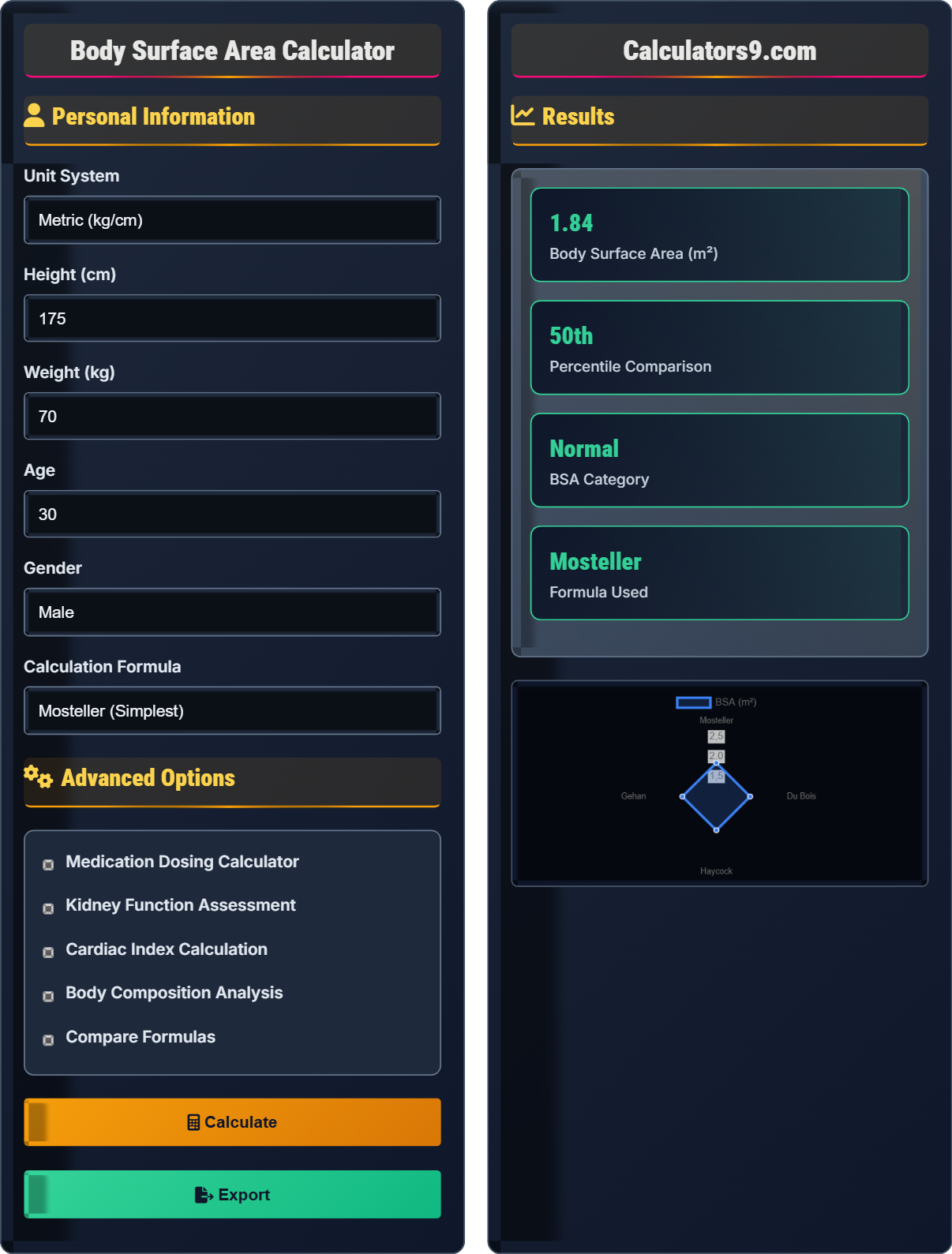
Example: For an adult who is 175cm tall and weighs 70kg:
Using Mosteller: \( BSA = \sqrt{\frac{175 \times 70}{3600}} = \sqrt{\frac{12,250}{3600}} = \sqrt{3.403} = 1.84 \) m²
Using Du Bois: \( BSA = 0.007184 \times 175^{0.725} \times 70^{0.425} = 1.87 \) m²
The Mosteller formula is preferred for its simplicity and accuracy.
Personal Information
Advanced Options
Results
| Formula | BSA (m²) | Method |
|---|
| Application | Value | Reference |
|---|
Comprehensive BSA Guide
Body Surface Area (BSA) is a measurement that estimates the total surface area of the human body. It's a crucial parameter in medicine because it provides a more accurate representation of metabolic mass than body weight alone. BSA accounts for both height and weight, making it a better indicator for drug dosing, cardiac output, and other physiological parameters that scale with body size.
Multiple formulas exist for calculating BSA, each with different levels of complexity and accuracy:
Where:
- \( BSA \) = Body Surface Area in square meters
- \( height \) = Height in centimeters
- \( weight \) = Weight in kilograms
BSA varies significantly with age, gender, and body composition:
- Infants: ~0.25 m²
- Children (2 years): ~0.5 m²
- Adults (average): ~1.7 m² (men), ~1.6 m² (women)
- Adults (range): 1.4-2.0 m²
- Large adults: Up to 2.5 m² or more
- Better Metabolic Indicator: More closely correlates with metabolic rate and organ function
- Size Independence: Accounts for both height and weight
- Standardization: Allows comparison across different body sizes
- Clinical Relevance: Reflects physiological scaling
BSA Basics
Body Surface Area - total surface area of the human body in square meters.
Mosteller, Du Bois, Haycock, Gehan & George formulas.
- Normal adults: 1.4-2.0 m²
- Men average: ~1.7 m²
- Women average: ~1.6 m²
- Used for medication dosing
Clinical Applications
BSA standardizes dosing and measurements across body sizes.
- Chemotherapy dosing
- Cardiac output normalization
- Kidney function assessment
- Burn injury evaluation
- Formula choice affects accuracy
- Not suitable for amputees
- May not reflect body composition
- Use with clinical judgment
BSA Learning Quiz
Which BSA formula is most commonly used in clinical practice due to its simplicity?
The answer is B) Mosteller Formula. The Mosteller formula (\( BSA = \sqrt{\frac{height \times weight}{3600}} \)) is most commonly used in clinical practice because of its simplicity. It only requires multiplication and a square root, making it easier to calculate manually. While the Du Bois formula is considered the gold standard for accuracy, the Mosteller formula provides a good balance of accuracy and simplicity.
In clinical settings, simplicity and speed are crucial. The Mosteller formula allows for quick calculations without sacrificing significant accuracy. Understanding the trade-offs between different formulas is important for healthcare practitioners who need to choose the most appropriate method based on their needs for speed versus precision.
BSA: Body Surface Area - total surface area of the human body
Mosteller Formula: Simplest BSA calculation method
Gold Standard: Most accurate method available
• Mosteller: Simplest and most practical
• Du Bois: Most accurate but complex
• Clinical choice balances accuracy and speed
• Mosteller is easiest to remember
• Du Bois is most accurate
• Choose based on clinical needs
• Confusing formulas in clinical settings
• Not knowing which formula to use
• Calculation errors with complex formulas
Calculate the BSA for a patient who is 170cm tall and weighs 65kg using the Mosteller formula. Show your work.
Using the Mosteller formula: \( BSA = \sqrt{\frac{height(cm) \times weight(kg)}{3600}} \)
Given:
- Height = 170 cm
- Weight = 65 kg
Step 1: Multiply height by weight
\( 170 \times 65 = 11,050 \)
Step 2: Divide by 3600
\( \frac{11,050}{3600} = 3.069 \)
Step 3: Take the square root
\( \sqrt{3.069} = 1.75 \) m²
Therefore, the patient's BSA is approximately 1.75 m².
This calculation demonstrates the straightforward nature of the Mosteller formula. The division by 3600 is a constant that converts the product of height and weight to square meters. This formula provides a quick and reasonably accurate estimate of BSA that is suitable for most clinical applications.
Mosteller Formula: Simple BSA calculation method
Body Surface Area: Total surface area of the human body
Clinical Application: Medical use of BSA measurements
• Multiply height by weight
• Divide by 3600
• Take square root of result
• Remember: √(ht×wt/3600)
• Units must be cm and kg
• Check reasonableness of result
• Using wrong units (inches vs cm)
• Forgetting to take square root
• Arithmetic errors in multiplication
A chemotherapy drug is dosed at 25 mg/m². If a patient has a BSA of 1.8 m², how much of the drug should be administered? If the drug concentration is 10 mg/mL, how many mL should be given?
Step 1: Calculate total dose needed
Dose = Dosage per m² × BSA
Dose = 25 mg/m² × 1.8 m² = 45 mg
Step 2: Calculate volume to administer
Volume = Total dose ÷ Concentration
Volume = 45 mg ÷ 10 mg/mL = 4.5 mL
Therefore, the patient should receive 45 mg of the drug, which equals 4.5 mL at the given concentration.
This problem demonstrates the practical clinical application of BSA in medication dosing. Many chemotherapy agents and other medications use BSA-based dosing to account for differences in body size. The calculation ensures that patients receive appropriate doses based on their surface area rather than just their weight, which provides a better correlation with organ function and drug metabolism.
BSA Dosing: Medication dosing based on body surface area
Concentration: Amount of drug per unit volume
Chemotherapy: Drug treatment for cancer
• Dose = Dosage per m² × BSA
• Volume = Total dose ÷ Concentration
• BSA dosing accounts for body size
• Always verify BSA calculation
• Double-check final dose
• Consider patient safety factors
• Incorrect BSA calculation
• Unit conversion errors
• Not accounting for drug concentration
A patient has a cardiac output of 5.5 L/min and a BSA of 1.9 m². Calculate the cardiac index. What does this value indicate about the patient's cardiac function?
Step 1: Calculate cardiac index
Cardiac Index = Cardiac Output ÷ BSA
Cardiac Index = 5.5 L/min ÷ 1.9 m² = 2.89 L/min/m²
Step 2: Interpret the result
Normal cardiac index ranges from 2.5 to 4.0 L/min/m²
A value of 2.89 L/min/m² is within the normal range, indicating normal cardiac function.
Cardiac index normalizes cardiac output to body surface area, allowing for comparison across patients of different sizes.
This example shows how BSA is used to normalize physiological parameters. Without normalization, a larger person would naturally have a higher cardiac output than a smaller person, even if their cardiac function was identical. By dividing cardiac output by BSA, we create a size-independent measure of cardiac performance that allows for meaningful comparisons between patients.
Cardiac Index: Cardiac output normalized to BSA
Cardiac Output: Amount of blood pumped by heart per minute
Normalization: Adjusting measurements for body size
• Cardiac Index = CO ÷ BSA
• Normal range: 2.5-4.0 L/min/m²
• Normalizes for body size differences
• Normalizes cardiac function for size
• Allows cross-patient comparison
• Essential for hemodynamic assessment
• Forgetting to normalize for body size
• Using wrong units in calculation
• Not understanding normal ranges
Which of the following is NOT a common clinical application of BSA?
The answer is C) Blood pressure measurement. Blood pressure is measured directly using sphygmomanometers and does not require BSA for calculation or interpretation. All other options are common clinical applications of BSA: chemotherapy dosing, cardiac index calculation, and kidney function assessment (GFR normalization) all utilize BSA to account for differences in body size.
It's important to understand which clinical parameters require BSA normalization and which do not. Blood pressure is an absolute measurement that reflects the force of blood against vessel walls, independent of body size. However, many other physiological parameters scale with body size, making BSA normalization essential for accurate assessment and comparison.
BSA Normalization: Adjusting measurements for body size
Clinical Parameters: Measurable aspects of patient health
Hemodynamic: Relating to blood flow and pressure
• BSA used for size-dependent parameters
• Blood pressure is absolute measurement
• Not all clinical values need normalization
• Consider if parameter scales with size
• BSA for metabolic/organ function
• Absolute measurements don't need BSA
• Applying BSA to inappropriate measurements
• Not normalizing when needed
• Confusing which parameters require normalization
FAQ
Q: Why is BSA used instead of body weight for medication dosing?
A: BSA provides a better correlation with metabolic rate and organ function than body weight alone. The mathematical relationship shows that physiological parameters scale more closely with surface area than with weight.
For example, the Mosteller formula: \( BSA = \sqrt{\frac{height(cm) \times weight(kg)}{3600}} \) incorporates both height and weight, providing a more comprehensive measure of body size. This is particularly important for medications where dosing needs to account for organ function and metabolism.
Consider two patients with the same weight but different heights - the taller patient would have a larger BSA and potentially higher metabolic activity, warranting a higher dose. Using weight alone would ignore this important physiological difference.
BSA dosing helps ensure therapeutic efficacy while minimizing toxicity by accounting for the patient's actual body size and metabolic capacity.
Q: Which BSA formula is most accurate and when should I use each one?
A: The Du Bois formula is considered the gold standard for accuracy: \( BSA = 0.007184 \times height(cm)^{0.725} \times weight(kg)^{0.425} \). However, it's complex to calculate manually.
The Mosteller formula (\( BSA = \sqrt{\frac{height \times weight}{3600}} \)) is widely used in clinical practice because it's simple and provides results that are very close to the Du Bois formula.
For clinical applications:
- Mosteller: Routine clinical use, easy to calculate
- Du Bois: Research studies, when highest accuracy is needed
- Haycock: Pediatric applications
All formulas provide similar results for most adults (typically within 5-10%), so the choice often depends on institutional preference and the need for manual calculation versus computer systems.