Body Type Calculator
Somatotype analysis • health assessment
Body Type Classification:
Show the calculator**Heath-Carter Somatotype Method:**
This method evaluates three components on a 7-point scale:
**Endomorphy (Roundness):**
\( E = 0.7182 \times (Triceps + Subscapular + Suprailiac) \)
Where skinfold measurements are in mm
**Mesomorphy (Muscularity):**
\( M = 0.858 \times (Humerus + Femur) + 0.601 \times Calf \)
Where bone diameters are in cm, Calf in cm
**Ectomorphy (Linearity):**
\( W/H \times 100 < 38: 0.7 \times (Height - Sitting) \)
\( W/H \times 100 \geq 38: (Height - Sitting) \)
Where Height and Sitting height are in cm
Where:
- \( E \) = Endomorphy score (1-7 scale)
- \( M \) = Mesomorphy score (1-7 scale)
- \( H \) = Hip circumference (cm)
- \( W \) = Waist circumference (cm)
Body type classifications based on component scores:
- Ectomorph: High Ectomorphy (6-7), Low Endomorphy (1-2), Variable Mesomorphy
- Mesomorph: High Mesomorphy (5-7), Moderate Endomorphy (3-5), Low Ectomorphy (1-3)
- Endomorph: High Endomorphy (5-7), Low Ectomorphy (1-2), Variable Mesomorphy
- Hybrid Types: Combinations like Ecto-Mesomorph, Mesomorph-Endomorph, etc.
Example: For a person with Endomorphy=2.5, Mesomorphy=5.0, Ectomorphy=3.5:
This would classify as a Mesomorphic Ectomorph (5.0-3.5-2.5)
The first number is always the highest, followed by the second highest, then the lowest.
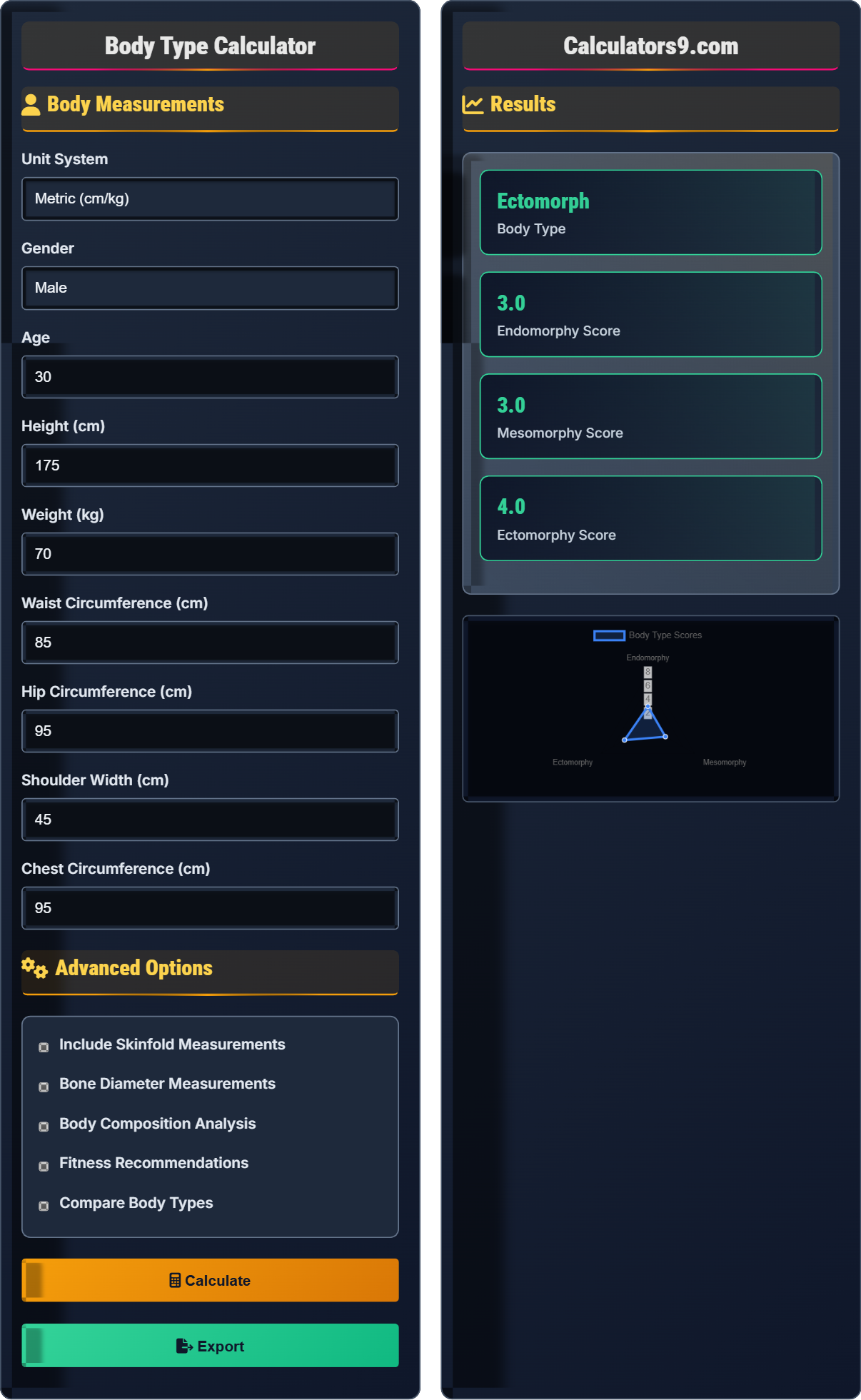
Body Measurements
Advanced Options
Results
| Component | Score | Range | Description |
|---|
| Characteristic | Your Profile | Typical for Type |
|---|
Comprehensive Body Type Guide
Body types, or somatotypes, are classifications based on body composition, bone structure, and muscle distribution. Developed by William Sheldon in the 1940s and refined by Heath-Carter, the system identifies three primary body types: Ectomorph, Mesomorph, and Endomorph. Each type has distinct physical characteristics and responds differently to exercise and nutrition.
The Heath-Carter method evaluates three components on a 7-point scale:
Where:
- \( E \) = Endomorphy score (1-7 scale)
- \( M \) = Mesomorphy score (1-7 scale)
- \( H \) = Hip circumference (cm)
- \( W \) = Waist circumference (cm)
Most people are combinations of the primary types:
- Ecto-Mesomorph: Lean but with some muscle potential
- Meso-Ectomorph: Athletic but lean
- Meso-Endomorph: Muscular but with some fat storage tendency
- Endo-Mesomorph: Rounded but with muscle potential
- Ecto-Endomorph: Lean but with some roundness
- Balance: Equal parts of all three types
- Ectomorphs: Focus on calorie surplus, heavy compound lifts, minimal cardio
- Mesomorphs: Versatile - respond well to various training styles
- Endomorphs: Emphasize cardio, controlled nutrition, circuit training
- Hybrids: Combine strategies based on dominant traits
Body Type Basics
Classification based on body composition, bone structure, and muscle distribution.
Heath-Carter method evaluating three components on 7-point scale.
- Ectomorph: Lean and long
- Mesomorph: Athletic build
- Endomorph: Rounded body
- Most are hybrids
Working with Your Type
Strategies optimized for your body's natural tendencies.
- Ectomorph: Heavy lifting, low cardio
- Mesomorph: Varied training
- Endomorph: Cardio + strength
- Hybrid: Combined approach
- Body type is not destiny
- Training can modify tendencies
- Nutrition plays key role
- Individual variations exist
Body Type Learning Quiz
Which body type is characterized by a lean, long build with narrow shoulders and hips?
The answer is C) Ectomorph. Ectomorphs are characterized by a lean, long build with narrow shoulders and hips. They typically have a fast metabolism and find it difficult to gain weight or muscle mass. This body type is dominated by the ectomorphy component in the somatotype classification.
Understanding the primary characteristics of each body type is fundamental to somatotype classification. Ectomorphs represent the "linear" end of the spectrum with long limbs, narrow frames, and low body fat. This knowledge helps in identifying one's body type and understanding how it might respond to training and nutrition.
Ectomorph: Lean, long body type with narrow frame
Somatotype: Classification system for body types
Metabolism: Speed at which body burns calories
• Ectomorphs: Lean and long
• Narrow shoulders and hips
• Fast metabolism
• Ectomorphs struggle to gain weight
• Long limbs and narrow frame
• High metabolic rate
• Confusing ectomorph with endomorph
• Not recognizing narrow frame characteristic
• Ignoring metabolic differences
If someone has an endomorphy score of 2, mesomorphy score of 5, and ectomorphy score of 3, what would their somatotype classification be?
Step 1: Identify the highest score
Mesomorphy = 5 (highest)
Step 2: Identify the second highest score
Ectomorphy = 3 (second highest)
Step 3: Identify the lowest score
Endomorphy = 2 (lowest)
Step 4: Arrange in descending order
Classification: 5-3-2 (Mesomorph-Ectomorph-Endomorph)
This would be classified as a Meso-Ectomorph, with mesomorphy being the dominant trait.
Somatotype classification always arranges the three components in descending order, with the highest score listed first. This system helps identify the dominant body type characteristics. In this case, the person is primarily mesomorphic (muscular/athletic) with some ectomorphic (lean) tendencies and minimal endomorphic (rounded) characteristics.
Somatotype: Three-component body type classification
Hybrid Type: Combination of primary types
Dominant Trait: Highest scoring component
• List scores in descending order
• Highest score determines primary type
• Second highest determines secondary
• Always arrange highest to lowest
• First number is dominant type
• Read as "Primary-Secondary-Tertiary"
• Not arranging in descending order
• Confusing which number represents which trait
• Misreading the sequence
An ectomorph wants to gain muscle mass. What training and nutrition strategies would be most effective for their body type?
For an ectomorph wanting to gain muscle mass:
Step 1: Training approach
• Focus on heavy compound lifts (squats, deadlifts, bench press)
• Use lower rep ranges (3-6 reps) with heavy weights
• Limit cardio to avoid burning too many calories
Step 2: Nutrition approach
• Eat in a calorie surplus to fuel muscle growth
• Consume adequate protein (1.6-2.2g per kg body weight)
• Include frequent meals throughout the day
Step 3: Recovery
• Allow adequate rest between sessions
• Ensure sufficient sleep for recovery
Ectomorphs need to overcome their naturally fast metabolism to gain muscle effectively.
Ectomorphs face unique challenges in muscle building due to their fast metabolism and difficulty gaining weight. The training approach emphasizes heavy, compound movements that stimulate maximum muscle growth, while nutrition must compensate for the high caloric needs. This example demonstrates how understanding one's body type can inform more effective training and nutrition strategies.
Compound Lifts: Exercises working multiple muscle groups
Calorie Surplus: Consuming more calories than burned
Metabolism: Rate of energy expenditure
• Ectomorphs need calorie surplus
• Heavy lifting for muscle growth
• Limit excessive cardio
• Eat frequently throughout the day
• Focus on compound movements
• Be patient with results
• Not eating enough calories
• Too much cardio
• Expecting quick results
A person has broad shoulders, narrow waist, and naturally builds muscle easily. They tend to stay lean even when eating freely. What body type are they most likely, and what are the implications for their fitness journey?
Step 1: Identify characteristics
• Broad shoulders and narrow waist = V-taper (mesomorphic trait)
• Builds muscle easily = High mesomorphy
• Stays lean = Low endomorphy
Step 2: Determine body type
This person exhibits classic mesomorphic characteristics with a muscular, athletic build.
Step 3: Fitness implications
• Responds well to most training methods
• Can excel in various sports and activities
• Maintains good body composition naturally
• Versatile in their approach to fitness goals
This person is likely a mesomorph, which is advantageous for most fitness pursuits.
Mesomorphs represent the "athletic" end of the somatotype spectrum with naturally muscular builds. They typically respond well to training and can achieve various fitness goals relatively easily. Understanding this body type helps recognize the advantages and potential challenges in a fitness journey.
Mesomorph: Athletic, muscular body type
V-Taper: Broad shoulders narrowing to waist
Body Composition: Proportions of fat and lean mass
• Mesomorphs build muscle easily
• Naturally athletic build
• Respond well to training
• Take advantage of natural advantages
• Still need consistent training
• Don't neglect nutrition
• Taking natural advantages for granted
• Not maintaining consistent training
• Assuming no effort needed
Which of the following statements about body types is most accurate?
The answer is C) Body type influences tendencies but training can modify them. Body type provides a framework for understanding natural tendencies and responses to training and nutrition, but it's not deterministic. Through targeted training and nutrition, individuals can modify their body composition and develop characteristics outside their primary type, though the underlying genetic tendencies remain.
This question addresses a common misconception about body types. While somatotypes provide valuable insights into natural tendencies, they don't limit potential. Understanding your body type helps optimize training and nutrition approaches, but consistent effort can lead to significant changes regardless of starting point. The key is working with your tendencies rather than against them.
Somatotype: Genetic body type classification
Phenotype: Observable characteristics
Plasticity: Ability to change with environment
• Body type influences but doesn't determine
• Training can modify characteristics
• Genetics provide starting point
• Use body type as guide, not limitation
• Work with natural tendencies
• Consistent effort yields results
• Seeing body type as destiny
• Ignoring genetic influences
• Expecting impossible transformations
FAQ
Q: I've heard that body types are just stereotypes. Is there scientific validity to somatotypes?
A: Somatotypes, developed by William Sheldon and refined by Heath-Carter, have scientific validity based on anthropometric measurements. The Heath-Carter method uses specific measurements to calculate endomorphy, mesomorphy, and ectomorphy scores on a 7-point scale.
The mathematical basis involves formulas like: \( E = 0.7182 \times (Triceps + Subscapular + Suprailiac) \) for endomorphy. These measurements correlate with body composition, bone structure, and muscle distribution.
While the system acknowledges individual variations, it provides a useful framework for understanding body composition patterns and predicting responses to training and nutrition. Modern research supports the relevance of body type concepts for fitness programming, though they should be viewed as tendencies rather than rigid categories.
Q: Can you change your body type through training and nutrition?
A: While you cannot completely change your underlying somatotype (which is genetically determined), you can significantly modify your body composition through training and nutrition.
For example, an endomorph (higher endomorphy score) can reduce body fat percentage and build muscle to achieve a more mesomorphic appearance. Similarly, an ectomorph can gain weight and muscle mass to appear more mesomorphic.
The mathematical relationships in body composition remain: \( Body\ Composition = Fat\ Mass + Lean\ Mass \). Through targeted interventions, you can change the proportions while the underlying genetic tendencies persist.
The key is understanding your starting point (your somatotype) and working strategically to modify your body composition in ways that align with your goals while respecting your natural tendencies.