Ideal Weight Calculator
Optimal weight • health assessment
Ideal Weight Formulas:
Show the calculator**Devine Formula (Most Common):**
**Men:** \( Ideal\ Weight\ (kg) = 50 + 2.3 \times (height\ in\ inches - 60) \)
**Women:** \( Ideal\ Weight\ (kg) = 45.5 + 2.3 \times (height\ in\ inches - 60) \)
**Robinson Formula:**
**Men:** \( Ideal\ Weight\ (kg) = 52 + 1.9 \times (height\ in\ inches - 60) \)
**Women:** \( Ideal\ Weight\ (kg) = 49 + 1.7 \times (height\ in\ inches - 60) \)
**Miller Formula:**
**Men:** \( Ideal\ Weight\ (kg) = 56.2 + 1.41 \times (height\ in\ inches - 60) \)
**Women:** \( Ideal\ Weight\ (kg) = 53.1 + 1.36 \times (height\ in\ inches - 60) \)
**Hamwi Formula:**
**Men:** \( Ideal\ Weight\ (kg) = 48 + 2.7 \times (height\ in\ inches - 60) \)
**Women:** \( Ideal\ Weight\ (kg) = 45.5 + 2.2 \times (height\ in\ inches - 60) \)
**BMI-Based Ideal Weight:**
\( Ideal\ Weight\ (kg) = 22 \times height(m)^2 \)
(Using BMI of 22, considered optimal by some researchers)
Where:
- \( Ideal\ Weight \) = Estimated ideal body weight in kilograms
- \( height \) = Height in inches (convert from cm: cm ÷ 2.54)
Ideal BMI ranges according to health experts:
- Optimal: BMI 21-23 (some suggest 22 as ideal)
- Normal weight: BMI 18.5-24.9
- Considered healthy by WHO: BMI 18.5-24.9
Example: For a 5'8" (68 inches) tall woman:
Using Devine: \( IW = 45.5 + 2.3 \times (68 - 60) = 45.5 + 2.3 \times 8 = 45.5 + 18.4 = 63.9 \) kg
Using BMI of 22 for 173cm (5'8") = 1.73m:
\( Ideal\ Weight = 22 \times 1.73^2 = 22 \times 2.99 = 65.8 \) kg
Therefore, the ideal weight is approximately 63.9-65.8 kg.
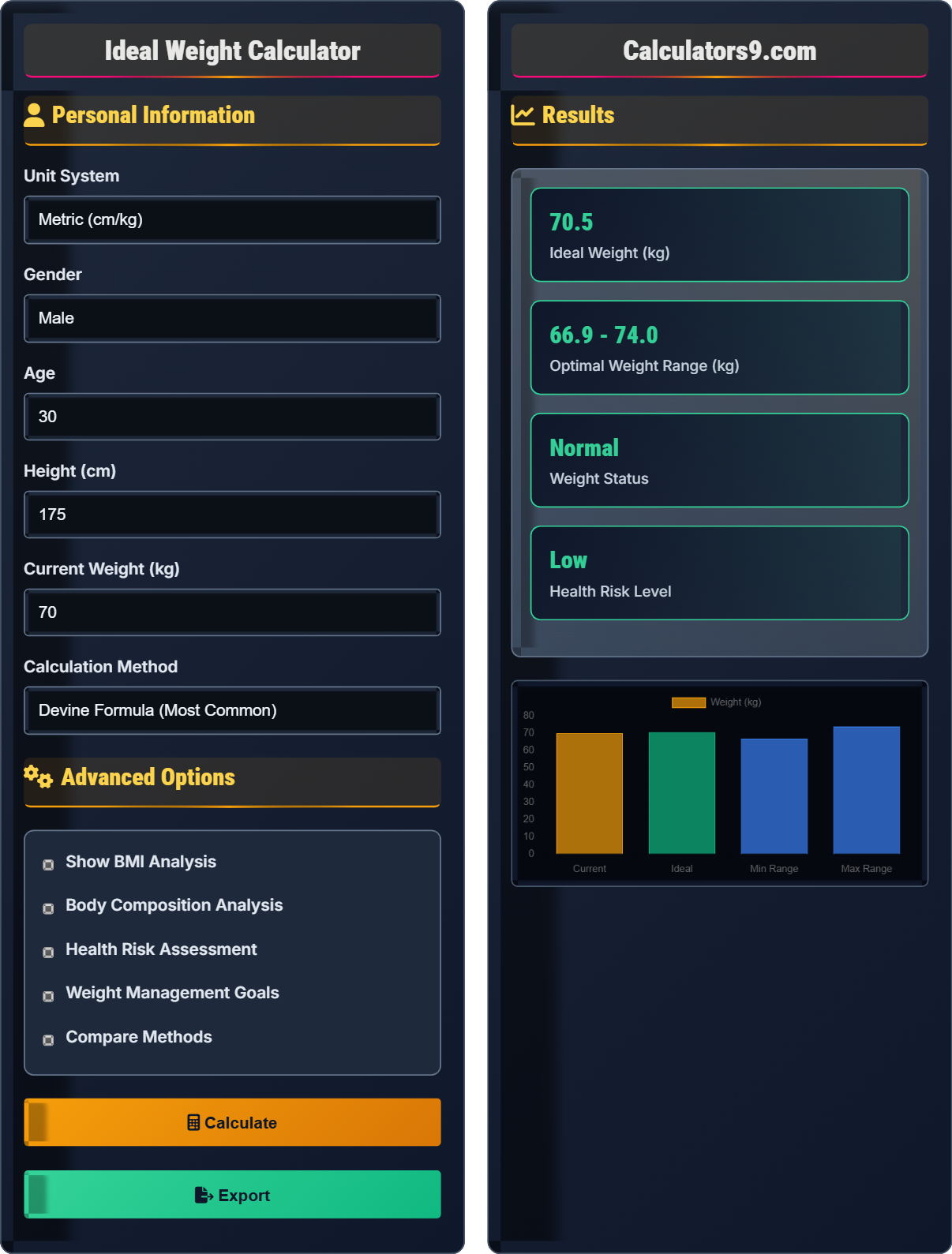
Personal Information
Advanced Options
Results
| Method | Weight (kg) | Weight (lbs) | Category |
|---|
| Formula | Result (kg) | Diff from Current | Accuracy |
|---|
Comprehensive Ideal Weight Guide
Ideal weight represents the weight that is associated with the lowest risk of health problems and the highest probability of good health outcomes. It's not a fixed number but rather an optimal range that takes into account factors such as height, gender, age, and body composition. The concept of ideal weight has evolved to focus more on health outcomes rather than appearance.
Several validated formulas exist for estimating ideal weight:
Where:
- \( IW \) = Ideal weight in kilograms
- \( height \) = Height in inches (convert from cm: cm ÷ 2.54)
- \( BMI \) = Body Mass Index (22 used as optimal)
Staying within an ideal weight range provides numerous benefits:
- Reduced Disease Risk: Lower risk of diabetes, heart disease, cancer
- Improved Mobility: Better joint health and physical function
- Enhanced Energy: Better metabolic efficiency
- Mental Health: Improved self-esteem and mood
- Longevity: Increased lifespan and quality of life
- Sleep Quality: Reduced sleep apnea and better rest
- Balanced Nutrition: Whole foods, appropriate portions
- Regular Exercise: Mix of cardio and strength training
- Consistent Monitoring: Regular weight and body composition checks
- Realistic Goals: Sustainable, gradual changes
- Adequate Rest: 7-9 hours of sleep nightly
- Stress Management: Techniques to prevent emotional eating
Ideal Weight Basics
Weight associated with lowest health risks and optimal health outcomes.
Devine, Robinson, Miller, Hamwi formulas; BMI-based approaches.
- Optimal BMI: 21-23
- Normal BMI: 18.5-24.9
- Varies by height/gender
- Consider body composition
Achieving Goals
Gradual changes that become lasting habits.
- Set realistic, measurable goals
- Combine diet and exercise
- Focus on body composition
- Track progress consistently
- Focus on health, not perfection
- Muscle vs fat matters
- Individual variations exist
- Professional guidance helpful
Ideal Weight Learning Quiz
Which of the following best describes the concept of ideal weight?
The answer is C) Weight associated with lowest health risks and optimal outcomes. Ideal weight is determined by what supports the best health outcomes rather than aesthetic preferences or a single number. It's personalized based on individual factors like height, gender, and body composition.
Understanding that ideal weight is based on health outcomes is crucial for proper weight management. The concept has evolved from appearance-focused to health-focused, emphasizing the importance of reducing disease risk and improving quality of life. This approach leads to more sustainable and beneficial results.
Ideal Weight: Weight supporting optimal health outcomes
Health Outcomes: Results related to physical wellbeing
Personalized: Tailored to individual characteristics
• Focus on health outcomes
• Consider individual factors
• It's a range, not single number
• Think health, not appearance
• Consider your unique factors
• Focus on sustainable changes
• Pursuing unrealistic standards
• Focusing only on weight loss
Calculate the ideal weight for a 5'7" (67 inches) tall man using the Devine formula. Show your work.
Using the Devine formula for men: \( Ideal\ Weight\ (kg) = 50 + 2.3 \times (height\ in\ inches - 60) \)
Given:
- Height = 67 inches
Step 1: Calculate height minus 60
\( 67 - 60 = 7 \)
Step 2: Multiply by 2.3
\( 2.3 \times 7 = 16.1 \)
Step 3: Add to base weight
\( 50 + 16.1 = 66.1 \) kg
Therefore, the ideal weight for a 5'7" tall man is approximately 66.1 kg.
This calculation demonstrates the straightforward nature of the Devine formula. The formula accounts for the fact that taller individuals have higher ideal weight ranges by adding a fixed amount per inch above 5 feet (60 inches). The different base weights for men and women reflect gender differences in body composition and skeletal structure.
Devine Formula: Common ideal weight calculation method
Base Weight: Starting weight before height adjustment
Height Adjustment: Additional weight per inch above 5'0"
• Subtract 60 from height in inches
• Multiply by appropriate factor
• Add to gender-specific base weight
• Remember: subtract 60 from height
• Different formulas for men/women
• Check units (inches vs cm)
• Forgetting to subtract 60
• Using wrong gender formula
• Mixing units (inches with cm)
Calculate the ideal weight for a person who is 175cm tall using the BMI-based method with an optimal BMI of 22. What is the ideal weight in kg and lbs?
Step 1: Convert height to meters
Height in meters = 175 cm ÷ 100 = 1.75 m
Step 2: Calculate ideal weight using BMI formula
Weight = BMI × Height²
Weight = 22 × (1.75)² = 22 × 3.0625 = 67.375 kg
Step 3: Convert to pounds
Weight in lbs = 67.375 kg × 2.205 = 148.6 lbs
Therefore, the ideal weight is approximately 67.4 kg (148.6 lbs).
This problem demonstrates the BMI-based approach to calculating ideal weight. The formula Weight = BMI × Height² is rearranged from the standard BMI formula. Using an optimal BMI of 22 is supported by some research suggesting this provides the lowest mortality risk.
BMI: Body Mass Index - weight-to-height ratio
Optimal BMI: BMI associated with lowest health risks
Mortality Risk: Risk of death from various causes
• Convert height to meters
• Square the height
• Weight = BMI × Height²
• Always convert to meters
• Don't forget to square the height
• BMI of 22 is considered optimal
• Forgetting to square the height
• Not converting to meters
• Using wrong BMI value
Calculate the ideal weight for a 5'6" (66 inches) tall woman using both the Devine and Robinson formulas. How do they compare?
Step 1: Calculate using Devine formula
\( IW_{Devine} = 45.5 + 2.3 \times (66 - 60) = 45.5 + 2.3 \times 6 = 45.5 + 13.8 = 59.3 \) kg
Step 2: Calculate using Robinson formula
\( IW_{Robinson} = 49 + 1.7 \times (66 - 60) = 49 + 1.7 \times 6 = 49 + 10.2 = 59.2 \) kg
Step 3: Compare results
The Devine formula gives 59.3 kg and the Robinson formula gives 59.2 kg. The difference is only 0.1 kg (0.2 lbs), showing these formulas provide very similar results.
Both formulas suggest an ideal weight of approximately 59 kg for this woman.
This example demonstrates that different ideal weight formulas often yield similar results, especially for average heights. The Devine and Robinson formulas are both well-validated and commonly used. The small differences between formulas reflect different research methodologies but don't significantly impact practical weight management recommendations.
Devine Formula: One of the most common ideal weight formulas
Robinson Formula: Alternative ideal weight calculation
Validation: Testing formulas against health outcomes
• Different formulas may yield similar results
• Both Devine and Robinson are valid
• Small differences are normal
• Several formulas are acceptable
• Small variations are normal
• Focus on ranges, not exact numbers
• Thinking one formula is universally best
• Overemphasizing small differences
• Ignoring body composition
Which of the following factors does NOT significantly affect what constitutes an ideal weight for an individual?
The answer is C) Favorite food. Favorite food does not significantly affect what constitutes an ideal weight for an individual. On the other hand, height affects frame size and overall weight capacity, muscle mass is denser than fat and affects weight-to-health relationships, and gender influences body composition and skeletal structure. These factors all play important roles in determining ideal weight ranges.
This question reinforces the importance of considering relevant factors when determining ideal weight. While height, muscle mass, and gender all have measurable impacts on appropriate weight ranges, personal preferences like favorite food do not. Understanding which factors truly matter helps focus weight management efforts on meaningful aspects of health.
Relevant Factors: Those that affect body composition
Body Composition: Proportions of different body tissues
Frame Size: Skeletal structure affecting weight capacity
• Height affects ideal weight range
• Muscle mass impacts weight-to-health relationship
• Gender influences body composition
• Focus on meaningful factors
• Consider body composition
• Individualize approach
• Considering irrelevant factors
• Ignoring body composition
• Using one-size-fits-all approach
FAQ
Q: Is it better to use ideal weight formulas or BMI to determine optimal weight?
A: Both approaches have value, but ideal weight formulas like Devine (\(IW = 50 + 2.3 \times (height\ in\ inches - 60)\) for men) were specifically designed for medication dosing and have historical precedence. BMI (\(BMI = \frac{weight\ (kg)}{height^2\ (m^2)}\)) provides a standardized ratio that correlates with health outcomes.
Ideal weight formulas provide a single target weight based on height, while BMI provides ranges. Recent research suggests an optimal BMI of 22-23 for lowest mortality risk, which aligns well with ideal weight formulas. For the most comprehensive assessment, consider both approaches along with body composition measurements.
Q: I'm an athlete with high muscle mass. How does this affect my ideal weight?
A: Muscle mass significantly affects ideal weight calculations because muscle is about 20% denser than fat. The mathematical relationship shows that a cubic inch of muscle weighs more than the same volume of fat.
Standard formulas like Devine (\(IW = 50 + 2.3 \times (height\ in\ inches - 60)\) for men) may underestimate healthy weight for athletes. If your BMI is in the "overweight" range (25-29.9) but you have high muscle mass, you may still be at low health risk.
For athletes, consider using body composition measurements alongside traditional weight calculations. An ideal weight that's slightly higher than standard formulas may be appropriate if body fat percentage is low and muscle mass is high.