Lean Body Mass Calculator
LBM calculation • body composition
LBM Formulas:
Show the calculator**Boer Formula (Most Common):**
**Men:** \( LBM (kg) = 0.407 \times weight(kg) + 0.267 \times height(cm) - 19.2 \)
**Women:** \( LBM (kg) = 0.252 \times weight(kg) + 0.473 \times height(cm) - 48.3 \)
**James Formula:**
**Men:** \( LBM (kg) = 1.1 \times weight(kg) - 128 \times \left(\frac{weight(kg)^2}{height(cm)^2}\right) \)
**Women:** \( LBM (kg) = 1.07 \times weight(kg) - 148 \times \left(\frac{weight(kg)^2}{height(cm)^2}\right) \)
**Hume Formula:**
**Men:** \( LBM (kg) = 0.32810 \times weight(kg) + 0.33929 \times height(cm) - 29.5336 \)
**Women:** \( LBM (kg) = 0.29569 \times weight(kg) + 0.41813 \times height(cm) - 43.2933 \)
Where:
- \( LBM \) = Lean Body Mass in kilograms
- \( weight \) = Total body weight in kilograms
- \( height \) = Height in centimeters
Alternative calculation if body fat percentage is known:
\( LBM = weight \times (1 - body\ fat\ percentage) \)
Typical LBM ranges (for reference):
- Men (average): 55-70 kg
- Women (average): 40-55 kg
- Athletes: Higher due to increased muscle mass
- As percentage of total weight: 70-90% for men, 60-80% for women
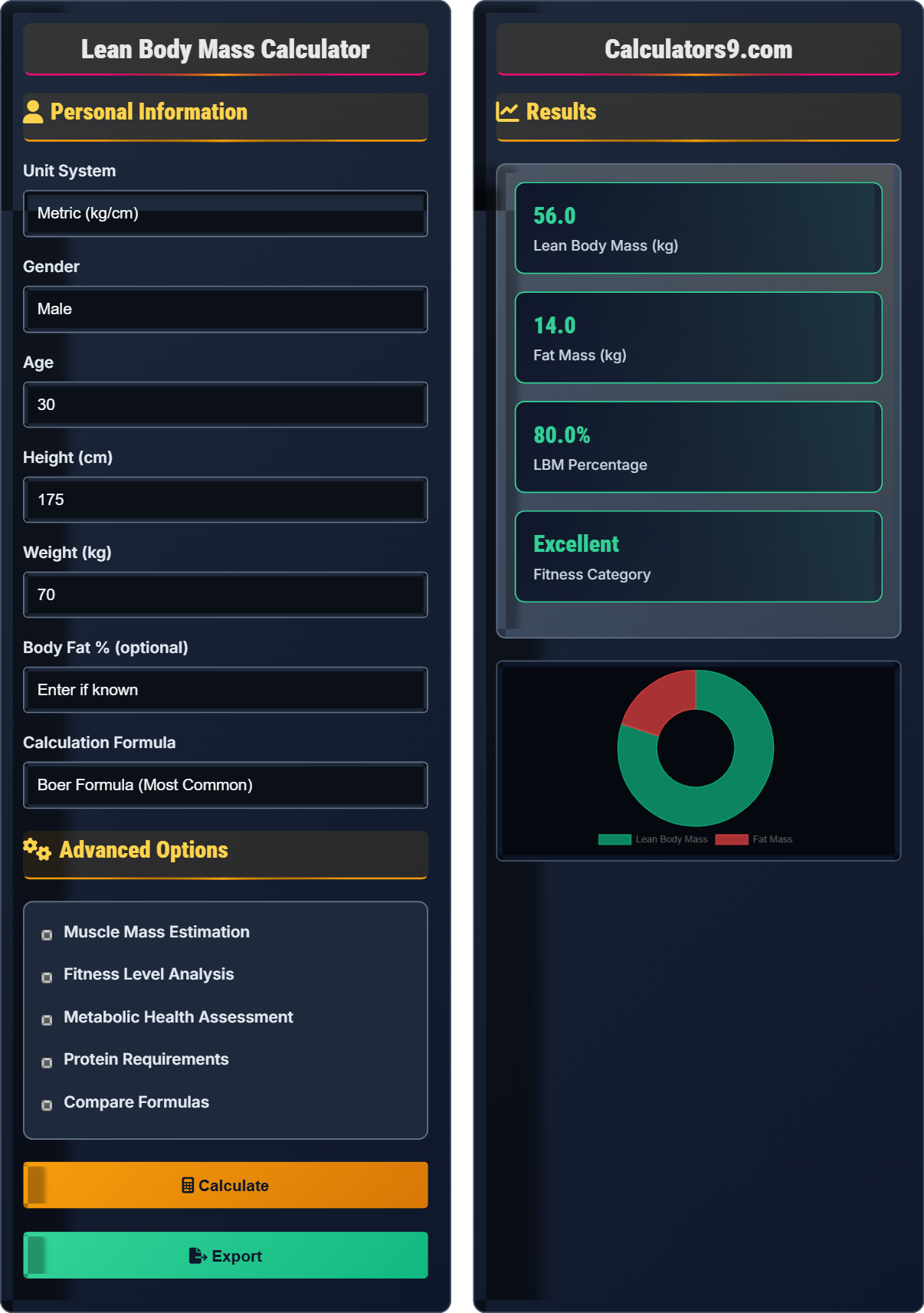
Example: For a 70kg male who is 175cm tall:
Using Boer: \( LBM = 0.407 \times 70 + 0.267 \times 175 - 19.2 = 28.49 + 46.73 - 19.2 = 56.02 \) kg
If this person has 18% body fat, then: \( LBM = 70 \times (1 - 0.18) = 70 \times 0.82 = 57.4 \) kg
Personal Information
Advanced Options
Results
| Component | Weight (kg) | Weight (lbs) | Percentage |
|---|
| Formula | LBM (kg) | Method |
|---|
Comprehensive LBM Guide
Lean Body Mass (LBM) refers to the total weight of your body minus all fat. It includes muscles, bones, organs, water, and other non-fat tissues. LBM is a critical component of body composition analysis and provides insights into metabolic health, physical fitness, and overall wellness. Unlike body weight, which fluctuates with water retention and food intake, LBM provides a more stable measure of your body's functional tissue mass.
Several validated formulas exist for estimating LBM, each with different levels of accuracy:
Where:
- \( LBM \) = Lean Body Mass in kilograms
- \( weight \) = Total body weight in kilograms
- \( height \) = Height in centimeters
LBM varies significantly with age, gender, and activity level:
- Men (average): 55-70 kg, representing 70-85% of total weight
- Women (average): 40-55 kg, representing 60-75% of total weight
- Athletes: Higher LBM percentages (80-90% for men, 70-80% for women)
- Age-related decline: LBM typically decreases by 3-8% per decade after age 30
- Resistance Training: Weightlifting and strength exercises
- Adequate Protein: 1.6-2.2g per kg of body weight for active individuals
- Sufficient Calories: Avoid excessive caloric deficits
- Quality Sleep: Supports muscle recovery and growth
- Stress Management: Chronic stress can break down muscle tissue
- Consistency: Regular exercise and nutrition habits
LBM Basics
Total body weight minus all fat tissue.
Boer, James, Hume formulas; Direct measurement if body fat % known.
- Men: 70-85% of total weight
- Women: 60-75% of total weight
- Athletes: Higher percentages
- Decreases with age
Building LBM
Supports metabolism, strength, and overall health.
- Resistance training 2-3 times/week
- Consume adequate protein
- Maintain caloric sufficiency
- Get quality sleep
- Gradual changes are sustainable
- Muscle growth takes time
- Consistency is key
- Age affects muscle building capacity
LBM Learning Quiz
Which of the following is NOT included in Lean Body Mass?
The answer is C) Body fat. Lean Body Mass (LBM) is defined as total body weight minus all fat tissue. It includes muscle tissue, bone tissue, organ tissue, water, and other non-fat components. Body fat is specifically excluded from LBM calculations, making it the opposite of lean mass.
Understanding the definition of LBM is fundamental to interpreting body composition results. The term "lean" refers to everything in the body except fat. This is why LBM is sometimes called "fat-free mass." When calculating LBM, we're measuring all the metabolically active and structural components of the body that are not fat tissue.
LBM: Lean Body Mass - total weight minus fat
Fat-Free Mass: Another term for LBM
Body Composition: Proportions of fat and non-fat tissues
• LBM = Total weight - Fat mass
• Includes muscle, bone, organs, water
• Excludes all fat tissue
• Remember: LBM excludes fat
• LBM includes all other tissues
• Higher LBM is generally healthier
• Including fat in LBM calculations
• Confusing LBM with muscle mass only
• Not understanding what LBM excludes
Calculate the LBM for a 75kg female who is 165cm tall using the Boer formula. Show your work.
Using the Boer formula for women: \( LBM (kg) = 0.252 \times weight(kg) + 0.473 \times height(cm) - 48.3 \)
Given:
- Weight = 75 kg
- Height = 165 cm
Step 1: Calculate each component
\( 0.252 \times 75 = 18.9 \)
\( 0.473 \times 165 = 78.045 \)
Step 2: Combine components
\( LBM = 18.9 + 78.045 - 48.3 = 48.645 \) kg
Therefore, the woman's LBM is approximately 48.6 kg.
This calculation demonstrates the gender-specific nature of LBM formulas. The Boer formula accounts for differences in body composition between men and women by using different coefficients. Women typically have lower LBM percentages due to higher essential fat requirements and different body composition patterns.
Boer Formula: Common LBM calculation method
Gender-Specific: Different formulas for men and womenBody Composition: Proportions of different body tissues
• Use gender-appropriate formula
• Ensure correct units (kg, cm)
• Follow order of operations
• Remember: different formulas for genders
• Check your math carefully
• LBM should be less than total weight
• Using wrong gender formula
• Mixing units (kg with inches)
• Arithmetic errors in calculations
John weighs 80kg and has 20% body fat. Calculate his LBM and fat mass. If his LBM percentage is 80%, how does this compare to typical ranges for men?
Step 1: Calculate fat mass
Fat mass = Total weight × Body fat percentage
Fat mass = 80 kg × 0.20 = 16 kg
Step 2: Calculate LBM
LBM = Total weight - Fat mass
LBM = 80 kg - 16 kg = 64 kg
Step 3: Verify LBM percentage
LBM % = (LBM / Total weight) × 100
LBM % = (64 / 80) × 100 = 80%
Step 4: Compare to typical ranges
For men, normal LBM percentage ranges from 70-85%, so John's 80% is within the normal range and indicates good body composition.
This problem demonstrates the relationship between total weight, body fat percentage, and LBM. When body fat percentage is known, calculating LBM is straightforward using the formula: LBM = Total weight × (1 - Body fat percentage). This method is often more accurate than predictive formulas when body fat has been measured.
Fat Mass: Total weight of body fat
LBM Percentage: LBM as percentage of total weight
Body Composition: Proportions of fat and lean mass
• LBM = Total weight - Fat mass
• LBM % = (LBM / Total weight) × 100
• Men typically: 70-85% LBM
• If body fat % is known, use direct calculation
• LBM % should be 70-85% for men
• Higher is generally better
• Adding fat mass to total weight
• Forgetting to convert percentage to decimal
• Confusing LBM with muscle mass only
Sarah is a 35-year-old woman with an LBM of 45kg and total weight of 60kg. Explain the metabolic health implications of her body composition and recommend strategies to maintain or improve her LBM.
Step 1: Calculate body composition
LBM % = (45 / 60) × 100 = 75%
Fat % = 100 - 75 = 25%
Step 2: Analyze metabolic health implications
With 75% LBM, Sarah has excellent body composition for a woman (normal range: 60-75%). This indicates:
- High metabolic rate due to muscle mass
- Good insulin sensitivity
- Strong bones and joints
- Reduced risk of metabolic diseases
Step 3: Recommendations to maintain/improve LBM
• Continue resistance training 2-3 times per week
• Consume adequate protein (1.6-2.2g per kg body weight)
• Maintain consistent eating patterns
• Get 7-9 hours of quality sleep
• Manage stress levels
Sarah's body composition is quite favorable, but maintaining it requires consistent effort.
This example illustrates how LBM relates to metabolic health. Higher LBM percentages correlate with better metabolic function because muscle tissue is metabolically active and responsible for glucose uptake. Sarah's 75% LBM is excellent for a 35-year-old woman, but maintaining it requires ongoing attention to exercise and nutrition, especially as she ages.
Metabolic Health: How efficiently body processes nutrients
Insulin Sensitivity: How effectively cells respond to insulin
Muscle Mass: Component of LBM that affects metabolism
• Higher LBM = Better metabolic health
• LBM decreases with age without intervention
• Maintenance requires consistent effort
• LBM supports metabolic rate
• Resistance training preserves muscle
• Protein helps maintain LBM
• Not understanding LBM's metabolic role
• Thinking LBM doesn't require maintenance
• Focusing only on weight loss
What happens to Lean Body Mass as we age, and why is this significant?
The answer is C) Decreases by 3-8% per decade after age 30. This process, called sarcopenia, begins around age 30 and accelerates after age 60. The loss of LBM with aging is significant because it leads to decreased metabolic rate, reduced strength, increased frailty, and higher risk of falls and fractures. This makes maintaining LBM through resistance training and proper nutrition crucial for healthy aging.
Understanding the natural decline of LBM with aging is crucial for long-term health planning. The 3-8% per decade loss may seem small, but it compounds over time. After 30 years (from age 30 to 60), this could represent a 10-25% decrease in LBM. This explains why older adults often appear more fragile and have slower metabolism, even if their weight hasn't changed significantly.
Sarcopenia: Age-related muscle mass loss
Frailty: Physical vulnerability due to muscle loss
Metabolic Rate: Speed at which body burns calories
• LBM decline starts at age 30
• Accelerates after age 60
• Resistance training slows decline
• Start resistance training early
• Maintain LBM throughout life
• LBM preservation supports independence
• Not understanding natural LBM decline
• Thinking it's inevitable and unchangeable
• Focusing only on cardiovascular exercise
FAQ
Q: I have a high LBM percentage but still look soft. How is this possible?