Golf Handicap Calculator
USGA Handicap System • 2026 Edition
USGA Handicap Formula:
Calculate NowScore Differential = (Adjusted Gross Score - Course Rating) × 113 ÷ Slope Rating
Handicap Index = (Lowest Score Differentials ÷ Number Used) × 0.96
Where:
- Adjusted Gross Score: Your actual score adjusted for maximum hole scores
- Course Rating: Average score expected from scratch golfer (typically 67-73)
- Slope Rating: Measure of course difficulty for bogey golfers (55-155)
- 113: Standard slope rating baseline
- 0.96: USGA bonus for excellence factor
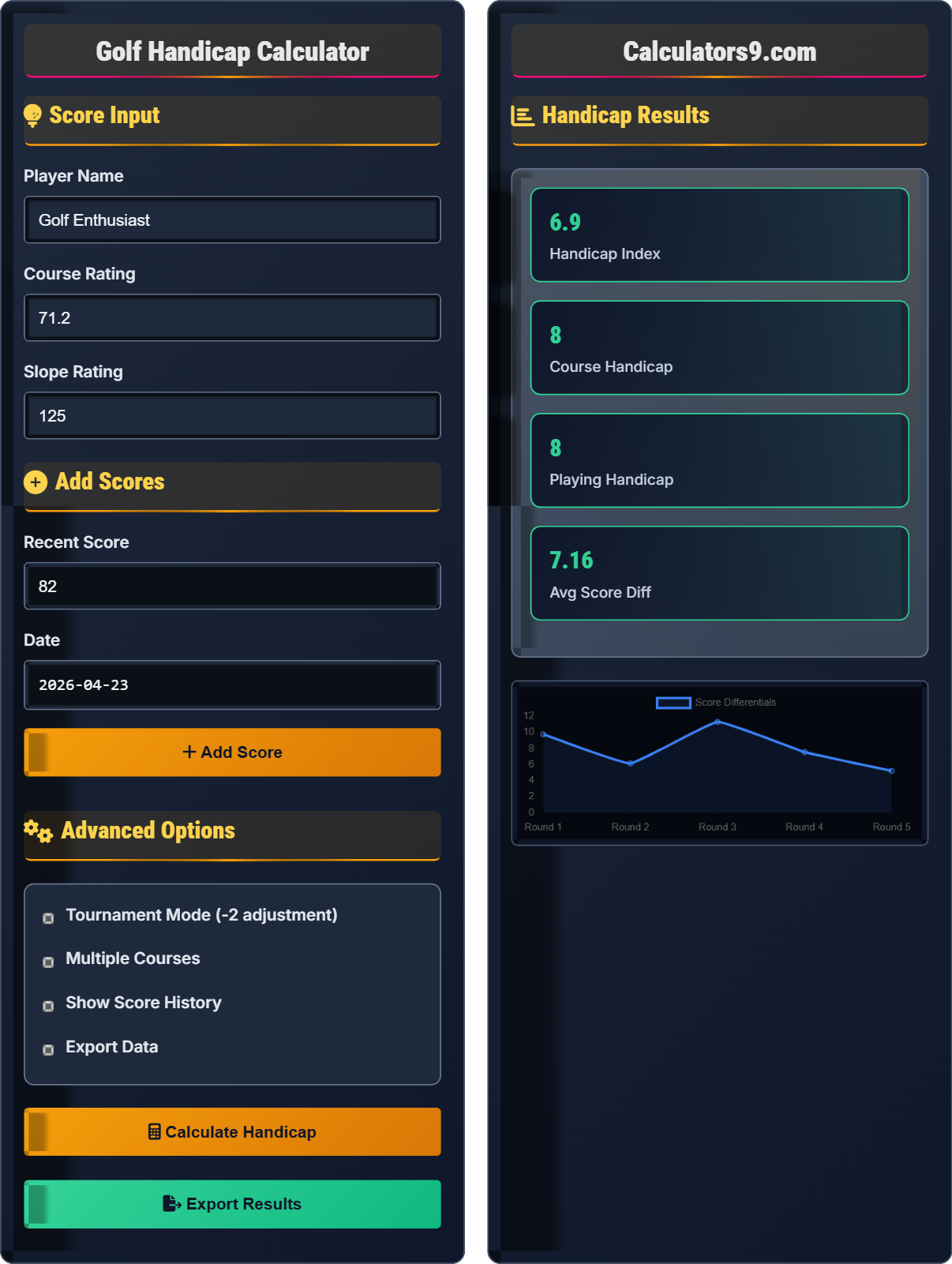
Example: For a score of 82 on a course rated 71.2 with slope 125:
Score Differential = (82 - 71.2) × 113 ÷ 125 = 9.75
With multiple rounds, the lowest differentials are averaged and multiplied by 0.96 to get your Handicap Index.
Score Input
Add Scores
Advanced Options
Handicap Results
| Date | Score | Rating | Slope | Diff |
|---|
| Round | Score | Differential | Used |
|---|
No history available yet.
USGA Handicap System Guide
A golf handicap is a numerical measure of a golfer's potential ability, allowing players of different skill levels to compete fairly against each other. The USGA Handicap System calculates your Handicap Index based on your recent scores, adjusted for course difficulty.
The USGA Handicap Index is calculated using two main formulas:
Where:
- Adjusted Gross Score: Your score adjusted for maximum hole scores (typically double bogey)
- Course Rating: Expected score for a scratch golfer on that course
- Slope Rating: Difficulty measure for bogey golfers (range 55-155)
- 113: Standard slope rating baseline
- 0.96: Bonus for Excellence factor
There are three main types of handicaps:
- Handicap Index: Your portable handicap that travels with you to any course
- Course Handicap: Adjusted for specific course difficulty
- Playing Handicap: Adjusted for tournament play or format
- Post scores regularly: More scores = more accurate index
- Play different courses: Expose your index to various difficulties
- Use maximum scores: Apply Equitable Stroke Control (ESC)
- Monitor trends: Track improvement over time
- Update regularly: Handicaps adjust after each qualifying round
Handicap Basics
A numerical representation of a golfer's potential ability, calculated from recent scores and course ratings.
Score Differential = (Adjusted Score - Course Rating) × 113 ÷ Slope Rating
Index = (Lowest Differentials ÷ Count) × 0.96
- Uses 8 best of 20 most recent rounds
- Bonus for Excellence factor: 0.96
- Minimum 5 rounds for official index
Scoring Rules
Maximum hole scores based on Course Handicap: Double Bogey for most players.
- Course Handicap 9 or less: Maximum double bogey
- Course Handicap 10-19: Maximum triple bogey
- Course Handicap 20-29: Maximum quadruple bogey
- Course Handicap 30+: Maximum quintuple bogey
- Must be from authorized competitions
- At least 7 holes for 9-hole rounds
- At least 13 holes for 18-hole rounds
- Must meet USGA playing conditions
Golf Handicap Learning Quiz
What is the correct formula for calculating a Score Differential in the USGA Handicap System?
The answer is B) (Adjusted Gross Score - Course Rating) × 113 ÷ Slope Rating. This is the official USGA formula for calculating score differentials. The formula compares your performance relative to the course difficulty and normalizes it to a standard slope rating of 113.
The score differential measures how many strokes above or below the course rating your score was, adjusted for the course's difficulty. The subtraction shows your performance relative to the scratch golfer's expected score, then the multiplication by 113 and division by slope rating standardizes the differential across different course difficulties.
Score Differential: Measurement of your performance relative to course difficulty
Course Rating: Expected score of a scratch golfer on a particular course
Slope Rating: Measure of course difficulty for bogey golfers compared to scratch golfers
• Score differential measures performance relative to course difficulty
• Higher differentials indicate poorer performance
• Lower differentials indicate better performance
• Remember: (Score - Rating) × 113 ÷ Slope
• Think of it as "how much worse/better than scratch did I play?"
• The 113 standardizes all courses to the same baseline
• Reversing the order of subtraction (score minus rating, not rating minus score)
• Forgetting to divide by slope rating
• Not using adjusted gross score (applying ESC limits)
Calculate the Score Differential for a golfer who shot 85 on a course rated 72.0 with a slope rating of 130. Show your work.
Using the formula: Score Differential = (Adjusted Gross Score - Course Rating) × 113 ÷ Slope Rating
Given:
- Adjusted Gross Score = 85
- Course Rating = 72.0
- Slope Rating = 130
Step 1: Calculate difference = 85 - 72.0 = 13.0
Step 2: Multiply by 113 = 13.0 × 113 = 1,469
Step 3: Divide by slope = 1,469 ÷ 130 = 11.3
The Score Differential is 11.3
This calculation shows that the golfer scored 13 strokes over the course rating, which is then adjusted for the course's difficulty. On a more difficult course (higher slope), the same raw score results in a lower differential. This ensures fair comparisons across different courses.
Adjusted Gross Score: Your actual score with maximum hole scores applied
Course Rating: Expected score for a scratch golfer
Slope Rating: Measure of difficulty for bogey golfers (55-155 scale)
• Always use Adjusted Gross Score, not raw score
• Higher slope ratings result in lower differentials
• Course rating represents scratch golfer's expected score
• Higher scores produce higher differentials
• Harder courses (higher slope) reduce differentials
• Practice with different course ratings and slopes
• Using raw score instead of adjusted gross score
• Dividing by slope instead of multiplying by 113 first
• Reversing the subtraction order
A golfer has submitted 10 rounds with the following score differentials: 12.1, 11.5, 13.2, 10.8, 14.3, 11.9, 12.7, 10.2, 13.8, 12.4. If the USGA system uses the 5 best differentials out of 10, what is their Handicap Index? (Remember the 0.96 factor)
Step 1: Sort the differentials from lowest to highest: 10.2, 10.8, 11.5, 11.9, 12.1, 12.4, 12.7, 13.2, 13.8, 14.3
Step 2: Select the 5 best (lowest) differentials: 10.2, 10.8, 11.5, 11.9, 12.1
Step 3: Calculate average: (10.2 + 10.8 + 11.5 + 11.9 + 12.1) ÷ 5 = 56.5 ÷ 5 = 11.3
Step 4: Apply Bonus for Excellence: 11.3 × 0.96 = 10.848
Step 5: Round to 1 decimal place: 10.8
The Handicap Index is 10.8
The USGA system rewards consistent good play by using only the best differentials and applying the 0.96 factor. This means even if you have some poor rounds mixed in, your index reflects your potential rather than your average play. The system is designed to encourage golfers to continue improving.
Handicap Index: Portable handicap that travels with you to any course
Bonus for Excellence: Factor of 0.96 that rewards good play
Best Differentials: The lowest differentials from your most recent rounds
• Uses the best differentials, not the average
• Always applies the 0.96 Bonus for Excellence factor
• Rounds to 1 decimal place
• Keep track of your best rounds
• Consistent play leads to stable handicaps
• The system favors your better performances
• Using all differentials instead of best ones
• Forgetting the 0.96 factor
• Rounding too early in the calculation
A golfer has a Handicap Index of 15.2 and is playing at a course with a slope rating of 128. What is their Course Handicap? Also, if they're playing in a tournament where a -2 adjustment is applied, what is their Playing Handicap?
Step 1: Calculate Course Handicap
Course Handicap = Handicap Index × Slope Rating ÷ 113
Course Handicap = 15.2 × 128 ÷ 113 = 1,945.6 ÷ 113 = 17.2, rounded to 17
Step 2: Calculate Playing Handicap for tournament
Playing Handicap = Course Handicap - Tournament Adjustment
Playing Handicap = 17 - 2 = 15
Therefore, the Course Handicap is 17 and the Playing Handicap is 15.
The Course Handicap adjusts your portable Handicap Index to the specific course you're playing. The formula accounts for the course's difficulty relative to the standard (slope rating of 113). Tournament adjustments further modify your effective handicap to create more equitable competition.
Course Handicap: Your handicap adjusted for specific course difficulty
Playing Handicap: Your effective handicap for tournament play
Tournament Adjustment: Modifications made for competitive equity
• Course Handicap = Index × Slope ÷ 113
• Always round Course Handicap to nearest whole number
• Tournament adjustments can vary by event
• Higher slope ratings increase your Course Handicap
• Lower slope ratings decrease your Course Handicap
• Always verify tournament adjustments before play
• Forgetting to divide by 113 in the formula
• Not rounding Course Handicap to whole number
• Confusing Handicap Index with Course Handicap
According to Equitable Stroke Control (ESC), what is the maximum score a player with a Course Handicap of 15 can post on any hole?
The answer is C) Par + 3 (triple bogey). According to USGA ESC guidelines, for a Course Handicap of 10-19, the maximum score per hole is triple bogey (Par + 3). ESC prevents extremely high scores from skewing a player's handicap index unfairly.
Equitable Stroke Control (ESC) is a critical rule that maintains the integrity of the handicap system. It ensures that exceptional bad holes don't disproportionately affect a player's index. The ESC limits are tiered based on Course Handicap to account for different skill levels.
Equitable Stroke Control (ESC): Rule limiting maximum hole scores for handicap purposes
Course Handicap: Your handicap adjusted for specific course difficulty
Handicap Integrity: Maintaining fair and accurate handicap measurements
• Course Handicap 9 or less: Max double bogey (Par + 2)
• Course Handicap 10-19: Max triple bogey (Par + 3)
• Course Handicap 20-29: Max quadruple bogey (Par + 4)
• Know your ESC limit before starting your round
• Post your ESC-adjusted score, not your actual score
• ESC prevents outlier scores from affecting your index
• Posting actual hole scores instead of ESC-limited scores
• Not knowing your ESC limit based on Course Handicap
• Confusing ESC with maximum net scores
FAQ
Q: How does the USGA Handicap System reward good play?
A: The USGA Handicap System rewards good play through two mechanisms:
1. Bonus for Excellence: The 0.96 factor applied to the average of your best score differentials
2. Selective Averaging: Only using your best differentials rather than all scores
For example, if a golfer's five best score differentials average to 12.0, their Handicap Index becomes 12.0 × 0.96 = 11.5. This system recognizes that golfers typically perform better than their average, especially in competitive situations.
Q: What's the difference between Course Handicap and Playing Handicap?
A: The Course Handicap and Playing Handicap serve different purposes:
Course Handicap: Adjusts your Handicap Index to the specific course you're playing, using the formula: Handicap Index × Slope Rating ÷ 113. This tells you how many strokes you receive on that particular course.
Playing Handicap: Further adjusts your Course Handicap for specific playing conditions, tournaments, or formats. For example, in a tournament with a -2 adjustment, if your Course Handicap is 17, your Playing Handicap becomes 15.
Formula: Playing Handicap = Course Handicap ± Tournament Adjustment