One Rep Max Calculator
Strength training • Workout planning • Fitness calculator
1RM Calculation Formulas:
Show the calculator\( \text{1RM} = \frac{\text{Weight Lifted}}{1.0278 - (0.0278 \times \text{Reps})} \) (Brzycki Formula)
\( \text{1RM} = \text{Weight} \times (1 + 0.0333 \times \text{Reps}) \) (Epley Formula)
\( \text{1RM} = \frac{\text{Weight}}{1.013 - (0.0267123 \times \text{Reps})} \) (McGlothin Formula)
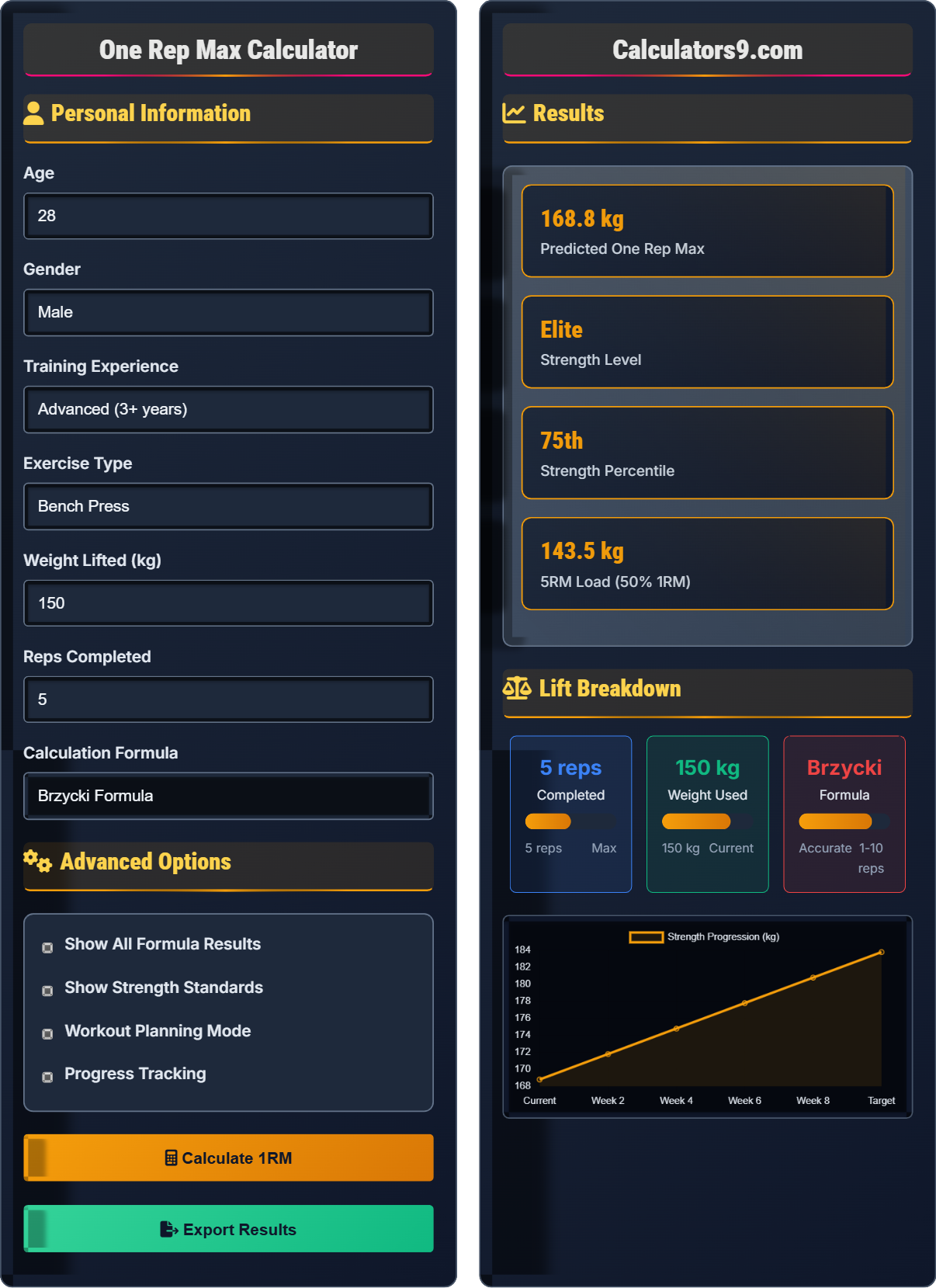
For a 150kg lift for 5 reps:
Brzycki: 150 ÷ (1.0278 - (0.0278 × 5)) = 150 ÷ 0.8888 = 168.8 kg
Epley: 150 × (1 + (0.0333 × 5)) = 150 × 1.1665 = 175.0 kg
McGlothin: 150 ÷ (1.013 - (0.0267123 × 5)) = 150 ÷ 0.8794 = 170.6 kg
Brzycki formula is most accurate for 1-10 reps.
Personal Information
Advanced Options
Results
Lift Breakdown
Comprehensive 1RM Guide
One Rep Max (1RM) is the maximum amount of weight that can be lifted for one repetition with proper form. It's a fundamental metric in strength training used to determine training loads, track progress, and prescribe workout intensities. 1RM testing should be performed safely with adequate warm-up and preferably with a spotter.
The most commonly used 1RM prediction formulas:
Brzycki formula is most accurate for 1-10 repetitions.
Common training intensity zones based on 1RM:
- 50-60% 1RM: Recovery/technique work (15+ reps)
- 60-70% 1RM: Hypertrophy (8-12 reps)
- 70-80% 1RM: Hypertrophy/strength (6-10 reps)
- 80-90% 1RM: Strength (3-6 reps)
- 90-100% 1RM: Max strength (1-3 reps)
- Progressive Overload: Gradually increase weight, reps, or sets over time
- Consistency: Train regularly with adequate recovery
- Form First: Prioritize proper technique over heavy weights
- Compound Movements: Focus on multi-joint exercises for maximum results
- Periodization: Plan training cycles to avoid plateaus
1RM Basics
Maximum weight lifted for one perfect repetition with proper form
\( \text{Brzycki: } \frac{\text{Weight}}{1.0278 - (0.0278 \times \text{Reps})} \)
Most accurate for 1-10 reps
- Never test 1RM without proper warm-up
- Always use proper form
- Have a spotter for safety
Training Intensity
50-60%: Recovery, 60-70%: Hypertrophy, 70-80%: Strength, 80-90%: Power
- Hypertrophy: 6-12 reps at 65-80% 1RM
- Strength: 3-6 reps at 80-95% 1RM
- Power: 1-5 reps at 85-100% 1RM
- Endurance: 12+ reps at 50-70% 1RM
- Adjust based on training phase
- Consider recovery time
- Periodize training cycles
- Track progress regularly
1RM Learning Quiz
Which 1RM formula is considered most accurate for predicting 1RM when using 1-10 repetitions?
The answer is B) Brzycki Formula. The Brzycki formula is widely regarded as the most accurate for predicting 1RM when using 1-10 repetitions. The formula is: \( \text{1RM} = \frac{\text{Weight}}{1.0278 - (0.0278 \times \text{Reps})} \). This formula accounts for the diminishing returns in strength as rep count increases and provides reliable predictions for submaximal testing.
Different 1RM formulas have varying degrees of accuracy depending on the rep range used. The Brzycki formula was specifically developed to address the non-linear relationship between load and reps. It's particularly accurate in the 1-10 rep range because it properly models the rapid decline in possible load as rep count increases beyond 10.
1RM: One Rep Max - maximum weight for one perfect rep
Submaximal Testing: Estimating 1RM using lighter weights and multiple reps
Formula Accuracy: How closely predicted 1RM matches actual 1RM
• Brzycki is most accurate for 1-10 reps
• Epley tends to overestimate for higher rep ranges
• Different formulas for different rep ranges
• Use 3-8 reps for most accurate 1RM prediction
• Test when fully recovered
• Use consistent form for all attempts
• Using 1RM formulas outside their optimal rep range
• Testing when fatigued or not properly warmed up
• Not considering the limitations of predictive formulas
Calculate the predicted 1RM using the Brzycki formula for a lifter who completed 135kg for 6 reps. Show your work.
Using the Brzycki formula: \( \text{1RM} = \frac{\text{Weight}}{1.0278 - (0.0278 \times \text{Reps})} \)
Given:
- Weight = 135 kg
- Reps = 6
Step 1: Calculate the denominator
Denominator = 1.0278 - (0.0278 × 6) = 1.0278 - 0.1668 = 0.861
Step 2: Divide weight by denominator
1RM = 135 ÷ 0.861 = 156.8 kg
Therefore, the predicted 1RM is 156.8 kg.
This calculation demonstrates how the Brzycki formula accounts for the relationship between load and reps. The formula recognizes that as reps increase, the weight that can be lifted decreases exponentially rather than linearly. This is why 6 reps of 135kg suggests a 1RM of 156.8kg, not simply 135kg + (some linear increment).
Submaximal Testing: Estimating max capacity using submaximal effort
Exponential Relationship: Non-linear relationship between load and reps
Predictive Modeling: Using mathematical formulas to estimate max capacity
• Follow order of operations (multiply first, then subtract)
• Denominator cannot be zero or negative
• Formula is most accurate for 1-10 reps
• Use calculator for complex divisions
• Check that denominator is positive
• Round to reasonable precision (0.1 kg)
• Incorrect order of operations in formula
• Forgetting to multiply reps by 0.0278 first
• Using formula outside optimal rep range
Sarah has a predicted 1RM of 100kg on the bench press. She wants to train in the hypertrophy zone (70-80% of 1RM). Calculate the weight range she should use for her hypertrophy-focused training. Also, determine how many reps she could likely perform with 80% of her 1RM.
Step 1: Calculate 70% of 1RM
70% of 100kg = 100 × 0.70 = 70 kg
Step 2: Calculate 80% of 1RM
80% of 100kg = 100 × 0.80 = 80 kg
Step 3: Determine rep range for 80kg
Using the inverse of the Brzycki formula: Reps ≈ (1.0278 - Weight/1RM)/0.0278
Reps ≈ (1.0278 - 80/100)/0.0278 = (1.0278 - 0.80)/0.0278 = 0.2278/0.0278 ≈ 8.2 reps
Sarah should use 70-80 kg for hypertrophy training and could likely perform 6-10 reps with 80kg.
This problem demonstrates how 1RM values are used to plan training intensities. The hypertrophy zone (70-80% 1RM) corresponds to 6-12 reps for most trained individuals. Understanding these relationships helps structure effective training programs. The calculation shows that 80% of 1RM allows for approximately 8 reps, which falls within the hypertrophy range.
Hypertrophy Zone: 70-80% 1RM for muscle growth
Training Intensity: Percentage of 1RM used in training
Rep Range: Number of repetitions performed per set• Hypertrophy: 6-12 reps at 70-80% 1RM
• Strength: 3-6 reps at 80-95% 1RM
• Adjust based on training goals
• Use 1RM to set training loads systematically
• Periodize intensity throughout training cycles
• Track 1RM progression over time
• Using too heavy weights for intended rep range
• Not adjusting loads as 1RM improves
• Confusing intensity zones and rep ranges
Mike is preparing for a powerlifting competition in 12 weeks. His current 1RM is 200kg on the squat. He plans a periodized program with 4-week blocks: strength (85-90% 1RM), hypertrophy (70-80% 1RM), peaking (90-95% 1RM), and competition. Calculate the training weights for each phase. If he improves his 1RM by 5% during the program, what would his new competition weights be?
Current 1RM: 200kg
Strength Phase (85-90%):
Lower range: 200 × 0.85 = 170kg
Upper range: 200 × 0.90 = 180kg
Range: 170-180kg (approximately 3-5 reps)
Hypertrophy Phase (70-80%):
Lower range: 200 × 0.70 = 140kg
Upper range: 200 × 0.80 = 160kg
Range: 140-160kg (approximately 6-12 reps)
Peaking Phase (90-95%):
Lower range: 200 × 0.90 = 180kg
Upper range: 200 × 0.95 = 190kg
Range: 180-190kg (approximately 1-3 reps)
If 1RM improves by 5%: New 1RM = 200 × 1.05 = 210kg
Competition attempt could be around 210kg (100% 1RM).
This problem demonstrates how 1RM values guide periodized training programs. The systematic approach of varying intensity and volume over time helps prevent plateaus and optimizes performance. The calculation shows how training loads are adjusted based on the athlete's current capacity and how improvements in 1RM affect subsequent training phases.
Periodization: Systematic variation of training variables over time
Peaking: Training phase to optimize performance for competition
Training Blocks: Organized periods of focused training adaptations
• Adjust training loads as 1RM improves
• Include deload periods to prevent overtraining
• Plan peaking phase before competitions
• Test 1RM regularly to update training loads
• Plan training cycles around competition dates
• Include recovery weeks in programming
• Using outdated 1RM values for training loads
• Not planning for progressive overload
• Skipping recovery periods in programming
What is the most important safety consideration when testing or training near 1RM?
The answer is B) Having a qualified spotter present. When testing or training near 1RM, having a qualified spotter is the most critical safety measure. A spotter can assist with the lift if form breaks down, prevent injury from failed lifts, and provide encouragement. This is especially important for exercises like bench press, squat, and overhead press where the lifter cannot safely rack the weight independently.
Safety should always be the priority in strength training, especially when approaching maximum loads. A qualified spotter not only prevents potentially serious injuries but also allows the lifter to push harder knowing help is available. The spotter should be experienced, attentive, and positioned appropriately for the specific exercise being performed.
Spotter: Person who assists and ensures safety during lifts
Safety Protocols: Procedures to prevent injury during training
Qualified Spotter: Experienced person who understands proper spotting technique
• Never attempt 1RM without proper warm-up
• Always use spotters for upper body lifts
• Use safety equipment (power rack, safety pins)
• Use power racks with safety pins for squats and bench
• Ensure spotter knows when to assist
• Start conservatively when testing
• Attempting max lifts without a spotter
• Inadequate warm-up before testing
• Ignoring warning signs of fatigue
FAQ
Q: How often should I test my 1RM?
A: Test 1RM every 8-12 weeks for most lifters. For example, if our calculator shows a 1RM of 168.8 kg for a 150kg lift at 5 reps, you might test again in 8-10 weeks to see if you can lift 170-175 kg for 1 rep. Frequent testing can interfere with training adaptations and increase injury risk. However, submaximal testing (like 3-5RM) can be done more frequently to track progress.
Beginners might test more frequently (every 4-6 weeks) as they adapt quickly, while advanced lifters typically test less often (every 12-16 weeks) due to slower progress rates and higher injury risk at maximum loads.
Q: Is it safe to guess my 1RM without actually testing it?
A: Yes, using predictive formulas is safer than attempting actual 1RM tests, especially for beginners. Our calculator uses formulas like Brzycki: \( \text{1RM} = \frac{\text{Weight}}{1.0278 - (0.0278 \times \text{Reps})} \). For example, if you can lift 100kg for 8 reps, the predicted 1RM would be 100 ÷ (1.0278 - (0.0278 × 8)) = 100 ÷ 0.8054 = 124.2 kg.
Predictive formulas allow you to estimate your strength level safely while avoiding the risks associated with maximal testing. However, keep in mind that predictions become less accurate at very high rep ranges (>10 reps) or for untrained individuals.