Target Heart Rate Calculator
Cardio training zones • Heart rate monitoring • Fitness calculator
Heart Rate Calculation Formulas:
Show the calculator\( \text{Max HR} = 220 - \text{Age} \) (Traditional Formula)
\( \text{Max HR} = 208 - (0.7 \times \text{Age}) \) (Tanaka Formula - More Accurate)
\( \text{Target HR} = \text{Resting HR} + (\text{Max HR} - \text{Resting HR}) \times \text{Intensity} \)
Heart Rate Zones:
- Zone 1 (50-60%): Very light activity, warm-up/cool-down
- Zone 2 (60-70%): Light activity, fat burning
- Zone 3 (70-80%): Moderate activity, aerobic base
- Zone 4 (80-90%): Hard activity, anaerobic threshold
- Zone 5 (90-100%): Maximum effort, VO2 max
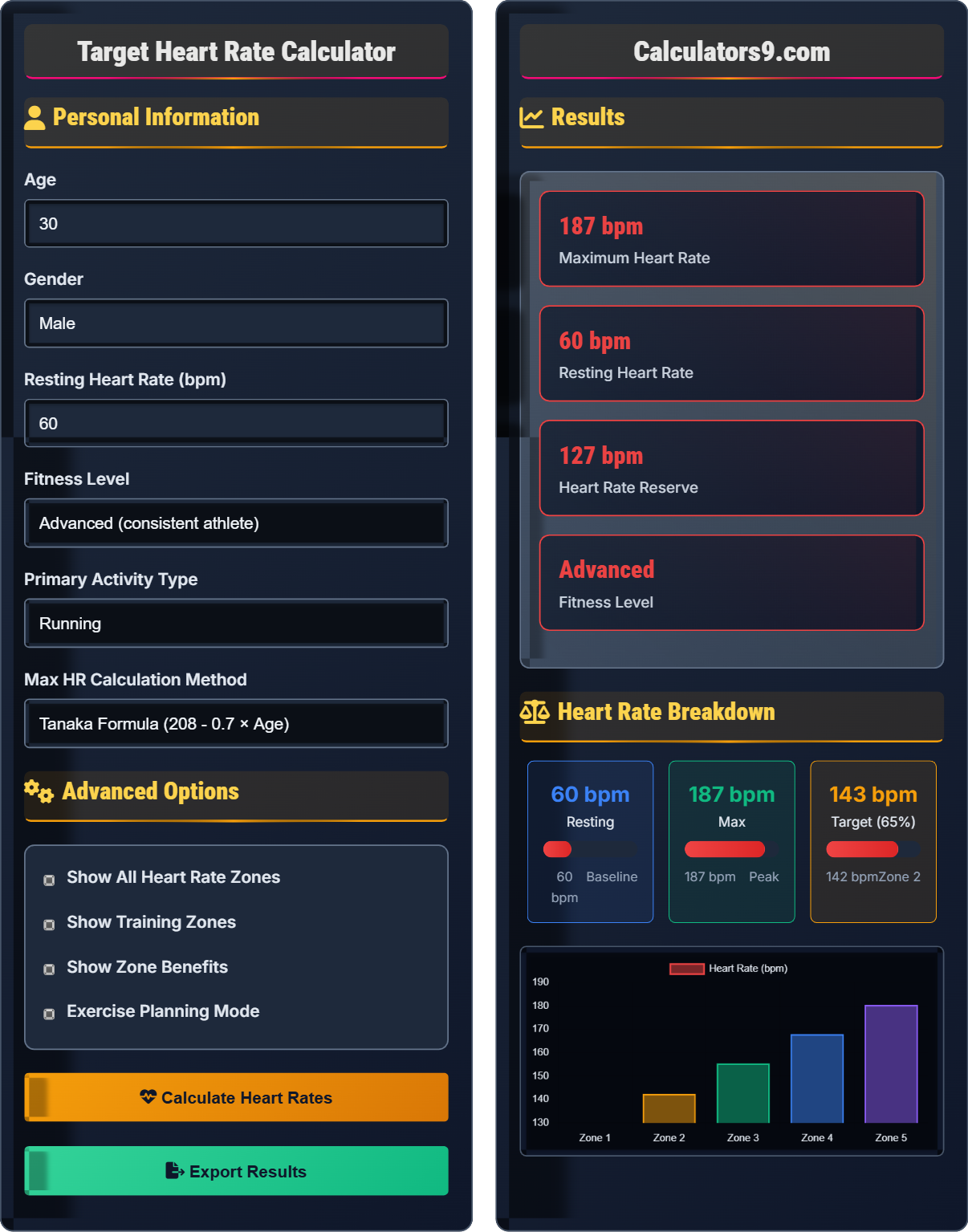
Example: 30-year-old with 60 bpm resting HR
Max HR: 208 - (0.7 × 30) = 187 bpm
Zone 2: 60 + (187-60) × 0.65 = 142 bpm (65% intensity)
Personal Information
Advanced Options
Results
Heart Rate Breakdown
Comprehensive Heart Rate Guide
Target heart rate is the optimal range of beats per minute that your heart should aim for during exercise. It's expressed as a percentage of your maximum heart rate and helps ensure you're exercising at the right intensity to achieve your fitness goals. Monitoring heart rate helps prevent overexertion and ensures effective training.
The most accurate heart rate formulas:
Heart Rate Reserve accounts for individual differences in resting heart rate.
Benefits by training zone:
- Zone 1-2: Improves aerobic capacity, burns fat, builds endurance base
- Zone 3: Enhances aerobic power, increases lactate threshold
- Zone 4: Improves anaerobic capacity, increases lactate clearance
- Zone 5: Develops VO2 max, increases speed and power
- Combination: Periodization with multiple zones yields best results
- Resting HR: Measure first thing in the morning after waking
- Consistency: Use the same measurement method each time
- Hydration: Stay hydrated as dehydration affects HR
- Environment: Consider temperature and humidity effects
- Recovery: Monitor HR recovery post-exercise for fitness assessment
Heart Rate Basics
Beats per minute (bpm) at rest and during exercise
\( \text{Max HR} = 208 - (0.7 \times \text{Age}) \)
\( \text{Target HR} = \text{Resting HR} + (\text{Max HR} - \text{Resting HR}) \times \text{Intensity} \)
- Max HR decreases with age
- Resting HR indicates fitness level
- Target zones optimize training
Training Zones
Zone 1: 50-60%, Zone 2: 60-70%, Zone 3: 70-80%, Zone 4: 80-90%, Zone 5: 90-100%
- Zone 1-2: 70% of training time
- Zone 3: 20% of training time
- Zone 4-5: 10% of training time
- Periodize across zones
- Adjust for fitness level
- Consider activity type
- Monitor recovery
- Track progress over time
Heart Rate Learning Quiz
Which heart rate zone is most beneficial for improving aerobic capacity and endurance base?
The answer is C) Zone 3 (70-80%). Zone 3, also known as the aerobic capacity zone, is most effective for improving aerobic power and building endurance base. Training in this zone increases stroke volume, capillary density, and mitochondrial function. While Zone 2 is important for fat burning and recovery, Zone 3 specifically targets aerobic capacity improvements.
Heart rate zones serve specific physiological adaptations. Zone 3 (70-80% max HR) is the sweet spot for aerobic capacity development. It's intense enough to stimulate improvements in cardiac output and oxygen utilization while remaining sustainable for extended periods. This zone balances stress and recovery effectively for aerobic adaptations.
Aerobic Capacity: Ability to utilize oxygen for energy production
Stroke Volume: Amount of blood pumped per heartbeat
Heart Rate Reserve: Difference between max and resting HR
• Zone 3: 70-80% max HR for aerobic capacity
• Zone 2: 60-70% max HR for fat burning
• Zone 4: 80-90% max HR for anaerobic threshold
• Spend 70% of training in Zones 1-2
• Use 20% for Zone 3
• Limit Zone 4-5 to 10%
• Training too hard too often
• Not utilizing lower zones enough
• Confusing intensity zones
Calculate the target heart rate for a 35-year-old with a resting heart rate of 58 bpm exercising at 75% intensity. Use the Tanaka formula for maximum heart rate. Show your work.
Step 1: Calculate maximum heart rate using Tanaka formula
Max HR = 208 - (0.7 × Age) = 208 - (0.7 × 35) = 208 - 24.5 = 183.5 bpm
Step 2: Calculate heart rate reserve
HRR = Max HR - Resting HR = 183.5 - 58 = 125.5 bpm
Step 3: Calculate target heart rate
Target HR = Resting HR + (HRR × Intensity) = 58 + (125.5 × 0.75) = 58 + 94.125 = 152.125 bpm
Therefore, the target heart rate is approximately 152 bpm at 75% intensity.
This calculation demonstrates the heart rate reserve method, which accounts for individual differences in resting heart rate. The formula (Resting HR + HRR × Intensity) ensures that training zones are personalized. The Tanaka formula (208 - 0.7 × Age) is more accurate than the traditional 220 - Age formula, especially for older adults.
Heart Rate Reserve (HRR): Max HR minus Resting HR
Target Heart Rate: Desired HR during exercise
Tanaka Formula: More accurate max HR calculation
• Use HRR method for personalized zones
• Tanaka formula: 208 - 0.7 × Age
• Target HR = Resting HR + (HRR × Intensity)
• Measure resting HR in morning after waking
• Use heart rate monitor for accuracy
• Adjust for environmental conditions
• Forgetting to subtract resting HR in HRR calculation
• Using incorrect max HR formula
• Not accounting for individual fitness level
Sarah is a recreational runner preparing for her first half-marathon. She wants to improve her aerobic endurance. Based on her calculated maximum heart rate of 185 bpm and resting heart rate of 60 bpm, what heart rate zone should she primarily train in, and what is the corresponding heart rate range? How long should she spend in this zone during each training session?
Step 1: Calculate heart rate reserve
HRR = Max HR - Resting HR = 185 - 60 = 125 bpm
Step 2: Determine appropriate zone for aerobic endurance
Zone 2 (60-70%) is optimal for aerobic endurance building
Step 3: Calculate heart rate range for Zone 2
Lower bound: 60 + (125 × 0.60) = 60 + 75 = 135 bpm
Upper bound: 60 + (125 × 0.70) = 60 + 87.5 = 147.5 bpm
Step 4: Recommended duration
For aerobic endurance: 30-60 minutes per session
Sarah should train in Zone 2 (135-148 bpm) for 30-60 minutes per session.
Zone 2 training is ideal for building aerobic endurance because it stimulates mitochondrial biogenesis and capillary density without excessive stress. This zone allows for longer training sessions while still providing adequate stimulus for endurance adaptations. For a half-marathon goal, spending 70-80% of training time in Zones 1-2 builds the necessary aerobic base.
Aerobic Endurance: Ability to sustain moderate exercise
Zone 2 Training: Light to moderate intensity
Training Base: Foundation of aerobic fitness
• Zone 2: 60-70% max HR for endurance
• 70% of training in Zones 1-2
• Build base before intensity work
• Maintain conversational pace in Zone 2
• Gradually increase duration
• Monitor heart rate consistency
• Training too hard during base building
• Not spending enough time in low zones
• Ignoring recovery in training plan
Michael is an intermediate cyclist preparing for a century ride (100 miles). His calculated maximum heart rate is 180 bpm and resting heart rate is 55 bpm. He wants to include anaerobic threshold training to improve his performance. Calculate the target heart rate zone for threshold training (Zone 4) and explain the benefits and duration for this type of training.
Step 1: Calculate heart rate reserve
HRR = Max HR - Resting HR = 180 - 55 = 125 bpm
Step 2: Calculate Zone 4 (80-90%) range
Lower bound: 55 + (125 × 0.80) = 55 + 100 = 155 bpm
Upper bound: 55 + (125 × 0.90) = 55 + 112.5 = 167.5 bpm
Step 3: Benefits of Zone 4 training
Improves lactate threshold, increases anaerobic capacity, enhances race performance
Step 4: Recommended duration
15-30 minutes per session, 1-2 times per week
Michael should train in Zone 4 (155-168 bpm) for 15-30 minutes, 1-2 times weekly.
Zone 4 training targets the anaerobic threshold, the point where lactate begins to accumulate faster than it can be cleared. Training at this intensity improves the body's ability to buffer lactate and increases the pace that can be sustained for longer periods. For a century ride, improving threshold pace allows Michael to maintain a higher sustainable speed.
Anaerobic Threshold: Point where lactate accumulation exceeds clearance
Lactate Buffering: Body's ability to manage lactate production
Zone 4 Training: Hard intensity work at threshold
• Zone 4: 80-90% max HR
• Limited to 10% of total training
• Requires adequate recovery
• Use RPE scale to complement HR data
• Plan recovery days after threshold sessions
• Monitor HR drift during sessions
• Too much high-intensity training
• Insufficient recovery between sessions
• Not balancing with base training
What does a low resting heart rate (under 60 bpm) typically indicate about a person's fitness level?
The answer is B) Excellent cardiovascular fitness. A low resting heart rate (under 60 bpm) typically indicates excellent cardiovascular fitness. This condition, called bradycardia in athletes, occurs because a well-conditioned heart can pump more blood per beat (increased stroke volume), requiring fewer beats per minute to maintain adequate circulation. Elite athletes often have resting heart rates in the 40-60 bpm range.
Resting heart rate is an excellent indicator of cardiovascular fitness. As fitness improves, the heart becomes more efficient, pumping more blood per contraction. This adaptation, called athletic bradycardia, is a sign of positive cardiovascular adaptation to training. However, sudden drops in resting HR or symptoms accompanying low HR warrant medical evaluation.
Bradycardia: Slow heart rate (under 60 bpm)
Stroke Volume: Blood pumped per heartbeat
Cardiac Efficiency: Heart's effectiveness at pumping blood
• Lower resting HR = Better fitness (generally)
• Normal range: 60-100 bpm
• Athletes: Often 40-60 bpm
• Track resting HR trends over time
• Consider context (stress, illness, etc.)
• Consult doctor if unusual symptoms
• Confusing athletic bradycardia with pathology
• Not considering individual variations
• Ignoring other health indicators
FAQ
Q: How accurate are heart rate calculations versus actual measurements?
A: Heart rate calculations are estimates with inherent variability. The Tanaka formula (208 - 0.7 × age) is more accurate than the traditional 220 - age formula, with typical accuracy within 10-15 bpm. For example, our calculator shows a 30-year-old with 60 bpm resting HR has a max HR of 187 bpm (208 - 0.7 × 30). Actual max HR testing would provide the most accurate value.
Individual factors like genetics, medications, fitness level, and health conditions affect heart rate responses. The formulas provide good starting points, but actual heart rate should be monitored during exercise for precise training zones.
Q: Should I always exercise in my target heart rate zone?
A: No, you shouldn't always exercise in the same heart rate zone. Effective training requires periodization across multiple zones. For example, if our calculator shows your Zone 2 is 112-125 bpm, you might spend 70% of training time here, but also include Zone 1 for recovery (94-112 bpm) and Zone 3 for capacity building (125-138 bpm).
A typical distribution might be: 70% in Zones 1-2, 20% in Zone 3, 10% in Zones 4-5. This approach maximizes adaptations while preventing overtraining. The key is matching intensity to your specific training goals for each session.