Sleep Calculator
Optimal Sleep Schedule • 2026 Edition
Sleep Cycle Formula:
Calculate NowBedtime = Wake Time - (Sleep Cycles × 90 minutes)
Wake Time = Bedtime + (Sleep Cycles × 90 minutes)
Where:
- Sleep Cycles: Complete sleep phases (typically 4-6 cycles per night)
- Cycle Length: 90 minutes (average for complete sleep phase)
- REM Sleep: Occurs during 20-25% of sleep cycle
- Deep Sleep: Occurs during 15-20% of sleep cycle
Example: For 7.5 hours of sleep (5 cycles):
If wake time is 7:00 AM: Bedtime = 7:00 AM - (5 × 90 min) = 11:30 PM
This allows for complete sleep cycles and optimal rest. Waking during light sleep phases (between cycles) results in feeling refreshed.
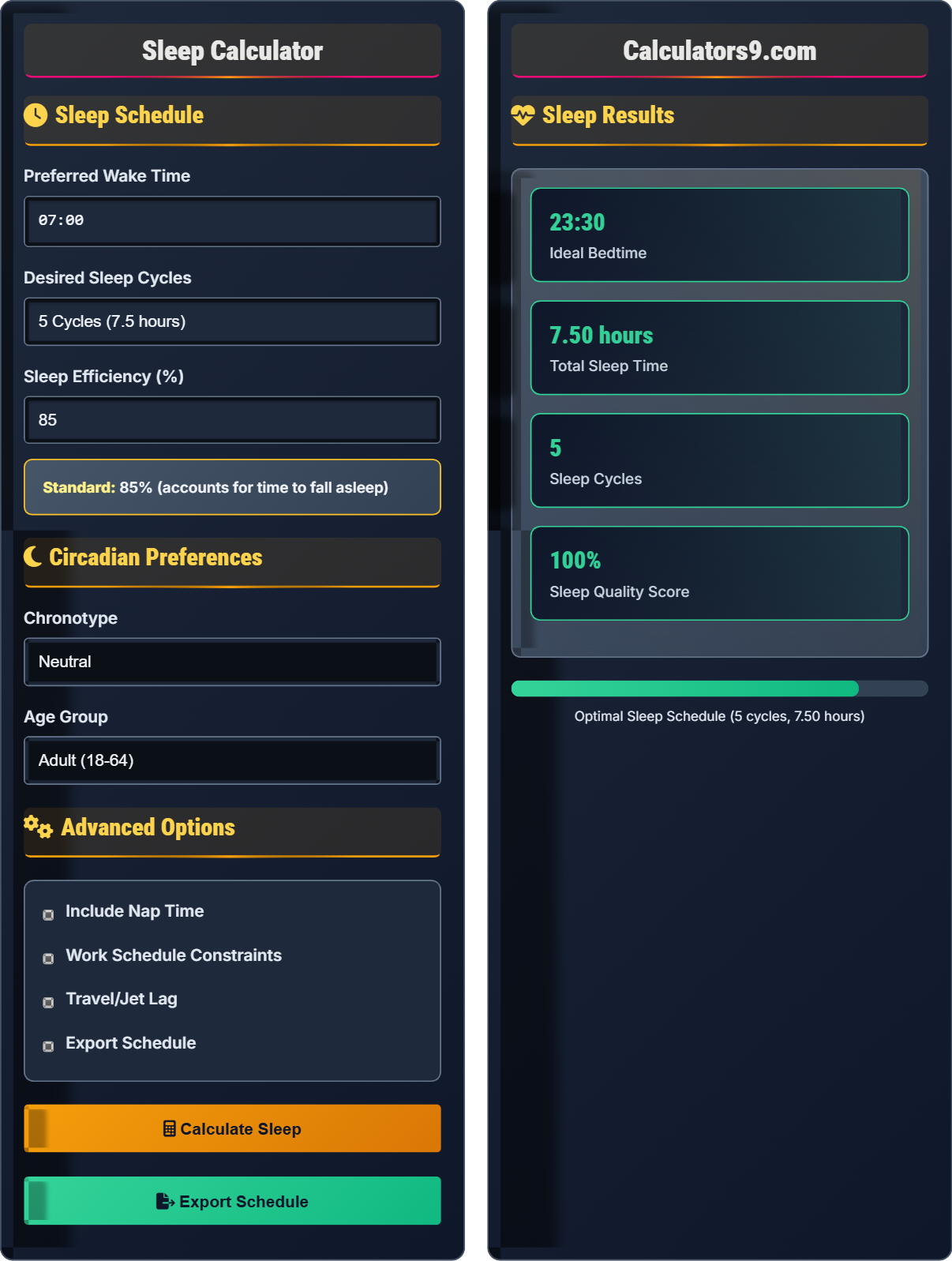
Sleep Schedule
Circadian Preferences
Advanced Options
Sleep Results
Bedtime: 11:30 PM
Wake Time: 7:00 AM
Total Sleep: 7.5 hours
Option 1: 11:00 PM (6 cycles, 9 hours)
Option 2: 12:00 AM (4.5 cycles, 6.75 hours)
Option 3: 10:45 PM (5.25 cycles, 7.875 hours)
| Parameter | Value | Recommendation | Quality |
|---|---|---|---|
| Bedtime | 11:30 PM | Before 12:00 AM | Optimal |
| Sleep Cycles | 5 | 4-6 cycles | Excellent |
| Efficiency | 85% | ≥80% | Good |
Each cycle: ~90 minutes
5 cycles = 450 minutes (7.5 hours)
Light Sleep: 20-25 minutes
Deep Sleep: 15-20 minutes
REM Sleep: 15-20 minutes
Transition: 20-25 minutes
| Cycle | Time | Phases | Importance |
|---|---|---|---|
| 1 | 11:30 PM - 1:00 AM | Deep Sleep | Physical Recovery |
| 2 | 1:00 AM - 2:30 AM | REM Sleep | Memory Consolidation |
| 3 | 2:30 AM - 4:00 AM | Deep Sleep | Physical Recovery |
| 4 | 4:00 AM - 5:30 AM | REM Sleep | Dream Processing |
| 5 | 5:30 AM - 7:00 AM | Light Sleep | Natural Awakening |
20-25% of total sleep
Transition phase, easily awakened
15-20% of total sleep
Physical restoration, immune function
20-25% of total sleep
Dreaming, memory consolidation
Sleep Cycle Science Guide
Human sleep occurs in cycles of approximately 90 minutes each. Each cycle contains different sleep phases: light sleep, deep sleep, and REM (Rapid Eye Movement) sleep. Completing full cycles is essential for optimal rest and recovery.
Optimal sleep timing is calculated based on 90-minute sleep cycles:
Where:
- Sleep Cycles: Complete sleep phases (typically 4-6 per night)
- Cycle Length: Average 90 minutes per complete phase
- Optimal: 5-6 cycles for most adults (7.5-9 hours)
Sleep needs vary by age group:
- Newborns (0-3 months): 14-17 hours
- Infants (4-11 months): 12-15 hours
- Toddlers (1-2 years): 11-14 hours
- Preschool (3-5 years): 10-13 hours
- School Age (6-13 years): 9-11 hours
- Teenagers (14-17 years): 8-10 hours
- Young Adults (18-25 years): 7-9 hours
- Adults (26-64 years): 7-9 hours
- Seniors (65+ years): 7-8 hours
- Maintain schedule: Consistent bedtime and wake time
- Create environment: Cool, dark, quiet bedroom
- Limit screens: Avoid devices 1 hour before bed
- Watch diet: Avoid caffeine 6 hours before bed
- Relax routine: Develop calming pre-sleep activities
- Exercise regularly: But not close to bedtime
Sleep Basics
Approximately 90-minute periods containing different sleep phases.
Bedtime = Wake Time - (Cycles × 90 min)
Optimal: 5-6 cycles for adults
- Complete cycles improve sleep quality
- 5-6 cycles = 7.5-9 hours
- Waking during light sleep feels better
Sleep Phases
Light, Deep, and REM sleep with different functions.
- Light Sleep: 20-25% (transition)
- Deep Sleep: 15-20% (restoration)
- REM Sleep: 20-25% (memory)
- Deep sleep occurs early in night
- REM sleep increases later
- Each phase serves unique purpose
- Balance is important
Sleep Science Quiz
What is the average length of a complete sleep cycle?
The answer is B) 90 minutes. A complete sleep cycle averages 90 minutes and includes light sleep, deep sleep, and REM sleep phases. This 90-minute pattern repeats throughout the night, with 4-6 cycles occurring during a typical night's sleep.
Understanding sleep cycle length is fundamental to optimizing sleep schedules. The 90-minute cycle allows for complete progression through all sleep phases. Waking at the end of a cycle (during light sleep) results in feeling more refreshed than waking during deep sleep in the middle of a cycle.
Sleep Cycle: Complete progression through sleep phases
REM Sleep: Rapid Eye Movement phase with dreaming
Deep Sleep: Slow-wave sleep for physical restoration
• Average cycle length: 90 minutes
• Complete cycles improve sleep quality
• 4-6 cycles per night is optimal
• Plan sleep in 90-minute increments
• Wake at cycle completion for better feeling
• 5 cycles = 7.5 hours optimal sleep
• Not accounting for complete cycles
• Waking during deep sleep phases
• Ignoring 90-minute rhythm
Calculate the ideal bedtime for someone who wants to wake at 7:00 AM and get 5 complete sleep cycles. Show your work.
Using the formula: Bedtime = Wake Time - (Sleep Cycles × 90 minutes)
Given: Wake Time = 7:00 AM, Sleep Cycles = 5
Step 1: Calculate total sleep time
5 cycles × 90 minutes = 450 minutes = 7.5 hours
Step 2: Calculate bedtime
7:00 AM - 7.5 hours = 11:30 PM
Therefore, the ideal bedtime is 11:30 PM for 5 complete sleep cycles ending at 7:00 AM.
This calculation demonstrates how to plan sleep schedules around complete cycles. By working backwards from the desired wake time and accounting for the 90-minute cycle length, we can optimize sleep quality by ensuring complete cycles and awakening during lighter sleep phases.
Complete Cycle: Full progression through all sleep phases
Optimal Sleep: Multiple complete cycles without interruption
Backward Calculation: Planning from desired wake time
• Work backwards from wake time
• Account for 90-minute cycles
• 5 cycles = 7.5 hours optimal sleep
• Use 90-minute increments
• Plan for 5-6 cycles
• Account for time to fall asleep
• Not accounting for full cycles
• Forgetting time to fall asleep
• Miscalculating 90-minute intervals
A person wants 8 hours of actual sleep but only achieves 80% sleep efficiency (percentage of time in bed spent sleeping). How long should they spend in bed, and what should their bedtime be if they want to wake at 6:30 AM?
Step 1: Calculate time needed in bed
Sleep Efficiency = Actual Sleep / Time in Bed
0.80 = 8 hours / Time in Bed
Time in Bed = 8 / 0.80 = 10 hours
Step 2: Calculate bedtime
6:30 AM - 10 hours = 8:30 PM
Step 3: Verification
Spending 10 hours in bed with 80% efficiency = 10 × 0.80 = 8 hours actual sleep
Therefore, they should be in bed by 8:30 PM to achieve 8 hours of actual sleep.
Sleep efficiency accounts for time spent trying to fall asleep and brief awakenings during the night. A realistic efficiency of 80-90% should be factored into sleep scheduling. This example shows how to adjust total time in bed based on individual sleep efficiency.
Sleep Efficiency: Percentage of time in bed spent sleeping
Actual Sleep: True sleep time excluding time to fall asleep
Time in Bed: Total time from lights out to wake up
• Sleep efficiency typically 80-90%
• Account for time to fall asleep
• Include brief awakenings
• Aim for 85%+ efficiency
• Track your personal efficiency
• Adjust schedule accordingly
• Not accounting for sleep efficiency
• Assuming 100% efficiency
• Forgetting time to fall asleep
A person is a natural evening chronotype (night owl) but needs to wake at 7:00 AM for work. How should they approach optimizing their sleep schedule? What are the challenges and solutions?
Step 1: Understand chronotype challenges
Evening chronotypes naturally prefer later bedtimes and wake times, which conflicts with early work schedules.
Step 2: Gradual adjustment strategy
• Gradually shift bedtime earlier by 15 minutes every few days
• Maintain consistent wake time (even on weekends)
• Use bright light therapy in the morning
Step 3: Environmental modifications
• Dim lights in the evening to promote melatonin
• Avoid screens 1-2 hours before desired bedtime
Step 4: Accept limitations
Some evening chronotypes may never feel completely optimal with very early schedules.
Chronotype refers to natural sleep-wake preferences determined by genetics. While some adaptation is possible, forcing a schedule incompatible with chronotype can lead to chronic sleep deprivation. The best approach combines gradual adjustment with environmental modifications.
Chronotype: Natural tendency toward sleep-wake timing
Evening Chronotype: Prefers later bedtimes and wake times
Light Therapy: Using bright light to adjust circadian rhythm
• Respect genetic chronotype preferences
• Gradual changes work better than abrupt shifts
• Consistent wake times anchor circadian rhythm
• Gradually shift by 15 minutes every 3 days
• Use bright light in morning
• Dim lights in evening
• Forcing impossible schedule changes
• Inconsistent wake times
• Ignoring genetic preferences
Which sleep phase is primarily responsible for physical restoration and immune function?
The answer is B) Deep Sleep (Slow-Wave Sleep). Deep sleep, also known as slow-wave sleep or N3 sleep, is when the body undergoes physical restoration, tissue repair, and immune system strengthening. Growth hormone is released during this phase, and the brain clears metabolic waste products.
Deep sleep is critical for physical health and recovery. During this phase, heart rate and breathing slow, muscles relax, and the body focuses on repair processes. This is why sleep deprivation affects immune function and recovery from physical exertion. REM sleep handles memory consolidation, while light sleep serves as transition.
Deep Sleep: Slow-wave sleep (N3) for physical restoration
Physical Restoration: Tissue repair and growth processes
Immune Function: Body's defense system strengthening
• Deep sleep: Physical restoration
• REM sleep: Memory consolidation
• Each phase serves unique function
• Deep sleep occurs early in night
• Alcohol reduces deep sleep
• Consistent schedule promotes deep sleep
• Confusing REM and deep sleep functions
• Thinking all sleep is equal
• Not understanding phase-specific benefits
FAQ
Q: How many sleep cycles do I need for optimal rest?
A: Most adults need 4-6 complete sleep cycles per night (6-9 hours total). Each cycle lasts approximately 90 minutes and includes all sleep phases:
- 4 cycles: 6 hours (minimum for most adults)
- 5 cycles: 7.5 hours (optimal for many)
- 6 cycles: 9 hours (for teens and some adults)
Completing full cycles is more important than total hours, as waking during light sleep phases (between cycles) results in feeling more refreshed.
Q: What's the difference between REM and deep sleep?
A: REM and deep sleep serve different functions:
REM Sleep:
- Characterized by rapid eye movement and vivid dreaming
- Crucial for memory consolidation and emotional processing
- Occurs more frequently in latter half of night
Deep Sleep (Slow-Wave Sleep):
Characterized by slow brain waves, essential for physical restoration, tissue repair, immune function, and growth hormone release. Occurs primarily in first half of night.
Both phases are essential for optimal health and cognitive function.