Calorie Calculator
Daily calorie needs • nutrition planning
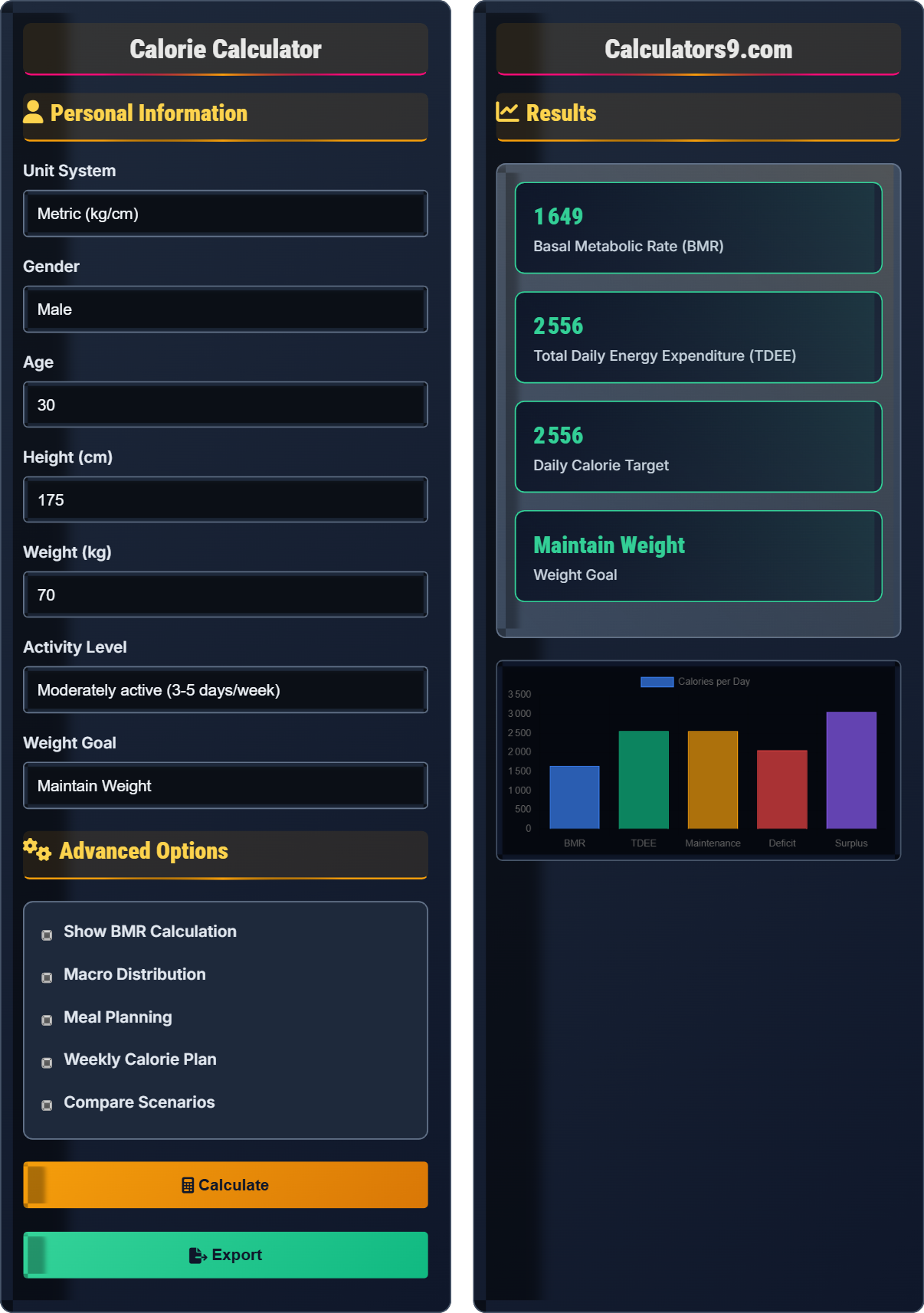
Calorie Calculation Formulas:
Show the calculator**Basal Metabolic Rate (BMR) - Mifflin-St Jeor Equation:**
**Men:** \( BMR = 10 \times weight(kg) + 6.25 \times height(cm) - 5 \times age(y) + 5 \)
**Women:** \( BMR = 10 \times weight(kg) + 6.25 \times height(cm) - 5 \times age(y) - 161 \)
**Total Daily Energy Expenditure (TDEE):**
\( TDEE = BMR \times Activity\ Factor \)
**Activity Factors:**
- Sedentary (little/no exercise): 1.2
- Lightly active (1-3 days/week): 1.375
- Moderately active (3-5 days/week): 1.55
- Very active (6-7 days/week): 1.725
- Extra active (very hard exercise): 1.9
**Weight Goals:**
- Maintain Weight: TDEE calories/day
- Lose 1 lb/week: TDEE - 500 calories/day
- Gain 1 lb/week: TDEE + 500 calories/day
**Macro Distribution (grams):**
\( Protein\ (g) = \frac{Calories \times Protein\ \%}{4} \)
\( Carbs\ (g) = \frac{Calories \times Carb\ \%}{4} \)
\( Fat\ (g) = \frac{Calories \times Fat\ \%}{9} \)
Where:
- \( BMR \) = Basal Metabolic Rate (calories/day)
- \( TDEE \) = Total Daily Energy Expenditure (calories/day)
- \( weight \) = Body weight in kilograms
- \( height \) = Height in centimeters
- \( age \) = Age in years
Example: For a 30-year-old female, 165cm tall, weighing 60kg, moderately active:
\( BMR = 10 \times 60 + 6.25 \times 165 - 5 \times 30 - 161 = 600 + 1,031.25 - 150 - 161 = 1,320.25 \) calories/day
\( TDEE = 1,320.25 \times 1.55 = 2,046.39 \) calories/day
For weight maintenance: 2,046 calories/day
For weight loss (1 lb/week): 1,546 calories/day
Personal Information
Advanced Options
Results
| Goal | Calories/Day | Weekly Change | Monthly Change |
|---|
| Macro | Percentage | Grams | Calories |
|---|
Comprehensive Calorie Guide
Calories are units of energy that measure the amount of energy provided by food and beverages. Your body uses calories for basic functions (breathing, circulation, cell production) and physical activity. Energy balance occurs when calories consumed equal calories burned. Understanding your daily calorie needs is fundamental to achieving and maintaining a healthy weight.
The Mifflin-St Jeor equation is the most accurate for calculating BMR (Basal Metabolic Rate), which represents the calories your body needs at rest:
Where:
- \( BMR \) = Basal Metabolic Rate (calories/day)
- \( weight \) = Body weight in kilograms
- \( height \) = Height in centimeters
- \( age \) = Age in years
Weight change occurs through calorie manipulation:
- Maintain Weight: Consume calories equal to TDEE
- Lose Weight: Create a 500-1000 calorie deficit for 1-2 lbs/week loss
- Gain Weight: Create a 300-500 calorie surplus for 0.5-1 lb/week gain
- Protein: 0.8-2.2g per kg body weight (more for athletes)
- Carbohydrates: 45-65% of total calories
- Fats: 20-35% of total calories
- Alcohol: 7 calories per gram (limit consumption)
Calorie Basics
Units of energy that measure food energy content.
Mifflin-St Jeor, Harris-Benedict equations for BMR.
- Body size and composition
- Age and gender
- Activity level
- Health status
Weight Management
Calories consumed vs calories burned determines weight changes.
- Calculate TDEE from BMR
- Create appropriate deficit/surplus
- Monitor progress
- Adjust as needed
- Safe weight loss: 1-2 lbs/week
- Extreme deficits can slow metabolism
- Muscle preservation important
- Long-term sustainability matters
Calorie Learning Quiz
How many calories must be burned to lose 1 pound of body fat?
The answer is C) 3,500. One pound of body fat is approximately equivalent to 3,500 calories. This is a fundamental principle in weight management and forms the basis for calculating weight loss goals. A daily deficit of 500 calories theoretically results in a weekly weight loss of 1 pound.
Understanding the 3,500-calorie rule is essential for creating realistic weight loss expectations. This figure represents the approximate energy content of 1 pound of body fat. It's important to note that this is an approximation, as body fat contains varying amounts of water and connective tissue, and metabolic changes occur during weight loss that can affect the relationship between calorie deficit and weight loss.
Calorie: Unit of energy
Body Fat: Stored energy in adipose tissue
Energy Deficit: Burning more calories than consumed
• 1 lb fat ≈ 3,500 calories
• 500 cal/day deficit = 1 lb/week loss
• 3,500 is an approximation
• Remember: 3,500 calories = 1 lb fat
• Create sustainable daily deficits
• Combine diet and exercise
• Underestimating the calorie requirement
• Expecting unrealistic weekly losses
• Not accounting for metabolic changes
Calculate the BMR for a 35-year-old female who is 165cm tall and weighs 65kg using the Mifflin-St Jeor equation. Show your work.
Using the Mifflin-St Jeor equation for women: \( BMR = 10 \times weight(kg) + 6.25 \times height(cm) - 5 \times age(y) - 161 \)
Given:
- Weight = 65 kg
- Height = 165 cm
- Age = 35 years
Step 1: Calculate each component
\( 10 \times 65 = 650 \)
\( 6.25 \times 165 = 1,031.25 \)
\( 5 \times 35 = 175 \)
Step 2: Combine components
\( BMR = 650 + 1,031.25 - 175 - 161 = 1,345.25 \) calories/day
Therefore, the woman's BMR is approximately 1,345 calories per day.
This calculation demonstrates the straightforward nature of BMR equations. The Mifflin-St Jeor equation is preferred because it provides more accurate results than older equations like Harris-Benedict. Notice how weight and height contribute positively to BMR, while age contributes negatively (reflecting the metabolic slowdown with aging). The constant (-161 for women, +5 for men) accounts for gender differences in body composition.
BMR: Basal Metabolic Rate - calories needed at rest
Mifflin-St Jeor: Most accurate BMR calculation equation
Basal Metabolic Rate: Calories burned at rest for basic functions
• Use correct equation for gender
• Ensure consistent units (kg, cm)
• Follow order of operations
• Remember: -161 for women, +5 for men
• Weight has largest impact on BMR
• Check your math carefully
• Using wrong gender constant
• Mixing units (pounds with metric)
• Arithmetic errors
John is a 40-year-old man, 180cm tall, weighing 80kg. He exercises moderately 4 days per week. Calculate his BMR and TDEE. How many calories should he consume daily to lose 1 lb per week?
Step 1: Calculate BMR using Mifflin-St Jeor for men
\( BMR = 10 \times 80 + 6.25 \times 180 - 5 \times 40 + 5 \)
\( = 800 + 1,125 - 200 + 5 = 1,730 \) calories/day
Step 2: Calculate TDEE for moderately active (multiplier 1.55)
\( TDEE = 1,730 \times 1.55 = 2,681.5 \) calories/day
Step 3: Calculate calories for 1 lb/week weight loss
1 lb of fat = ~3,500 calories
Daily deficit needed = 3,500 ÷ 7 = 500 calories
Target calories = 2,681 - 500 = 2,181 calories/day
John should consume approximately 2,181 calories per day to lose 1 lb per week.
This problem demonstrates the practical application of BMR calculations for weight management. The conversion from BMR to TDEE using activity multipliers is essential for determining actual daily calorie needs. The 3,500-calorie rule (1 lb of fat = 3,500 calories) is a fundamental principle in weight management, though it's an approximation that can vary between individuals.
TDEE: Total Daily Energy Expenditure - total calories burned per day
Activity Multiplier: Factor to account for physical activity level
Calorie Deficit: Consuming fewer calories than burned
• BMR + Activity Factor = TDEE
• 3,500 calories ≈ 1 lb fat
• Safe weight loss: 1-2 lbs/week
• Calculate BMR first, then apply activity factor
• 500 cal/day deficit ≈ 1 lb/week loss
• Use moderate deficits for sustainability
• Forgetting to calculate TDEE from BMR
• Using incorrect activity multiplier
• Extreme deficits that are unsustainable
Calculate the macronutrient distribution for a 2,000 calorie diet with 30% protein, 40% carbohydrates, and 30% fat. How many grams of each macronutrient should be consumed?
Step 1: Calculate calories for each macronutrient
Protein: 2,000 × 0.30 = 600 calories
Carbohydrates: 2,000 × 0.40 = 800 calories
Fat: 2,000 × 0.30 = 600 calories
Step 2: Convert calories to grams
Protein: 600 ÷ 4 = 150 grams (protein has 4 calories per gram)
Carbohydrates: 800 ÷ 4 = 200 grams (carbs have 4 calories per gram)
Fat: 600 ÷ 9 = 67 grams (fat has 9 calories per gram)
Therefore, the diet should contain 150g protein, 200g carbs, and 67g fat.
This calculation demonstrates how to translate percentage-based macronutrient targets into gram quantities. The conversion uses the fact that protein and carbohydrates each provide 4 calories per gram, while fat provides 9 calories per gram. This knowledge is essential for meal planning and tracking macronutrient intake.
Macronutrients: Protein, carbohydrates, and fat
Calories per Gram: Protein=4, Carbs=4, Fat=9
Macro Distribution: Percentage of calories from each macronutrient
• Protein: 4 cal/g
• Carbs: 4 cal/g
• Fat: 9 cal/g
• Remember: Fat has 9 cal/g, others have 4
• Total percentages should equal 100%
• Check your calculations
• Using 4 cal/g for fat
• Forgetting to convert percentages to decimals
• Not checking that percentages sum to 100%
Which of the following has the greatest impact on daily calorie needs?
The answer is C) Activity Level. While all factors affect calorie needs, activity level has the most dramatic impact. A sedentary person may need 1,800 calories while an extremely active person may need 3,500+ calories for the same body size. Activity level multipliers range from 1.2 to 1.9, creating a significant difference in daily calorie needs.
This question highlights the importance of physical activity in determining calorie needs. While BMR (basal metabolic rate) accounts for about 60-75% of daily calorie expenditure, physical activity can significantly increase total energy expenditure. This is why activity level is the most variable and impactful factor in determining daily calorie requirements.
Activity Level: Physical activity intensity and frequency
Calorie Expenditure: Total calories burned daily
Activity Multiplier: Factor applied to BMR for TDEE
• Activity level creates largest variation
• Multipliers range from 1.2-1.9
• BMR is baseline, activity adds to it
• Activity level greatly affects needs
• Be honest about activity level
• Adjust for actual activity
• Overestimating activity level
• Not accounting for daily variations
• Using wrong multiplier
FAQ
Q: I have a very high BMR according to the calculator. Does this mean I can eat whatever I want without gaining weight?
A: A high BMR means your body burns more calories at rest, but it doesn't give you free rein to eat unlimited amounts without consequences. BMR represents only about 60-75% of your total daily energy expenditure. The remaining 25-40% comes from physical activity, digestion, and other processes.
The BMR calculation uses the formula: \( BMR = 10 \times weight(kg) + 6.25 \times height(cm) - 5 \times age(y) + 5 \) (for men). A high BMR might result from factors like higher muscle mass, younger age, or genetic factors.
However, overeating consistently, even with a high BMR, will still lead to weight gain. The relationship is: \( \text{Weight Change} = \frac{\text{Calories Consumed} - \text{Calories Burned}}{3,500} \) (for pounds).
While you may have more flexibility with food choices, maintaining a balanced diet is still important for overall health, energy levels, and preventing nutrient deficiencies.
Q: How accurate are these calorie calculations?
A: Calorie calculations provide estimates rather than exact figures. The Mifflin-St Jeor equation is considered the most accurate for BMR calculation with an average error of 5-10%.
The mathematical relationship shows: \( BMR = 10 \times weight(kg) + 6.25 \times height(cm) - 5 \times age(y) + 5 \) (for men). This formula accounts for the primary factors affecting metabolic rate but doesn't capture individual variations in genetics, hormone levels, or body composition.
Activity multipliers also have limitations as they assume average metabolic responses to different activity levels. Individual variations can occur based on exercise intensity, efficiency, and non-exercise activity thermogenesis (NEAT).
These calculations serve as a starting point for planning. Monitor your actual weight changes and adjust your calorie intake accordingly. If you're not seeing expected results, your actual needs may differ from the calculated values.