Calories Burned Calculator
Exercise & activity tracker • Fitness calculator
Calories Burned Formulas:
Show the calculator\( \text{Calories Burned} = \text{MET} \times \text{weight(kg)} \times \text{time(hours)} \)
Where MET = Metabolic Equivalent of Task (energy cost of activity)
\( \text{Time in hours} = \text{minutes} \div 60 \)
Common MET values: Walking (3.5), Running (8.0), Cycling (7.5), Swimming (7.0), Strength Training (3.0)
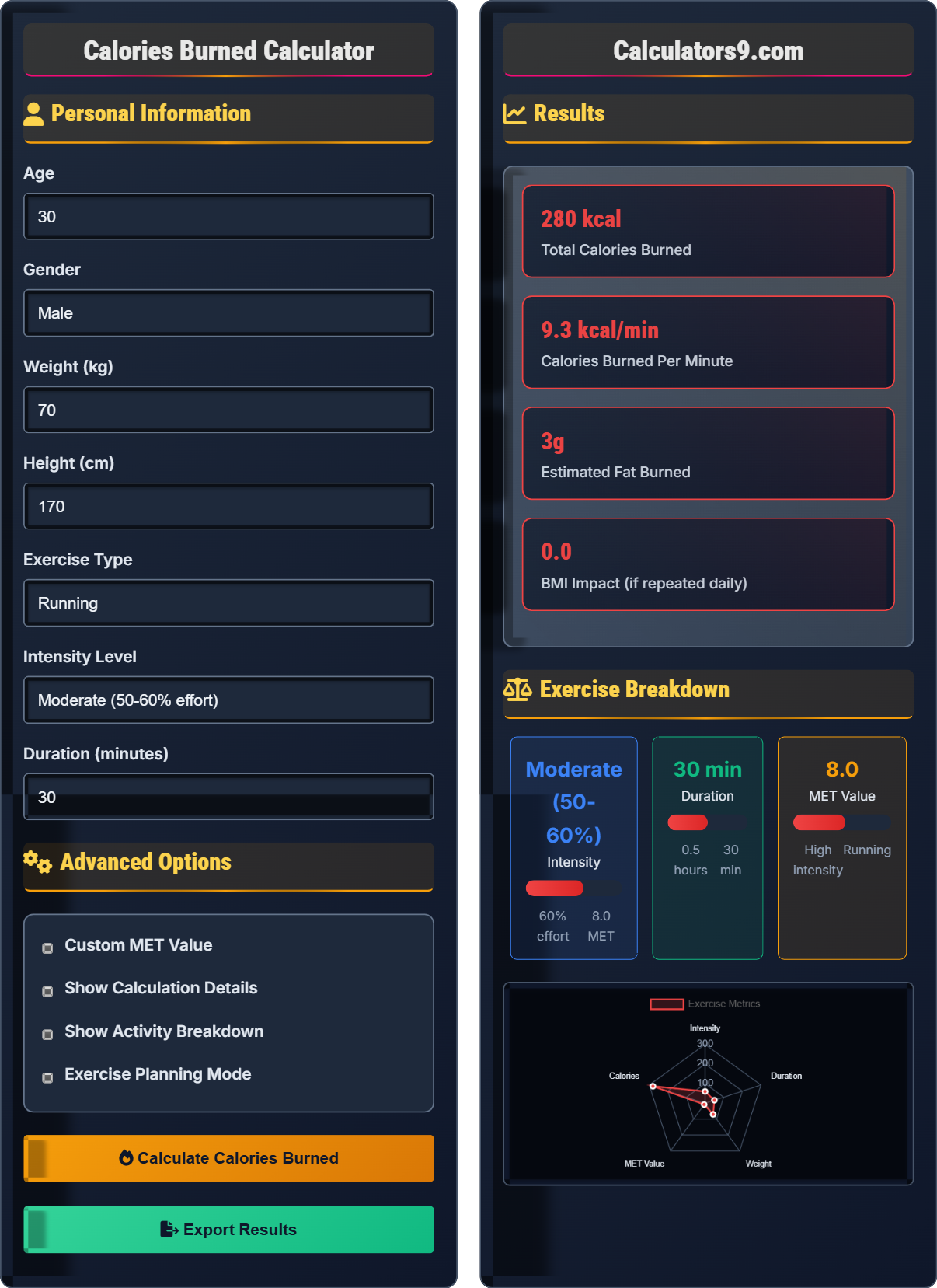
For a 70kg person running for 30 minutes:
Calories = 8.0 × 70 × (30÷60) = 8.0 × 70 × 0.5 = 280 calories
Alternative formula: \( \text{Calories} = \frac{\text{MET} \times \text{weight(kg)} \times \text{time(minutes)}}{60} \)
Personal Information
Advanced Options
Results
Exercise Breakdown
Comprehensive Calories Burned Guide
MET stands for Metabolic Equivalent of Task, a unit that measures the energy cost of physical activities. One MET is defined as the energy it takes to sit quietly, which is approximately 3.5 milliliters of oxygen per kilogram of body weight per minute. Activities are classified by their MET values, allowing for standardized comparisons of energy expenditure across different exercises.
The standard calories burned calculation uses these formulas:
Where:
- \( \text{MET} \) = Metabolic Equivalent of Task
- \( \text{weight(kg)} \) = Body weight in kilograms
- \( \text{time} \) = Duration of activity
Several factors influence the number of calories burned during exercise:
- Body Weight: Heavier individuals burn more calories performing the same activity
- Exercise Intensity: Higher intensity = more calories burned per minute
- Duration: Longer activities burn more total calories
- Fitness Level: More fit individuals may burn calories more efficiently
- Muscle Mass: Higher muscle mass increases resting and exercise metabolism
- Interval Training: Alternating high and low intensity increases calorie burn
- Strength Training: Builds muscle mass for increased resting metabolism
- Cardiovascular Exercise: Maintains heart health and burns calories during activity
- Consistency: Regular exercise provides cumulative benefits
- Progressive Overload: Gradually increasing intensity improves fitness
Calories Burned Basics
1 MET = 3.5 ml O₂/kg/min at rest, activity measured relative to this baseline
\( \text{Calories} = \text{MET} \times \text{weight(kg)} \times \text{time(hours)} \)
Or: \( \text{Calories} = \frac{\text{MET} \times \text{weight(kg)} \times \text{time(minutes)}}{60} \)
- Higher MET values = more calories burned
- Body weight affects calorie burn significantly
- Duration is equally important as intensity
Exercise Intensity
Low: 2-4 METs, Moderate: 5-7 METs, Vigorous: 8+ METs
- Moderate: 50-70% of max heart rate
- Vigorous: 70-85% of max heart rate
- Max HR = 220 - age
- Combination yields best results
- Start gradually and increase intensity
- Listen to your body
- Mix intensities for balanced approach
- Allow recovery time between sessions
Calories Burned Learning Quiz
Which activity has the highest MET value among the following options?
The answer is C) Running at 6 mph (8.0 METs). MET values indicate the energy cost of activities relative to resting metabolic rate. Running at 6 mph has a MET value of 8.0, which is higher than swimming laps (7.0), cycling (7.5), and walking (3.0). Higher MET values mean more calories burned per minute for the same body weight.
MET values provide a standardized way to compare the intensity of different activities. One MET equals the energy expenditure at rest, so an activity with 8 METs requires 8 times the energy of sitting quietly. Understanding MET values helps individuals choose activities that match their fitness goals and energy expenditure targets.
MET: Metabolic Equivalent of Task - energy cost of activity
Resting Metabolic Rate: Energy needed at complete rest (1 MET)
Energy Expenditure: Calories burned during activity
• Higher MET values = more calories burned per minute
• MET values are standardized across populations
• Actual calorie burn varies by body weight
• Mix high and low MET activities for variety
• Interval training combines different MET levels
• Consider MET when planning exercise routine
• Assuming all activities burn calories equally
• Not considering body weight in calculations
• Overestimating intensity of familiar activities
Calculate the calories burned for a 75kg person who runs at 6 mph (8.0 METs) for 45 minutes. Show your work.
Using the calories burned formula: \( \text{Calories} = \frac{\text{MET} \times \text{weight(kg)} \times \text{time(minutes)}}{60} \)
Given:
- MET = 8.0
- Weight = 75 kg
- Time = 45 minutes
Step 1: Multiply MET × weight × time = 8.0 × 75 × 45 = 27,000
Step 2: Divide by 60 = 27,000 ÷ 60 = 450 calories
Therefore, the person burns 450 calories during the 45-minute run.
This calculation demonstrates the direct relationship between body weight, activity intensity (MET), and duration in determining calorie burn. The division by 60 converts the time factor to hours, which is the standard unit in the original formula. Understanding this relationship helps individuals predict calorie burn and set realistic exercise goals.
Caloric Expenditure: Energy burned during physical activity
Body Weight Factor: Heavier individuals burn more calories
Duration Factor: Longer activities burn more total calories
• Calories = (MET × weight × minutes) ÷ 60
• Body weight in kilograms
• Time in minutes
• Use the simplified formula for quick calculations
• Remember: heavier people burn more calories at same intensity
• Double duration = double calories (same intensity)
• Forgetting to divide by 60 in the formula
• Using pounds instead of kilograms
• Confusing MET values for different activities
Emma weighs 65kg and has 60 minutes to exercise. She can either run at 6 mph (8.0 METs) for 30 minutes or cycle at 14 mph (7.5 METs) for 60 minutes. Which activity burns more calories? Calculate both options.
Option 1: Running for 30 minutes
Calories = (8.0 × 65 × 30) ÷ 60 = 15,600 ÷ 60 = 260 calories
Option 2: Cycling for 60 minutes
Calories = (7.5 × 65 × 60) ÷ 60 = 29,250 ÷ 60 = 488 calories
Cycling for 60 minutes burns 488 calories, which is more than running for 30 minutes (260 calories). However, the running option provides higher intensity in less time.
This comparison illustrates the trade-off between intensity and duration. While running has a slightly higher MET value, the longer duration of cycling results in greater total calorie burn. This demonstrates that both factors contribute to total energy expenditure, and individuals can achieve their goals through different combinations of intensity and duration.
Intensity-Duration Trade-off: Balancing exercise intensity and time
Total Energy Expenditure: Overall calories burned in session
Exercise Efficiency: Calories burned per minute
• Both intensity and duration affect total calories
• Higher MET activities burn more per minute
• Longer duration increases total calories burned
• High-intensity, short-duration for time efficiency
• Lower-intensity, longer-duration for total burn
• Interval training combines both approaches
• Only considering intensity and ignoring duration
• Assuming high MET always means more total calories
• Not accounting for individual preferences and capabilities
David weighs 80kg and wants to lose 1kg per week. He knows that 1kg of fat equals approximately 7,700 calories. He plans to burn 500 calories per day through exercise. What intensity activity should he choose for 45 minutes, 5 days a week? Calculate the required MET value.
Step 1: Calculate daily calorie deficit needed
Weekly deficit for 1kg loss = 7,700 calories
Daily deficit = 7,700 ÷ 7 = 1,100 calories
Step 2: Calculate calories burned per exercise session
Daily exercise calories = 500
Exercise days per week = 5
Calories per session = 500
Step 3: Solve for required MET value
Formula: Calories = (MET × weight × minutes) ÷ 60
500 = (MET × 80 × 45) ÷ 60
500 = (MET × 3,600) ÷ 60
500 = MET × 60
MET = 500 ÷ 60 = 8.3
David needs an activity with approximately 8.3 METs for 45 minutes.
This problem demonstrates how to work backwards from a goal to determine exercise requirements. The calculation shows that achieving a 1kg/week weight loss through exercise alone requires high-intensity activities. A MET value of 8.3 corresponds to vigorous activities like running at 6-7 mph or cycling at 16-19 mph. This illustrates the significant exercise commitment needed for substantial weight loss.
Caloric Deficit: Burning more calories than consumed
Weight Loss Rate: 1kg = ~7,700 calories deficit
Exercise Prescription: Planned activity for specific goals
• 1kg fat = ~7,700 calories deficit
• Sustainable weight loss is 0.5-1kg/week
• Combine exercise with dietary changes for best results
• Realistic weight loss combines diet and exercise
• 500-750 calorie daily deficit is sustainable
• Include rest days in exercise plan
• Expecting to achieve significant weight loss through exercise alone
• Not accounting for dietary intake in weight loss plans
• Setting unrealistic exercise targets for beginners
Which of the following factors has the MOST significant impact on the number of calories burned during a 30-minute run at the same pace?
The answer is C) Body Weight. In the calories burned formula (MET × weight × time ÷ 60), body weight is a direct multiplier. A heavier person will burn proportionally more calories performing the same activity for the same duration. For example, a 90kg person will burn 50% more calories than a 60kg person doing identical exercise.
Body weight has a direct linear relationship with calorie burn in the standard formula. While age, gender, and fitness level do influence metabolism and efficiency, body weight is the most significant factor in the calculation. This explains why weight loss often accelerates initially when individuals are heavier and then slows as they lose weight, even with the same exercise routine.
Direct Proportionality: Calorie burn increases with body weight
Linear Relationship: Double weight = double calories (same activity)
Exercise Efficiency: How effectively body uses energy
• Calorie burn is directly proportional to body weight
• Same activity burns more calories for heavier individuals
• Weight loss may slow exercise calorie burn over time
• Adjust expectations as body weight changes
• Increase intensity/duration as weight decreases
• Focus on total body movement, not just exercise
• Not adjusting calorie expectations as weight changes
• Assuming everyone burns the same calories for same activity
• Ignoring the impact of body composition on metabolism
FAQ
Q: How accurate are calories burned estimates from fitness trackers?
A: Fitness trackers typically have a 10-15% margin of error for calorie estimates. They use algorithms based on heart rate, movement sensors, and personal data. For example, if our calculator shows 300 calories burned during running, a tracker might report 270-330 calories. The accuracy depends on correct personal data entry (age, weight, height) and proper device calibration.
More advanced devices with chest strap heart rate monitors provide better accuracy. The formula we use (MET × weight × time ÷ 60) is scientifically validated, but individual variations in metabolism, fitness level, and efficiency can affect actual calorie burn.
Q: Is it better to exercise longer at low intensity or shorter at high intensity?
A: Both approaches have benefits. For total calories burned, longer low-intensity exercise can sometimes exceed shorter high-intensity sessions. For example, walking for 60 minutes (3.0 METs) burns 210 calories for a 70kg person, while running for 20 minutes (8.0 METs) burns 187 calories.
However, high-intensity exercise provides additional benefits like increased post-exercise oxygen consumption (EPOC), improved cardiovascular fitness, and time efficiency. The best approach often combines both: moderate-intensity for endurance and high-intensity intervals for metabolic benefits. A balanced program might include 150 minutes of moderate activity or 75 minutes of vigorous activity weekly.