Carbohydrate Calculator
Daily carb needs • glycemic index
Carbohydrate Calculation Formulas:
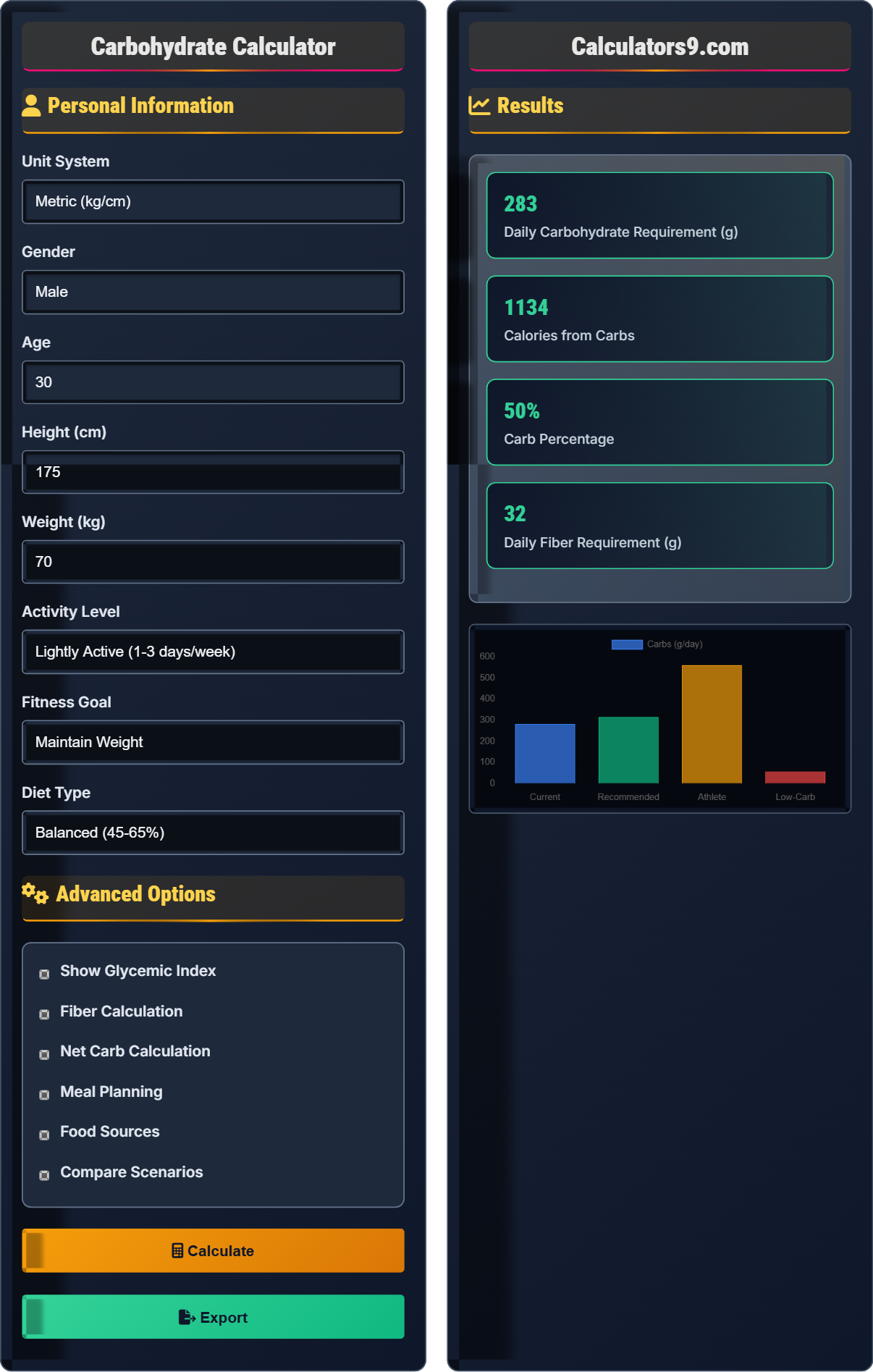
Show the calculator**Recommended Daily Carbohydrate Intake:**
**General Population:** \( 45-65\%\ of\ total\ calories \)
**Active Adults:** \( 50-65\%\ of\ total\ calories \)
**Athletes:** \( 60-70\%\ of\ total\ calories \)
**Keto/Low-Carb:** \( 5-10\%\ of\ total\ calories \)
**Carbohydrate Calculation:**
\( Carb\ (g) = \frac{Calories\ from\ Carbs}{4} \)
**Glycemic Load:**
\( GL = \frac{GI \times Carb\ Content\ (g)}{100} \)
**Net Carbs (for low-carb diets):**
\( Net\ Carbs = Total\ Carbs - Fiber - Sugar\ Alcohols \)
Where:
- \( GI \) = Glycemic Index (scale 0-100)
- \( GL \) = Glycemic Load (measures blood sugar impact)
- \( Carb\ Content \) = Carbohydrate content in grams
- \( Fiber \) = Dietary fiber content in grams
- \( Sugar\ Alcohols \) = Sugar alcohol content in grams
Example: For a 2,500 calorie diet with 50% carbs:
\( Carbs\ (calories) = 2,500 \times 0.50 = 1,250\ calories \)
\( Carbs\ (grams) = 1,250 \div 4 = 312.5\ g\ carbs/day \)
This equals 312.5g of carbohydrates per day.
Personal Information
Advanced Options
Results
| Category | Requirement (g/day) | Per kg Body Weight | Justification |
|---|
| Food Source | Carbs (g) | Serving Size | Glycemic Index |
|---|
Comprehensive Carbohydrate Guide
Carbohydrates are one of the three macronutrients essential for human health. They serve as the body's primary source of energy, particularly for the brain and muscles. Carbohydrates are classified as simple (sugars) or complex (starches and fiber) and are found in foods like grains, fruits, vegetables, and dairy products.
Carbohydrate requirements vary based on individual factors:
Where:
- \( cal/g \) = calories per gram (carbs provide 4 calories per gram)
- \( g/kg \) = grams per kilogram of body weight
Carbohydrates are categorized by structure and impact:
- Simple Carbs: Monosaccharides and disaccharides (glucose, fructose, sucrose)
- Complex Carbs: Polysaccharides (starch, fiber)
- Refined Carbs: Processed with fiber removed
- Whole Grains: Unprocessed with fiber intact
- Low-GI Foods: Cause gradual blood sugar rise
- High-GI Foods: Cause rapid blood sugar rise
- Pre-Workout: 30-60g of easily digestible carbs 30-60 min before
- Post-Workout: 30-60g combined with protein within 30-60 minutes
- Evening: Complex carbs with protein for overnight recovery
- Throughout Day: Distribute across 3-5 meals for steady energy
Carb Basics
Macronutrient that provides energy for the body and brain.
Based on calories, body weight, and activity level.
- General: 45-65% of calories
- Athletes: 6-10g/kg body weight
- Low-carb: 20-30% of calories
- Keto: 5-10% of calories
Optimal Intake
Spread intake throughout the day for sustained energy.
- 30-60g per main meal
- 15-30g per snack
- Pre-workout: 30-60 min before
- Post-workout: within 30-60 min
- Quality matters as much as quantity
- Timing enhances performance and recovery
- Individual needs vary significantly
- Health conditions affect requirements
Carbohydrate Learning Quiz
Which of the following is considered a complex carbohydrate?
The answer is C) Starch. Starch is a complex carbohydrate composed of long chains of glucose molecules. Glucose and fructose are simple sugars (monosaccharides), while sucrose is a disaccharide made of glucose and fructose. Complex carbohydrates provide sustained energy release compared to simple sugars.
Understanding carbohydrate classification is fundamental to nutrition planning. Complex carbohydrates (polysaccharides) like starch, glycogen, and fiber are composed of multiple sugar units and provide steady energy. Simple carbohydrates (monosaccharides and disaccharides) are absorbed quickly and cause rapid blood sugar spikes.
Complex Carbohydrate: Multiple sugar units linked together
Simple Carbohydrate: Single or double sugar units
Polysaccharide: Chain of many sugar molecules
• Complex carbs: Starch, glycogen, fiber
• Simple carbs: Glucose, fructose, sucrose
• Complex carbs provide sustained energy
• Complex carbs cause slower blood sugar rise
• Include fiber in complex carbs
• Pair simple carbs with protein/fat
• Confusing simple and complex carbs
• Thinking all carbs are equal
• Not considering fiber content
Calculate the daily carbohydrate requirement for a 70kg person on a 2,500 calorie diet with 50% carbs. Show your work.
Step 1: Calculate calories from carbs
\( 2,500\ calories \times 0.50 = 1,250\ calories\ from\ carbs \)
Step 2: Convert calories to grams
Carbs provide 4 calories per gram
\( 1,250\ calories \div 4\ cal/g = 312.5\ g\ carbs/day \)
Step 3: Calculate per kg body weight
\( 312.5\ g \div 70\ kg = 4.5\ g/kg\ body\ weight \)
Therefore, the person needs 312.5g of carbohydrates per day (4.5g/kg body weight).
This calculation demonstrates the relationship between calories and grams for carbohydrates. Since carbs provide 4 calories per gram, dividing calories by 4 gives the gram equivalent. The 4.5g/kg body weight falls within the general recommendation range for active individuals.
Carb Requirement: Amount of carbs needed per day
Calories per Gram: Carbs provide 4 calories per gram
Percentage of Calories: Carb contribution to total intake
• 1g carbs = 4 calories
• Calculate calories first
• Then convert to grams
• Remember: 1g carbs = 4 calories
• Calculate % of total calories first
• Divide by 4 to get grams
• Forgetting carbs provide 4 cal/g
• Confusing percentages with grams
• Not converting calories to grams
An athlete weighing 75kg needs 8g of carbs per kg body weight. How many carbs should they consume daily? If they eat 5 meals, how many carbs per meal?
Step 1: Calculate total daily carb requirement
\( 75\ kg \times 8\ g/kg = 600\ g\ carbs/day \)
Step 2: Calculate carbs per meal
\( 600\ g \div 5\ meals = 120\ g\ carbs\ per\ meal \)
Step 3: Calculate calories from carbs
\( 600\ g \times 4\ cal/g = 2,400\ calories\ from\ carbs \)
Therefore, the athlete needs 600g of carbs per day, distributed as 120g per meal across 5 meals.
Athletes have higher carbohydrate needs due to increased glycogen depletion during intense training. The 6-10g/kg recommendation reflects the need to replenish muscle glycogen stores. Distributing carbs across multiple meals helps maintain steady energy and prevents digestive discomfort.
Athlete Carb Needs: 6-10g/kg body weight
Glycogen: Stored form of carbohydrates
Carb Distribution: Spreading intake across meals
• Athletes: 6-10g/kg body weight
• Distribute across 4-6 meals
• Pre/post-workout timing important
• Athletes need more carbs
• Spread across multiple meals
• Time around workouts
• Using general recommendations for athletes
• Not distributing carbs throughout day
• Missing workout timing windows
A food item has 25g total carbs, 8g fiber, and 2g sugar alcohols. Calculate the net carbs for someone on a ketogenic diet.
Step 1: Identify components
Total carbs = 25g
Fiber = 8g
Sugar alcohols = 2g
Step 2: Calculate net carbs
Net carbs = Total carbs - Fiber - Sugar alcohols
Net carbs = 25g - 8g - 2g = 15g
Step 3: Interpretation
For ketogenic dieters, only 15g of carbs will impact blood sugar and ketosis, not the full 25g.
Therefore, the net carbs are 15g, which is the amount that counts toward daily carb limits on keto.
Net carb calculation is important for low-carb and ketogenic diets. Fiber and sugar alcohols don't significantly impact blood sugar or ketosis, so they're subtracted from total carbs. This allows for more food variety while staying within carb limits.
Net Carbs: Digestible carbs that impact blood sugar
Sugar Alcohols: Sugar substitutes with minimal impact
Ketogenic Diet: Very low-carb diet for ketosis
• Net carbs = Total - Fiber - Sugar alcohols
• Fiber doesn't impact blood sugar
• Sugar alcohols have minimal impact
• Always check fiber content
• Subtract sugar alcohols on keto
• Read labels carefully
• Counting fiber as net carbs
• Not accounting for sugar alcohols
• Using total carbs for keto
Which of the following foods has the lowest Glycemic Index (GI)?
The answer is C) Apple. An apple has a low Glycemic Index (around 38), causing a gradual rise in blood sugar. White bread has a high GI (~70), brown rice has a moderate GI (~50), and potatoes have a high GI (~80). Low-GI foods are beneficial for blood sugar control and sustained energy.
The Glycemic Index ranks carbohydrates from 0-100 based on how quickly they raise blood sugar. Low-GI foods (55 or less) cause gradual rises in blood sugar, while high-GI foods (70 or more) cause rapid spikes. Choosing low-GI carbs helps maintain steady energy and supports metabolic health.
Glycemic Index: Scale measuring blood sugar impact
Low-GI: 0-55 (gradual rise)
High-GI: 70+ (rapid rise)
• Low-GI: 0-55
• Medium-GI: 56-69
• High-GI: 70-100
• Choose low-GI carbs when possible
• Combine with protein/fat
• Include fiber-rich options
• Not considering GI impact
• Eating only high-GI foods
• Not pairing with protein/fiber
FAQ
Q: How much carbohydrates should I consume around my workouts?
A: Carbohydrate timing around workouts is crucial for performance and recovery. The mathematical relationship is: \( Pre-Workout\ Carbs = 1-4\ g/kg\ body\ weight \) consumed 1-4 hours before exercise.
For a 70kg athlete: \( 70\ kg \times 1-4\ g/kg = 70-280\ g \) depending on workout duration and intensity.
Post-workout, consume 0.8-1.2g/kg body weight within 30 minutes, combined with protein for optimal recovery. This replenishes muscle glycogen stores depleted during exercise and supports muscle protein synthesis.
The 0.8-1.2g/kg recommendation is based on research showing optimal glycogen resynthesis rates with this amount. For endurance athletes, higher amounts (up to 1.2g/kg) may be needed.
Q: How do I count carbohydrates for diabetes management?
A: Carbohydrate counting is essential for diabetes management. The formula is: \( Carb\ Units = \frac{Total\ Carbs}{15} \) (1 carb unit = 15g carbs).
For example, if a meal contains 60g of carbs, that equals 4 carb units. This helps predict blood sugar response and calculate insulin needs.
Consider the Glycemic Load (GL): \( GL = \frac{GI \times Carb\ Content}{100} \). Foods with lower GL cause smaller blood sugar spikes. Focus on complex carbs with fiber, which slow absorption and reduce glycemic impact.
Work with your healthcare team to determine your individual carb allowance and insulin-to-carb ratios for optimal blood sugar control.