Macro Calculator
Protein, carb & fat calculator • Nutrition tracking
Macro Calculation Formulas:
Show the calculator\( \text{BMR} = 10 \times \text{weight(kg)} + 6.25 \times \text{height(cm)} - 5 \times \text{age(y)} + s \)
Where s = +5 (men) or -161 (women)
\( \text{TDEE} = \text{BMR} \times \text{Activity Multiplier} \)
\( \text{Protein(g)} = \text{weight(kg)} \times \text{Protein Factor} \)
\( \text{Fat(g)} = \frac{\text{TDEE} \times \% \text{Fat Goal}}{9} \)
\( \text{Carbs(g)} = \frac{\text{TDEE} - (\text{Protein Cal} + \text{Fat Cal})}{4} \)
Standard recommendations: 1.6-2.2g/kg protein, 20-35% fat, remainder as carbs.
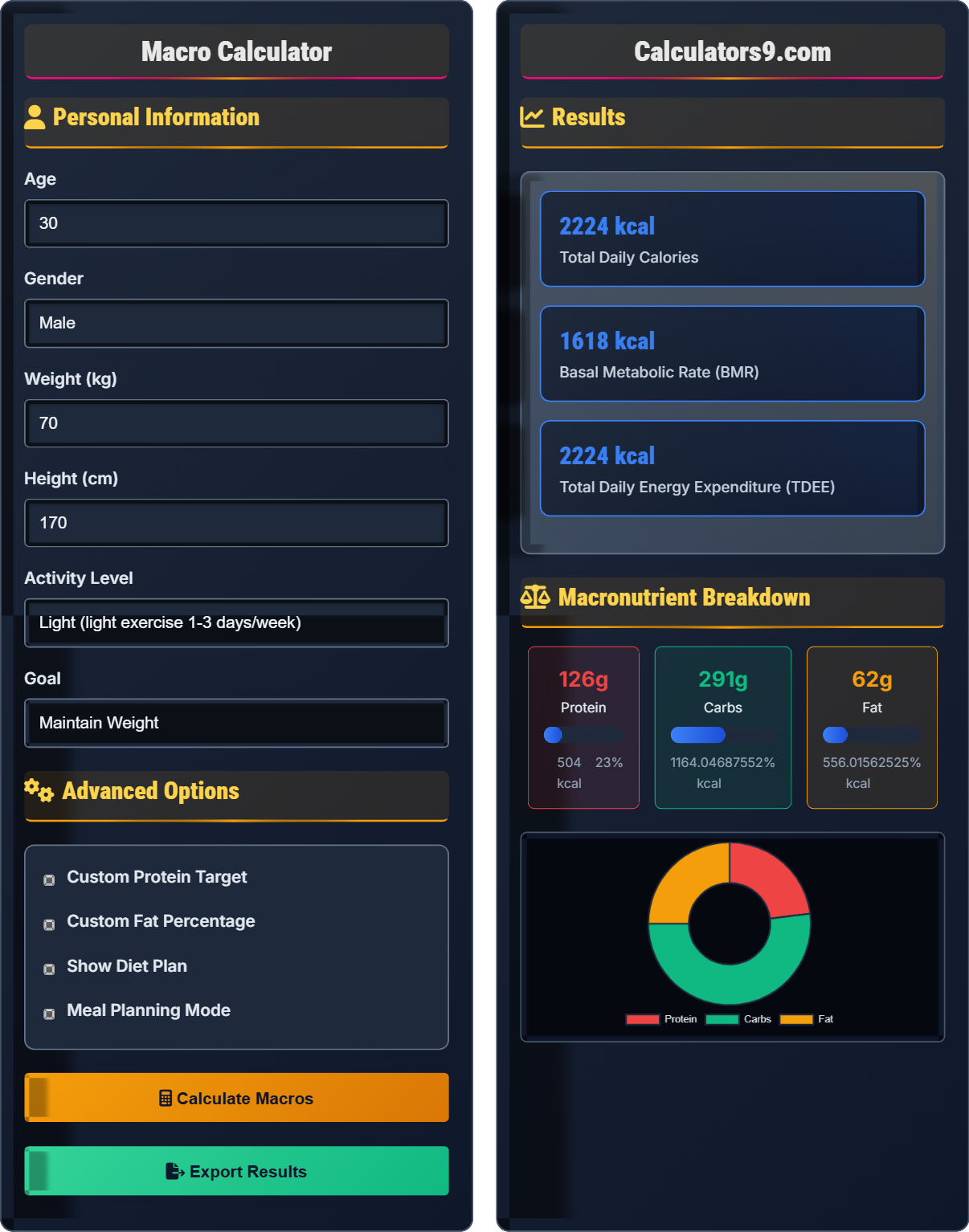
For a 70kg male, 175cm, 30y, moderately active (TDEE~2,800kcal):
Protein: 70 × 1.8 = 126g (504kcal)
Fat: (2,800 × 0.25) ÷ 9 = 78g (702kcal)
Carbs: (2,800 - 504 - 702) ÷ 4 = 399g (1,594kcal)
Personal Information
Advanced Options
Results
Macronutrient Breakdown
Comprehensive Macro Guide
Macronutrients are nutrients required in large amounts by the human body. They include proteins, carbohydrates, and fats, which provide energy and support various bodily functions. Each macronutrient serves unique roles: proteins build and repair tissues, carbohydrates provide quick energy, and fats support hormone production and nutrient absorption.
The standard macro calculation uses these formulas:
Where:
- \( s = +5 \) for men, \( -161 \) for women
- \( \text{Activity Multiplier} \) ranges from 1.2 (sedentary) to 1.9 (very active)
- \( \text{Protein Factor} \) is typically 1.6-2.2 g/kg for active individuals
Adjust macros based on your specific goals:
- Weight Loss: Increase protein (2.2-2.7 g/kg), moderate carbs (30-40%), lower fat (20-25%)
- Weight Gain: Maintain protein (1.8-2.2 g/kg), higher carbs (45-55%), moderate fat (25-30%)
- Muscle Building: High protein (2.2-2.7 g/kg), adequate carbs (40-50%), sufficient fat (20-25%)
- Endurance Training: Moderate protein (1.6-2.0 g/kg), higher carbs (50-60%), moderate fat (20-25%)
- Weigh Food: Use a kitchen scale for accurate measurements
- Read Labels: Check nutrition facts for accurate macro counts
- Plan Ahead: Prepare meals in advance to meet macro targets
- Track Consistently: Use apps or journals to monitor intake
- Stay Flexible: Adjust macros based on progress and feedback
Macro Basics
Protein: 4 kcal/g, Carbs: 4 kcal/g, Fat: 9 kcal/g
\( \text{BMR} = 10 \times \text{weight(kg)} + 6.25 \times \text{height(cm)} - 5 \times \text{age(y)} + s \)
Where s = +5 (men) or -161 (women)
- Protein intake: 1.6-2.2 g/kg body weight
- Fat intake: 20-35% of total calories
- Carbs fill remaining calories after protein and fat
Goal-Specific Macros
Adjust macros based on your primary objective.
- Weight loss: Increase protein, moderate carbs
- Muscle gain: Maintain high protein
- Performance: Optimize carbs for training
- Health: Focus on quality sources
- Individual tolerance varies
- Activity level affects needs
- Track progress and adjust
- Quality matters as much as quantity
Macro Learning Quiz
For a 2,500 calorie diet, what is the recommended range of protein intake in grams for an active individual?
The answer is B) 100-138g. For an active individual, protein recommendations are 1.6-2.2 g per kg of body weight. Assuming an average 70kg person: 70 × 1.6 = 112g (448 kcal) to 70 × 2.2 = 154g (616 kcal). This represents 18-25% of a 2,500 calorie diet.
Protein requirements are based on body weight rather than total calories, as they serve structural and functional roles in the body. The range (1.6-2.2 g/kg) accounts for different activity levels and goals. Higher intakes (up to 3.0 g/kg) may be beneficial during periods of caloric restriction or intense training.
Protein: Macronutrient made of amino acids, essential for muscle synthesis and repair
Caloric Density: Calories per gram (protein = 4 kcal/g)
Active Individual: Someone engaged in regular exercise (3+ times/week)
• Protein intake is based on body weight, not total calories
• Range is 1.6-2.2 g/kg for active individuals
• Higher intakes may be needed during weight loss
• Remember: 1g protein = 4 calories
• Distribute protein evenly across meals for optimal synthesis
• Include complete proteins (contain all essential amino acids)
• Calculating protein as percentage of total calories instead of body weight
• Not adjusting for activity level and goals
• Consuming too little protein during caloric restriction
Calculate the macronutrient breakdown for a 75kg male athlete (age 28, 180cm) with moderate activity level following a 3,000 calorie diet. Assume 2.0g/kg protein, 25% fat, and remaining calories as carbs.
Step 1: Calculate BMR = 10×75 + 6.25×180 - 5×28 + 5 = 750 + 1,125 - 140 + 5 = 1,740 kcal
Step 2: Calculate TDEE = 1,740 × 1.55 = 2,697 kcal (rounded to 2,700)
Step 3: Calculate protein = 75 × 2.0 = 150g (600 kcal)
Step 4: Calculate fat = (3,000 × 0.25) ÷ 9 = 750 ÷ 9 = 83g (750 kcal)
Step 5: Calculate carbs = (3,000 - 600 - 750) ÷ 4 = 1,650 ÷ 4 = 413g (1,650 kcal)
Final breakdown: 150g protein (20%), 413g carbs (55%), 83g fat (25%)
This calculation demonstrates the systematic approach to macro planning. We start with BMR to establish baseline metabolic needs, adjust for activity level to get TDEE, then allocate calories based on specific goals. The order (protein first, then fat, then carbs) ensures essential needs are met before filling remaining calories.
BMR: Basal Metabolic Rate - calories needed at rest
TDEE: Total Daily Energy Expenditure - total calories burned
Activity Multiplier: Factor to adjust BMR for activity level
• Calculate protein based on body weight first
• Allocate fat as percentage of total calories
• Use Mifflin-St Jeor equation for BMR calculations
• Round macro values to whole grams for practicality
• Verify total calories match target (600+750+1650=3000)
• Forgetting to account for activity level in TDEE
• Allocating carbs first instead of protein
• Not verifying that all three macros add up to target calories
Sarah is a 65kg endurance athlete training 5-6 days per week. She needs 2.5g/kg protein, 60% of calories from carbs, and 20% from fat. Calculate her daily macro needs for a 2,800 calorie diet. How many calories come from each macronutrient?
Step 1: Calculate protein = 65 × 2.5 = 163g
Step 2: Calculate protein calories = 163 × 4 = 652 kcal
Step 3: Calculate carb calories = 2,800 × 0.60 = 1,680 kcal
Step 4: Calculate carb grams = 1,680 ÷ 4 = 420g
Step 5: Calculate fat calories = 2,800 × 0.20 = 560 kcal
Step 6: Calculate fat grams = 560 ÷ 9 = 62g
Step 7: Verify: 652 + 1,680 + 560 = 2,892 kcal (slight rounding difference)
Final breakdown: 163g protein (652 kcal), 420g carbs (1,680 kcal), 62g fat (560 kcal)
Endurance athletes have higher carbohydrate needs to fuel prolonged exercise and replenish glycogen stores. The approach here differs from standard calculations - instead of calculating fat as a percentage, we're given both carb and fat percentages, which means protein becomes the variable to solve for. However, since protein is critical for recovery, we prioritize meeting the target first.
Endurance Athlete: Someone engaged in prolonged aerobic exercise
Glycogen: Stored form of glucose used for energy during exercise
Carbohydrate Loading: Strategy to maximize glycogen stores
• Endurance athletes need higher carb percentages (50-60%)
• Protein needs remain elevated for recovery
• Fat intake should not fall below 15% of calories
• Consume carbs around workout times for optimal performance
• Include anti-inflammatory foods to support recovery
• Time protein intake to optimize muscle protein synthesis
• Underestimating carb needs for endurance athletes
• Not accounting for increased protein needs during heavy training
• Failing to adjust macros based on training intensity and volume
Mark wants to lose weight while preserving muscle mass. He weighs 90kg and needs 2.5g/kg protein, 20% fat, and the remainder as carbs in a 2,200 calorie diet. Calculate his daily macros and explain why this approach is effective for weight loss while preserving muscle.
Step 1: Calculate protein = 90 × 2.5 = 225g
Step 2: Calculate protein calories = 225 × 4 = 900 kcal
Step 3: Calculate fat calories = 2,200 × 0.20 = 440 kcal
Step 4: Calculate fat grams = 440 ÷ 9 = 49g
Step 5: Calculate carb calories = 2,200 - 900 - 440 = 860 kcal
Step 6: Calculate carb grams = 860 ÷ 4 = 215g
Final breakdown: 225g protein (41%), 215g carbs (39%), 49g fat (20%)
This approach is effective because high protein intake (2.5g/kg) provides the amino acids necessary to maintain muscle mass during caloric restriction. The elevated protein also increases thermogenesis and satiety, helping with adherence. By maintaining adequate protein while creating a caloric deficit, the body preferentially loses fat rather than muscle tissue.
Thermogenesis: Heat production that burns calories
Satiety: Feeling of fullness after eating
Caloric Deficit: Consuming fewer calories than burned
• Higher protein (2.2-2.7g/kg) preserves muscle during weight loss
• Adequate fat (minimum 20%) maintains hormone production
• Carbs provide energy for workouts and brain function
• Include resistance training to preserve muscle mass
• Monitor weight, body composition, and performance
• Adjust macros based on progress and energy levels
• Not consuming enough protein during weight loss
• Cutting carbs too low, affecting performance and mood
• Ignoring the importance of strength training during weight loss
Which combination of macro sources would provide the best nutritional value while meeting calculated macro targets?
The answer is B) Lean chicken, quinoa, olive oil. This combination provides high-quality complete protein (chicken), complex carbohydrates with fiber and micronutrients (quinoa), and healthy monounsaturated fats (olive oil). It offers superior micronutrient density, bioavailability, and health benefits compared to processed alternatives.
While meeting macro targets is important, the quality of food sources significantly impacts health outcomes and satiety. Whole foods typically provide more micronutrients, fiber, and bioactive compounds. The combination of lean protein, complex carbs, and healthy fats creates a balanced meal that promotes satiety, stable blood sugar, and optimal nutrient intake.
Micronutrient Density: Nutrients per calorie of food
Bioavailability: How well nutrients are absorbed
Complete Protein: Contains all essential amino acids
• Prioritize whole food sources when possible
• Balance convenience with nutritional quality
• Include colorful vegetables with each meal
• Choose minimally processed whole grain options
• Include omega-3 rich foods like fatty fish
• Focusing only on hitting macro numbers without considering food quality
• Neglecting micronutrient needs while tracking macros
• Relying heavily on processed foods to meet targets
FAQ
Q: How do I know if my macro ratios are optimal for my goals?
A: Monitor these key indicators: energy levels throughout the day, workout performance, recovery quality, sleep quality, and progress toward your specific goals (weight, body composition, performance metrics). For example, if you're losing muscle during weight loss, increase protein intake (2.2-2.7g/kg). If you feel fatigued during workouts, increase carbs. Track consistently for 2-4 weeks before making adjustments.
Standard ranges: Protein 1.6-2.7g/kg (higher during caloric restriction), Carbs 3-7g/kg (higher for endurance athletes), Fat 0.8-1.5g/kg (minimum for hormone production).
Q: Do I need to hit my macro targets exactly every day?
A: No, daily precision isn't necessary! Aim to hit your targets on average over 3-7 days. For example, if your daily protein target is 150g, you might eat 140g one day and 160g another day, as long as your weekly average is close to target. The key is consistency over time rather than perfection daily.
Research shows that staying within ±10g for protein and ±25g for carbs and fat is perfectly acceptable for most people. Focus more on hitting protein targets consistently than carbs and fat, as protein has the most significant impact on satiety and muscle preservation.