TDEE Calculator
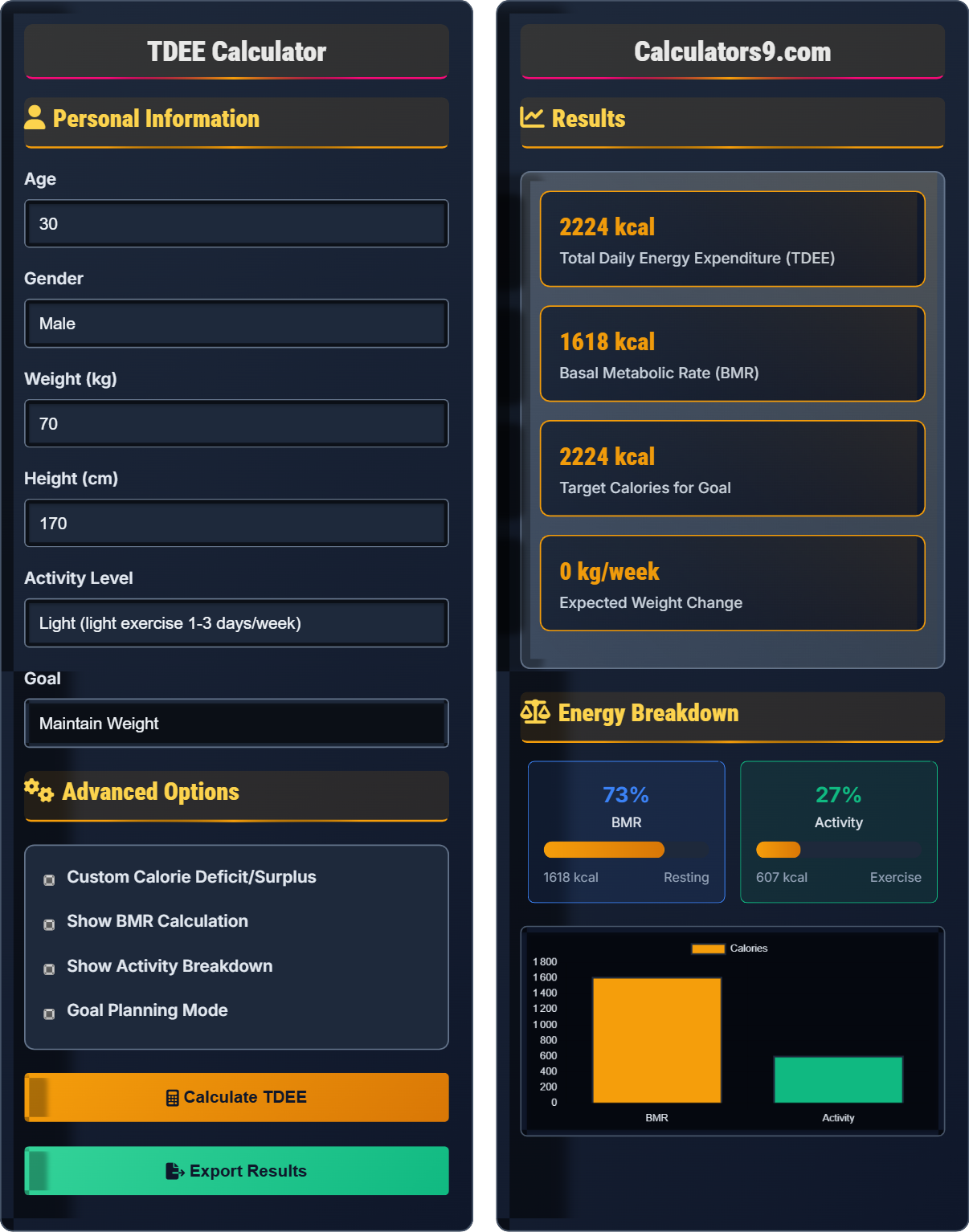
Total daily energy expenditure • Calorie calculator
TDEE Calculation Formulas:
Show the calculator\( \text{BMR} = 10 \times \text{weight(kg)} + 6.25 \times \text{height(cm)} - 5 \times \text{age(y)} + s \)
Where s = +5 (men) or -161 (women)
\( \text{TDEE} = \text{BMR} \times \text{Activity Multiplier} \)
\( \text{Goal Calories} = \text{TDEE} + \text{Deficit/Surplus} \)
Activity multipliers: Sedentary (1.2), Light (1.375), Moderate (1.55), Active (1.725), Very Active (1.9)
For a 70kg male, 175cm, 30y, moderately active:
BMR = 10×70 + 6.25×175 - 5×30 + 5 = 1,721 kcal
TDEE = 1,721 × 1.55 = 2,668 kcal
For weight loss: 2,668 - 500 = 2,168 kcal
Personal Information
Advanced Options
Results
Energy Breakdown
Comprehensive TDEE Guide
Total Daily Energy Expenditure (TDEE) is the total number of calories your body burns in a day, including all activities. It consists of four components: Basal Metabolic Rate (BMR), Thermic Effect of Food (TEF), Non-Exercise Activity Thermogenesis (NEAT), and Exercise Activity Thermogenesis (EAT). Understanding your TDEE is crucial for weight management and nutrition planning.
The standard TDEE calculation uses these formulas:
Where:
- \( s = +5 \) for men, \( -161 \) for women (Mifflin-St Jeor Equation)
- \( \text{Activity Multiplier} \) ranges from 1.2 (sedentary) to 1.9 (very active)
- \( \text{Goal Calories} = \text{TDEE} + \text{Deficit/Surplus} \)
Adjust TDEE based on your specific goals:
- Weight Loss: 500-750 kcal deficit = 0.5-1kg/week loss
- Weight Maintenance: Match TDEE exactly
- Weight Gain: 300-500 kcal surplus = 0.3-0.5kg/week gain
- Body Recomposition: Small deficit with high protein and resistance training
- Accuracy: Use a food scale and measure portions precisely
- Consistency: Track for at least 2-3 weeks before adjusting
- Flexibility: Adjust based on progress and lifestyle changes
- Reassessment: Recalculate TDEE every 4-6 weeks
- Monitoring: Track weight, measurements, and energy levels
TDEE Basics
BMR: 60-75% of TDEE, Activity: 15-30%, TEF: 10%, NEAT: 5-15%
\( \text{BMR} = 10 \times \text{weight(kg)} + 6.25 \times \text{height(cm)} - 5 \times \text{age(y)} + s \)
Where s = +5 (men) or -161 (women)
- TDEE = BMR × Activity Multiplier
- 1 lb weight loss = ~3,500 kcal deficit
- Recalculate when activity level changes
Goal-Specific TDEE
Deficit: 500-750 kcal for weight loss, Surplus: 300-500 for gain
- Weight loss: TDEE - 500 to -750 kcal
- Weight gain: TDEE + 300 to +500 kcal
- Maintenance: TDEE ± 100 kcal
- Recomposition: TDEE - 200 kcal + high protein
- Minimum 1,200 calories for women
- Minimum 1,500 calories for men
- Adjust for progress plateaus
- Consider metabolic adaptation
TDEE Learning Quiz
What percentage of TDEE does Basal Metabolic Rate (BMR) typically represent?
The answer is C) 60-75%. BMR (Basal Metabolic Rate) represents the largest component of TDEE, accounting for 60-75% of total daily energy expenditure. BMR is the energy required to maintain basic physiological functions at rest, including breathing, circulation, and cellular processes. The remaining 25-40% comes from physical activity, digestion, and non-exercise movement.
Understanding the components of TDEE helps explain why some people struggle to lose weight despite exercise. Since BMR accounts for the majority of calorie burn, factors like muscle mass, age, and hormones significantly impact metabolism. Physical activity, while important, contributes a smaller percentage to total calorie burn than many people realize.
BMR: Basal Metabolic Rate - calories needed at complete rest
TDEE: Total Daily Energy Expenditure - all calories burned daily
Metabolism: Chemical processes that sustain life
• BMR is the largest component of TDEE (60-75%)
• Muscle mass increases BMR
• Age decreases BMR over time
• Resistance training increases muscle mass and BMR
• Adequate sleep supports healthy metabolism
• Stay hydrated to maintain metabolic efficiency
• Overestimating calories burned through exercise
• Not accounting for BMR as the largest energy component
• Assuming all weight loss comes from exercise alone
Calculate the TDEE for a 25-year-old female who weighs 60kg, is 165cm tall, and has a moderate activity level. Then calculate her target calories for weight loss.
Step 1: Calculate BMR using Mifflin-St Jeor equation
BMR = 10×60 + 6.25×165 - 5×25 - 161
BMR = 600 + 1,031.25 - 125 - 161 = 1,345.25 kcal (rounded to 1,345)
Step 2: Calculate TDEE using activity multiplier
For moderate activity: TDEE = 1,345 × 1.55 = 2,085 kcal
Step 3: Calculate target for weight loss
Weight loss target: 2,085 - 500 = 1,585 kcal
Therefore, her TDEE is 2,085 kcal and her target for weight loss is 1,585 kcal.
This calculation demonstrates the systematic approach to TDEE determination. We start with BMR using the most accurate equation available, then adjust for activity level. The weight loss target is achieved by creating a caloric deficit, typically 500 kcal for safe, sustainable weight loss of about 0.5kg per week.
Mifflin-St Jeor: Most accurate BMR equation for adults
Caloric Deficit: Consuming fewer calories than burned
Safe Weight Loss: 0.5-1kg per week
• Use correct gender-specific BMR equation
• Apply appropriate activity multiplier
• Maximum safe deficit is 750 kcal/day
• Round BMR to nearest 5 kcal for practicality
• Verify activity level matches actual lifestyle
• Ensure minimum 1,200 calories for women
• Using wrong gender constant in BMR equation
• Applying incorrect activity multiplier
• Creating too large a caloric deficit
James is a 28-year-old male athlete who weighs 85kg and is 180cm tall. He trains intensely 6 days per week and has a physically demanding job. Calculate his TDEE and determine his caloric needs for muscle gain. How many calories should he consume daily?
Step 1: Calculate BMR for James
BMR = 10×85 + 6.25×180 - 5×28 + 5
BMR = 850 + 1,125 - 140 + 5 = 1,840 kcal
Step 2: Apply activity multiplier for very active
TDEE = 1,840 × 1.9 = 3,496 kcal
Step 3: Calculate target for muscle gain
For muscle gain: 3,496 + 500 = 3,996 kcal
James should consume approximately 4,000 calories daily for muscle gain.
Athletes with high activity levels and physically demanding jobs have significantly higher TDEE values. The "very active" category (1.9 multiplier) is appropriate for someone who exercises 6-7 days per week AND has a physically demanding job. For muscle gain, a moderate surplus (300-500 kcal) is sufficient to support growth while minimizing fat gain.
Very Active: Hard exercise 6-7 days/week + physical job
Muscle Gain: Requires caloric surplus and resistance training
Physical Job: Work involving significant physical activity
• Athletes need higher caloric intake for performance
• Muscle gain requires moderate caloric surplus
• Monitor performance and adjust calories as needed
• Prioritize protein intake for muscle synthesis
• Include post-workout nutrition for recovery
• Underestimating caloric needs for very active individuals
• Not accounting for physical job demands
• Overestimating surplus needed for muscle gain
Sarah calculated her TDEE as 2,200 kcal and has been eating 1,700 kcal daily for 8 weeks. Initially, she lost weight, but now she's experiencing a plateau. What could be causing this, and what should she do? Calculate her new TDEE considering metabolic adaptation.
Plateau causes: Metabolic adaptation (decreased BMR), reduced NEAT, muscle loss, hormonal changes.
Metabolic adaptation typically reduces TDEE by 10-15% during weight loss.
New TDEE estimate: 2,200 × 0.875 = 1,925 kcal (12.5% reduction)
New weight loss target: 1,925 - 500 = 1,425 kcal
Alternatively, she could increase activity to boost TDEE or implement a diet break.
Metabolic adaptation is a normal physiological response to sustained caloric restriction. As body weight decreases, BMR naturally declines because there's less body mass to maintain. Additionally, the body becomes more efficient at using energy, leading to further reductions in calorie needs. This explains why weight loss often slows over time.
Metabolic Adaptation: Decrease in energy expenditure during weight loss
NEAT: Non-Exercise Activity Thermogenesis
Diet Break: Temporary return to maintenance calories
• Reassess TDEE every 4-6 weeks during weight loss
• Plateaus are normal and expected
• Gradual weight loss is more sustainable
• Take progress photos and measurements, not just weight
• Consider periodic diet breaks to reset metabolism
• Focus on non-scale victories (energy, strength, clothes fit)
• Creating larger deficits when plateauing (counterproductive)
• Not reassessing TDEE during weight loss journey
• Giving up during plateaus instead of adjusting strategy
Which activity level classification is most appropriate for someone who works a sedentary office job but goes to the gym 4 times per week for 1-hour strength training sessions?
The answer is C) Moderate (1.55). This person engages in structured exercise 4 times per week, which fits the moderate activity level description. While their job is sedentary, the regular exercise sessions significantly increase their daily energy expenditure. The moderate category (1.55) applies to those doing moderate exercise 3-5 days per week, which matches their routine.
Activity level classification considers both structured exercise and daily movement. While this person has a sedentary job, their regular gym attendance moves them into the moderate category. The key is consistency - exercising 4 times per week regularly meets the criteria for moderate activity. This highlights the importance of considering the whole picture when assessing activity levels.
Structured Exercise: Planned, repetitive physical activity
Non-Exercise Activity: Daily movements (walking, stairs, etc.)
Activity Consistency: Regular exercise pattern
• Consider both exercise and daily movement
• Frequency matters more than intensity for classification
• Consistency determines activity level category
• Include daily movement like walking stairs or parking farther away
• Be honest about actual activity level, not ideal
• Reassess if exercise routine changes significantly
• Overestimating activity level based on good intentions
• Not considering the impact of sedentary work
• Misclassifying inconsistent exercise routines
FAQ
Q: How often should I recalculate my TDEE?
A: Recalculate your TDEE every 4-6 weeks during active weight loss or gain phases, or whenever your activity level changes significantly. For example, if you initially calculated a TDEE of 2,500 kcal and lost 5kg over 6 weeks, your new TDEE would be approximately 2,500 × (current weight/original weight) = 2,500 × (65/70) = 2,321 kcal. Weight changes and activity modifications both affect energy needs.
Q: Is it safe to eat below my calculated TDEE for weight loss?
A: Yes, but with important limitations. Safe caloric deficits are 500-750 kcal below TDEE for most people. However, women should not go below 1,200 calories and men below 1,500 calories per day without medical supervision. For example, if your TDEE is 2,000 kcal, a safe weight loss target is 1,500-1,700 kcal daily. Going too low can lead to muscle loss, hormonal disruptions, and metabolic damage.