Pregnancy Calculator
Due Date Calculator • 2026 Edition
Naegele's Rule Formula:
Calculate NowDue Date = LMP + 7 days - 3 months + 1 year
Where:
- LMP: Last Menstrual Period (first day of last period)
- + 7 days: Accounts for average ovulation timing
- - 3 months: Gestational period adjustment
- + 1 year: Full pregnancy cycle
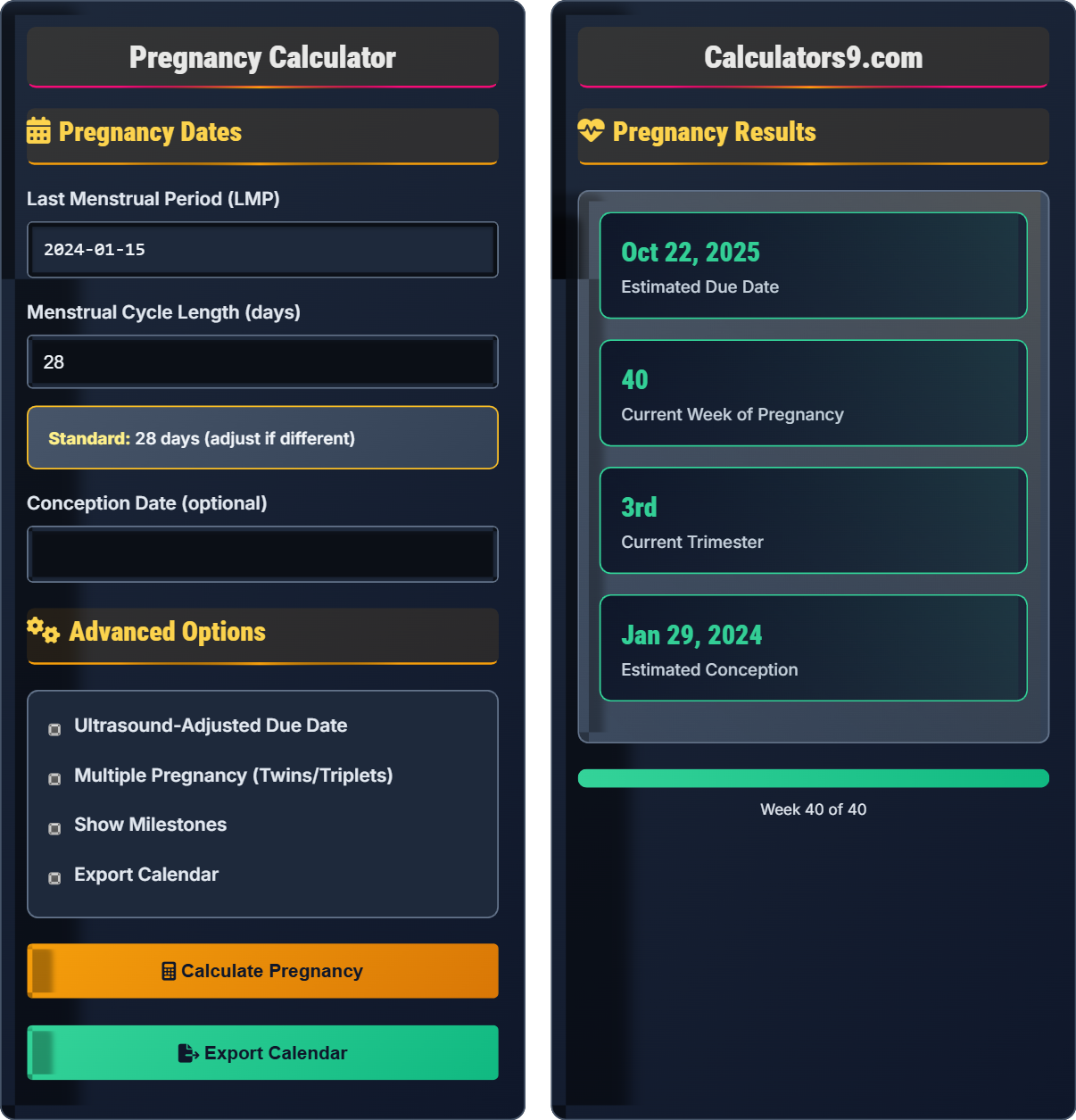
Example: If LMP was January 15, 2024:
Step 1: Add 7 days → January 22, 2024
Step 2: Subtract 3 months → October 22, 2024
Step 3: Add 1 year → October 22, 2025
Therefore, the estimated due date is October 22, 2025. This assumes a standard 28-day menstrual cycle.
Pregnancy Dates
Advanced Options
Pregnancy Results
Embryonic development, organ formation, increased hormone levels
Fetal growth acceleration, movement felt, anatomy scan
Rapid weight gain, lung maturation, preparation for birth
| Trimester | Weeks | Key Events | Tests |
|---|---|---|---|
| 1st | 1-12 | Organ formation | Blood tests |
| 2nd | 13-27 | Movement felt | Anatomy scan |
| 3rd | 28-40 | Final preparations | Strep test |
Implantation occurs, hCG hormone detectable
All major organs formed, heartbeat detectable
End of first trimester, gender may be visible
Midpoint, fetal movement felt, gender confirmed
Third trimester begins, baby viable outside womb
- Heartbeat detectable
- Brain development accelerating
- Arm and leg buds forming
Pregnancy Calculation Guide
Naegele's Rule is the standard method for calculating estimated due dates in obstetrics. Developed by Dr. Franz Carl Naegele in the 1800s, it assumes a regular 28-day menstrual cycle with ovulation occurring on day 14.
The traditional Naegele's Rule:
Alternative formula for irregular cycles:
Where:
- LMP: First day of Last Menstrual Period
- Cycle Length: Average length of menstrual cycles
- 280: Standard gestational days (40 weeks)
Critical development periods occur throughout pregnancy:
- Weeks 3-8: Organogenesis - formation of all major organs
- Weeks 9-12: Fetal period begins, recognizable human form
- Weeks 16-20: Quickening - first fetal movements felt
- Weeks 24-28: Viability - baby can potentially survive outside womb
- Weeks 32-40: Final maturation and weight gain
- Track your cycle: Know your average length for accurate calculations
- Confirm with ultrasound: Early scans provide more accurate dating
- Consider irregularities: Adjust for cycles shorter or longer than 28 days
- Plan appointments: Schedule prenatal visits around key milestones
- Monitor symptoms: Track changes throughout each trimester
Pregnancy Basics
The calculated date when delivery is expected, based on LMP and cycle length.
LMP + 7 days - 3 months + 1 year
Standard 280-day (40-week) gestation period.
- Assumes 28-day cycle with ovulation on day 14
- Actual delivery within 2 weeks is normal
- Ultrasound provides more accurate dating
Trimester Guide
Most critical period for development, highest miscarriage risk.
- Week 4: Implantation
- Week 6: Heartbeat detected
- Week 8: All organs formed
- Week 12: End of embryonic stage
- Take prenatal vitamins
- Avoid harmful substances
- Monitor for complications
- Establish prenatal care
Pregnancy Calculation Quiz
According to Naegele's Rule, what is the correct sequence for calculating an estimated due date?
The answer is B) LMP + 7 days - 3 months + 1 year. This is the standard Naegele's Rule formula used in obstetrics. The sequence adds 7 days to account for ovulation timing, subtracts 3 months to adjust for the gestational period, and adds 1 year to complete the full pregnancy cycle.
Naegele's Rule simplifies the complex process of pregnancy dating by using a standardized formula. The addition of 7 days compensates for the typical 14-day ovulation cycle, while subtracting 3 months aligns with the approximate gestational period. The formula assumes a regular 28-day menstrual cycle with ovulation on day 14.
Naegele's Rule: Standard method for calculating estimated due dates
LMP: Last Menstrual Period - first day of last menstrual bleeding
EDD: Estimated Due Date - calculated delivery date
• Sequence matters: add 7, subtract 3 months, add 1 year
• Assumes regular 28-day cycles
• Actual delivery within 2 weeks is considered normal
• Remember: Add 7, subtract 3, add 1
• Always use first day of LMP
• Confirm with early ultrasound
• Reversing the order of operations
• Using the last day of period instead of first
• Forgetting to adjust for irregular cycles
Calculate the estimated due date for a woman whose LMP was March 15, 2024. Show your work using Naegele's Rule.
Using Naegele's Rule: LMP + 7 days - 3 months + 1 year
Given: LMP = March 15, 2024
Step 1: Add 7 days → March 15 + 7 = March 22, 2024
Step 2: Subtract 3 months → March 22 - 3 months = December 22, 2024
Step 3: Add 1 year → December 22, 2024 + 1 year = December 22, 2025
Therefore, the estimated due date is December 22, 2025.
This calculation demonstrates how Naegele's Rule accounts for the typical 280-day (40-week) gestational period. The formula works by adjusting the calendar to accommodate the biological timeline of pregnancy, assuming ovulation occurred 14 days after the LMP and fertilization followed shortly after.
Gestational Age: Time elapsed since first day of LMP
Conception Age: Time elapsed since fertilization
Full Term: Pregnancy lasting 37-42 weeks gestational age
• Always use the first day of LMP
• Account for month boundaries (March to December)
• Add full year to reach due date year
• Break down into steps: add, subtract, add
• Use calendar to visualize month transitions
• Verify with online calculators
• Adding months instead of subtracting
• Forgetting to add the year
• Miscounting days in months
Sarah has an irregular menstrual cycle that averages 32 days instead of the standard 28 days. Her LMP was February 10, 2024. Calculate her adjusted due date considering her longer cycle. (Hint: Standard gestation is 280 days, so adjust for the 4 extra days per cycle)
Step 1: Calculate standard due date using Naegele's Rule
February 10, 2024 + 7 days = February 17, 2024
February 17, 2024 - 3 months = November 17, 2024
November 17, 2024 + 1 year = November 17, 2025
Step 2: Adjust for longer cycle (32 vs 28 days)
Difference per cycle = 32 - 28 = 4 days longer
Since her cycle is longer, ovulation occurs later, so due date should be later
Adjusted due date = November 17, 2025 + 4 days = November 21, 2025
Therefore, Sarah's adjusted due date is November 21, 2025.
Women with longer cycles typically ovulate later in their cycle, which shifts the conception date and subsequently the due date. The adjustment accounts for the delayed ovulation. For every day the cycle is longer than 28 days, the due date moves forward by one day.
Irregular Cycle: Menstrual cycle varying more than 7-9 days
Ovulation Timing: Day of egg release, varies with cycle length
Conception Window: Days when pregnancy is possible
• Longer cycles = later ovulation = later due date
• Shorter cycles = earlier ovulation = earlier due date
• Adjust by the difference from 28 days
• Track cycles for 3-6 months to find average
• Use ovulation predictor kits for accuracy
• Confirm with early ultrasound
• Not adjusting for irregular cycles
• Adjusting in wrong direction
• Using single cycle length instead of average
If a woman's due date is June 15, 2026, calculate the start and end dates for each trimester. When will each trimester begin and end?
First, determine LMP: Due date - 280 days = LMP
June 15, 2026 - 280 days = September 8, 2025 (LMP)
Now calculate trimesters from LMP:
Step 1: First Trimester (Weeks 1-12) = September 8, 2025 to December 2, 2025
Step 2: Second Trimester (Weeks 13-27) = December 3, 2025 to April 2, 2026
Step 3: Third Trimester (Weeks 28-40) = April 3, 2026 to June 15, 2026
Therefore: 1st Trimester: Sep 8, 2025 - Dec 2, 2025; 2nd Trimester: Dec 3, 2025 - Apr 2, 2026; 3rd Trimester: Apr 3, 2026 - Jun 15, 2026
Trimesters divide pregnancy into three approximately equal periods, each with distinct developmental milestones. The first trimester is critical for organ formation, the second for growth, and the third for maturation. Understanding these periods helps plan prenatal care appropriately.
Trimester: One-third of pregnancy (approximately 13-14 weeks)
Organogenesis: Formation of organs (weeks 3-8)
Viability: Ability of fetus to survive outside womb (~24 weeks)
• First Trimester: Weeks 1-12 (organ formation)
• Second Trimester: Weeks 13-27 (growth period)
• Third Trimester: Weeks 28-40 (maturation period)
• First trimester: Highest miscarriage risk
• Second trimester: Most comfortable period
• Third trimester: Preparation for birth
• Miscounting weeks between trimesters
• Not accounting for exact date calculations
• Confusing gestational vs conception age
During which week of pregnancy does the embryo become a fetus and organogenesis largely complete?
The answer is C) Week 12. At the end of week 12, the embryonic period ends and the fetal period begins. By this time, all major organs have been formed (organogenesis), and the developing baby is now referred to as a fetus rather than an embryo. This marks the end of the first trimester.
The distinction between embryo and fetus is important in medical terminology and has legal implications in many jurisdictions. The embryonic period (weeks 1-10) is characterized by rapid cell division and organ formation, while the fetal period (weeks 11-birth) focuses on growth and maturation of established structures.
Embryo: Developing baby from conception to end of week 10
Fetus: Developing baby from week 11 until birth
Organogenesis: Formation of organs and organ systems
• Embryonic period: Weeks 1-10 (organ formation)
• Fetal period: Weeks 11-birth (growth and maturation)
• Critical period for teratogen exposure: Weeks 3-8
• Remember: Embryo to Fetus at 12 weeks
• First trimester is most sensitive period
• Take prenatal vitamins before conception
• Confusing embryo/fetus transition timing
• Underestimating sensitivity of early pregnancy
• Misunderstanding organ formation timeline
FAQ
Q: How accurate is the due date calculated by Naegele's Rule?
A: Naegele's Rule is surprisingly accurate for women with regular 28-day cycles, but only about 4% of women deliver on their exact due date. The rule assumes:
- A 28-day cycle with ovulation on day 14
- 40-week (280-day) gestation period
- Regular, predictable ovulation timing
For more accuracy, early ultrasounds (especially before 12 weeks) provide better dating by measuring fetal crown-rump length. The margin of error decreases from ±2 weeks (LMP method) to ±5-7 days (early ultrasound).
Q: How do irregular cycles affect due date calculations?
A: Irregular cycles complicate due date calculations because ovulation timing varies. The adjustment formula is:
Adjusted Due Date = Standard Due Date + (Cycle Length - 28 days)
For example, with a 32-day cycle: Due date moves 4 days later (32-28=4). Women with irregular cycles should rely more heavily on early ultrasound dating, as hormonal fluctuations can significantly impact ovulation timing and thus conception date.