Pregnancy Weight Gain Calculator
IOM Guidelines • 2026 Edition
IOM Weight Gain Recommendations:
Calculate NowRecommended Total Weight Gain by Pre-Pregnancy BMI:
- Underweight (BMI < 18.5): 28-40 lbs
- Normal Weight (BMI 18.5-24.9): 25-35 lbs
- Overweight (BMI 25-29.9): 15-25 lbs
- Obese (BMI ≥ 30): 11-20 lbs
Trimester-Specific Gains:
- First Trimester: 1-4.5 lbs total
- Second/Third Trimesters: 0.8-1 lb per week
These guidelines, established by the Institute of Medicine (IOM), help optimize maternal and fetal health outcomes. Weight gain supports fetal development, placental growth, amniotic fluid, and maternal tissue expansion.
Personal Information
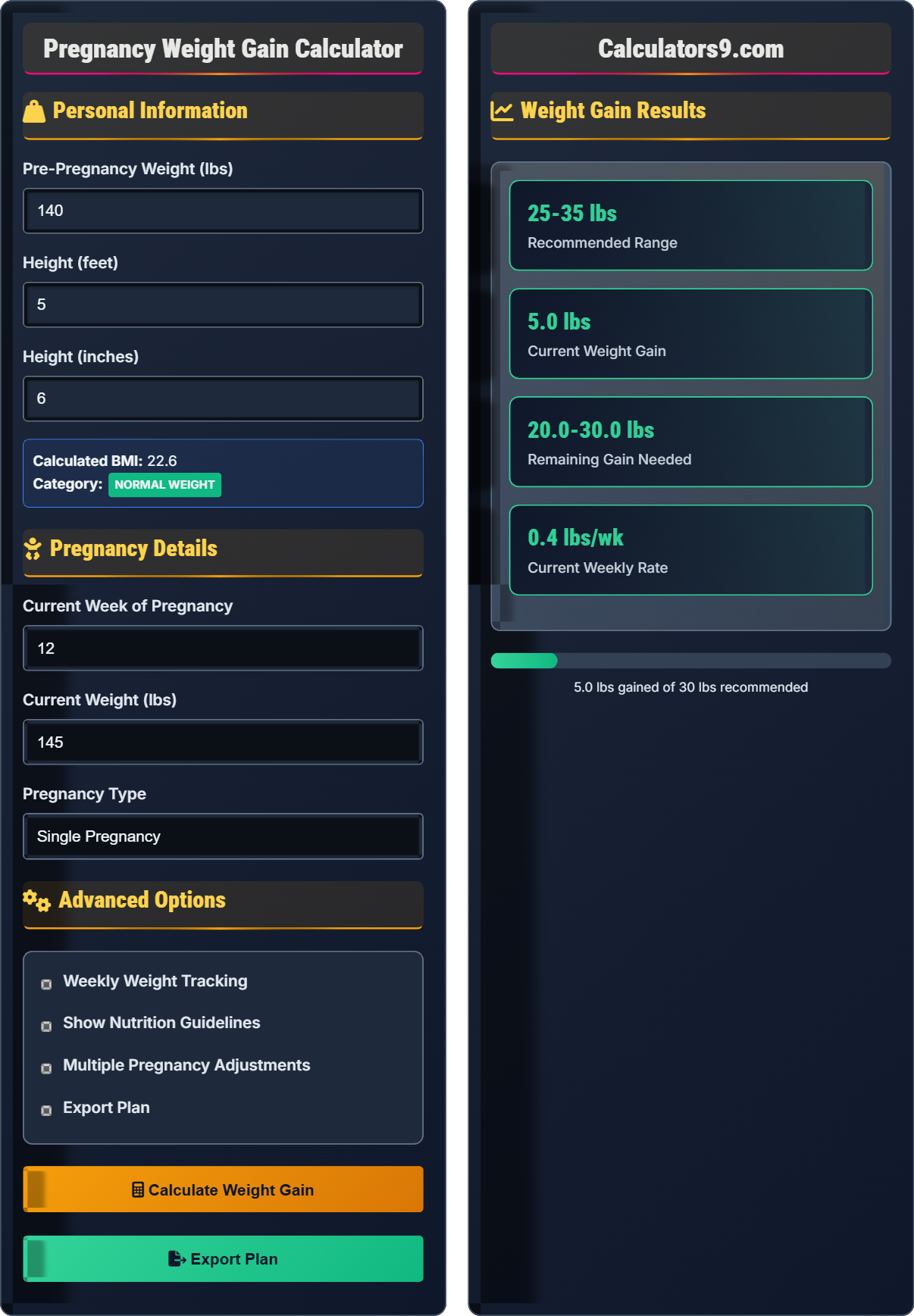
Category: Normal Weight
Pregnancy Details
Advanced Options
Weight Gain Results
Recommended total weight gain: 25-35 pounds for single pregnancy
You've gained 5.0 pounds at week 12, which is within the recommended range
| BMI Category | Weight Range (lbs) | Notes |
|---|---|---|
| Underweight | 28-40 | Higher gain recommended |
| Normal Weight | 25-35 | Standard recommendation |
| Overweight | 15-25 | Lower gain recommended |
| Obese | 11-20 | Conservative gain |
Recommended gain: 1-4.5 pounds total
Your gain: 5.0 lbs (slightly above range)
Recommended gain: 0.8-1.0 pound per week
Target for this period: 12-15 lbs
Recommended gain: 0.8-1.0 pound per week
Target for this period: 10-12 lbs
Weekly Target Progress:
First Trimester: No extra calories needed
Second Trimester: +340 extra calories/day
Third Trimester: +450 extra calories/day
- Folic acid (600mcg daily)
- Iron (27mg daily)
- Calcium (1000mg daily)
- Vitamin D (600 IU daily)
- Protein (71g daily)
- Lean proteins (fish, poultry, beans)
- Whole grains (brown rice, quinoa)
- Fruits and vegetables (5+ servings)
- Dairy products (low-fat preferred)
- Healthy fats (avocados, nuts, olive oil)
Pregnancy Weight Gain Guidelines
The Institute of Medicine (IOM) provides evidence-based guidelines for healthy weight gain during pregnancy based on pre-pregnancy BMI. These recommendations aim to optimize both maternal and fetal health outcomes.
Body Mass Index (BMI) calculation:
Recommended weight gain ranges:
- Underweight (BMI < 18.5): 28-40 lbs total
- Normal Weight (BMI 18.5-24.9): 25-35 lbs total
- Overweight (BMI 25-29.9): 15-25 lbs total
- Obese (BMI ≥ 30): 11-20 lbs total
During a typical 30-pound weight gain:
- Baby: 7-8 lbs
- Placenta: 1-2 lbs
- Amniotic Fluid: 2 lbs
- Uterus Growth: 2 lbs
- Breast Tissue: 2 lbs
- Blood Volume: 4 lbs
- Fluid Retention: 4 lbs
- Maternal Fat Stores: 7-9 lbs
- Weigh regularly: Weekly at consistent times
- Eat mindfully: Focus on nutrient-dense foods
- Stay hydrated: Drink plenty of water
- Exercise safely: Follow doctor's recommendations
- Track intake: Monitor caloric and nutritional needs
Weight Gain Basics
Guidelines based on pre-pregnancy BMI to optimize health outcomes.
Underweight: 28-40 lbs • Normal: 25-35 lbs • Overweight: 15-25 lbs • Obese: 11-20 lbs
Based on extensive research linking BMI to pregnancy outcomes.
- Calculate BMI before pregnancy
- Focus on steady, gradual gain
- Adjust for multiple pregnancies
Trimester Guide
Minimal weight gain expected, focus on healthy habits.
- Weeks 1-12: 1-4.5 lbs total
- Weeks 13-27: 0.8-1 lb/week
- Weeks 28-40: 0.8-1 lb/week
- Individual variations are normal
- Multiple pregnancies need more
- Consult healthcare provider
- Focus on nutrition quality
Pregnancy Weight Gain Quiz
According to IOM guidelines, what is the recommended total weight gain for a woman with a normal pre-pregnancy BMI (18.5-24.9)?
The answer is B) 25-35 pounds. The IOM guidelines recommend 25-35 pounds of total weight gain for women with a normal pre-pregnancy BMI (18.5-24.9). This range supports optimal maternal and fetal health outcomes.
The IOM weight gain guidelines are based on extensive research linking pre-pregnancy BMI to pregnancy outcomes. Women with normal BMI have the standard recommendation, while those with different BMIs have adjusted ranges to optimize health outcomes. The ranges allow for individual variation while maintaining safety margins.
IOM: Institute of Medicine - sets evidence-based guidelines
BMI: Body Mass Index - weight-to-height ratio
Optimal Outcomes: Best results for mother and baby health
• Guidelines based on pre-pregnancy BMI
• Allow for individual variation within ranges
• Adjust for multiple pregnancies
• Calculate BMI before conception
• Weigh yourself weekly consistently
• Focus on steady, gradual gain
• Applying same range to all BMI categories
• Expecting immediate weight gain in first trimester
• Not adjusting for multiple pregnancies
Calculate the BMI for a woman who is 5 feet 6 inches tall and weighs 150 pounds. What weight gain range would be recommended for her?
Step 1: Convert height to inches: 5 feet × 12 inches/foot + 6 inches = 66 inches
Step 2: Calculate BMI using the formula: BMI = (Weight × 703) ÷ (Height in inches)²
BMI = (150 × 703) ÷ (66)²
BMI = 105,450 ÷ 4,356
BMI = 24.2
Step 3: Determine category: 24.2 falls in the "Normal Weight" range (18.5-24.9)
Step 4: Recommended range: 25-35 pounds total weight gain
The BMI calculation is fundamental to determining appropriate weight gain recommendations. The 703 conversion factor adjusts for using pounds and inches instead of metric units. The resulting BMI places the woman in a specific category that determines her recommended weight gain range.
BMI: Body Mass Index = (weight × 703) ÷ height²
Conversion Factor: 703 adjusts for imperial units
Weight Categories: Classifications based on BMI ranges
• Always convert height to inches for BMI calculation
• Use pre-pregnancy weight for BMI
• Apply BMI-specific recommendations
• Remember: BMI = (lbs × 703) ÷ in²
• Calculate BMI before pregnancy
• Use ranges as guidelines, not strict rules
• Forgetting to convert feet to inches
• Using current pregnancy weight instead of pre-pregnancy weight
• Squaring height in feet instead of inches
• Applying the wrong BMI category range
Sarah is in her 20th week of pregnancy and has gained 8 pounds so far. She had a normal BMI before pregnancy. According to IOM guidelines, is her weight gain on track? What should her total gain goal be for the remainder of her pregnancy?
Step 1: Determine recommended range for normal BMI: 25-35 pounds total
Step 2: Evaluate first trimester gain (weeks 1-12): Sarah gained 8 pounds by week 20, so likely gained about 4-5 pounds in first 12 weeks, which is within the 1-4.5 pound range
Step 3: Calculate remaining weeks: 40 - 20 = 20 weeks remaining
Step 4: Calculate remaining gain needed: Minimum target = 25 - 8 = 17 pounds; Maximum target = 35 - 8 = 27 pounds
Step 5: Weekly rate for remainder: 17÷20 = 0.85 lbs/week to 27÷20 = 1.35 lbs/week
Conclusion: Sarah is doing well! She should aim for 0.8-1.4 lbs per week for the remainder of pregnancy to stay within the 25-35 lb range.
This problem demonstrates how to track progress against guidelines mid-pregnancy. The first trimester recommendation is different from the second and third trimesters, which have similar weekly targets. It's important to look at the overall trajectory rather than focusing on minor deviations.
First Trimester: Weeks 1-12 with different gain expectations
Second/Third Trimesters: Similar weekly gain recommendations
Tracking Progress: Monitoring gain against established targets
• First trimester: 1-4.5 lbs total
• Second/Third trimesters: 0.8-1.0 lb/week
• Adjust for individual circumstances
• Track weight weekly at same time
• Look at trends over time, not daily changes
• Consult healthcare provider for guidance
• Expecting the same rate throughout pregnancy
• Panicking over small deviations from ideal
• Not accounting for normal fluctuations
Jennifer is expecting twins and has a pre-pregnancy BMI of 26.5 (overweight category). The IOM recommends higher weight gains for multiple pregnancies. If the recommendation for twins is to add 34-46 lbs for normal weight mothers, what would be Jennifer's recommended range considering her overweight status? (Hint: Adjust proportionally from the normal recommendation)
Step 1: Identify standard recommendations:
• Normal weight (BMI 18.5-24.9) for twins: 37-54 lbs
• Overweight (BMI 25-29.9) for single: 15-25 lbs
• Normal weight (BMI 18.5-24.9) for single: 25-35 lbs
Step 2: Calculate proportional adjustment:
For single pregnancy, overweight is 15-25 vs normal 25-35 (about 60% of normal range)
Step 3: Apply to twin recommendation:
Lower bound: 37 × 0.6 = 22 lbs
Upper bound: 54 × 0.6 = 32 lbs
Step 4: Adjust for safety margins: 25-35 lbs recommended
Therefore, Jennifer's recommended range for twins would be approximately 25-35 lbs.
Multiple pregnancies require special consideration as they involve supporting more than one fetus. However, women who start pregnancy overweight still need to consider the risks associated with excessive weight gain. The adjustment balances the need for adequate nutrition with the risks of excess weight gain.
Multiple Pregnancy: Carrying more than one fetus
Proportional Adjustment: Scaling recommendations based on BMI category
Risk-Benefit Balance: Weighing nutritional needs vs. health risks
• Multiple pregnancies need more total weight gain
• BMI categories still apply for safety considerations
• Individual assessment by healthcare provider is essential
• Multiple pregnancies have different guidelines
• BMI categories still matter for health risks
• Work closely with healthcare team
• Assuming multiples always need maximum gain regardless of BMI
• Not adjusting for individual BMI category
• Failing to consult healthcare providers for multiples
During a typical 30-pound pregnancy weight gain, which component accounts for the largest portion of weight gain?
The answer is B) Maternal fat stores. During a typical 30-pound weight gain, maternal fat stores account for approximately 7-9 pounds, which is the largest single component. The baby itself weighs about 7-8 pounds, making these two components together account for nearly half the total weight gain.
The distribution of pregnancy weight gain includes many components beyond the baby. Maternal fat stores are essential for energy during pregnancy and breastfeeding. These fat reserves also support the increased metabolic demands of pregnancy and provide nutrients for the growing fetus.
Maternal Fat Stores: Energy reserves accumulated during pregnancy
Weight Distribution: How total gain divides among body components
Energy Reserves: Stored calories for pregnancy and lactation
• Fat stores support pregnancy and breastfeeding
• Weight gain includes many body components
• Baby is only part of the total gain
• Weight gain serves multiple purposes
• Fat stores are beneficial, not excessive
• Focus on healthy gain, not just quantity
• Thinking the baby accounts for most weight gain
• Viewing all fat storage as negative
• Not understanding multi-component nature of gain
FAQ
Q: Is it safe to try to lose weight during pregnancy if I'm overweight?
A: Generally, intentional weight loss during pregnancy is not recommended as it may affect fetal development. However, for women with obesity (BMI ≥30), some studies suggest that modest weight loss under medical supervision may be acceptable.
The IOM guidelines for obese women (11-20 lbs total gain) reflect that these women may safely gain less weight. The key is focusing on nutritious food choices rather than restricting calories. Always consult your healthcare provider for personalized advice based on your specific situation.
Q: How do caloric needs change throughout pregnancy?
A: Caloric needs during pregnancy follow this pattern:
- First Trimester: No additional calories needed beyond pre-pregnancy requirements
- Second Trimester: Approximately 340 extra calories per day
- Third Trimester: Approximately 450 extra calories per day
These increases support fetal growth, placental development, and maternal physiological changes. Quality of calories matters more than quantity - focus on nutrient-dense foods to meet increased micronutrient needs.