Aviation Range Calculator
Flight range estimator • 2026 fuel efficiency
Breguet Range Equation:
Show the calculator\( R = \frac{V}{c} \times \frac{L}{D} \times \ln\left(\frac{W_i}{W_f}\right) \)
Where:
- R = Range (distance)
- V = True Airspeed
- c = Specific fuel consumption
- L/D = Lift-to-Drag ratio
- Wi = Initial weight (including fuel)
- Wf = Final weight (without fuel)
This equation describes the maximum distance an aircraft can fly based on its aerodynamic efficiency and fuel capacity.
Example: For an aircraft with 120 kts TAS, L/D of 10, and fuel fraction of 0.3:
If fuel represents 30% of total weight, Wi/Wf = 1/(1-0.3) = 1.43
Assuming c = 0.6 lbs/hr/lb thrust: R = (120/0.6) × 10 × ln(1.43) ≈ 680 nautical miles
Thus, the theoretical maximum range is approximately 680 nautical miles.
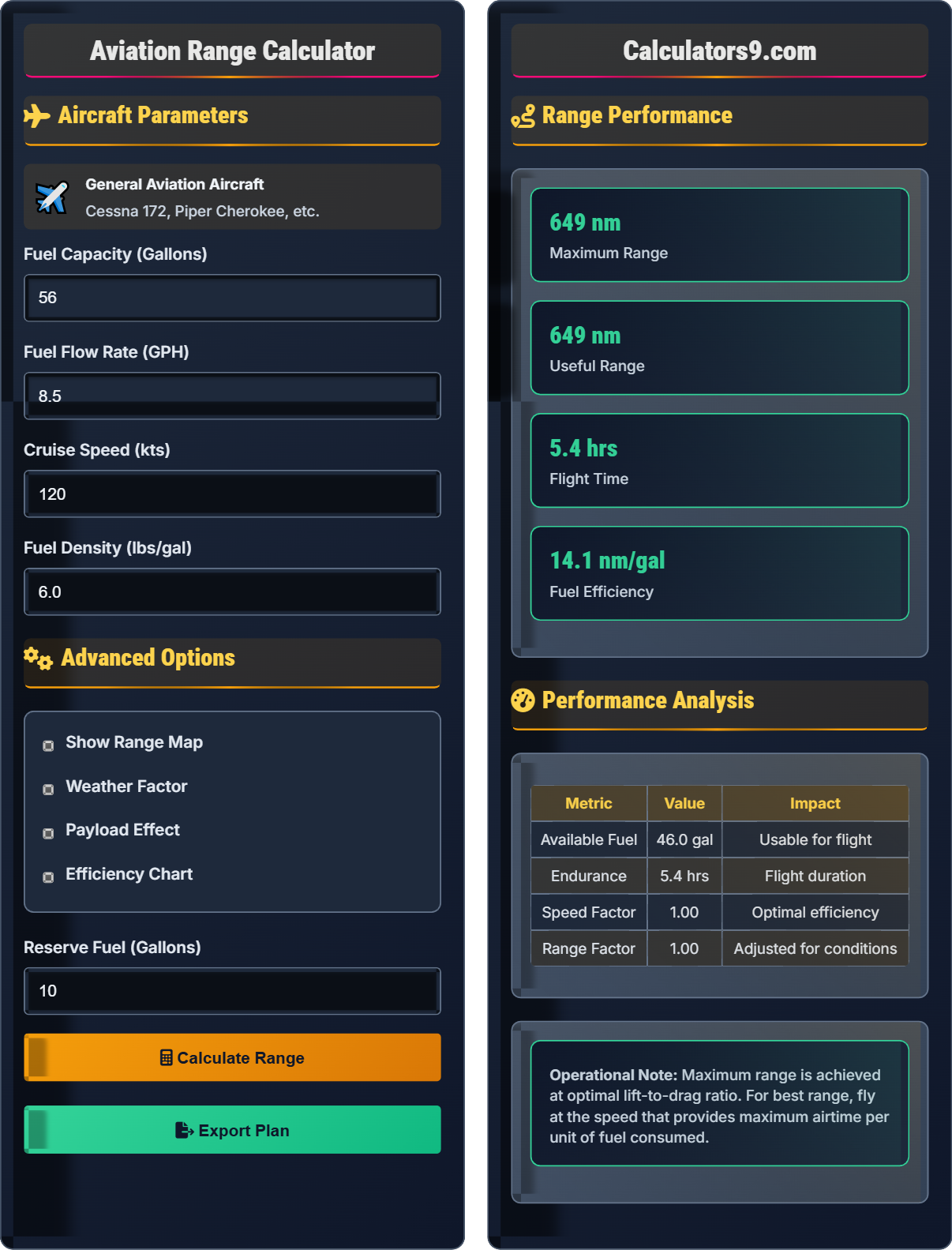
Aircraft Parameters
Advanced Options
Range Performance
Performance Analysis
| Metric | Value | Impact |
|---|---|---|
| Available Fuel | 46 gal | Usable for flight |
| Endurance | 5.4 hrs | Flight duration |
| Speed Factor | 1.00 | Optimal efficiency |
| Range Factor | 1.00 | Adjusted for conditions |
Range Fundamentals
Aircraft range is the maximum distance an aircraft can fly on a full load of fuel. It's determined by fuel capacity, consumption rate, and flight efficiency. Range is affected by payload, weather conditions, and operational factors.
Basic Range = Available Fuel × Fuel Efficiency
Where Fuel Efficiency = Speed ÷ Fuel Flow Rate (kts ÷ GPH = nm/gal)
Practical range accounts for reserves, weather, and operational requirements.
- Range decreases with headwinds
- Heavy loads reduce range
- Optimal speed maximizes range
- Always plan for reserves
Range Optimization
Maximum range is achieved at the speed where fuel consumption per nautical mile is minimized. This typically occurs at speeds slower than maximum endurance speed but faster than minimum sink rate speed.
- Operate at optimal altitude for weight
- Maintain lean mixture settings
- Minimize drag (flaps, gear, speed)
- Plan routes to avoid headwinds
- Reduce unnecessary weight
- Altitude affects engine efficiency
- Temperature impacts air density
- Wind direction changes effective range
- Weight affects fuel consumption
Aviation Range Quiz
Which factor has the greatest impact on maximum range performance?
The answer is B) Lift-to-Drag ratio. The lift-to-drag ratio (L/D) is the most critical factor in determining maximum range. According to the Breguet range equation, range is directly proportional to L/D. An aircraft with a higher L/D ratio can fly farther on the same amount of fuel because it generates more lift relative to the drag it creates.
The lift-to-drag ratio represents aerodynamic efficiency. A glider with an L/D of 50 can travel 50 feet forward for every foot of altitude lost, while an aircraft with L/D of 10 travels only 10 feet forward per foot of altitude loss. In powered flight, a higher L/D means less thrust (and thus less fuel) is needed to maintain level flight.
Lift-to-Drag Ratio (L/D): Measure of aerodynamic efficiency
Drag: Force opposing aircraft motion
Lift: Force supporting aircraft weight
• Range ∝ L/D ratio
• Higher L/D = Greater range
• Optimal L/D occurs at specific angle of attack
• Clean configuration maximizes L/D
• Optimal speed for range is usually slower than max speed
• Wing loading affects L/D performance
• Confusing range with endurance
• Not considering L/D optimization
• Ignoring drag sources during flight
An aircraft has a fuel capacity of 100 gallons and burns fuel at 10 GPH while cruising at 150 knots. Calculate the maximum range and endurance. Show your work.
Step 1: Calculate endurance (maximum flight time)
Endurance = Total Fuel ÷ Fuel Flow Rate
Endurance = 100 gallons ÷ 10 GPH = 10 hours
Step 2: Calculate maximum range
Range = Speed × Endurance
Range = 150 knots × 10 hours = 1,500 nautical miles
Maximum endurance: 10 hours
Maximum range: 1,500 nautical miles
This calculation assumes constant speed and fuel flow throughout the flight. In practice, range might be optimized by flying at a different speed than the cruise speed shown. The maximum range condition occurs when the aircraft flies at the speed that gives the best nautical miles per gallon, which is typically slower than the speed for maximum endurance.
Endurance: Maximum flight time possible
Range: Maximum distance possible
Fuel Flow Rate: Fuel consumed per hour
• Endurance = Fuel ÷ Flow Rate
• Range = Speed × Time
• Optimal range speed differs from max endurance
• Max endurance speed is slower than max range
• Consider headwinds/tailwinds in planning
• Account for fuel reserves in usable range
• Confusing range speed with endurance speed
• Not accounting for fuel reserves
• Assuming constant fuel flow throughout flight
An aircraft has a maximum range of 1,000 nautical miles in calm winds at 150 knots true airspeed. If it encounters a 30-knot headwind, what is the new effective range? How does this affect flight planning?
Original calculation: Range = 1,000 nm at 150 kts
With 30-knot headwind: Ground Speed = 150 - 30 = 120 knots
Time to consume same fuel: Time = 1,000 nm ÷ 150 kts = 6.67 hours
New range = Ground Speed × Time = 120 knots × 6.67 hours = 800 nautical miles
The effective range is reduced by 200 nautical miles (20%) due to the headwind.
Headwinds significantly impact range because they reduce ground speed while fuel consumption remains essentially constant. The aircraft takes longer to cover the same distance, consuming more fuel in the process. This is why pilots must consider wind forecasts during flight planning and may need to carry additional fuel or plan intermediate stops.
True Airspeed (TAS): Aircraft speed through air mass
Ground Speed (GS): Aircraft speed over ground
Headwind: Wind opposing flight direction
• Range affected by ground speed, not airspeed
• Headwinds reduce effective range
• Tailwinds increase effective range
• Calculate ground speed for accurate range
• Plan routes to minimize headwind exposure
• Consider wind aloft forecasts in planning
• Calculating range using airspeed instead of ground speed
• Not considering wind effects on fuel planning
• Assuming range is independent of wind conditions
An aircraft has a basic range of 800 nm with empty weight. With maximum payload, its range decreases to 600 nm. If the aircraft is loaded with 75% of maximum payload, estimate the range using linear interpolation. Explain the physics behind payload-range relationship.
Range reduction with full payload: 800 - 600 = 200 nm
At 75% payload: Reduction = 200 nm × 0.75 = 150 nm
Estimated range = 800 - 150 = 650 nautical miles
The physics: Increased weight requires more lift, which increases induced drag. More drag requires more thrust (and fuel) to maintain speed. Additionally, heavier aircraft may need to fly at less efficient altitudes due to performance limitations.
The relationship between weight and range is governed by the fact that lift must equal weight in level flight. As weight increases, the aircraft must fly at a higher angle of attack to generate more lift, which increases induced drag. This requires more thrust and fuel consumption, reducing range. The effect is approximately linear for small weight changes but becomes exponential for large changes.
Induced Drag: Drag caused by lift generation
Parasite Drag: Drag from air resistance
Weight Penalty: Range reduction due to excess weight
• Range decreases with increasing weight
• Induced drag increases with weight
• Optimal loading balances mission needs with range
• Remove unnecessary weight to maximize range
• Consider fuel dumping for emergency situations
• Plan payload vs. range trade-offs
• Ignoring payload effects on range
• Not accounting for fuel burn-off during flight
• Assuming range is independent of aircraft weight
How does altitude affect aircraft range for a normally aspirated piston aircraft?
The answer is B) Range peaks at an optimal altitude. For normally aspirated aircraft, range initially improves with altitude due to reduced air density (less parasite drag) and improved specific fuel consumption. However, beyond the optimal altitude, engine power decreases significantly due to reduced air density, which outweighs the drag reduction benefits.
The relationship between altitude and range is complex. At lower altitudes, climbing reduces drag and improves efficiency. However, as altitude increases further, the engine's power output drops due to reduced air pressure. For normally aspirated engines, there's an optimal altitude where the benefits of reduced drag are balanced against the penalties of reduced power. Turbocharged engines can maintain sea-level power to higher altitudes, extending the beneficial altitude range.
Normally Aspirated: Engine without forced induction
Specific Fuel Consumption: Fuel per unit of power produced
Optimal Altitude: Altitude giving best performance
• Range vs. altitude curve has peak value
• Normally aspirated engines lose power with altitude
• Turbocharged engines maintain power to higher altitudes
• Consult POH for altitude performance charts
• Consider oxygen requirements above 12,500'
• Account for temperature inversions affecting performance
• Assuming higher altitude always means better range
• Not considering engine limitations with altitude
• Ignoring temperature effects on density altitude
FAQ
Q: How do I determine the optimal speed for maximum range in my aircraft?
A: The optimal speed for maximum range is typically found in your Pilot's Operating Handbook (POH) as "maximum range speed" or "long-range cruise speed." It's generally slower than maximum cruise speed but faster than maximum endurance speed.
For most general aviation aircraft, maximum range speed is approximately 1.3 times the minimum sink rate speed. The principle is to fly at the speed where fuel consumption per nautical mile is minimized: Best Range Speed = Minimize (Fuel Flow ÷ Ground Speed).
In practice, this often corresponds to 65-75% power at altitude. For example, in a Cessna 172 at 75% power, the best range speed might be around 110-115 KIAS at 7,000 feet. Always consult your specific aircraft's performance charts.
Q: What's the difference between ferry range and normal operational range?
A: Ferry range is the maximum possible distance an aircraft can fly under ideal conditions, typically with maximum fuel and minimal payload. Normal operational range accounts for required reserves, normal payload, and realistic operating conditions.
Ferry range calculations exclude required fuel reserves and assume optimal conditions. For example, a Cessna 182 might have a normal range of 800 nautical miles with legal fuel reserves and typical payload, but a ferry range of 1,200 nautical miles with maximum fuel and no passengers. The formula for maximum range is: R = (Efficiency Factor) × (Fuel Energy Content) / (Drag), where the efficiency factor includes engine efficiency and propeller efficiency.