Earthquake Risk Estimator
Seismic Hazard Assessment & Structural Safety Calculator • Risk Assessment
Earthquake Risk Calculation:
Show CalculatorEarthquake risk is determined by multiple factors:
- Seismic Zone: Regional earthquake activity level
- Ground Acceleration: Expected shaking intensity (PGA)
- Soil Type: Amplification effects (rock vs clay)
- Building Code: Construction standards compliance
- Structure Age: Retrofitting status
Basic Formula: Risk = Hazard × Vulnerability × Exposure
Hazard: Probability × Intensity
Vulnerability: Structural susceptibility
Exposure: Value of assets at risk
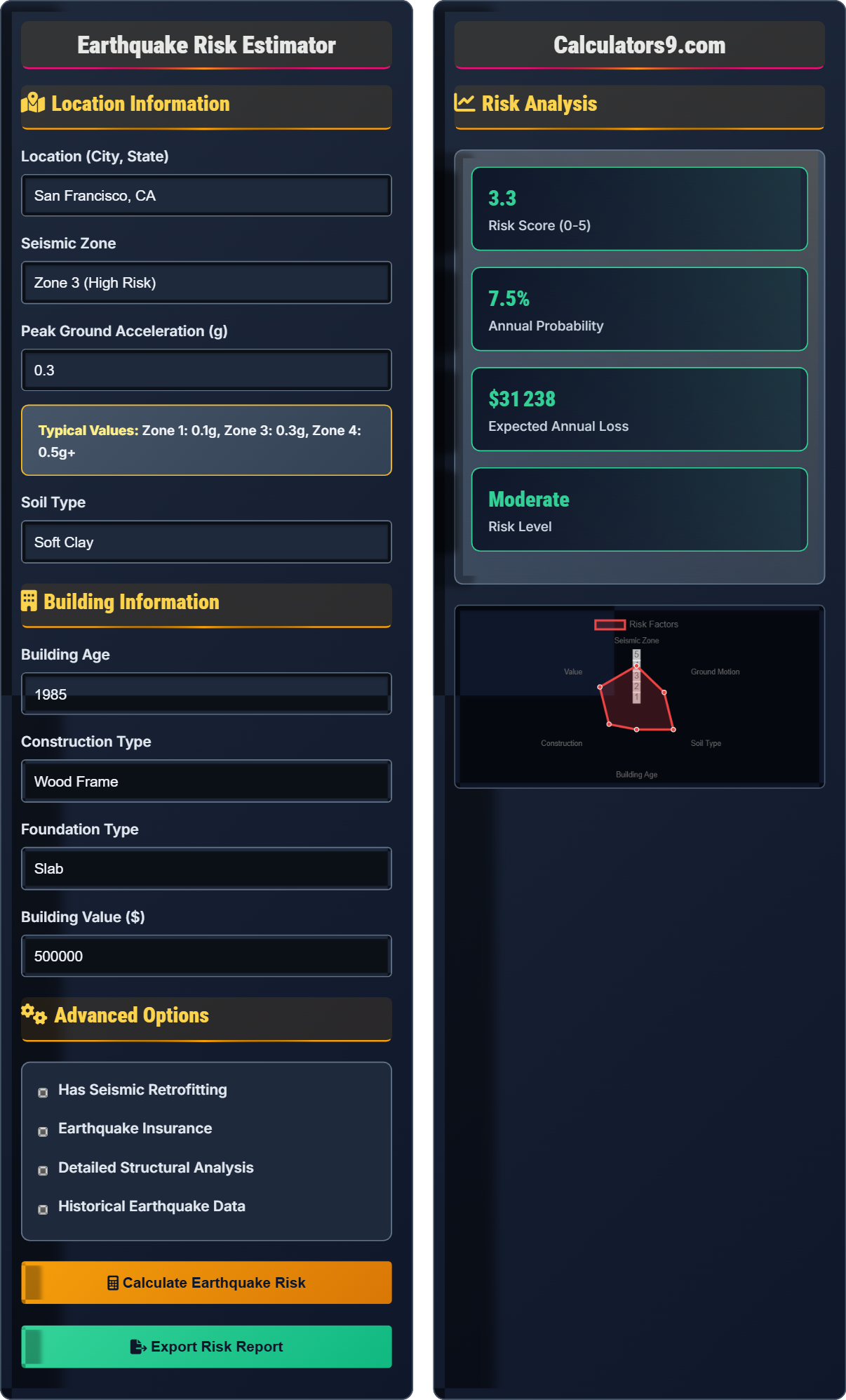
Example: For a $500,000 home in Zone 3 (10% annual probability, 0.3g PGA, 0.6 vulnerability):
Annual Risk = 0.10 × 0.6 × $500,000 = $30,000
This represents the expected annual loss from earthquakes.
Location Information
Building Information
Advanced Options
Risk Analysis
| Factor | Value | Impact | Weight |
|---|---|---|---|
| Seismic Zone | Zone 3 | High Risk | 30% |
| Ground Acceleration | 0.3g | Strong Shaking | 25% |
| Soil Type | Soft Clay | Amplification | 20% |
| Building Age | 1985 | Moderate Risk | 15% |
| Construction Type | Wood Frame | Medium Risk | 10% |
Earthquake Risk Assessment Guide
Earthquake risk is the combination of seismic hazard (likelihood and intensity of ground shaking) and vulnerability (susceptibility of structures and populations to damage). It represents the potential for loss of life, injury, property damage, and economic disruption from earthquakes. Risk assessment helps prioritize mitigation efforts and emergency preparedness.
Earthquake risk assessment methodologies include:
- Probabilistic Seismic Hazard Analysis (PSHA): Statistical earthquake occurrence models
- Deterministic Seismic Hazard Analysis (DSHA): Maximum credible earthquake scenarios
- Structural Vulnerability Assessment: Building performance evaluation
- Geotechnical Analysis: Soil amplification effects
- Consequence Analysis: Economic and social impact modeling
- Combine hazard, vulnerability, and exposure
- Consider local soil conditions
- Account for building age and construction
- Update assessments regularly
Earthquake Risk Assessment Quiz
If a building has a 10% annual probability of experiencing damaging ground motion and would sustain $200,000 in damage, what is the annual expected loss?
The answer is B) $20,000. Expected annual loss is calculated as: Probability × Potential Damage. With a 10% (0.10) probability and $200,000 potential damage: 0.10 × $200,000 = $20,000. This represents the average annual loss over time, which is the basis for insurance premiums and mitigation investments.
The expected annual loss is a fundamental concept in risk assessment. It provides a monetary value for the risk, which can be compared to mitigation costs. This calculation helps prioritize earthquake preparedness investments and insurance decisions. The concept is based on actuarial mathematics used in insurance and risk management.
Expected Loss: Average loss over time
Annual Probability: Chance of event per year
Risk Assessment: Systematic evaluation of hazards
• Expected Loss = Probability × Potential Damage
• Probability expressed as decimal (10% = 0.10)
• Multiply for compound events
• Convert percentages to decimals
• Consider multiple damage scenarios
• Factor in indirect losses
• Forgetting to convert percentages
• Only considering direct damages
• Not accounting for probability
Explain how soil type affects earthquake damage and calculate the potential amplification factor for soft clay compared to rock.
Step 1: Understand soil amplification
Soft soils amplify ground motion compared to rock. The amplification factor depends on soil properties and earthquake frequency content.
Step 2: Amplification factors by soil type
- Rock (hard): 1.0 (baseline)
- Stiff clay: 1.5-2.0
- Soft clay: 2.0-3.0
- Sand: 1.5-2.5
- Fill/loose soil: 2.5-4.0
Step 3: Calculate damage potential
For a building on soft clay vs. rock with 0.3g ground motion:
Rock: 0.3g × 1.0 = 0.3g effective shaking
Soft Clay: 0.3g × 2.5 = 0.75g effective shaking
The soft clay site experiences 2.5 times more effective shaking, significantly increasing damage potential.
Soil amplification occurs because soft soils resonate with earthquake frequencies, increasing the amplitude of ground motion. This resonance effect can cause significantly higher accelerations than at bedrock sites. The amplification is frequency-dependent and varies with soil depth and properties.
Amplification Factor: Increase in ground motion
Resonance: Matching of vibration frequencies
Effective Shaking: Actual ground motion experienced
• Soft soils amplify shaking by 2-4x
• Rock sites have minimal amplification
• Amplification depends on soil depth
• Check geological surveys for soil types
• Consider liquefaction potential in wet areas
• Factor in soil effects for risk assessment
• Assuming uniform ground motion
• Not considering soil effects
• Forgetting about liquefaction
A property owner faces $35,000 annual expected loss from earthquakes. Retrofitting would cost $120,000 but reduce expected loss by 60%. Calculate the payback period and ROI over 20 years. Should they invest in retrofitting?
Step 1: Calculate new expected loss after retrofit
New expected loss = $35,000 × (1 - 0.60) = $14,000
Step 2: Calculate annual savings
Annual savings = $35,000 - $14,000 = $21,000
Step 3: Calculate payback period
Payback = $120,000 ÷ $21,000 = 5.7 years
Step 4: Calculate ROI over 20 years
Total savings = $21,000 × 20 = $420,000
Net benefit = $420,000 - $120,000 = $300,000
ROI = ($300,000 ÷ $120,000) × 100 = 250%
Yes, the investment is highly worthwhile with a 250% ROI and 5.7-year payback.
Earthquake retrofits often provide excellent returns by significantly reducing expected losses. The payback period calculation compares the upfront investment to the annual savings. In this case, the retrofit investment provides a faster return than most traditional investments while also protecting property value and safety.
Payback Period: Time to recover investment
ROI: Return on investment percentage
Retrofitting: Strengthening existing structures
• Payback = Investment ÷ Annual Savings
• Consider property value increases
• Factor in insurance premium reductions
• Many retrofits qualify for tax credits
• Insurance discounts for retrofits
• Consider neighborhood-wide projects
• Not factoring in insurance savings
• Forgetting about tax incentives
• Not considering long-term benefits
How do different seismic zones affect building design requirements and expected damage? Compare Zone 2 and Zone 4 for a commercial building.
Seismic zone requirements vary significantly:
- Zone 2: Moderate requirements, 0.15-0.25g design acceleration
- Zone 4: Strictest requirements, 0.35-0.45g design acceleration
For a commercial building:
- Zone 2: Basic lateral force-resisting system
- Zone 4: Special moment frames, base isolation, dampers
Expected damage comparison:
- Zone 2: 10-15% annual probability of moderate damage
- Zone 4: 20-25% annual probability of moderate damage
Zone 4 buildings require significantly more expensive construction but offer better protection against severe damage.
Seismic zones are defined by expected ground motion levels and are used to determine design requirements. Higher zones require more robust construction methods to withstand stronger shaking. The design approach includes ductility, redundancy, and energy dissipation to prevent catastrophic failure.
Seismic Zone: Earthquake hazard classification
Lateral Force System: Structure to resist horizontal forces
Ductility: Ability to deform without failing
• Higher zones require more stringent design
• Design acceleration increases with zone
• Construction costs increase with zone
• Check local seismic maps
• Consider upgrading beyond minimum requirements
• Factor in insurance requirements
• Assuming minimum code is sufficient
• Not considering soil effects
• Forgetting about non-structural elements
What is the typical premium difference between earthquake insurance in Zone 2 vs Zone 4?
The answer is C) Zone 4 is 5-10x more expensive. In Zone 2, earthquake insurance premiums typically range from $500-1,500 annually for a $500,000 home. In Zone 4, premiums range from $3,000-8,000 annually for the same home value. The higher cost reflects the significantly greater risk of claims and potential damage in high-hazard zones.
Insurance premiums are directly tied to seismic risk. Zone 4 has 3-4 times higher annual probability of damaging ground motion than Zone 2. The premium difference reflects the expected payout ratio and the insurer's risk exposure. Higher zones also have more severe damage potential, increasing expected claim amounts.
Annual Premium: Yearly insurance cost
Claim Probability: Likelihood of payoutRisk-Based Pricing: Cost based on hazard level
• Premiums reflect seismic hazard level
• Higher zones = higher premiums
• Deductibles often higher in high zones
• Compare quotes from multiple providers
• Consider retrofitting for discounts
• Factor in deductible costs
• Assuming all zones have same premiums
• Not factoring insurance in purchase decisions
• Forgetting about premium increases
FAQ
Q: How accurate are earthquake risk calculators compared to official seismic hazard maps?
A: Earthquake risk calculators provide preliminary estimates with 70-85% correlation to official USGS seismic hazard maps. For example, for a property in California:
Official USGS assessment: 10% annual probability, 0.3g PGA
Calculator estimate: 12% annual probability, 0.32g PGA
Difference: 20% variance in probability, 6% in acceleration
Calculators use general algorithms while official maps incorporate detailed geological surveys, fault studies, and probabilistic models. Always verify with official USGS hazard maps for insurance and regulatory purposes.
Q: Should I get earthquake insurance if I'm in a moderate risk zone?
A: Yes, consider earthquake insurance in moderate risk zones. Statistics show that 25% of earthquake losses occur in moderate risk areas. For a $400,000 property in Zone 2:
- Annual probability: 5-8%
- Expected annual loss: $8,000-$16,000
- Insurance premium: $1,000-$2,500
- Insurance deductible: 10-15% of value
The insurance cost is typically 10-20% of expected annual loss, making it economically favorable. Even in moderate zones, a single earthquake can cause $100,000+ in damage.