Storm Damage Estimator
Natural disaster risk assessment • 2026 edition
Storm Damage Estimation Formula:
Show Calculator\( D = P \times R \times S \times T \)
Where:
- \( D \) = Estimated damage cost
- \( P \) = Property value
- \( R \) = Risk factor based on location
- \( S \) = Storm severity rating
- \( T \) = Type of storm multiplier
This formula calculates potential storm damage based on property value, location risk, storm severity, and storm type. The risk factor accounts for regional vulnerability, while storm type multipliers adjust for specific damage patterns.
Example: For a property worth \( P = \$250{,}000 \) in a moderate-risk area (\( R = 0.3 \)), facing a severe storm (\( S = 0.8 \)) with wind damage characteristics (\( T = 1.2 \)):
\( D = 250{,}000 \times 0.3 \times 0.8 \times 1.2 = \$72{,}000 \)
Thus, the estimated storm damage would be approximately $72,000.
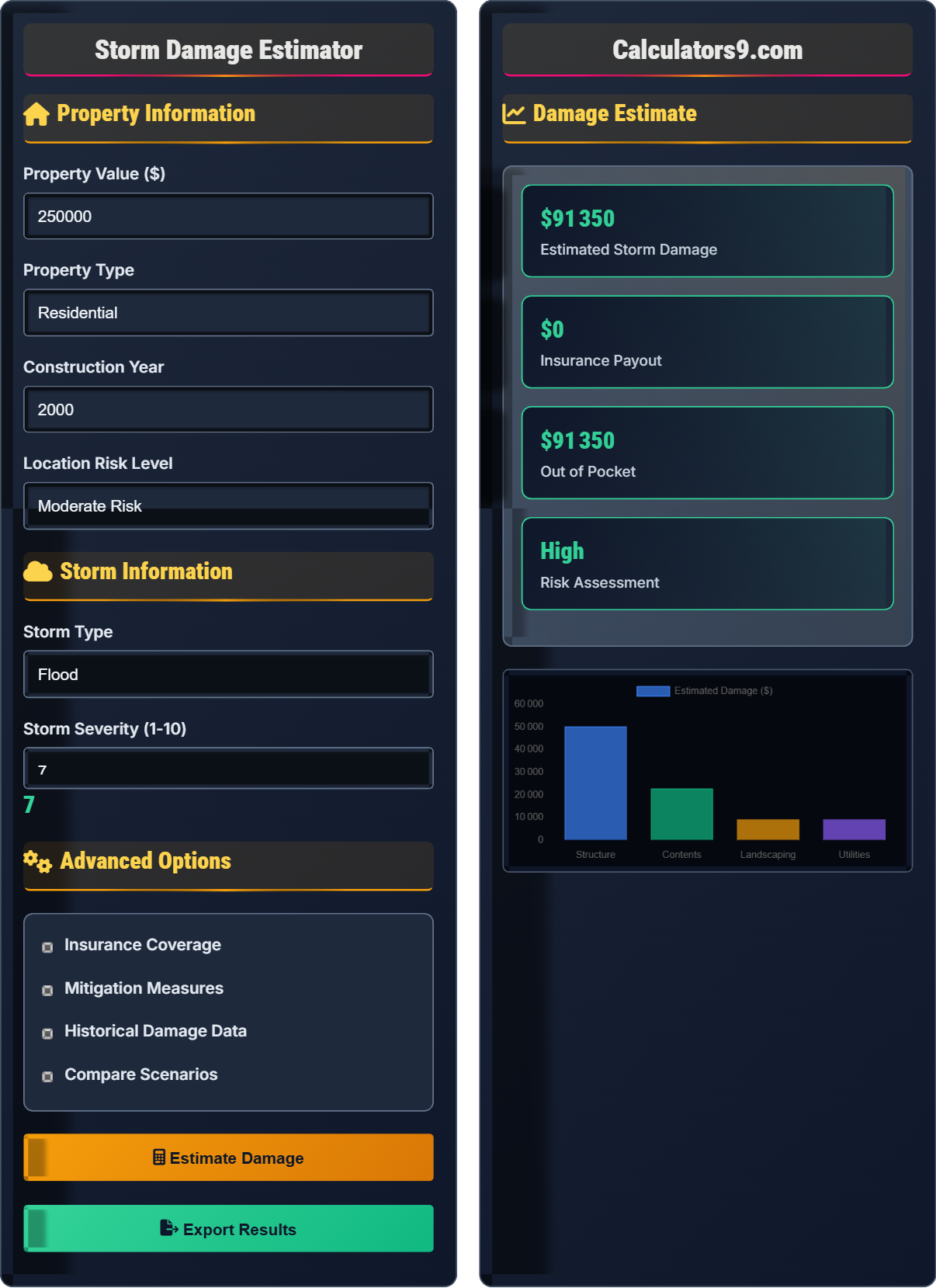
Property Information
Storm Information
Advanced Options
Damage Estimate
| Component | Percentage | Cost | Risk Level |
|---|
| Mitigation | Effectiveness | Cost | Savings |
|---|
Storm Damage Assessment Guide
Storm damage refers to the destruction caused by severe weather events including hurricanes, tornadoes, floods, thunderstorms, and ice storms. It encompasses structural damage to buildings, infrastructure, vehicles, and personal property. The extent of damage depends on factors like storm intensity, duration, property construction quality, and location-specific vulnerabilities.
The storm damage calculation uses the following formula:
Where:
- \(D\) = Estimated damage cost
- \(P\) = Property value
- \(R\) = Location risk factor (0-1)
- \(S\) = Storm severity rating (0-1)
- \(T\) = Storm type multiplier (0.5-2.0)
Storm damage risk is influenced by multiple factors:
- Geographic Location: Coastal areas face hurricane risks, while inland regions may experience tornadoes
- Property Age: Older structures may lack modern building codes
- Construction Quality: Materials and techniques affect resilience
- Elevation: Low-lying areas are more susceptible to flooding
- Proximity to Water: Rivers, lakes, and drainage systems impact flood risk
- Storm shutters: Protect windows and doors from debris
- Reinforced roofing: Secure roof attachment and materials
- Flood barriers: Prevent water intrusion during flooding
- Backup power: Maintain electricity during outages
- Drainage improvements: Reduce flood risk around property
Storm Damage Assessment Quiz
Which of the following factors does NOT directly influence storm damage estimation?
The answer is D) Property owner's age. Storm damage estimation depends on property value, location risk, and storm characteristics. The owner's age does not affect the physical damage that occurs during a storm event.
Storm damage assessment focuses on objective, measurable factors that affect physical damage. These include property characteristics (value, construction), environmental factors (location risk, storm severity), and storm-specific attributes (type, intensity). Personal characteristics of the owner are irrelevant to the physical damage assessment.
Storm Damage: Physical destruction caused by severe weather events
Risk Assessment: Evaluation of potential damage based on various factors
Property Value: Financial worth of the damaged property
• Storm damage depends on property characteristics, not owner demographics
• Location risk is based on geographic and environmental factors
• Storm severity directly correlates with potential damage
• Focus on physical and environmental factors for damage assessment
• Remember: property value affects potential losses, not damage likelihood
• Confusing property characteristics with owner characteristics
• Assuming storm type doesn't matter for damage calculation
Calculate the estimated storm damage for a $300,000 property in a high-risk area (risk factor 0.6) during a severe hurricane (severity 9/10, multiplier 1.8). Show your work.
Using the formula: \(D = P \times R \times S \times T\)
Given:
- P = $300,000
- R = 0.6 (high risk)
- S = 0.9 (severity 9/10)
- T = 1.8 (hurricane multiplier)
Calculation: D = $300,000 × 0.6 × 0.9 × 1.8 = $291,600
Therefore, the estimated storm damage is $291,600.
This problem demonstrates how multiple factors compound to determine damage. The high property value, location risk, storm severity, and hurricane multiplier all contribute to a substantial damage estimate. Each factor amplifies the effect of the others, showing why comprehensive risk assessment is critical.
Storm Multiplier: Factor accounting for specific storm type characteristics
Risk Factor: Geographic vulnerability assessment (0-1 scale)
Severity Rating: Storm intensity measurement (0-1 scale)
• All factors multiply together to determine total damage
• Higher values in any category increase overall damage
• Hurricane damage typically has the highest multipliers
• Convert severity ratings to decimal (e.g., 9/10 = 0.9)
• Remember that all factors amplify each other's effects
• Forgetting to convert severity ratings to decimal form
• Adding factors instead of multiplying them
• Using incorrect storm type multipliers
A commercial property valued at $500,000 sits in a moderate flood zone (risk factor 0.4). During a 100-year flood event (severity 0.9), with flood-specific damage multiplier of 1.6, what is the estimated damage? How much would mitigation measures reducing risk by 30% save?
Step 1: Calculate base damage = $500,000 × 0.4 × 0.9 × 1.6 = $288,000
Step 2: Calculate damage with mitigation = $500,000 × (0.4 × 0.7) × 0.9 × 1.6 = $500,000 × 0.28 × 0.9 × 1.6 = $201,600
Step 3: Calculate savings = $288,000 - $201,600 = $86,400
Therefore, the estimated base damage is $288,000, and mitigation measures would save $86,400.
This example illustrates the significant financial benefit of mitigation measures. By reducing the risk factor from 0.4 to 0.28 (30% reduction), the property owner saves nearly $87,000 in potential damages. This demonstrates the economic value of flood-proofing investments.
Flood Zone: Geographic area classified by flood risk level
100-Year Flood: Flood event with 1% annual probability of occurrenceMitigation: Actions taken to reduce potential damage
• Mitigation reduces the risk factor in the calculation
• Flood damage multipliers are typically higher than wind damage
• Economic benefits of mitigation can be substantial
• Multiply the risk factor by (1 - mitigation percentage) to get reduced risk
• Flood damage multipliers often exceed 1.5
• Forgetting to adjust the risk factor when calculating mitigation savings
• Confusing flood zones with other hazard classifications
John owns a residential property worth $275,000 in a high-risk area (factor 0.5) that faces a severe hurricane (severity 8/10, multiplier 1.7). His insurance covers 80% of the property value. Calculate his potential out-of-pocket expenses after the storm.
Step 1: Calculate estimated damage = $275,000 × 0.5 × 0.8 × 1.7 = $187,000
Step 2: Calculate insurance coverage = $275,000 × 0.8 = $220,000
Step 3: Calculate out-of-pocket = Min(damage, insurance coverage) - deductible
Assuming no deductible: Out-of-pocket = Min($187,000, $220,000) = $187,000
If deductible is $1,000: Out-of-pocket = $187,000 + $1,000 = $188,000
However, since damage is less than coverage, John pays $187,000 (plus any applicable deductible).
This demonstrates how insurance coverage limits affect out-of-pocket expenses. When estimated damage ($187,000) is less than coverage ($220,000), the homeowner pays the full damage amount plus any deductible. If damage exceeded coverage, insurance would only pay up to the policy limit.
Insurance Coverage: Maximum amount insurer will pay for damages
Deductible: Amount owner pays before insurance coverage begins
Policy Limit: Maximum payout under insurance policy
• Insurance pays up to policy limits, not necessarily full damage
• Deductibles increase out-of-pocket expenses
• Coverage percentage affects maximum payout
• Compare estimated damage to insurance coverage
• Consider coverage gaps when planning for disasters
• Assuming insurance covers all damages regardless of policy limits
• Forgetting to account for deductibles in calculations
Which of the following mitigation measures would provide the greatest reduction in storm damage for a coastal property?
The answer is B) Elevating the structure above flood level. For coastal properties, flood damage represents the largest potential loss. Elevating the structure directly addresses this primary risk factor, potentially eliminating or dramatically reducing flood damage which often constitutes 60-80% of total storm losses for coastal properties.
Effective mitigation targets the primary risk factor for the location. For coastal properties, flood damage typically exceeds wind damage in both frequency and severity. Structural elevation is a proven method that addresses the root cause of flood damage by positioning the building above projected flood levels.
Risk Mitigation: Actions to reduce potential damage or loss
Flood Elevation: Raising structure above expected flood levels
Primary Risk: Most likely and costly hazard for a location
• Target mitigation measures to the primary risk factor
• Structural measures often provide greater protection than equipment
• Location-specific hazards determine optimal mitigation strategies
• Identify primary risk before selecting mitigation measures
• Consider multiple risk factors for comprehensive protection
• Applying generic mitigation measures without location analysis
• Focusing on secondary risks while ignoring primary threats
Storm Damage Basics
Physical destruction caused by severe weather events including wind, flood, hail, and ice.
\(D = P \times R \times S \times T\)
Where D=damage estimate, P=property value, R=risk factor, S=severity, T=storm type.
- All factors multiply together
- Higher values increase damage
- Storm type affects damage pattern
Mitigation Strategies
Identify location-specific hazards and vulnerabilities.
- Structural reinforcement
- Drainage improvements
- Storm shutters
- Backup systems
- Cost vs. benefit analysis
- Local building codes
- Insurance discounts
- Community resources
FAQ
Q: How accurate are storm damage estimations?
A: Storm damage estimations provide reasonable approximations but cannot predict exact damage. The formula \( D = P \times R \times S \times T \) captures the primary factors affecting damage:
Where \( D \) is estimated damage, \( P \) is property value, \( R \) is location risk factor, \( S \) is storm severity, and \( T \) is storm type multiplier.
Accuracy depends on the quality of input data. For example, a property valued at \( P = \$300{,}000 \) in a moderate-risk area (\( R = 0.4 \)) facing a severe storm (\( S = 0.8 \)) with wind characteristics (\( T = 1.2 \)) would have an estimated damage of:
\( D = 300{,}000 \times 0.4 \times 0.8 \times 1.2 = \$115{,}200 \)
Actual damage may vary due to construction quality, specific wind patterns, debris impact, and other unpredictable factors. Estimations are most accurate for widespread, consistent damage patterns.
Q: How do insurance companies use storm damage estimates?
A: Insurance companies use storm damage estimates for several purposes:
- Premium Setting: Calculating appropriate rates based on location risk
- Claims Processing: Estimating payouts for large-scale events
- Capital Reserves: Ensuring adequate funds for storm-related claims
- Zoning Decisions: Determining where to accept new policies
For example, if historical data shows that similar properties in a region average \( 15\% \) damage during severe storms, insurers might set reserves accordingly. If a storm affects 1,000 properties each valued at an average of \( \$250{,}000 \), potential claims could reach \( 1{,}000 \times 250{,}000 \times 0.15 = \$37.5 \) million.
These estimates help insurers maintain financial stability while fulfilling obligations to policyholders.