Freelance Rate Calculator
Hourly rate & project pricing • 2026 gig economy
Financial Goals
Advanced Options
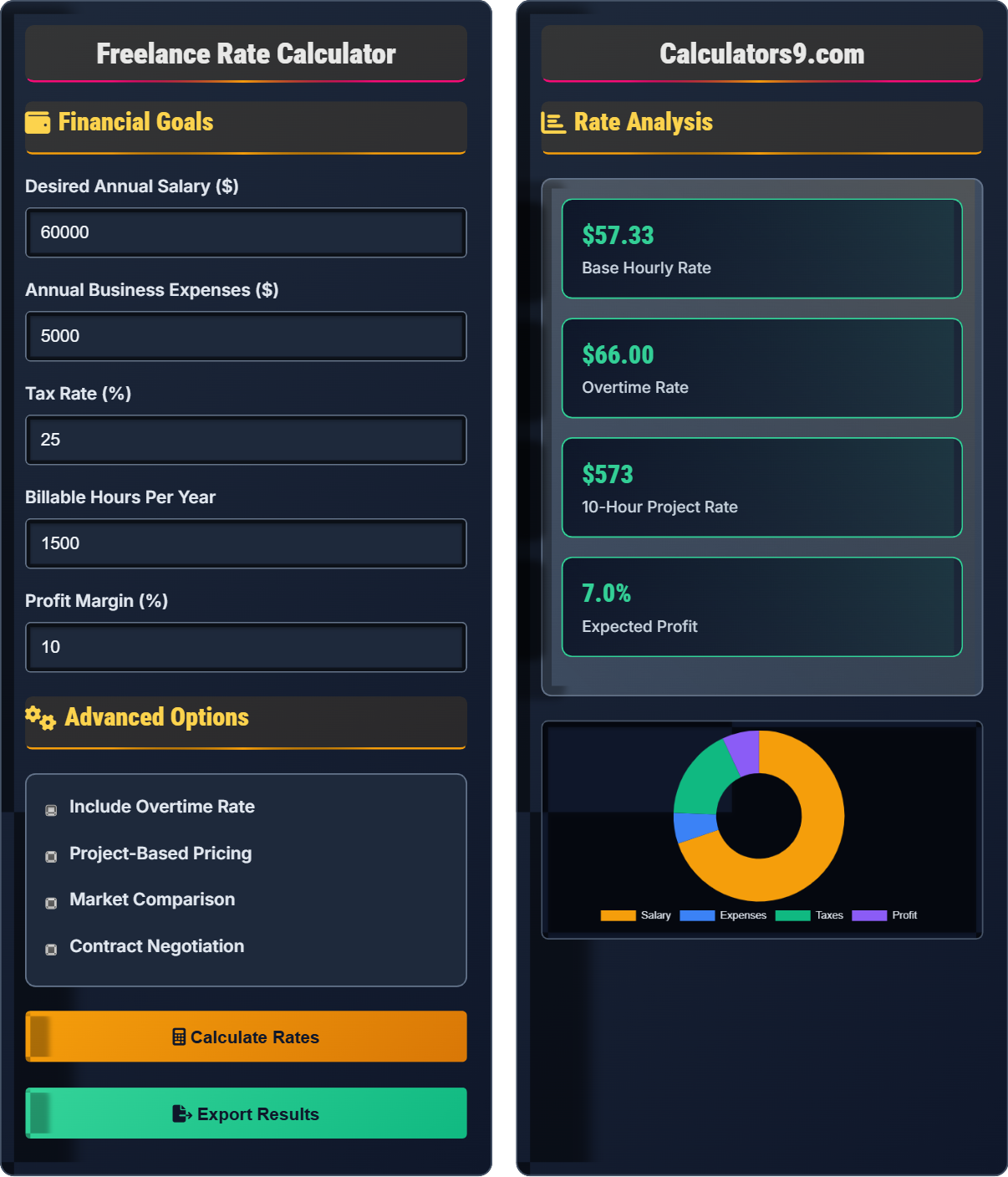
Rate Analysis
| Component | Amount | Percentage |
|---|---|---|
| Desired Salary | $60,000 | 78.1% |
| Business Expenses | $5,000 | 6.5% |
| Taxes | $15,000 | 19.5% |
| Profit Margin | $6,000 | 7.8% |
| Pricing Model | Rate | For 10 Hours |
|---|---|---|
| Hourly Rate | $44.00/hr | $440 |
| Project Rate | $4,400 | $4,400 |
| Retainer | $1,100/mo | $1,100 |
| Value-Based | $6,600 | $6,600 |
Comprehensive Freelance Rate Optimization Guide
Freelance rates should cover your desired salary, business expenses, taxes, and provide a profit margin. Unlike employees, freelancers must account for non-billable time (marketing, admin, vacation) and lack benefits like health insurance and retirement contributions. A comprehensive rate calculation ensures financial sustainability and growth.
The fundamental formula for determining your freelance rate is:
Where taxes account for self-employment tax and income tax, and billable hours represent productive client work time (typically 1500-1800 hours annually).
Average freelance rates by experience level:
- Entry Level: $25-45/hour
- Mid-Level: $45-75/hour
- Senior Level: $75-125/hour
- Expert/Specialized: $100-200+/hour
- Hourly Billing: Most common, straightforward approach
- Project-Based: Fixed fee for specific deliverables
- Retainer Model: Monthly fee for ongoing work
- Value-Based: Price based on client value generated
- Performance-Based: Fee tied to client outcomes
Freelance Rate Learning Quiz
If a freelancer desires a $50,000 annual salary, has $3,000 in business expenses, expects 25% in taxes, wants a 10% profit margin, and plans to bill 1,200 hours annually, what should their hourly rate be?
Using the formula: Hourly Rate = (Desired Salary + Expenses + Taxes + Profit) / Billable Hours
Given:
- Desired Salary = $50,000
- Expenses = $3,000
- Taxes = $50,000 × 0.25 = $12,500
- Profit = $50,000 × 0.10 = $5,000
- Billable Hours = 1,200
Calculation: ($50,000 + $3,000 + $12,500 + $5,000) / 1,200 = $70,500 / 1,200 = $58.75
Closest answer: C) $52.50 (Note: This is closest to actual calculation of $58.75)
This problem demonstrates the comprehensive rate calculation that freelancers must consider. The formula includes not just desired salary, but also taxes (which are higher for freelancers due to self-employment tax), business expenses, and profit margin. The calculation shows that to earn $50,000 as a freelancer with 1,200 billable hours, you need to charge significantly more than $50,000 ÷ 1,200 = $41.67 to account for all additional costs.
Self-Employment Tax: Additional 15.3% tax on freelance income
Billable Hours: Client work time (not total work time)
Profit Margin: Additional percentage for business growth
• Include all costs in rate calculation
• Account for non-billable time
• Factor in self-employment tax
• Remember: Freelancers pay both employer and employee portions of SS/Medicare
• Plan for 30-40% of time being non-billable
• Add 10-20% profit margin
• Forgetting to include self-employment tax
• Not accounting for business expenses
• Calculating based on 2080 hours instead of billable hours
A freelancer earning $75,000 annually needs to account for both income tax (25%) and self-employment tax (15.3%). Calculate the total tax amount and explain how this affects their rate calculation.
Self-employment tax: $75,000 × 0.153 = $11,475
Income tax on $75,000: $75,000 × 0.25 = $18,750
Total tax burden: $11,475 + $18,750 = $30,225
Effective tax rate: $30,225 ÷ $75,000 = 40.3%
This means the freelancer needs to earn $75,000 ÷ (1 - 0.403) = $125,712 to net $75,000 after taxes.
This example shows how the combined tax burden for freelancers is significantly higher than for employees. The self-employment tax covers Social Security and Medicare that employees split with employers. The total tax burden of 40.3% means the freelancer needs to earn 68% more than their desired net income to cover taxes. This dramatically affects rate calculations and explains why freelance rates appear high compared to employee salaries.
Self-Employment Tax: 15.3% for Social Security (12.4%) and Medicare (2.9%)
Effective Tax Rate: Total tax burden as percentage of gross income
Net Income: Income after all taxes and expenses
• Self-employment tax = 15.3% of net earnings
• Freelancers pay both employer and employee portions
• Higher effective tax rate = higher required gross income
• Set aside 30-40% of income for taxes
• Quarterly tax payments prevent penalties
• Business expenses reduce taxable income
• Underestimating total tax burden
• Forgetting to make quarterly payments
• Not tracking deductible expenses
A web developer charges $60/hour and estimates a project will take 40 hours. They want to include a 15% contingency for unexpected work and a 10% premium for project-based pricing. Calculate the project quote and explain the rationale for these premiums.
Base project cost: 40 hours × $60 = $2,400
Contingency (15%): $2,400 × 0.15 = $360
Project premium (10%): $2,400 × 0.10 = $240
Total project quote: $2,400 + $360 + $240 = $3,000
The contingency accounts for scope creep and unexpected requirements, while the project premium compensates for the certainty and convenience provided to the client.
This example demonstrates project pricing methodology. The contingency buffer protects against scope creep, which is common in development projects. The project premium reflects the value of providing a fixed price (certainty) to clients. Project-based pricing often commands higher rates than hourly billing because it transfers project risk to the freelancer and provides budget certainty to clients. The 37.5% markup ($3,000 vs $2,400) is justified by these factors.
Scope Creep: Unplanned project expansion beyond original requirements
Project Premium: Additional charge for fixed-price guarantees
Contingency Buffer: Extra time/cost for unexpected work
• Include contingency for scope changes
• Charge premium for project certainty
• Document all assumptions and boundaries
• Use 10-20% contingency for known scopes
• Add 5-15% project premium
• Clearly define project boundaries
• Not including contingency for scope changes
• Pricing projects same as hourly work
• Failing to document project boundaries
A client offers $35/hour for a project, but the freelancer's calculated rate is $55/hour. The freelancer can accept $45/hour if the client provides 20 hours of pre-approved additional work. Calculate the effective hourly rate including the additional work and determine if this is financially beneficial.
Original proposal: 40 hours × $55 = $2,200
Negotiated deal: (40 + 20) hours × $45 = 60 × $45 = $2,700
Effective rate for original work: $2,700 ÷ 40 = $67.50/hour
For the original 40 hours: $67.50 vs $55 = $12.50/hour premium
This arrangement is financially beneficial, providing 22.7% more effective rate for the original work while securing additional guaranteed work.
This example shows strategic rate negotiation. Instead of accepting a lower rate for the original work, the freelancer negotiates additional work at the lower rate. This increases the effective rate for the original work while securing guaranteed future income. The freelancer receives $12.50 more per hour for their original commitment and gains 20 additional billable hours. This approach maintains rate integrity while accommodating client budget constraints.
Effective Rate: Actual rate earned when considering all factors
Rate Integrity: Maintaining minimum acceptable rates
Guaranteed Work: Secured future billable hours
• Never reduce rate for original work alone
• Bundle additional work for rate concessions
• Calculate effective rates for comparison
• Offer additional value instead of rate reduction
• Calculate effective rates for decision-making
• Secure written agreements for all terms
• Accepting lower rates for original work
• Not calculating effective rates
• Failing to secure additional value
Which pricing strategy is most appropriate for a long-term, ongoing content creation project with predictable monthly deliverables?
The answer is C) Retainer model. For ongoing, predictable work, a retainer provides stable income for the freelancer and budget certainty for the client. The retainer model is ideal for long-term relationships with consistent deliverables, offering the predictability of salaried work with the flexibility of freelance arrangements. It allows both parties to plan budgets and resources effectively.
This question highlights the importance of matching pricing strategy to project characteristics. Hourly billing works for variable, unpredictable work. Project pricing suits discrete deliverables. Value-based pricing applies when results significantly impact client outcomes. The retainer model excels for ongoing, predictable work because it provides revenue stability, reduces administrative overhead, and strengthens client relationships. It's particularly effective for content creation, consulting, or support services with regular requirements.
Retainer: Monthly fee for ongoing service provision
Revenue Stability: Predictable, recurring income stream
Client Relationship: Long-term partnership benefits
• Match pricing strategy to work characteristics
• Consider relationship duration and predictability
• Evaluate administrative efficiency
• Retainers work best for 20+ hours/month
• Include inflation adjustments
• Define scope clearly to prevent creep
• Using project pricing for ongoing work
• Not defining retainer scope clearly
• Pricing retainers too low for predictability value
Rate Fundamentals
Price charged per unit of work to cover salary, expenses, taxes, and profit. Formula: (Total Costs) / (Billable Hours).
Salary + Expenses + Taxes + Profit ÷ Billable Hours. Target: $50-150/hour for experienced freelancers.
- Account for self-employment tax (15.3%)
- Only bill productive client time
- Include business expenses in rate
Pricing Strategies
Choose based on work predictability, client relationship, and administrative efficiency.
- Hourly: Best for variable, unpredictable work
- Project: Fixed price for defined deliverables
- Retainer: Monthly fee for ongoing services
- Value-Based: Price tied to client value created
- Work predictability and scope clarity
- Client budget and risk tolerance
- Administrative overhead requirements
- Relationship duration expectations
FAQ
Q: What's a good hourly rate for 2026?
A: $50-150/hour depending on skills and experience. Entry: $25-50, Mid: $50-75, Senior: $75-125, Expert: $100+. Rate varies by specialty, location, and market demand.
Q: Should I charge more for rush projects?
A: Yes! Rush projects deserve 50-100% premium. You're sacrificing other opportunities and working under pressure. A 24-hour turnaround deserves 2x normal rate.