Hourly Wage Calculator
Salary & wage converter • 2026 gig economy
Income Parameters
Advanced Options
Wage Analysis
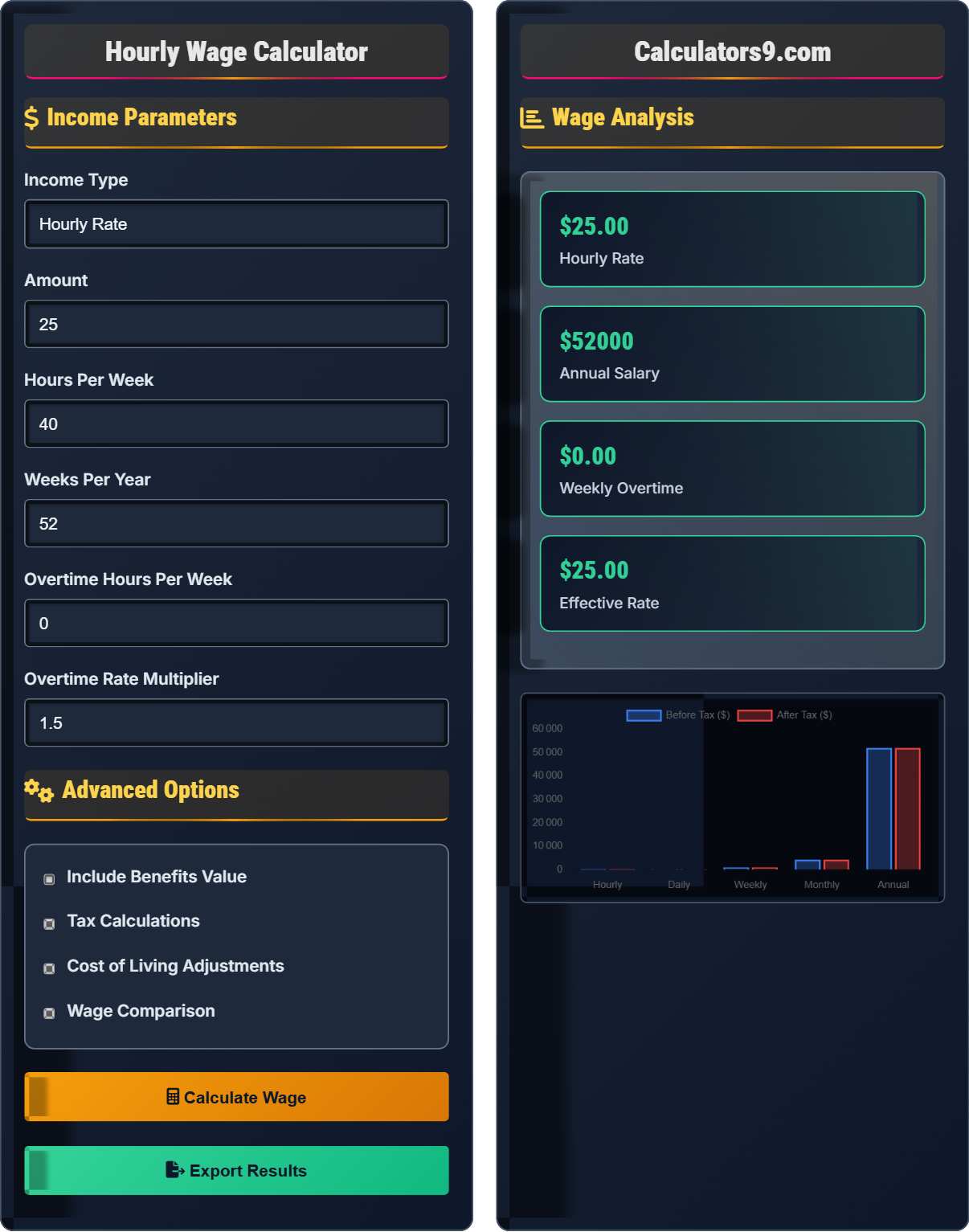
| Period | Before Tax | After Tax | Net Pay |
|---|---|---|---|
| Hourly | $25.00 | $18.75 | $18.75 |
| Daily (8h) | $200.00 | $150.00 | $150.00 |
| Weekly | $1,000.00 | $750.00 | $750.00 |
| Monthly | $4,333.33 | $3,250.00 | $3,250.00 |
| Annual | $52,000.00 | $39,000.00 | $39,000.00 |
| Time Frame | Without Overtime | With Overtime | Difference |
|---|---|---|---|
| Weekly | $1,000.00 | $1,000.00 | $0.00 |
| Monthly | $4,333.33 | $4,333.33 | $0.00 |
| Annual | $52,000.00 | $52,000.00 | $0.00 |
Comprehensive Wage Conversion Guide
Wage conversions allow comparison between different compensation structures. The basic conversion formula is: Hourly Rate = Annual Salary / (Hours per Week × Weeks per Year). This assumes a standard 40-hour work week for 52 weeks, totaling 2,080 hours annually. However, actual calculations should account for vacation, holidays, sick leave, and overtime.
The fundamental formulas for wage conversions are:
Annual Salary = Hourly Rate × Hours per Week × Weeks per Year
For overtime calculations: Overtime Rate = Regular Rate × Overtime Multiplier (typically 1.5 for time-and-a-half).
Typical conversion benchmarks by income level:
- Entry Level: $15-25/hour ($31,200-52,000/year)
- Mid Level: $25-40/hour ($52,000-83,200/year)
- Senior Level: $40-60/hour ($83,200-124,800/year)
- Executive Level: $60+/hour ($124,800+/year)
- Negotiate Benefits: Include health, retirement, PTO in compensation
- Calculate Total Package: Consider all compensation elements
- Factor in Flexibility: Remote work, flexible schedules have value
- Account for Overtime: Regular overtime increases effective hourly rate
- Consider Location: Cost of living affects real purchasing power
Wage Conversion Learning Quiz
If someone earns $60,000 annually working 40 hours per week for 52 weeks, what is their hourly rate?
Using the formula: Hourly Rate = Annual Salary / (Hours per Week × Weeks per Year)
Given:
- Annual Salary = $60,000
- Hours per Week = 40
- Weeks per Year = 52
Calculation: $60,000 / (40 × 52) = $60,000 / 2,080 = $28.85
This problem demonstrates the fundamental wage conversion formula. The calculation shows that $60,000 per year equals $28.85 per hour when working 40 hours per week for 52 weeks. This is a common conversion that helps compare hourly and salaried positions. The standard assumption of 2,080 hours per year (40 × 52) is widely used in HR and compensation analysis.
Standard Work Year: 2,080 hours (40 hours/week × 52 weeks)
Annual Salary: Total compensation per year
Hourly Rate: Compensation per hour worked
• Standard calculation: 40 hours × 52 weeks = 2,080 hours
• Include all paid time off in calculations
• Consider actual working hours vs. theoretical
• Remember: $25/hour ≈ $52,000/year
• Use 2,080 hours as standard for annual calculations
• Adjust for actual working hours vs. theoretical
• Forgetting to include all 52 weeks in calculation
• Not accounting for unpaid time off
• Using incorrect number of hours per week
A worker earns $20/hour and works 10 hours of overtime per week at time-and-a-half. Calculate their weekly overtime pay and annual overtime earnings.
Overtime rate: $20 × 1.5 = $30/hour
Weekly overtime pay: 10 hours × $30 = $300
Annual overtime earnings: $300 × 52 weeks = $15,600
The worker earns $300 per week in overtime pay, totaling $15,600 annually.
This example demonstrates overtime pay calculations. Time-and-a-half means the overtime rate is 1.5 times the regular rate. So $20/hour becomes $30/hour for overtime. This calculation shows how overtime significantly increases effective hourly earnings. The worker's effective rate increases when overtime is included, making their total compensation higher than the base rate suggests.
Time-and-a-half: 1.5 times regular hourly rate
Double Time: 2 times regular hourly rate
Overtime Hours: Hours worked beyond standard threshold
• Standard overtime rate is 1.5 × regular rate
• Usually applies after 40 hours per week
• Overtime can significantly increase effective earnings
• Remember: 1.5 = time-and-a-half
• 2.0 = double time
• Overtime increases effective hourly rate
• Confusing overtime rate with regular rate
• Not accounting for overtime in total compensation
• Assuming overtime is available every week
A job offers $45,000 annual salary with $8,000 in benefits. Another offers $25/hour with no benefits. If both jobs involve 40 hours per week for 52 weeks, calculate the total compensation and determine which offer is better.
Job 1: Total compensation = $45,000 + $8,000 = $53,000
Job 2: Annual salary = $25 × 40 × 52 = $52,000
Job 1 provides $53,000 vs Job 2's $52,000, making Job 1 better by $1,000 in total compensation.
Job 1's effective hourly rate = $53,000 ÷ 2,080 = $25.48/hour
This example demonstrates the importance of considering total compensation packages. The salary job appears lower ($45,000 vs. $52,000 equivalent), but when benefits are included, it becomes more valuable. Benefits like health insurance, retirement contributions, and PTO have significant monetary value. The effective hourly rate calculation shows that Job 1 is actually paying $25.48/hour when benefits are included, making it superior to the $25/hour job.
Total Compensation: All monetary and non-monetary benefits
Benefits Value: Monetary value of non-cash compensation
Effective Rate: Total compensation divided by hours worked
• Always include benefits in total compensation analysis
• Calculate effective hourly rate with total compensation
• Consider value of benefits when comparing offers
• Health insurance can be worth $5,000-15,000 annually
• Retirement contributions add significant value
• Calculate effective hourly rate including benefits
• Only comparing base salaries without benefits
• Not valuing benefits appropriately
• Forgetting to consider total package value
A salaried employee makes $60,000 annually with a 25% effective tax rate. A contractor charges $35/hour but pays an additional 15.3% self-employment tax. Calculate the after-tax income for both and determine which provides better net income.
Employee after-tax: $60,000 × (1 - 0.25) = $45,000
Contractor before SE tax: $35 × 40 × 52 = $72,800
Contractor after SE tax: $72,800 × (1 - 0.153) = $61,661.60
Contractor after income tax: $61,661.60 × (1 - 0.25) = $46,246.20
The contractor earns $46,246.20 vs. employee's $45,000, making the contractor position $1,246.20 better net income.
This example shows the tax implications of different employment statuses. Contractors pay self-employment tax (15.3% for Social Security and Medicare), which employees don't pay directly (since employers pay half). However, contractors can often deduct business expenses, and their higher rate can compensate for the additional tax burden. The calculation shows that despite higher taxes, the contractor's higher rate results in better net income.
Self-Employment Tax: 15.3% for Social Security (12.4%) and Medicare (2.9%)
Effective Tax Rate: Total tax burden as percentage of gross income
Net Income: Income after all taxes and deductions
• Contractors pay both employer and employee portions of SS/Medicare
• Self-employment tax = 15.3% of net earnings
• Consider all tax implications in compensation analysis
• Set aside 30-35% for taxes as a contractor
• Business expenses can reduce taxable income
• Consider quarterly tax payments
• Forgetting self-employment tax for contractors
• Not accounting for all tax obligations
• Underestimating tax burden for self-employed
Which of the following is the most important factor when comparing wages across different geographic locations?
The answer is B) Cost of living index. While all factors are important, the cost of living index provides a comprehensive measure of how far your money will go in different locations. It accounts for housing, food, transportation, healthcare, and other expenses. A higher salary in an expensive city may provide less purchasing power than a lower salary in an affordable area.
This question highlights the importance of location-adjusted compensation analysis. The cost of living index is a composite measure that considers multiple expense categories, making it more comprehensive than looking at individual factors like housing or taxes. A salary of $60,000 in a low-cost area may provide more purchasing power than $80,000 in an expensive metro area. Smart compensation comparison must consider the real buying power of money in different locations.
Cost of Living Index: Measure comparing living expenses across locations
Purchasing Power: Amount of goods/services money can buy
Real Income: Income adjusted for inflation and cost of living
• Compare cost of living before accepting relocation
• Consider all expenses, not just housing
• Higher salaries in expensive cities may not be better
• Use COL calculators to compare locations
• Consider quality of life factors
• Factor in commuting costs and time
• Comparing only salary amounts without location context
• Focusing only on housing costs
• Not considering tax differences by state
Wage Fundamentals
Converting between hourly, weekly, monthly, and annual compensation. Formula: Annual = Hourly × 40 × 52.
Assumes 40 hours/week × 52 weeks = 2,080 hours/year. Time-and-a-half = 1.5 × regular rate.
- Include all compensation elements in analysis
- Account for taxes and benefits
- Consider cost of living differences
Optimization
Salary + benefits + overtime + perks. Consider the complete package value.
- Calculate total compensation package
- Account for taxes and deductions
- Consider cost of living
- Factor in flexibility and benefits
- Self-employment tax for contractors
- Benefits value (health, retirement)
- Location cost differences
- Work-life balance factors
FAQ
Q: What's a good hourly rate for 2026?
A: $20-40/hour for skilled workers. Entry level: $15-20, Experienced: $25-35, Expert: $35+. Adjust for location and industry. Consider inflation and cost of living.
Q: How do I calculate my effective hourly rate as a contractor?
A: Factor in self-employment tax (15.3%), business expenses, insurance, and vacation time. If charging $40/hour, your effective rate after expenses might be $25-30/hour.