Overtime Pay Calculator
Overtime earnings • 2026 gig economy
Work Schedule
Advanced Options
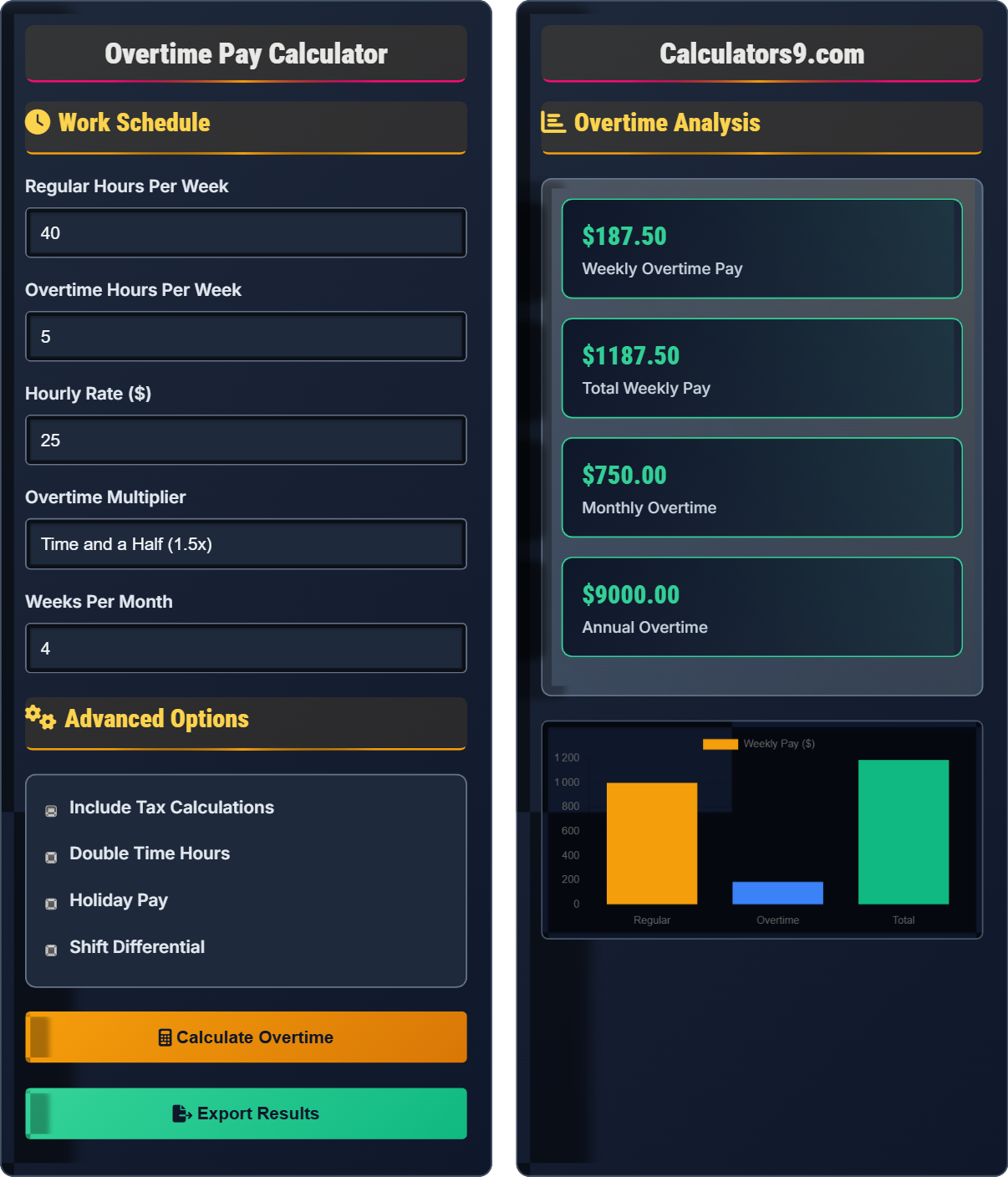
Overtime Analysis
| Category | Hours | Rate | Pay |
|---|---|---|---|
| Regular Pay | 40 | $25.00 | $1,000.00 |
| Overtime Pay | 5 | $37.50 | $187.50 |
| Total Before Tax | 45 | $26.39 | $1,187.50 |
| Tax Deduction | - | 25% | $296.88 |
| Total After Tax | - | $19.79 | $890.62 |
| Time Period | Regular Pay | Overtime Pay | Total Pay |
|---|---|---|---|
| Weekly | $1,000.00 | $187.50 | $1,187.50 |
| Monthly | $4,000.00 | $750.00 | $4,750.00 |
| Quarterly | $12,000.00 | $2,250.00 | $14,250.00 |
| Annually | $52,000.00 | $9,750.00 | $61,750.00 |
Comprehensive Overtime Pay Guide
Overtime pay is additional compensation for hours worked beyond standard work limits. In most jurisdictions, overtime is calculated at 1.5 times the regular hourly rate for hours worked over 40 per week. The Fair Labor Standards Act (FLSA) in the US requires overtime pay for eligible employees, though specific rules vary by state and industry.
The standard overtime calculation is:
Where overtime multiplier is typically 1.5 for time-and-a-half or 2.0 for double time. The regular rate includes all compensation earned during the workweek divided by total hours worked.
Examples of overtime calculations:
- Time-and-a-Half: $20/hour × 1.5 = $30/hour overtime
- Double Time: $20/hour × 2.0 = $40/hour overtime
- Double and a Half: $20/hour × 2.5 = $50/hour overtime
- Shift Differential: Add percentage to base rate
- Track Hours Accurately: Maintain detailed records
- Understand Your Rights: Know overtime regulations
- Negotiate Rates: Consider overtime when negotiating salary
- Plan Workload: Distribute hours to minimize overtime
- Calculate True Value: Factor in taxes and benefits
Overtime Pay Learning Quiz
If an employee earns $30/hour and works 45 hours in a week, what is their total weekly pay (including overtime)?
Regular pay: 40 hours × $30 = $1,200
Overtime pay: 5 hours × $30 × 1.5 = $225
Total pay: $1,200 + $225 = $1,425
This problem demonstrates the standard overtime calculation. The first 40 hours are paid at the regular rate, while any hours over 40 are paid at time-and-a-half (1.5x) the regular rate. This is the most common overtime calculation method in the United States. Understanding this formula is essential for anyone working overtime or managing payroll.
Regular Hours: Standard work hours (typically 40/week)
Overtime Hours: Hours worked beyond standard limit
Time-and-a-Half: 1.5 times the regular hourly rate
• Standard workweek is 40 hours in most jurisdictions
• Overtime rate is typically 1.5x regular rate
• Calculate regular pay separately from overtime
• Remember: 40 hours regular + overtime hours
• Overtime = excess hours × regular rate × 1.5
• Always verify your timesheets are accurate
• Including overtime hours in regular pay calculation
• Forgetting to apply the 1.5 multiplier
• Not tracking hours accurately
An employee earning $25/hour works 10 hours of overtime per week. If they're in a 28% tax bracket, calculate their after-tax overtime earnings per week.
Overtime rate: $25 × 1.5 = $37.50/hour
Weekly overtime pay: 10 hours × $37.50 = $375
Tax deduction: $375 × 0.28 = $105
After-tax overtime: $375 - $105 = $270
The employee earns $270 after taxes from their overtime work.
This example shows how taxes impact overtime earnings. While overtime pay provides significant additional income, the effective take-home pay is reduced by tax obligations. The employee receives $270 after taxes for 10 hours of overtime work, which is equivalent to $27/hour after taxes. This demonstrates that overtime, while valuable, doesn't provide the full premium rate after tax considerations.
Tax Bracket: Percentage of income subject to taxation
Take-Home Pay: Earnings after tax deductions
Effective Rate: Actual earnings after taxes
• Overtime pay is subject to the same tax rates
• Higher earners may face higher marginal rates
• Consider tax impact when calculating net benefits
• Factor taxes into overtime decision-making
• Consider quarterly tax payments if self-employed
• Maximize tax-advantaged savings opportunities
• Forgetting that overtime is taxed at regular rates
• Not accounting for state tax obligations
• Overestimating take-home overtime pay
A nurse earns $35/hour with a 15% night shift differential. During a week, they work 32 regular hours and 12 overtime hours (including 8 night shift hours). Calculate their total weekly pay.
Regular day hours: 24 hours × $35 = $840
Night shift regular: 8 hours × $35 × 1.15 = $322
Regular overtime rate: $35 × 1.5 = $52.50/hour
Night shift overtime: 8 hours × $52.50 × 1.15 = $483
Day shift overtime: 4 hours × $52.50 = $210
Total pay: $840 + $322 + $483 + $210 = $1,855
The nurse earns $1,855 for the week.
This problem demonstrates the complexity of pay calculations when multiple factors apply. The night shift differential is applied to both regular and overtime rates. The calculation shows that combining overtime with shift differentials can significantly increase total earnings. Healthcare workers, security personnel, and manufacturing staff often receive shift differentials for working non-standard hours.
Shift Differential: Additional pay for non-standard shifts
Non-Standard Hours: Evening, night, weekend work
Combined Multipliers: Multiple factors affecting pay rate
• Apply shift differential to both regular and overtime rates
• Calculate overtime on the adjusted rate
• Verify differential rates with employer policy
• Document shift differentials in your employment agreement
• Verify calculations on pay stubs
• Understand how differentials affect overtime
• Applying differentials only to regular hours
• Forgetting to apply differential to overtime rates
• Not understanding cumulative effect of multiple factors
A freelancer charges $45/hour and wants to earn $3,000/month from overtime work. If they work 20 hours of overtime per month, what hourly rate would they need to charge to reach their goal?
Target monthly earnings: $3,000
Planned overtime hours: 20 hours
Required hourly rate: $3,000 ÷ 20 = $150/hour
The freelancer would need to charge $150/hour for overtime work to reach their goal.
Alternatively, if they maintain their $45/hour rate, they would need to work: $3,000 ÷ $45 = 66.67 hours of overtime per month.
This example demonstrates how freelancers can approach overtime planning differently than traditional employees. Since freelancers can set their own rates, they can decide whether to charge premium rates for overtime work or work more hours at standard rates. The calculation shows that achieving a specific income goal requires either a higher rate or more hours. This flexibility is an advantage of freelance work.
Freelance Overtime: Additional hours at premium rate
Rate Flexibility: Ability to set premium rates
Income Goal Planning: Strategic rate and hour planning
• Freelancers can set premium rates for overtime
• Income = Rate × Hours
• Consider market rates when setting premiums
• Charge 1.5-2x regular rate for overtime work
• Factor in opportunity cost of overtime hours
• Consider client budget constraints
• Charging same rate for overtime as regular work
• Not accounting for time value properly
• Setting rates too low for overtime premium
According to federal law in the United States, when does overtime pay typically begin?
The answer is B) After 40 hours per week. According to the Fair Labor Standards Act (FLSA), covered, nonexempt employees must receive overtime pay for hours worked over 40 per workweek at a rate not less than time and one-half their regular rate of pay. Some states have additional overtime requirements that may be more generous than federal law.
This question highlights the standard overtime threshold established by federal law. The 40-hour workweek is the baseline for overtime calculations in the United States. However, it's important to note that some states have more protective laws (like California's daily overtime after 8 hours) and some industries have special exemptions. Workers should familiarize themselves with both federal and state regulations.
FLSA: Fair Labor Standards Act - federal wage law
Nonexempt: Workers entitled to overtime pay
Workweek: Seven consecutive 24-hour periods
• Federal overtime begins after 40 hours/week
• Check state-specific overtime laws
• Understand your exemption status
• Keep accurate time records
• Assuming all workers are entitled to overtime
• Not tracking hours properly
• Confusing exempt vs. nonexempt status
Overtime Fundamentals
Additional compensation for hours worked beyond standard limits. Formula: Overtime = Hours × Rate × 1.5.
40 hours/week standard. Time-and-a-half for hours over 40. Double time for specific situations.
- 40 hours per week standard threshold
- 1.5x rate for overtime hours
- 2x rate for double-time situations
Optimization
Balance between additional income and work-life balance.
- Track hours accurately
- Understand your rights
- Consider tax implications
- Balance work and rest
- Health and wellness impacts
- Tax implications
- Employment regulations
- Work-life balance
FAQ
Q: Do I get overtime for weekend work?
A: Only if weekend work puts you over 40 hours in the workweek. Saturday/Sunday work alone doesn't trigger overtime unless it exceeds the weekly threshold.
Q: How should I price overtime for freelance projects?
A: Charge 1.5-2x your regular rate for overtime. This compensates for opportunity cost and premium of urgent work. Clear contracts specify overtime terms.