Client Profitability Calculator
Freelancer ROI tracker • 2026 edition
Client Profitability Formulas:
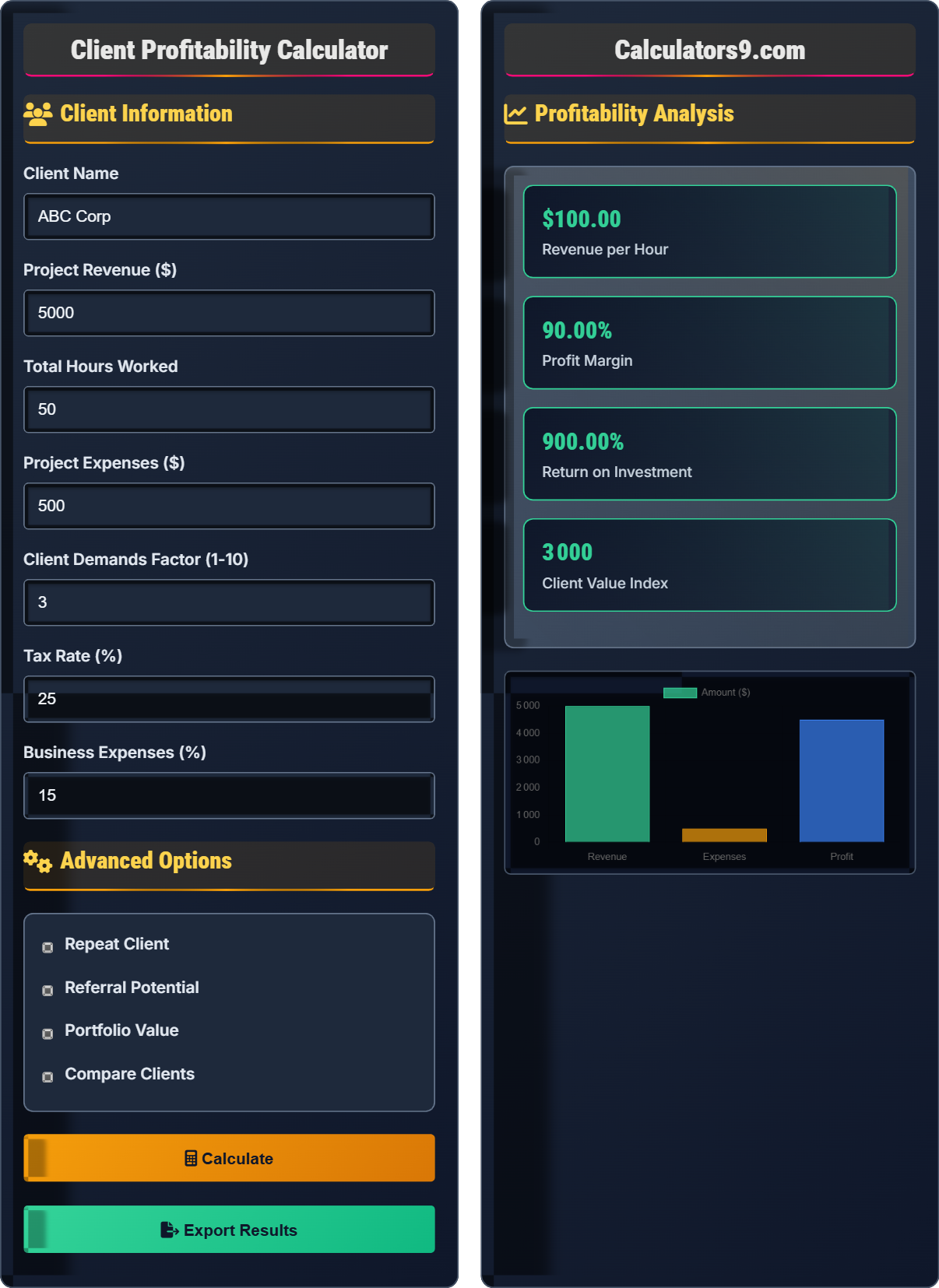
- Revenue per Hour: Total Revenue ÷ Total Hours
- Profit Margin: (Revenue - Expenses) ÷ Revenue × 100
- ROI per Client: (Revenue - Total Costs) ÷ Total Costs × 100
- Value Index: (Revenue per Hour × Profit Margin) ÷ Client Demands
For example: A client generating $5,000 revenue with $1,000 expenses and 50 hours of work has a profit margin of 80% and ROI of 400%.
Client Information
Advanced Options
Profitability Analysis
| Item | Amount | Percentage | Notes |
|---|
| Metric | Value | Rating | Recommendation |
|---|
Client Profitability Analysis
Understanding client profitability is crucial for freelancers to make strategic business decisions. It helps identify which clients are truly valuable, allowing you to focus on high-value relationships and avoid time-consuming, low-profit engagements.
Key profitability metrics for freelancers include:
Profit Margin = (Revenue - Expenses) ÷ Revenue × 100
ROI = (Revenue - Total Costs) ÷ Total Costs × 100
Revenue per Hour = Total Revenue ÷ Total Hours
Value Index = (Revenue per Hour × Profit Margin) ÷ Client Demands
Classify clients into categories based on profitability metrics:
- Gold Tier (ROI > 200%): Highly profitable, minimal demands, repeat potential
- Silver Tier (ROI 100-200%): Good profitability, manageable demands
- Bronze Tier (ROI 50-100%): Acceptable but monitor closely
- Red Flag (ROI < 50%): Consider dropping or renegotiating terms
- Focus on Gold Tier: Allocate more resources to high-value clients
- Improve Silver Tier: Find ways to increase profitability
- Renegotiate Bronze Tier: Increase rates or reduce scope
- Eliminate Red Flags: Gradually phase out unprofitable clients
- Upsell Opportunities: Expand relationships with profitable clients
Client Profitability Learning Quiz
Which profitability metric best indicates the efficiency of a client relationship?
The answer is D) Both B and C. Profit margin percentage indicates the efficiency of converting revenue to profit, while revenue per hour measures time efficiency. Together, they provide a complete picture of how efficiently a client relationship converts time and effort into profit.
This question highlights the importance of using multiple metrics for evaluation. Revenue alone doesn't indicate profitability, and profit margin doesn't account for time investment. A client paying $10,000 but requiring 100 hours has a different efficiency profile than one paying $10,000 for 20 hours, even with the same profit margin.
Profit Margin: Percentage of revenue remaining after expenses
Revenue per Hour: Efficiency measure of income generated per time unit
Efficiency: How well resources convert to profit
• Profit margin = (Revenue - Expenses) ÷ Revenue × 100
• Revenue per hour = Total Revenue ÷ Total Hours
• Both metrics needed for complete efficiency analysis
• Track both profit margin and time efficiency
• Compare metrics across different clients
• Consider qualitative factors alongside quantitative metrics
• Focusing only on revenue without considering expenses
• Ignoring time investment when evaluating profitability
• Not comparing metrics across different clients
If a freelancer completes a project generating $8,000 in revenue with $1,200 in direct project expenses and 40 hours of work, what is the ROI and revenue per hour?
Step 1: Calculate ROI = (Revenue - Expenses) ÷ Expenses × 100
ROI = ($8,000 - $1,200) ÷ $1,200 × 100
ROI = $6,800 ÷ $1,200 × 100 = 566.67%
Step 2: Calculate Revenue per Hour = Revenue ÷ Hours
Revenue per Hour = $8,000 ÷ 40 = $200 per hour
Therefore: ROI is 566.67% and revenue per hour is $200.
This problem demonstrates the difference between ROI and revenue per hour. ROI measures the return on the investment (expenses), while revenue per hour measures efficiency of time utilization. A high ROI indicates good profitability relative to investment, while high revenue per hour indicates efficient time use.
Return on Investment (ROI): Measure of profitability relative to investment
Direct Project Expenses: Costs directly attributable to the project
Revenue per Hour: Income generated per hour of work
• ROI = (Revenue - Expenses) ÷ Expenses × 100
• Revenue per Hour = Total Revenue ÷ Total Hours
• Both metrics provide different insights into profitability
• High ROI doesn't necessarily mean high revenue per hour
• Look for clients with both good ROI and good time efficiency
• Use ROI to compare different types of projects
• Dividing by revenue instead of expenses for ROI calculation
• Forgetting to multiply by 100 to get percentage
• Confusing ROI with profit margin
Sarah has two clients: Client A generates $10,000 revenue with 60 hours of work and a 75% profit margin, but has a high demand factor of 8. Client B generates $8,000 revenue with 40 hours of work and a 70% profit margin, with a low demand factor of 3. Which client has a higher Client Value Index?
Step 1: Calculate Revenue per Hour for Client A = $10,000 ÷ 60 = $166.67
Step 2: Calculate Value Index for Client A = ($166.67 × 75) ÷ 8
Client A Value Index = $12,500.25 ÷ 8 = 1,562.5
Step 3: Calculate Revenue per Hour for Client B = $8,000 ÷ 40 = $200
Step 4: Calculate Value Index for Client B = ($200 × 70) ÷ 3
Client B Value Index = $14,000 ÷ 3 = 4,666.7
Therefore: Client B has a higher Client Value Index (4,666.7 vs 1,562.5).
This problem demonstrates how the Client Value Index incorporates multiple factors: revenue per hour, profit margin, and client demands. Despite Client A having higher revenue and profit margin, Client B scores higher due to better time efficiency and lower demands. This shows the importance of considering all factors in client evaluation.
Client Value Index: Composite metric combining efficiency and demands
Demand Factor: Subjective rating of client complexity/difficulty
Time Efficiency: Revenue generated per unit of time
• Value Index = (Revenue per Hour × Profit Margin) ÷ Demand Factor
• Higher demand factor reduces value index
• All three factors contribute to overall client value
• Use value index to compare diverse clients objectively
• Consider qualitative factors alongside quantitative metrics
• Regularly recalculate value index as circumstances change
• Forgetting to include all components in value index calculation
• Misinterpreting the impact of demand factor
• Not adjusting calculations when circumstances change
Mike has 200 available hours per month. He has three clients: Client X (40 hours, $150/hour, 80% margin), Client Y (60 hours, $100/hour, 70% margin), and Client Z (50 hours, $200/hour, 60% margin). Which combination of clients maximizes his monthly profit?
Step 1: Calculate profit per hour for each client:
Client X: $150 × 0.80 = $120 profit per hour
Client Y: $100 × 0.70 = $70 profit per hour
Client Z: $200 × 0.60 = $120 profit per hour
Step 2: Prioritize clients by profit per hour:
Clients X and Z tie at $120/hour, Client Y at $70/hour
Step 3: Allocate hours optimally:
Take all of Client Z (50 hours, $6,000 profit) and all of Client X (40 hours, $4,800 profit) = 90 hours, $10,800 profit
Remaining hours: 200 - 90 = 110 hours
Add Client Y for remaining 110 hours (but only 60 available) = $4,200 profit
Total: 150 hours, $15,000 profit
Therefore: Take all of X and Z, plus as much of Y as possible.
This problem demonstrates resource optimization - allocating limited time to maximize profit. The key insight is that profit per hour, not just hourly rate, determines priority. Client Z has the highest hourly rate but lower margin, while Client X has a lower rate but higher margin, resulting in the same profit per hour.
Profit per Hour: Revenue per hour multiplied by profit margin
Resource Allocation: Distributing limited time among opportunities
Opportunity Cost: Value of next best alternative
• Profit per hour = Hourly Rate × Profit Margin
• Prioritize clients by profit per hour when constrained
• Consider total available time in allocation decisions
• Focus on profit per hour, not just revenue per hour
• Consider client availability when planning
• Factor in non-financial benefits of client relationships
• Prioritizing clients with highest hourly rates instead of profit rates
• Not considering total time constraints
• Ignoring opportunity cost in allocation decisions
Based on profitability analysis, which strategy would be most beneficial for a freelancer?
The answer is B) Focus on high-value, low-demand clients. This strategy maximizes profitability while minimizing stress and time investment. High-value clients provide good returns, while low-demand clients require less management overhead, allowing for better work-life balance and more time for other profitable opportunities.
This question emphasizes the importance of quality over quantity in client relationships. Simply pursuing large clients or high revenue can lead to unprofitable relationships if demands are too high. The optimal strategy balances profitability with operational efficiency.
High-Value Client: One with good profit margins and ROI
Low-Demand Client: One requiring minimal management overhead
Operational Efficiency: Minimizing non-productive time
• Quality often trumps quantity in client relationships
• Consider both profitability and operational demands
• Evaluate long-term sustainability of client relationships
• Develop a client scoring system combining multiple factors
• Regularly review and adjust your client portfolio
• Invest in relationships with high-value clients
• Chasing revenue without considering profitability
• Keeping unprofitable clients due to fear of gaps
• Not evaluating the total cost of client management
Profitability Basics
Profit margins, ROI, and efficiency metrics for client evaluation.
Profit Margin = (Revenue - Expenses) ÷ Revenue × 100
ROI = (Revenue - Total Costs) ÷ Total Costs × 100
Revenue per Hour = Total Revenue ÷ Total Hours
- Track both quantitative and qualitative metrics
- Regularly review client profitability
- Focus on efficiency, not just revenue
Optimization Strategies
Focus on high-value, low-demand client relationships.
- Score clients regularly using multiple metrics
- Allocate time to highest-value opportunities
- Negotiate terms with low-value clients
- Phase out unprofitable relationships
- Balance profitability with portfolio diversity
- Consider long-term relationship potential
- Factor in referral and portfolio value
- Plan for client turnover
FAQ
Q: How do I calculate the true cost of a client relationship beyond just the direct project expenses?
A: The true cost of a client relationship includes several components:
1. Direct Project Expenses: Materials, software licenses, subcontractors
2. Time Costs: Your hourly rate × all hours spent (including communication, revisions, admin)
3. Opportunity Cost: Income lost from other projects due to time commitment
4. Management Overhead: Time spent on client communication, meetings, project management
5. Stress/Complexity Factor: Higher stress may require higher compensation
Formula: True Cost = Direct Expenses + (Total Hours × Hourly Rate) + Opportunity Cost
Example: If a project takes 40 hours of actual work, 20 hours of communication/admin, and prevents you from taking $2,000 in other work, the true cost includes all of these factors.
Q: How often should I re-evaluate client profitability and when should I consider ending a relationship?
A: Regular evaluation is crucial for business health:
Frequency: Review profitability quarterly for active clients, annually for dormant ones.
Triggers for Re-evaluation:
- Project scope changes
- Payment delays or disputes
- Significant time overruns
- Changes in your rates or costs
When to End Relationships:
- ROI consistently below 50% after adjustments
- Client demands consume >20% of time without proportional revenue
- Payment reliability deteriorates
- Relationship affects mental health/productivity
Gradual Phase-out Strategy: Complete existing commitments, decline new work, recommend alternatives to maintain goodwill.