Expense Reimbursement Calculator
Freelancer cost tracker • 2026 edition
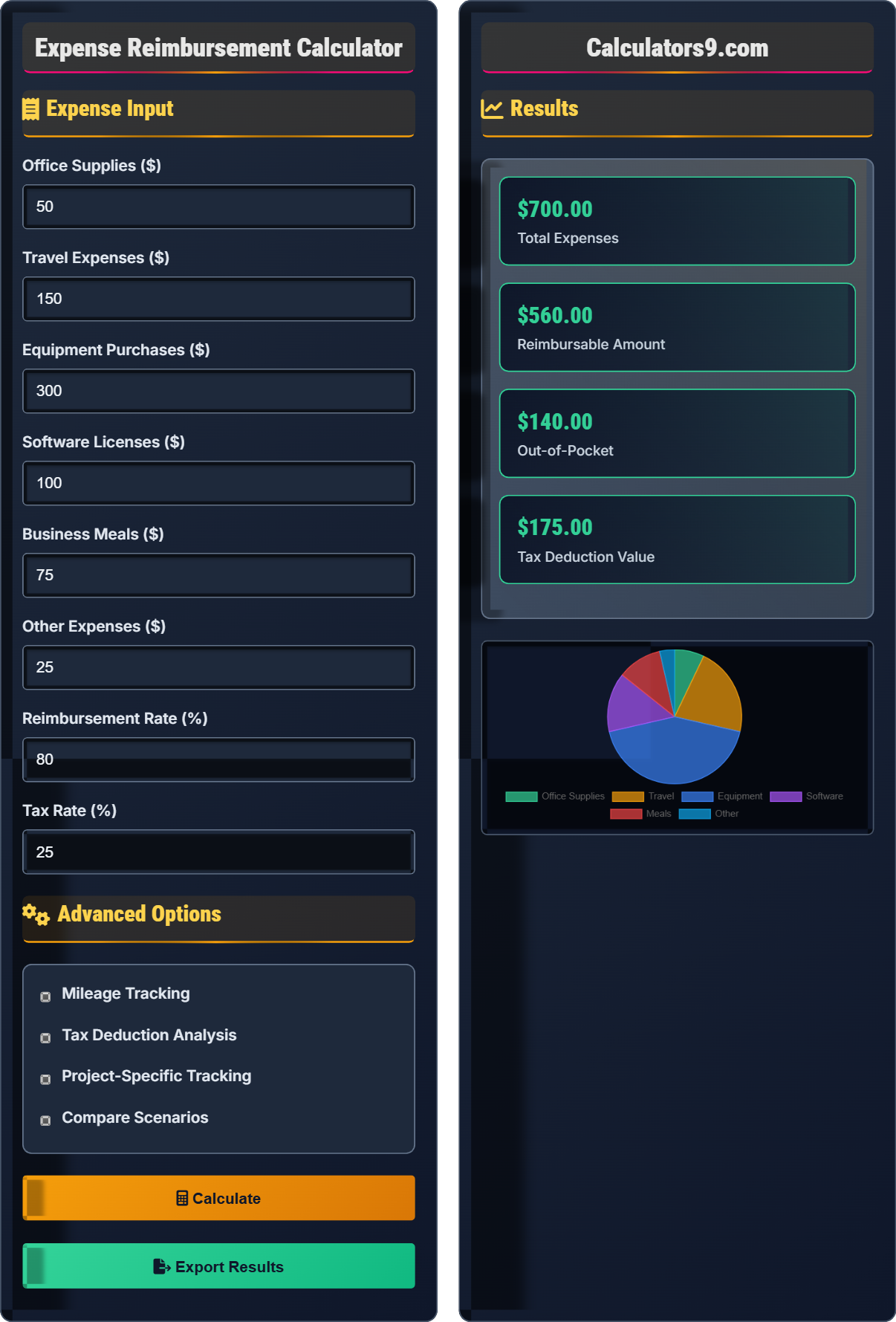
Expense Reimbursement Formulas:
- Total Eligible Expenses = Sum of all qualifying business expenses
- Reimbursable Amount = Total Eligible Expenses × Reimbursement Rate
- Tax Deduction = Total Eligible Expenses × Tax Rate
- Net Out-of-Pocket = Total Expenses - Reimbursable Amount
For example: $500 in eligible expenses with 80% reimbursement rate = $400 reimbursed, $100 out-of-pocket. With 25% tax rate, you get $125 tax deduction.
Expense Input
Advanced Options
Results
| Category | Amount | Reimbursable | Tax Deductible | Out-of-Pocket |
|---|
| Metric | Value | Description |
|---|
Expense Reimbursement Essentials
Expense reimbursement is compensation provided to independent contractors for business-related expenses incurred during work. For freelancers and gig workers, understanding which expenses qualify for reimbursement and tax deduction is crucial for maintaining profitability and compliance.
Key calculations for effective expense management:
Total Eligible Expenses = Σ All Qualifying Business Expenses
Reimbursable Amount = Total Eligible Expenses × Reimbursement Rate
Out-of-Pocket = Total Eligible Expenses - Reimbursable Amount
Tax Deduction Value = Total Eligible Expenses × Tax Rate
Successful freelancers typically allocate expenses as follows:
- Equipment & Software (30-40%): Computers, software subscriptions, hardware
- Office & Supplies (15-20%): Office supplies, utilities, workspace costs
- Travel & Transportation (20-25%): Mileage, flights, hotels for client meetings
- Marketing & Business Development (15-20%): Advertising, conferences, networking events
- Professional Services (10-15%): Legal, accounting, professional development
- Keep Receipts: Digital copies of all receipts for audit purposes
- Separate Business/Personal: Use dedicated business credit card/account
- Track Mileage: Log dates, destinations, and business purpose
- Quarterly Reviews: Analyze spending patterns and adjust budget
- Know Limits: Understand IRS limits and client reimbursement policies
Expense Management Learning Quiz
Which of the following expenses is generally NOT deductible for independent contractors?
The answer is C) Commuting from home to regular workplace. The IRS considers commuting to your regular workplace a personal expense, even if you're self-employed. However, travel between job sites, client meetings, or business-related locations is deductible as business mileage.
This question highlights an important distinction in tax law: the difference between commuting and business travel. Commuting is considered a personal expense regardless of employment status. Understanding this distinction helps freelancers avoid claiming non-deductible expenses during tax season.
Deductible Expense: Business expense that reduces taxable income
Commuting: Travel between home and regular workplace
Business Travel: Travel between job sites or to client locations
• Commuting is never deductible for any worker
• Travel between job sites is deductible
• Client meetings are deductible business travel
• Keep detailed logs of business mileage
• Use apps to track mileage automatically
• Distinguish between commuting and business travel
• Claiming regular commuting as business expense
• Not documenting business trips properly
• Mixing personal and business travel records
If a freelancer has $1,200 in total business expenses and their client reimburses 75% of all expenses, how much will they be reimbursed and how much will they pay out-of-pocket? What is the tax deduction value if they're in a 28% tax bracket?
Step 1: Calculate reimbursable amount = Total expenses × Reimbursement rate
Reimbursable amount = $1,200 × 0.75 = $900
Step 2: Calculate out-of-pocket = Total expenses - Reimbursable amount
Out-of-pocket = $1,200 - $900 = $300
Step 3: Calculate tax deduction value = Total expenses × Tax rate
Tax deduction value = $1,200 × 0.28 = $336
Therefore: $900 reimbursed, $300 out-of-pocket, $336 tax deduction value.
This problem demonstrates the dual benefit of business expenses: direct reimbursement from clients and tax deductions. The calculation shows how expenses reduce both immediate out-of-pocket costs and taxable income. The tax deduction effectively reduces the real cost of expenses.
Reimbursement Rate: Percentage of expenses covered by client
Tax Deduction Value: Tax savings from deductible expenses
Effective Expense Cost: Out-of-pocket cost after tax benefits
• Reimbursable amount = Total expenses × Reimbursement rate
• Out-of-pocket = Total expenses - Reimbursable amount
• Tax deduction = Total expenses × Tax rate
• Negotiate higher reimbursement rates when possible
• Track expenses separately from tax preparation
• Understand your effective tax rate for planning
• Forgetting to account for tax benefits of expenses
• Not tracking expenses separately from tax calculations
• Confusing gross expenses with net cost after tax
Sarah drives 150 miles to meet a client and another 100 miles to visit a supplier for her freelance graphic design business. If the standard mileage rate is $0.655 per mile and her client reimburses 100% of travel expenses, how much will she be reimbursed? What is the tax deduction value if she's in a 25% tax bracket?
Step 1: Calculate total business miles = Client meeting + Supplier visit
Total miles = 150 + 100 = 250 miles
Step 2: Calculate mileage reimbursement = Total miles × Mileage rate
Mileage reimbursement = 250 × $0.655 = $163.75
Step 3: Calculate tax deduction value = Total mileage expense × Tax rate
Tax deduction value = $163.75 × 0.25 = $40.94
Therefore: Sarah will be reimbursed $163.75 with a tax deduction value of $40.94.
This problem demonstrates the calculation of mileage expenses, which is a common business expense for freelancers. The standard mileage rate simplifies record-keeping by allowing freelancers to deduct a flat rate per mile instead of actual vehicle costs. The calculation includes both the direct reimbursement and the tax benefit.
Standard Mileage Rate: IRS-set rate for business mileage deduction
Business Miles: Miles driven for legitimate business purposes
Actual Expense Method: Alternative to standard mileage rate
• Standard mileage rate applies to business-related driving
• Commuting is not deductible under any method
• Keep detailed logs of business trips
• Use mileage tracking apps for automatic logging
• Distinguish between business and personal driving
• Know the current year's standard mileage rate
• Including commuting miles in business mileage
• Not keeping accurate records of business trips
• Using outdated mileage rates
Mike purchases a laptop for $2,000 for his freelance consulting business. His client reimburses 50% of equipment purchases. If the laptop has a 5-year useful life and Mike uses straight-line depreciation, how much can he deduct annually? What is the annual tax benefit if he's in a 32% tax bracket?
Step 1: Calculate annual depreciation = Cost ÷ Useful life
Annual depreciation = $2,000 ÷ 5 = $400 per year
Step 2: Calculate client reimbursement = Total cost × Reimbursement rate
Client reimbursement = $2,000 × 0.50 = $1,000
Step 3: Calculate annual tax benefit = Annual depreciation × Tax rate
Annual tax benefit = $400 × 0.32 = $128 per year
Step 4: Calculate effective annual cost = Annual depreciation - Annual tax benefit
Effective annual cost = $400 - $128 = $272 per year
Therefore: $400 annual deduction, $128 annual tax benefit, $272 effective annual cost.
This problem demonstrates how expensive equipment purchases are handled for tax purposes. Rather than deducting the full cost immediately, equipment is depreciated over its useful life. The calculation shows the annual benefit of depreciation and how it reduces the effective cost of business equipment.
Straight-Line Depreciation: Equal deduction each year over asset's life
Useful Life: Expected period of productive use
Effective Cost: Actual cost after tax benefits
• Expensive equipment must be depreciated over time
• Annual depreciation = Cost ÷ Useful life
• Tax benefit = Annual depreciation × Tax rate
• Consider Section 179 for immediate expensing of small purchases
• Track depreciation schedules for all equipment
• Plan equipment purchases strategically
• Trying to deduct full equipment cost immediately
• Not tracking depreciation schedules properly
• Confusing depreciation with immediate deduction
Which strategy will provide the GREATEST financial benefit for a freelancer with $3,000 in annual business expenses and a 30% tax rate?
The answer is D) Both A and B combined. Let's analyze each option:
A) 100% reimbursement: $3,000 back = $3,000 benefit
B) Tax deduction: $3,000 × 0.30 = $900 tax savings
C) 20% reduction: $3,000 × 0.20 = $600 saved
D) Combined: $3,000 + $900 = $3,900 total benefit
Combining both strategies provides the maximum financial advantage.
This question demonstrates that expense management involves multiple strategies that can work together. The optimal approach combines securing reimbursement from clients with maximizing tax benefits. This shows how freelancers can create multiple revenue streams from the same expenses.
Financial Leverage: Using multiple strategies simultaneously
Expense Optimization: Maximizing return on business expenses
Tax Strategy: Planning expenses for maximum tax benefit
• Combine reimbursement and tax benefits for maximum advantage
• Proper documentation is essential for both strategies
• Negotiate reimbursement rates when possible
• Always negotiate expense reimbursement upfront
• Keep excellent records for tax purposes
• Consider both immediate and long-term benefits
• Only pursuing one strategy (reimbursement OR tax deduction)
• Not negotiating reimbursement rates
• Poor record-keeping for tax benefits
Expense Management Basics
Reimbursement rates, tax deductions, and expense categorization.
Reimbursable Amount = Total Expenses × Reimbursement Rate
Out-of-Pocket = Total Expenses - Reimbursable Amount
Tax Deduction Value = Total Expenses × Tax Rate
- Document all business expenses
- Separate business from personal
- Know IRS guidelines
Optimization Strategies
Maximize both reimbursement and tax benefits simultaneously.
- Negotiate reimbursement rates
- Track expenses meticulously
- Plan purchases strategically
- Review quarterly spending
- Quality over cost reduction
- Documentation requirements
- IRS compliance
- Client relationships
FAQ
Q: Can I deduct home office expenses if I work from home?
A: Yes, home office expenses are deductible if you meet specific requirements:
1. Exclusive Use: The space must be used exclusively for business. If you use the room for other purposes (like sleeping), it doesn't qualify.
2. Regular Use: The space must be used regularly for business, not just occasionally.
3. Principal Place of Business: The home office must be where you conduct substantial business activities.
Calculation methods:
- Simplified Method: $5 per square foot up to 300 sq ft = maximum $1,500
- Actual Expense Method: Calculate percentage of home used for business
Example: If your home office is 200 sq ft and represents 15% of your home, and your total home expenses are $10,000 annually, your deduction would be $10,000 × 0.15 = $1,500.
Q: How do I handle expenses that serve both business and personal purposes?
A: For mixed-use items, you can only deduct the percentage used for business:
1. Computer: If used 70% for business and 30% for personal, only 70% of costs are deductible.
2. Cell Phone: Calculate percentage of business calls/data usage.
3. Vehicle: Use mileage log to determine business percentage.
Formula: Deductible Amount = Total Cost × (Business Use ÷ Total Use)
Example: If your $1,200 cell phone plan supports 60% business use, you can deduct $1,200 × 0.60 = $720.
For better record-keeping, consider maintaining separate devices/accounts for business to simplify deductions and reduce audit risk.