Income Variability Calculator
Freelancer volatility tracker • 2026 edition
Income Variability Formulas:
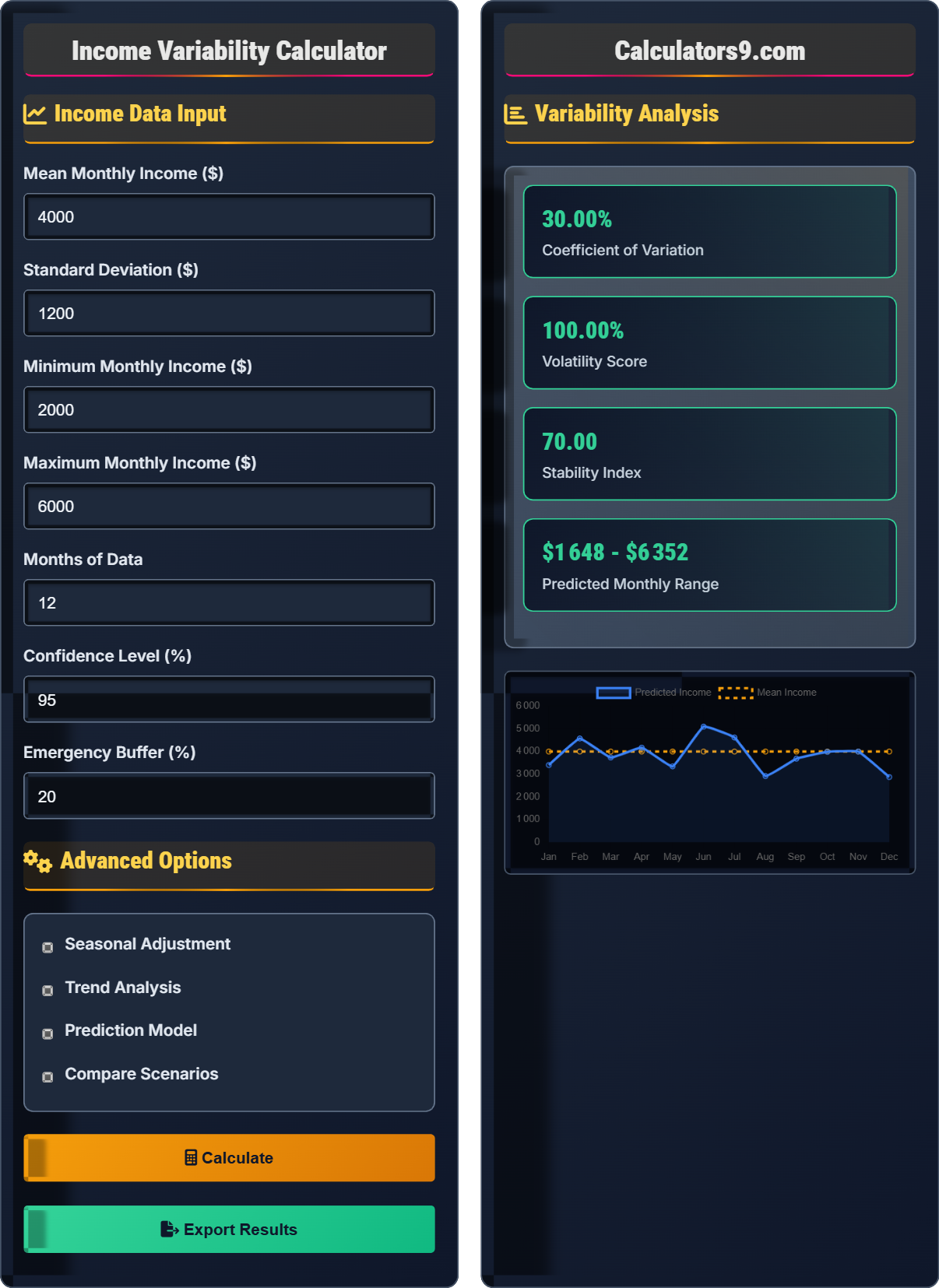
- Coefficient of Variation: (Standard Deviation ÷ Mean) × 100
- Volatility Score: (Maximum - Minimum) ÷ Mean × 100
- Stability Index: 100 - Coefficient of Variation
- Predicted Range: Mean ± (Standard Deviation × Confidence Factor)
For example: Income of $3000, $5000, $2000, $4000 has mean=$3500, std dev=$1291, coefficient of variation=36.9%. Lower CV indicates more stable income.
Income Data Input
Advanced Options
Variability Analysis
| Metric | Value | Interpretation | Recommendation |
|---|
| Month | Predicted Income | Range | Probability |
|---|
Income Variability Analysis
Income variability is a critical metric for freelancers and gig workers. Unlike salaried employees, independent workers face unpredictable income fluctuations that require careful financial planning and risk management.
Key metrics for measuring income variability include:
Coefficient of Variation = (Standard Deviation ÷ Mean) × 100
Volatility Score = (Maximum - Minimum) ÷ Mean × 100
Stability Index = 100 - Coefficient of Variation
Predicted Range = Mean ± (Standard Deviation × Confidence Factor)
Effective strategies for managing income variability:
- Emergency Fund: Maintain 3-6 months of average expenses
- Buffer Months: Save excess during high-income months
- Expense Management: Prioritize essential expenses during low months
- Income Diversification: Spread across multiple clients/platforms
- Prepaid Expenses: Pay for annual subscriptions during high months
- Retainer Clients: Secure ongoing monthly contracts
- Subscription Services: Offer recurring service packages
- Passive Income: Develop revenue streams requiring minimal maintenance
- Seasonal Planning: Prepare for predictable fluctuations
- Upselling: Increase value per client rather than quantity
Income Variability Learning Quiz
If a freelancer has a coefficient of variation of 45%, how would you classify their income stability?
The answer is D) High Variability. According to the classification system: Very Stable (CV < 10%), Stable (CV 10-20%), Moderate (CV 20-35%), High (CV 35-50%), and Extreme (CV > 50%). A CV of 45% falls in the "High" category, indicating significant income fluctuations.
This question tests understanding of the coefficient of variation (CV) scale. The CV is a normalized measure of dispersion that allows comparison across different income levels. It's calculated as (standard deviation ÷ mean) × 100. This standardized approach makes it easier to compare variability between freelancers with different income levels.
Coefficient of Variation (CV): Standard deviation as percentage of mean
Standard Deviation: Measure of how spread out income values are
Income Stability: Consistency of monthly earnings over time
• CV = (Standard Deviation ÷ Mean) × 100
• Lower CV = More stable income
• CV allows comparison across different income levels
• CV of under 20% is generally considered manageable
• Higher CV requires larger emergency funds
• Track CV over time to see improvement trends
• Confusing standard deviation with coefficient of variation
• Not understanding that higher CV means less stability
• Forgetting to multiply by 100 to get percentage
If a freelancer has an average monthly income of $5,000 with a standard deviation of $1,500, what would be an appropriate emergency fund amount for 4 months of expenses?
Step 1: Calculate coefficient of variation = ($1,500 ÷ $5,000) × 100 = 30%
Step 2: Determine stability category = 30% falls in "Moderate" range (20-35%)
Step 3: For moderate stability, recommended emergency fund = 4-6 months of expenses
Step 4: Calculate emergency fund = 4 months × $5,000 = $20,000
However, given the 30% variability, consider 5-6 months = $25,000-$30,000
Therefore: An appropriate emergency fund would be $25,000-$30,000.
This problem demonstrates how income variability affects emergency fund planning. The coefficient of variation helps determine the appropriate size of the emergency fund. Higher variability requires larger reserves to weather low-income periods. The calculation shows that while the base need is $20,000, the volatility suggests a larger buffer is prudent.
Emergency Fund: Savings to cover expenses during low-income periods
Expense Buffer: Additional reserves beyond basic needs
Variability Factor: How income fluctuations affect reserve needs
• Higher CV requires larger emergency funds
• Emergency fund = Months of expenses × Average monthly income
• Adjust for variability: Moderate (4-6 months), High (6-12 months)
• Calculate CV to determine appropriate fund size
• Keep emergency fund in liquid, low-risk investments
• Reassess fund size as income stability changes
• Using only 3 months for high-variability income
• Not adjusting fund size based on income volatility
• Confusing emergency fund with retirement savings
Sarah has been freelancing for 12 months with an average income of $4,500 and a standard deviation of $1,200. Using a 95% confidence interval (1.96 standard deviations), what is the predicted range for her next month's income?
Step 1: Calculate coefficient of variation = ($1,200 ÷ $4,500) × 100 = 26.7%
Step 2: Determine confidence factor = 1.96 (for 95% confidence)
Step 3: Calculate range = Mean ± (Standard Deviation × Confidence Factor)
Lower bound = $4,500 - ($1,200 × 1.96) = $4,500 - $2,352 = $2,148
Upper bound = $4,500 + ($1,200 × 1.96) = $4,500 + $2,352 = $6,852
Therefore: Predicted range is $2,148 to $6,852 for next month's income.
This problem demonstrates how statistical methods can predict income ranges. The 95% confidence interval means that in 95 out of 100 months, Sarah's income should fall within this range. The calculation uses the standard deviation to quantify uncertainty around the mean. This approach helps freelancers prepare for likely income fluctuations.
Confidence Interval: Range of values likely to contain the true value
Standard Error: Measure of uncertainty in sample estimate
Prediction Range: Estimated bounds for future income
• 95% confidence = Mean ± (1.96 × Standard Deviation)
• Higher standard deviation = wider prediction range
• Prediction assumes past patterns continue
• Use 90% confidence (1.645) for tighter range
• Use 99% confidence (2.576) for more certainty
• Recalculate as more data becomes available
• Forgetting to multiply standard deviation by confidence factor
• Using wrong confidence multiplier
• Assuming predictions are guarantees rather than estimates
Mike has an average monthly income of $3,000 with a standard deviation of $900 (CV = 30%). He wants to reduce his CV to 20% by securing more stable contracts. What should his maximum standard deviation be to achieve this goal?
Step 1: Current CV = ($900 ÷ $3,000) × 100 = 30%
Step 2: Desired CV = 20%
Step 3: Use CV formula rearranged: Standard Deviation = (CV × Mean) ÷ 100
Target Standard Deviation = (20 × $3,000) ÷ 100 = $60,000 ÷ 100 = $600
Step 4: Calculate reduction needed = $900 - $600 = $300
Therefore: Mike needs to reduce his standard deviation to $600 to achieve a 20% CV.
This problem shows how to set concrete goals for improving income stability. By working backwards from the desired coefficient of variation, we can determine the required standard deviation. This gives freelancers a measurable target for reducing income fluctuations. The calculation shows that Mike needs to reduce his income volatility by $300 per month.
Target CV: Desired level of income stability
Required SD: Standard deviation needed to achieve target CVImprovement Goal: Quantifiable reduction in variability
• Required SD = (Target CV × Mean) ÷ 100
• Reducing SD requires diversification or stabilization
• Set measurable goals for improvement
• Secure retainer agreements for stability
• Diversify client base to reduce dependency
• Track progress toward stability goals
• Not knowing how to calculate required standard deviation
• Setting unrealistic stability goals
• Forgetting that mean income might change while stabilizing
For a freelancer with a CV of 40%, which financial planning strategy would be most appropriate?
The answer is C) Maintain 8-12 months of emergency fund. A CV of 40% falls in the "High" variability category (35-50%). For high variability income, financial experts recommend maintaining 8-12 months of expenses in an emergency fund to weather extended low-income periods. This provides sufficient cushion for the significant fluctuations typical in high-variability situations.
This question connects income variability directly to financial planning recommendations. The emergency fund size should scale with income volatility. The higher the CV, the larger the reserve needed. This relationship ensures that freelancers have adequate protection during inevitable low-income periods. The recommendation is based on the principle that more volatile income requires larger buffers.
Emergency Fund: Savings for unexpected expenses or income drops
Reserve Ratio: Relationship between emergency fund and monthly expenses
Risk Tolerance: Ability to withstand income fluctuations
• Very Stable: 2-3 months reserve
• Stable/Moderate: 4-6 months reserve
• High: 8-12 months reserve
• Build emergency fund gradually over time
• Keep funds in high-yield savings accounts
• Reassess fund size as income stability changes
• Underestimating emergency fund needs for high variability
• Not adjusting fund size based on income changes
• Confusing emergency fund with investment capital
Variability Analysis Basics
Coefficient of variation, volatility scores, and stability indices.
CV = (Standard Deviation ÷ Mean) × 100
Volatility Score = (Max - Min) ÷ Mean × 100
Stability Index = 100 - Coefficient of Variation
- Lower CV indicates more stable income
- Higher emergency fund needed for higher CV
- Track CV over time to measure improvement
Stability Strategies
Reduce variability through diversification and stabilization.
- Secure retainer clients for stability
- Diversify income streams
- Build emergency reserves
- Plan for seasonal fluctuations
- Balance stability with growth opportunities
- Consider tax implications of savings
- Factor in inflation in long-term planning
- Review and adjust regularly
FAQ
Q: How can I calculate my income variability if I only have 3 months of data?
A: With only 3 months of data, you can calculate basic variability metrics, but interpret results cautiously:
Basic Calculation:
- Mean = (Month1 + Month2 + Month3) ÷ 3
- Range = Max(Months) - Min(Months)
- Volatility = (Range ÷ Mean) × 100
Important Considerations:
- 3 months may not represent full seasonal cycles
- Initial months often have higher variability
- Recalculate as more data becomes available
- Use this as preliminary estimate only
Example: Months $3000, $5000, $2000 = Mean $3333, Range $3000, Volatility 90%
With only 3 months, expect that your true variability pattern will become clearer over 6-12 months of data collection.
Q: My income varies greatly by season. How do I account for this in my financial planning?
A: Seasonal income variations require special planning approaches:
Identify Patterns:
- Track income by month over 2-3 years
- Identify high and low seasons
- Calculate seasonal averages
Financial Strategies:
- Save excess during high seasons
- Reduce discretionary spending during low seasons
- Plan major purchases during high-income periods
- Consider temporary side work during slow months
Example Calculation: If your summer months average $4000 and winter months average $2000, you might budget $3000/month and save $1000/month during summer to supplement winter income.
Seasonal planning allows you to smooth out income variations and maintain consistent spending throughout the year.