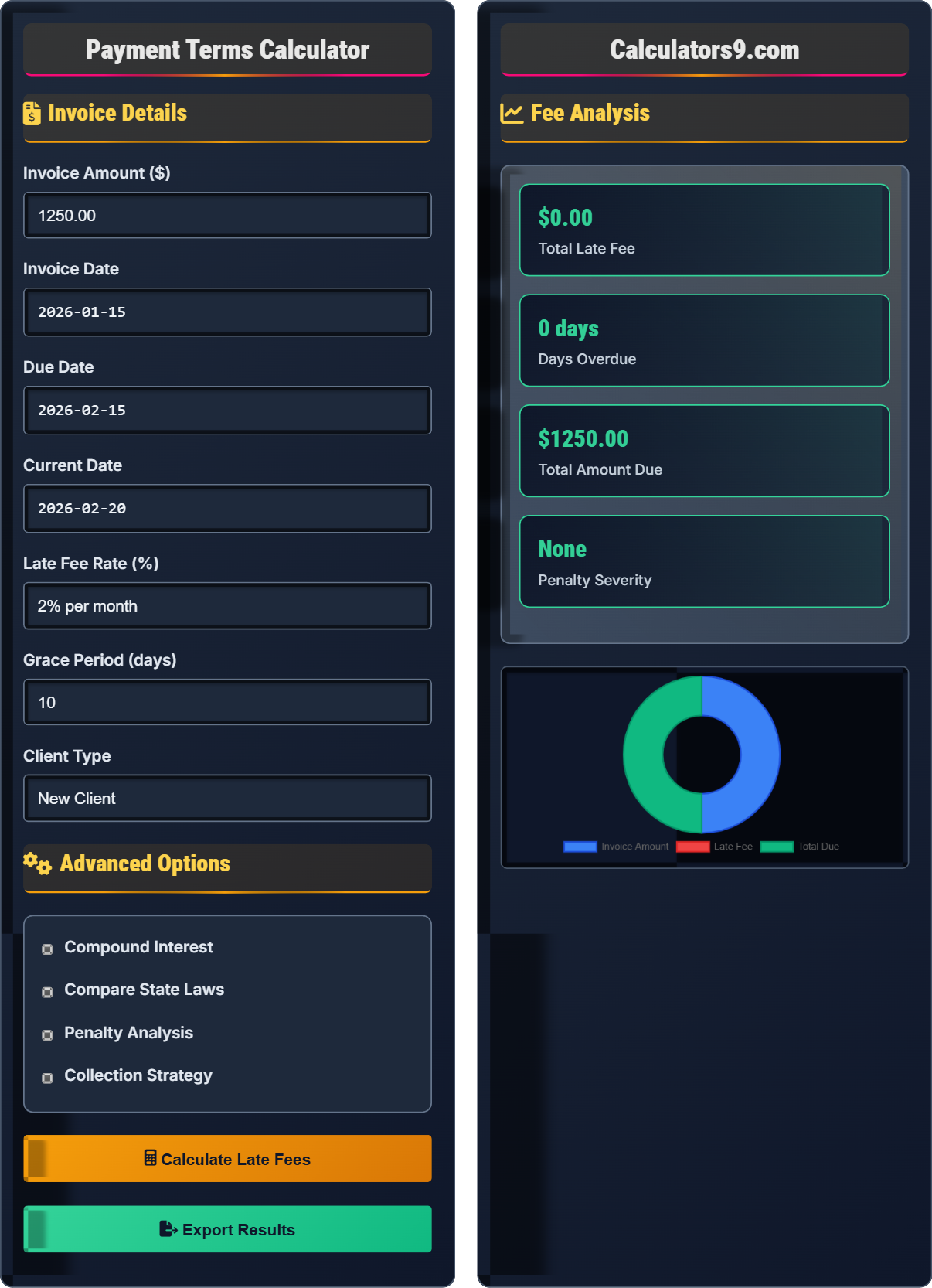
Payment Terms Calculator
Late fees & penalty analysis • 2026 e-commerce
Invoice Details
Advanced Options
Fee Analysis
| Component | Amount | Percentage | Description |
|---|
| Day | Cumulative Fee | Total Due | Status |
|---|
Comprehensive Late Payment Guide
Late payment fees are charges applied to invoices that remain unpaid after the due date. They serve as compensation for delayed payment and encourage prompt settlement. In e-commerce, late fees are essential for maintaining cash flow and protecting against payment delays. Properly structured late fees are legally enforceable when included in contract terms.
The standard late fee calculation uses this formula:
Where:
- \(Principal\) = Outstanding invoice amount
- \(Rate\) = Monthly or daily late fee rate
- \(Time\) = Duration in months or days past due
According to recent studies, here are the average late fee practices:
- Standard Rate: 1-2% per month (12-24% annually)
- Grace Period: 10-15 days after due date
- Notice Period: 5-10 days before applying fees
- Maximum Rate: Varies by state (5-18% annually)
- Enterprise Clients: Often negotiate lower rates
- Small Businesses: May require more lenient terms
Most successful e-commerce businesses implement graduated penalty systems with increasing rates over time.
- Early Communication: Friendly reminders 3 days before due date
- Grace Period: Allow 10 days after due date before applying fees
- Graduated Fees: 1% for first 30 days, 2% thereafter
- Legal Action: After 90+ days, consider collection agencies
- Relationship Preservation: Balance firmness with customer relations
Late Payment Learning Quiz
What is the most important factor to consider when setting late payment fees?
The answer is B) State law compliance and customer relationships. Legal compliance is paramount to ensure fees are enforceable. Customer relationships are critical for repeat business. Balancing these factors with appropriate fees creates sustainable payment practices.
Legal compliance ensures that fees are enforceable in court, while maintaining customer relationships ensures long-term business sustainability. Fees that are too high or not compliant with state law may be unenforceable, while fees that are too low may not adequately compensate for late payment costs.
Enforceable Fee: Legally permitted and collectible
Grace Period: Time allowed after due date before penalties
Compound Interest: Interest calculated on principal plus previous interest
• Fees must comply with state maximums
• Contract terms must be agreed upon
• Proper notice must be given before applying fees
• Research state-specific laws before setting rates
• Include fee terms in initial contracts
• Provide clear grace period notices
• Not researching state law limits
• Applying fees without proper notice
• Not including terms in initial contracts
Calculate the late fee for a $2,000 invoice that's 45 days overdue with a 1.5% monthly rate. Show your work.
Step 1: Convert days to months
Months overdue = 45 days ÷ 30 days/month = 1.5 months
Step 2: Calculate late fee
Late Fee = Principal × Rate × Time
Late Fee = $2,000 × 0.015 × 1.5 = $45.00
The late fee is $45.00.
This calculation demonstrates the standard late fee formula. The rate is applied monthly, so days overdue must be converted to months. This example shows how fees accumulate over time, incentivizing prompt payment while providing compensation for delayed cash flow.
Principal: Original invoice amount
Time Factor: Duration of delay
Monthly Rate: Percentage applied per month• Convert time periods to match rate period
• Apply rate to principal amount only
• Consider grace period exclusions
• Remember: Principal × Rate × Time
• Convert days to months for monthly rates
• Factor in grace period before applying
• Forgetting to convert days to months
• Applying rate to total including previous fees
• Not accounting for grace periods
Company A charges 2% monthly on overdue amounts after 10-day grace period. Company B charges 1.5% monthly after 5-day grace period. For a $1,500 invoice paid 30 days after due date, which company collects more in late fees?
Step 1: Calculate Company A fees
Days overdue for Company A = 30 - 10 = 20 days
Months = 20 ÷ 30 = 0.67 months
Fee A = $1,500 × 0.02 × 0.67 = $20.00
Step 2: Calculate Company B fees
Days overdue for Company B = 30 - 5 = 25 days
Months = 25 ÷ 30 = 0.83 months
Fee B = $1,500 × 0.015 × 0.83 = $18.68
Step 3: Compare results
Company A collects $20.00 vs Company B's $18.68
Company A collects $1.32 more despite higher rate and longer grace period.
This example shows how both the rate and grace period affect total fees. Company A has a higher rate (2% vs 1.5%) but also a longer grace period (10 vs 5 days). The longer grace period reduces the effective time period for fee calculation, partially offsetting the higher rate.
Grace Period: Time allowed before penalties
Effective Overdue Time: Actual time after grace period
Rate Impact: How percentage affects total amount
• Subtract grace period from total delay
• Calculate fees on effective overdue time
• Compare both rate and grace period together
• Always subtract grace period first
• Calculate effective time period for fees
• Consider both rate and grace period when comparing
• Not accounting for grace period in calculation
• Using total days instead of effective overdue days
• Forgetting to convert days to months
A freelancer has $15,000 in overdue invoices averaging 45 days past due. If they implement a 1.5% monthly late fee policy, how much additional revenue could they generate? What percentage of their total overdue amount would this represent?
Step 1: Calculate time factor
Months overdue = 45 days ÷ 30 days/month = 1.5 months
Step 2: Calculate total late fees
Total Late Fees = $15,000 × 0.015 × 1.5 = $337.50
Step 3: Calculate percentage of overdue amount
Percentage = ($337.50 ÷ $15,000) × 100 = 2.25%
The freelancer could generate $337.50 in late fees, representing 2.25% of their overdue amount.
This demonstrates the financial impact of implementing late fee policies. While $337.50 may seem small, it represents pure profit with minimal effort. For freelancers with significant overdue receivables, late fees can provide meaningful additional income while encouraging prompt payment for future invoices.
Overdue Receivables: Money owed past due date
Recovery Rate: Percentage of overdue amounts collected
Fee Revenue: Income generated from late payment fees
• Late fees should be applied consistently
• Ensure legal compliance before implementation
• Consider relationship impact on long-term clients
• Implement consistent late fee policy
• Document policy in initial contracts
• Consider graduated rates for long-term delinquency
• Not implementing consistent fee policies
• Applying fees without proper documentation
• Forgetting to account for state law limits
Which factor has the greatest impact on late payment rates in e-commerce?
The answer is B) Payment terms clarity. Clear, unambiguous payment terms in contracts significantly reduce late payments. When clients understand exactly when and how to pay, payment delays decrease substantially. This is more effective than penalties alone.
Prevention is more effective than correction. Clear payment terms address the root cause of late payments - misunderstanding or confusion about payment obligations. While late fees provide financial incentive, clear terms prevent the confusion that leads to delays in the first place.
Payment Terms: Conditions for payment timing and methods
Preventive Measures: Actions taken before problems occur
Corrective Measures: Actions taken after problems occur
• Prevention is more effective than penalties
• Clear terms reduce disputes
• Consistent follow-up is essential
• Include payment terms in initial contracts
• Send payment reminders before due dates
• Use automated systems for consistent follow-up
• Not clearly defining payment terms upfront
• Relying solely on penalties for compliance
• Inconsistent follow-up processes
Payment Fundamentals
Grace periods, compound interest, state regulations, and fee enforcement.
\(Late\ Fee = Principal \times Rate \times Time\)
\(Compound\ Fee = Principal \times (1 + Rate)^{Time} - Principal\)
\(Effective\ Rate = \frac{Total\ Fees}{Principal} \times 100\)
- Comply with state maximum rates
- Document terms in contracts
- Provide proper notice before applying fees
Collection Strategies
Early communication, graduated penalties, relationship preservation, and legal compliance.
- Send payment reminders before due dates
- Implement clear grace periods
- Use graduated fee structures
- Document all communication
- State-specific regulations
- Client relationship importance
- Collection agency costs
- Legal enforcement options
FAQ
Q: What's a reasonable late fee rate?
A: 1-2% monthly (12-24% annually) is standard for e-commerce. Check state laws - most allow up to 10-15% annually. Enterprise clients may negotiate lower rates. Never exceed state maximums.
Q: When should I apply late fees?
A: After grace period (typically 10-15 days after due date). Always notify client before applying fees. Send reminder at 5 days past due, then apply fees after grace period. Document everything.