Platform Fee Calculator
Gig worker earnings tracker • 2026 edition
Platform Fee Formulas:
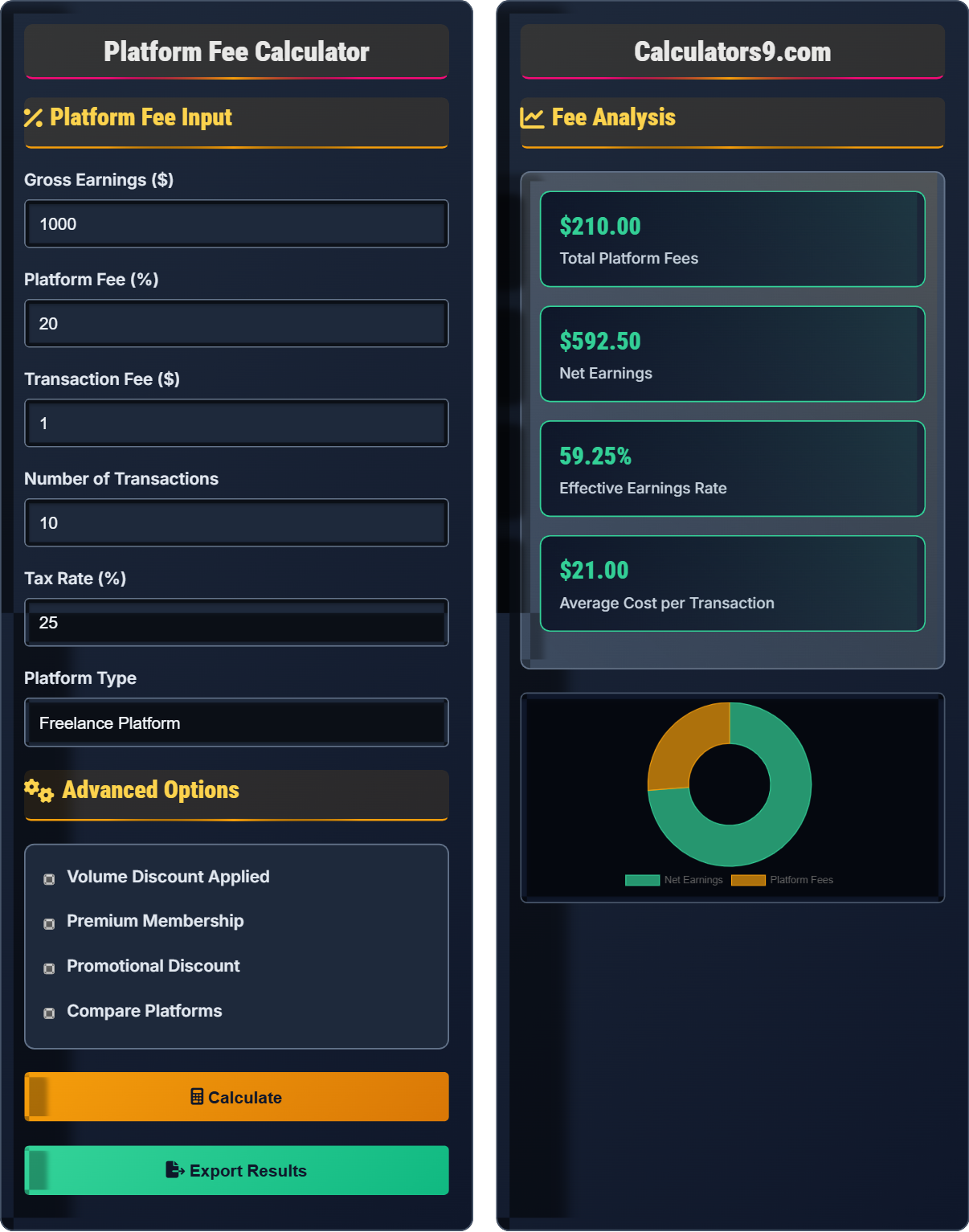
- Net Earnings: Gross Earnings - Platform Fees - Transaction Fees
- Effective Rate: Net Earnings ÷ Gross Earnings × 100
- Fee Percentage: Total Fees ÷ Gross Earnings × 100
- Cost per Transaction: Fixed Fee + (Variable Rate × Transaction Amount)
For example: $100 transaction with 20% platform fee and $1 fixed fee = $20 + $1 = $21 total fees. Net earnings = $79 (79% effective rate).
Platform Fee Input
Advanced Options
Fee Analysis
| Fee Type | Amount | Percentage | Notes |
|---|
| Platform | Gross | Fees | Net | Effective Rate |
|---|
Platform Fee Analysis
Platform fees are charges levied by online marketplaces and gig economy platforms for connecting service providers with customers. These fees vary significantly across platforms and can dramatically impact your net earnings.
Common fee structures include:
Fixed Fee: Constant amount per transaction
Percentage Fee: Variable based on transaction amount
Hybrid Fee: Combination of fixed + percentage
Net Earnings = Gross - Fees
Industry standard fee ranges by platform type:
- Freelance Platforms: 10-20% + $1-3 fixed fee
- Ride Share: 20-25% + surge pricing
- Delivery Services: 15-30% + delivery fees
- Rental Platforms: 3-12% + service fees
- E-commerce Marketplaces: 8-15% + transaction fees
- Negotiate Rates: High-volume performers may negotiate better terms
- Multi-Platform Approach: Distribute across platforms for optimal rates
- Direct Sales: Build client relationships to bypass platform fees
- Volume Tier Advancement: Meet thresholds for reduced rates
- Off-Peak Timing: Avoid surge pricing periods
Platform Fee Learning Quiz
If a freelancer earns $500 on a platform with a 15% fee plus a $2 transaction fee, what are their net earnings?
Step 1: Calculate percentage fee = $500 × 0.15 = $75
Step 2: Add fixed fee = $75 + $2 = $77 total fees
Step 3: Calculate net earnings = $500 - $77 = $423
Therefore: The answer is A) $423.
This problem demonstrates how both percentage and fixed fees combine to impact net earnings. The fixed fee has a more significant impact on smaller transactions, while the percentage fee scales with transaction size. Understanding both components is crucial for accurate earnings projections.
Percentage Fee: Fee calculated as a percentage of transaction amount
Fixed Fee: Constant fee charged per transaction
Net Earnings: Amount received after all fees are deducted
• Total Fees = (Gross × Percentage Rate) + Fixed Fee
• Net Earnings = Gross - Total Fees
• Fixed fees disproportionately impact smaller transactions
• Always calculate both percentage and fixed components
• Fixed fees hurt small transactions more than large ones
• Compare platforms using net earnings, not gross amounts
• Forgetting to include fixed fees in calculations
• Adding percentage to fixed instead of calculating separately
• Confusing gross with net earnings
Calculate the effective earnings rate for a ride-share driver who earned $800 in gross fares, paid $180 in platform fees, and $40 in taxes. What percentage of their gross earnings did they keep?
Step 1: Calculate total deductions = Platform fees + Taxes
Total deductions = $180 + $40 = $220
Step 2: Calculate net earnings = Gross - Total deductions
Net earnings = $800 - $220 = $580
Step 3: Calculate effective rate = (Net ÷ Gross) × 100
Effective rate = ($580 ÷ $800) × 100 = 72.5%
Therefore: The driver kept 72.5% of their gross earnings.
This problem demonstrates the importance of considering all deductions when calculating effective earnings. The effective rate gives a true picture of what percentage of gross earnings is retained. This metric is crucial for comparing different income opportunities across platforms.
Effective Earnings Rate: Percentage of gross earnings retained after all deductions
Total Deductions: All fees, taxes, and other expenses
Retention Rate: Another term for effective earnings rate• Effective Rate = (Net Earnings ÷ Gross Earnings) × 100
• Net Earnings = Gross Earnings - Total Deductions
• Include all deductions in the calculation
• Track all deductions, not just platform fees
• Use effective rate to compare different platforms
• Monitor effective rate over time to detect changes
• Only considering platform fees, ignoring taxes
• Dividing by net earnings instead of gross earnings
• Forgetting to multiply by 100 to get percentage
Sarah completes 100 deliveries on a food delivery platform with a standard 22% fee. She qualifies for a 10% volume discount tier. If her total gross earnings were $2,000, how much does she save in fees with the volume discount?
Step 1: Calculate fees without discount = $2,000 × 0.22 = $440
Step 2: Calculate fees with 10% discount = $440 × (1 - 0.10) = $440 × 0.90 = $396
Step 3: Calculate savings = Original fees - Discounted fees
Savings = $440 - $396 = $44
Therefore: Sarah saves $44 in fees with the volume discount.
This problem shows how volume discounts work in practice. The discount is applied to the calculated fees, not directly to the gross amount. Volume discounts can provide significant savings for high-volume performers, making it worthwhile to track and reach volume tiers.
Volume Discount: Reduced fee rate for high-volume activity
Threshold: Activity level required to qualify for discount
Fee Reduction: Dollar amount saved with discount
• Volume discount applies to calculated fees
• Savings = Original fees - (Original fees × Discount rate)
• Track activity to maximize discount benefits
• Understand the threshold requirements for discounts
• Calculate the breakeven point for reaching discount tiers
• Consider clustering activity to reach thresholds
• Applying discount directly to gross earnings instead of fees
• Not understanding how volume discounts are calculated
• Missing out on available discounts by not tracking activity
Mike is deciding between two delivery platforms. Platform A charges 20% + $1 per order, while Platform B charges 18% + $2.50 per order. If Mike expects to make 100 deliveries averaging $25 each, which platform offers better net earnings?
Step 1: Calculate total gross earnings = 100 × $25 = $2,500
Platform A Calculation:
Percentage fees = $2,500 × 0.20 = $500
Fixed fees = 100 × $1 = $100
Total fees for A = $500 + $100 = $600
Net earnings for A = $2,500 - $600 = $1,900
Platform B Calculation:
Percentage fees = $2,500 × 0.18 = $450
Fixed fees = 100 × $2.50 = $250
Total fees for B = $450 + $250 = $700
Net earnings for B = $2,500 - $700 = $1,800
Therefore: Platform A offers $100 more in net earnings.
This problem demonstrates why it's important to consider both percentage and fixed fee components when comparing platforms. Platform A has a higher percentage rate but lower fixed fees, making it better for high-volume earners. The optimal choice depends on transaction volume and average order size.
Fee Structure: Combination of percentage and fixed fee components
Cost Optimization: Choosing platform with lowest total fees
Volume Sensitivity: How fees change with transaction volume
• Total fees = (Gross × Percentage) + (Transactions × Fixed fee)
• Compare net earnings, not just fee percentages
• Consider your typical transaction volume
• Calculate total fees for your typical volume
• Consider both percentage and fixed fee components
• Factor in other platform benefits (insurance, support, etc.)
• Only comparing percentage fees without considering fixed fees
• Not calculating for your actual transaction volume
• Forgetting to factor in all fee components
Is a premium membership that costs $20/month worth it if it reduces platform fees from 22% to 18% for a freelancer earning $3,000/month?
Step 1: Calculate fees without premium = $3,000 × 0.22 = $660
Step 2: Calculate fees with premium = $3,000 × 0.18 = $540
Step 3: Calculate savings = $660 - $540 = $120
Step 4: Compare savings to membership cost = $120 - $20 = $100 net benefit
Therefore: Yes, savings of $120 exceed the $20 cost by $100. The answer is B.
This problem demonstrates cost-benefit analysis for premium memberships. The key is to calculate the difference in fees before and after the membership, then compare that to the membership cost. Premium memberships can be worthwhile if the fee reduction exceeds the membership cost.
Premium Membership: Paid subscription for reduced fees
Cost-Benefit Analysis: Evaluating if benefits exceed costs
Break-Even Point: Where benefits equal costs
• Savings = Old fees - New fees
• Net benefit = Savings - Membership cost
• Premium is worth it if net benefit is positive
• Calculate monthly savings vs. monthly cost
• Consider your typical earnings when evaluating
• Factor in other premium benefits beyond fee reduction
• Forgetting to subtract membership cost from savings
• Not calculating the actual difference in fees
• Assuming premium memberships are always beneficial
Fee Analysis Basics
Platform fees, effective earnings rate, and cost per transaction.
Total Fees = (Gross × Percentage Rate) + (Transactions × Fixed Fee)
Net Earnings = Gross - Total Fees
Effective Rate = (Net ÷ Gross) × 100
- Always calculate both percentage and fixed components
- Compare platforms using net earnings
- Consider volume discounts for high earners
Optimization Strategies
Maximize net earnings by optimizing platform selection and fee structure.
- Calculate net earnings for each platform
- Track your volume to qualify for discounts
- Evaluate premium membership benefits
- Consider timing to avoid surge pricing
- Other platform features matter too
- Consistency and reliability factor in
- Customer base differences
- Service requirements vary
FAQ
Q: How do I accurately track platform fees to calculate my true profit?
A: Tracking platform fees accurately requires systematic record-keeping:
1. Transaction Logs: Record each transaction with gross amount, platform fee, and net received
2. Monthly Summaries: Aggregate fees by platform and fee type (percentage, fixed, promotional)
3. Tax Considerations: Track fees separately from taxes for accurate net profit calculation
4. Platform Reports: Most platforms provide detailed fee breakdowns in their analytics dashboards
5. Spreadsheet Tracking: Use columns for date, gross, fees, net, and platform to calculate totals
Example formula: True Profit = Revenue - Platform Fees - Business Expenses - Taxes
By tracking fees separately, you can identify which platforms offer the best net returns and make informed decisions about where to focus your efforts.
Q: Should I accept surge pricing periods even though they come with higher platform fees?
A: The decision to work during surge pricing periods requires careful analysis:
When to Accept Surge Pricing:
- Net earnings (after fees) are still higher than normal periods
- You can complete more orders in less time
- The time commitment fits your schedule
- Increased safety/security during busy periods
When to Decline:
- Increased stress/decreased safety outweighs financial gain
- Excessive competition reduces order availability
- Personal time is more valuable
- Physical exhaustion affects performance
Calculation Example: If normal rate is $20/order with 20% fee ($16 net), and surge is $30/order with 25% fee ($22.50 net), surge provides 41% more net earnings per order despite higher fees.
Always calculate your net earnings per hour including all fees before making surge pricing decisions.