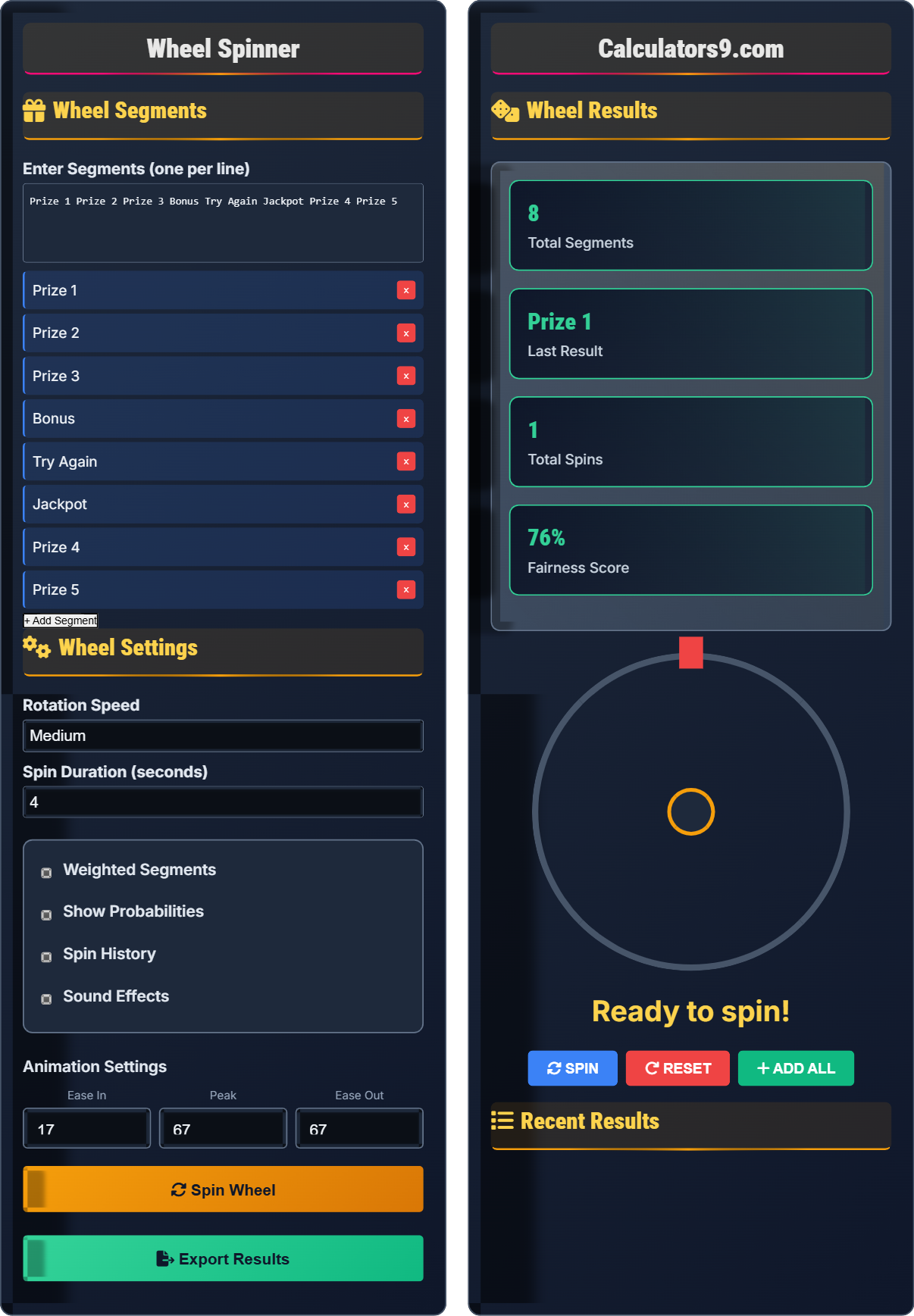
Wheel Spinner
Random prize wheel • 2026 edition
Spin Probability Formula:
Spin Wheel\( P = \frac{1}{n} \times W \)
Where:
- \( P \) = Probability of landing on segment
- \( n \) = Total number of segments
- \( W \) = Weight of segment (1.0 for equal size)
This formula calculates the probability of landing on a specific segment. For equal-sized segments, each has a 1/n probability. Weighted segments adjust probability based on relative size.
Example: For 8 equal segments: \( P = \frac{1}{8} \times 1.0 = 0.125 \) or 12.5% each. For weighted segments where one is twice as large: \( P = \frac{1}{8} \times 2.0 = 0.25 \) or 25%.
Wheel Segments
Wheel Settings
Wheel Results
Recent Results
Comprehensive Wheel Spinning Guide
Wheel spinning is a random selection method using a circular wheel divided into segments. Each segment represents a different outcome, prize, or option. When spun, the wheel randomly lands on one segment, determining the result. Modern digital wheels use random number generators and physics-based animations to simulate real-world spinning. The technique is commonly used for games, promotions, prize drawings, and decision-making.
The fundamental probability calculation uses the following formula:
Where:
- \(P\) = Probability of landing on segment
- \(n\) = Total number of segments
- \(W\) = Weight of segment (1.0 for equal size)
Wheel spinners are commonly used for:
- Prize Drawings: Awarding gifts and rewards
- Game Shows: Determining contestant outcomes
- Marketing: Customer engagement and promotions
- Education: Random selection of topics or questions
- Team Building: Assigning roles or activities
- Decision Making: Random choice between options
- Equal Segments: Ensure fair probability distribution
- True Randomness: Use proper random number generation
- Transparent Process: Make spinning visible to all
- Verification: Allow participants to verify results
- Consistent Physics: Apply same rules to every spin
Wheel Spinning Fundamentals
Chance of landing on a specific wheel segment.
\( P = \frac{1}{n} \times W \)
Where P=probability, n=segments, W=weight.
- Equal segments have equal probability
- Larger segments have higher probability
- Total probability sums to 100%
Strategies
Creating balanced and visually appealing wheel segments.
- Determine desired probabilities
- Calculate segment angles
- Assign colors and labels
- Test for fairness
- Consider visual balance
- Ensure readability
- Test with actual users
- Document the process
Wheel Spinning Learning Quiz
What is the probability of landing on any single segment of a wheel divided into 8 equal parts?
The answer is B) 12.5%. Using the probability formula \( P = \frac{1}{n} \times W \), where n=8 segments and W=1.0 for equal size: \( P = \frac{1}{8} \times 1.0 = 0.125 \) or 12.5%. This is the fundamental principle of equal-probability wheel spinning where each segment has an equal chance of being selected.
This question tests the basic understanding of probability in wheel spinning. The key concept is that when all segments are equal in size, each has an equal chance of being selected. The probability is always 1 divided by the total number of segments. This forms the foundation for understanding more complex weighted wheels where segments have different sizes and probabilities.
Equal Probability: Each segment has same chance of selection
Segment Count: Total number of divisions on the wheel
Fair Distribution: Equal chance for all outcomes
• Probability equals 1 divided by total segments
• Equal segments have equal probability
• Total probability always sums to 100%
• Use 1/n to calculate individual segment probability
• Verify total probabilities equal 100%
• Consider segment size when designing wheels
• Assuming probability is evenly distributed without calculation
• Forgetting to convert fraction to percentage
• Not accounting for weighted segments
Using the formula \( P = \frac{1}{n} \times W \), calculate the probability of landing on a segment that is twice as large as the others in a wheel with 6 total segments. Show your work.
Using the formula: \( P = \frac{1}{n} \times W \)
Given:
- n = 6 (total number of segments)
- W = 2.0 (the segment is twice as large as others)
Step 1: Calculate the base probability
1/n = 1/6 = 0.1667
Step 2: Apply the weight factor
P = 0.1667 × 2.0 = 0.3333
Therefore, the probability is 0.3333 or 33.33%.
This calculation demonstrates how segment weighting affects probability. The larger segment has double the probability of a standard segment. In this case, a segment that is twice as large has a 33.33% chance of being selected, while the other 5 segments each have a 13.33% chance (0.1667 ÷ 5 = 0.0333 each). The weighted segment is 2.5 times more likely to be selected than any standard segment.
Weighted Probability: Probability adjusted by segment size
Segment Size: Relative area of wheel section
Probability Distribution: How chances are spread across segments
• Larger segments have higher probability
• Weight factor multiplies base probability
• Total probability must sum to 100%
• Calculate base probability first (1/n)
• Then apply weight factors
• Verify all probabilities sum to 100%
• Forgetting to account for segment weights
• Misapplying the weight factor
• Not verifying total probability sums to 100%
If you spin a wheel with 10 equal segments 100 times, how many times would you expect each segment to be selected? What is the probability that a specific segment will appear at least once in 5 spins?
For 100 spins with 10 equal segments:
Expected appearances per segment = Total spins ÷ Number of segments
Expected appearances = 100 ÷ 10 = 10 times per segment
For probability of appearing at least once in 5 spins:
Probability of NOT appearing in one spin = 1 - (1/10) = 0.9
Probability of NOT appearing in 5 spins = 0.9^5 = 0.59049
Probability of appearing at least once = 1 - 0.59049 = 0.40951 or 40.95%
Therefore, each segment should appear about 10 times in 100 spins, and there's a 40.95% chance of a specific segment appearing in 5 spins.
This problem demonstrates both expected value and cumulative probability in wheel spinning. The first part shows the law of large numbers - over many trials, outcomes approach their expected values. The second part demonstrates that the probability of an event occurring at least once increases with multiple trials, even though each individual trial has the same probability. This is important for understanding how many spins might be needed to achieve desired outcomes.
Expected Value: Average result over many trials
Cumulative Probability: Probability of event occurring over multiple trials
Law of Large Numbers: Results approach expected values over many trials
• Expected value = Probability × Number of trials
• Cumulative probability uses complementary events
• More trials approach theoretical probabilities
• Use complement rule for "at least once" problems
• More spins approach expected distributions
• Consider variance around expected values
• Confusing probability with expected value
• Not using complement rule for "at least once"
• Expecting exact theoretical results in small samples
You want to design a prize wheel with 6 segments: 1 jackpot (high value), 2 major prizes, 2 minor prizes, and 1 "try again". How should you weight the segments to make the jackpot rare but possible, and ensure minor prizes are most common?
Recommended segment weights:
• Jackpot: Weight 1 (smallest segment)
• Major Prizes: Weight 2 each (medium-small segments)
• Minor Prizes: Weight 3 each (larger segments)
• Try Again: Weight 2 (medium-small segment)
Total weight units: 1 + 2 + 2 + 3 + 3 + 2 = 13
Probabilities:
• Jackpot: (1/13) × 1 = 7.7%
• Each Major Prize: (1/13) × 2 = 15.4%
• Each Minor Prize: (1/13) × 3 = 23.1%
• Try Again: (1/13) × 2 = 15.4%
This design makes minor prizes most common (46.2% combined) while keeping the jackpot rare but achievable.
This example shows how to design a wheel with specific outcome frequencies. The key is assigning weights that reflect the desired rarity of each outcome. The jackpot gets the smallest weight to make it rare, while minor prizes get higher weights to ensure they occur frequently. The design balances excitement (rare jackpot) with player satisfaction (frequent wins). The total weights determine the relative probabilities while maintaining fairness in the selection process.
Weight Assignment: Allocating relative sizes to segments
Outcome Frequency: How often each result occurs
Design Balance: Balancing rarity with achievability
• Assign weights based on desired frequency
• Rare items get lower weights
• Common items get higher weights
• Test your design with probability calculations
• Consider player satisfaction and excitement
• Balance rare prizes with frequent rewards
• Making rare prizes too rare to be exciting
• Not considering total probability distribution
• Ignoring player experience and satisfaction
Which animation timing function would create the most realistic wheel spinning effect?
The answer is D) Cubic-bezier (accelerates then decelerates). Real wheel spinning follows physics principles: it accelerates initially due to applied force, then gradually decelerates due to friction and air resistance. A cubic-bezier function like cubic-bezier(0.17, 0.67, 0.83, 0.67) mimics this natural acceleration and deceleration pattern, creating the most realistic spinning effect. This matches real-world physics where objects don't move at constant speeds.
This question addresses the importance of realistic physics in digital wheel spinning. Real wheels experience forces that cause acceleration and deceleration, not constant motion. The cubic-bezier function allows for complex timing that mimics real-world physics. This creates a more engaging and believable experience for users. Linear motion feels mechanical and unrealistic, while proper easing functions create the sensation of physical momentum and friction.
Cubic-Bezier: Complex timing function with acceleration/deceleration
Physics Simulation: Mimicking real-world motion patternsAnimation Timing: How speed changes over time
• Real wheels accelerate then decelerate
• Cubic-bezier mimics physical forces
• Realistic physics improves user experience
• Use cubic-bezier for natural motion
• Adjust parameters for different wheel weights
• Test animations for realism
• Using linear timing for wheel rotation
• Not considering physics principles
• Ignoring user experience in animation
FAQ
Q: How can I ensure my digital wheel spinner is truly random and fair?
A: True randomness requires proper algorithms and verification.
The randomness verification formula:
\( R = \frac{\sum_{i=1}^{n}(O_i - E_i)^2}{E_i} \)
Where:
- \( R \) = Randomness Chi-square statistic
- \( O_i \) = Observed frequency for outcome i
- \( E_i \) = Expected frequency for outcome i
- \( n \) = Number of possible outcomes
For a wheel to be considered random, the chi-square value should be less than the critical value (typically 3.84 for 95% confidence with 1 degree of freedom). Conduct at least 100 spins to validate distribution approaches expected probabilities. Look for patterns or biases in results.
Q: How do I design a wheel that balances excitement with profitability?
A: Use this optimization framework:
\( O = \frac{(E \times S) + (F \times R)}{C} \)
Where:
- \( O \) = Optimization score
- \( E \) = Excitement factor (jackpot weight)
- \( S \) = Satisfaction (win frequency)
- \( F \) = Fairness (probability distribution)
- \( R \) = Revenue impact
- \( C \) = Cost of prizes
Design wheels with small jackpot segments (high excitement) and larger common reward segments (satisfaction). Ensure total prize costs don't exceed revenue. The key is creating frequent wins to maintain engagement while offering occasional large prizes for excitement.