Betting Odds Converter
Probability calculator • 2026 betting tools
Betting Odds Conversion Formula:
Show the calculator\( \text{Probability} = \frac{1}{\text{Decimal Odds}} \)
Where:
- \( \text{Decimal Odds} \) = European odds format
- \( \text{Probability} \) = Implied probability (0-1)
For American Odds (Moneyline):
If positive: \( \text{Decimal} = \frac{\text{American} + 100}{100} \)
If negative: \( \text{Decimal} = \frac{100}{|\text{American}|} + 1 \)
For Fractional Odds:
\( \text{Decimal} = \frac{\text{Numerator}}{\text{Denominator}} + 1 \)
Example: Converting +200 American odds to decimal:
Decimal = (200 + 100) / 100 = 3.0
Probability = 1 / 3.0 = 0.333 or 33.3%
Thus, +200 odds imply a 33.3% probability.
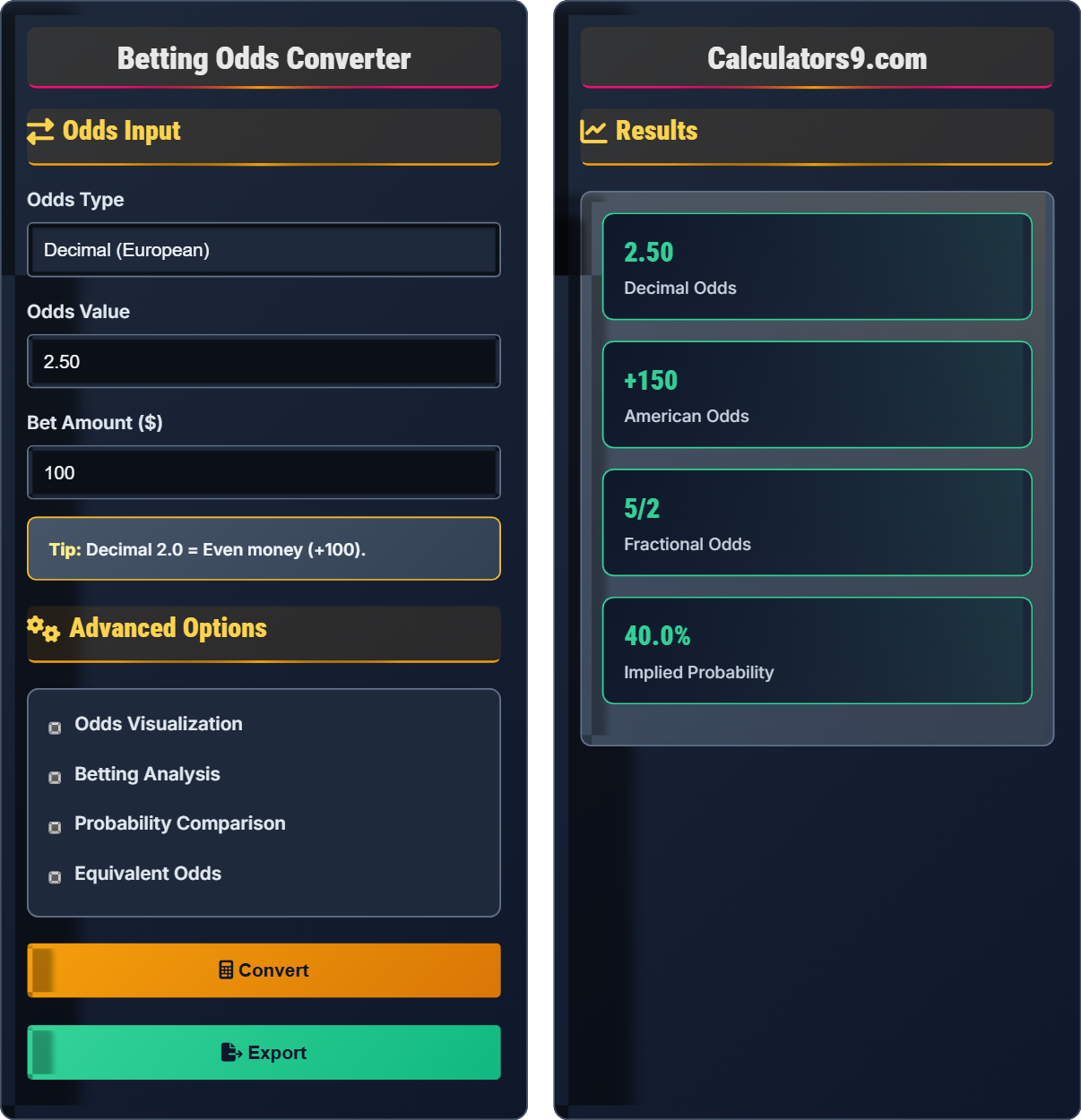
Odds Input
Advanced Options
Results
Comprehensive Betting Odds Guide
Betting odds represent the probability of an event occurring and determine potential payouts. There are three main systems used globally: Decimal (European), American (Moneyline), and Fractional (British). Understanding these systems is crucial for effective betting.
The conversion formulas between different odds systems:
For American Odds:
- Positive: \( \text{Decimal} = \frac{\text{American} + 100}{100} \)
- Negative: \( \text{Decimal} = \frac{100}{|\text{American}|} + 1 \)
- Implied Probability: Probability suggested by odds
- Value Betting: Finding odds higher than true probability
- Margin: Bookmaker's profit built into odds
- Vig: Commission charged by bookmakers
- Arbitrage: Exploiting odds differences
- Comparing Lines: Finding best odds across bookmakers
- Calculating Payouts: Determining potential returns
- Probability Assessment: Comparing odds to true chances
- Bankroll Management: Using probability for bet sizing
- Market Analysis: Understanding market movements
Betting Odds Fundamentals
Representing probability and potential payout.
\( P = \frac{1}{\text{Decimal}} \)
Where P=probability, Decimal=odds.
- Lower odds = higher probability
- Higher odds = lower probability
- Always convert to same format
Strategy Tips
Probability suggested by the odds.
- Convert odds to probability
- Estimate true probability
- Compare the two
- Bet if true > implied
- Bookmaker margins exist
- Shop for best odds
- Manage your bankroll
Betting Odds Learning Quiz
Which of the following represents the same probability as decimal odds of 4.00?
The answer is D) Both A and C. To verify:
Decimal 4.00 implies probability = 1/4.00 = 0.25 or 25%
American +300: Decimal = (300+100)/100 = 4.00 → 25% probability
Fractional 3/1: Decimal = 3/1 + 1 = 4.00 → 25% probability
Both represent the same underlying probability as decimal 4.00.
This demonstrates how different odds formats represent the same underlying probability. The conversion between formats preserves the implied probability, which is the fundamental relationship between odds and probability.
Decimal Odds: Total return per unit staked
American Odds: Profit on $100 stake
Implied Probability: Probability suggested by odds
• All formats represent same probability
• Convert to same format for comparison
• P = 1/Decimal
• Decimal 2.0 = Even money (+100)
• Convert all odds to same format
• Comparing different formats directly
Convert American odds of -250 to decimal and fractional formats. Show your work.
For negative American odds: \( \text{Decimal} = \frac{100}{|\text{American}|} + 1 \)
Step 1: Calculate decimal odds
Decimal = 100/|-250| + 1 = 100/250 + 1 = 0.4 + 1 = 1.40
Step 2: Convert to fractional
Fractional = (Decimal - 1)/1 = (1.40 - 1)/1 = 0.40/1 = 2/5
Verification: 2/5 + 1 = 1.40 ✓
Therefore, -250 American = 1.40 decimal = 2/5 fractional.
This demonstrates the conversion formula for negative American odds, which represent favorites. The negative sign indicates how much needs to be wagered to win $100, so the formula reflects the inverse relationship between stake and profit.
Favorites: Teams expected to win (- odds)
Underdogs: Teams expected to lose (+ odds)
Conversion Formula: Math relationship
• Negative American: Decimal = 100/|A| + 1
• Positive American: Decimal = (A+100)/100
• Fractional = (Decimal-1)/1
• Negative odds are favorites
• Positive odds are underdogs
• Always verify conversions
• Using wrong formula for negative odds
• Forgetting to add 1 to fractional
• Incorrect fraction simplification
If you place a $50 bet on decimal odds of 3.50, what is your total return and profit? If the same bet was made at fractional odds of 5/2, would the return be the same?
Step 1: Calculate return with decimal odds
Total Return = Stake × Decimal Odds = $50 × 3.50 = $175
Profit = Total Return - Stake = $175 - $50 = $125
Step 2: Verify with fractional odds
Fractional 5/2 = 5÷2 = 2.5, so Decimal = 2.5 + 1 = 3.50
This confirms both formats give the same return.
Therefore, your total return is $175 with a profit of $125, and yes, fractional 5/2 gives the same return.
This demonstrates how different odds formats yield identical payouts for the same implied probability. The conversion between formats preserves the relationship between stake and potential return.
Total Return: Stake + Profit
Profit: Winnings only
Same Probability: Different formats, same payout
• Total Return = Stake × Decimal
• Different formats = same payout
• Probability remains constant
• Use decimal for easy calculation
• Verify conversions match
• Check with simple examples
• Confusing return with profit
• Not understanding format equivalence
• Incorrect arithmetic in calculations
A bookmaker offers decimal odds of 2.20 on a team winning. You estimate the team has a 50% chance of winning. Is this a value bet? Calculate the expected value of a $100 bet.
Step 1: Calculate implied probability
Implied Probability = 1/Decimal = 1/2.20 = 0.4545 or 45.45%
Step 2: Compare to your estimate
Your estimate: 50%
Implied: 45.45%
Since 50% > 45.45%, this IS a value bet.
Step 3: Calculate expected value
EV = (Your Probability × Win Amount) - ((1 - Your Probability) × Loss Amount)
Win Amount = $100 × 2.20 - $100 = $120 profit
Loss Amount = $100 (stake)
EV = (0.50 × $120) - (0.50 × $100) = $60 - $50 = +$10
Therefore, this is a value bet with positive expected value of $10.
This demonstrates value betting - finding situations where the true probability exceeds the implied probability. The expected value calculation shows the long-term profitability of the bet.
Value Betting: True probability > implied probability
Expected Value: Average outcome over time
Positive EV: Profitable in long run
• Value: True > Implied probability
• EV = (P × Win) - ((1-P) × Loss)
• Aim for positive EV bets
• Compare your estimate to implied
• Calculate EV for important bets
• Look for market inefficiencies
• Not calculating implied probability
• Confusing odds with probability
• Forgetting to subtract stake from win
Which of the following statements about betting markets is TRUE?
The answer is C) Bookmakers build a margin into odds to guarantee profit. This margin (also called vigorish or vig) ensures the bookmaker profits regardless of the outcome. For example, if true probabilities sum to 100%, bookmaker odds might imply 105%, creating a 5% margin.
Example: Team A (50% true prob) → 2.00 odds (50% implied), Team B (50% true prob) → 1.90 odds (52.6% implied). Total = 102.6% → 2.6% margin.
This highlights the fundamental business model of bookmakers. The margin ensures profitability over time, which is why beating the market consistently is challenging. The margin is built into all odds offered.
Margin: Bookmaker's built-in profit
Vigorish (Vig): Commission on bets
Market Efficiency: How well prices reflect info
• Bookmakers charge a margin
• Implied probabilities > 100%
• Consistent profit is difficult
• Shop for best odds (lowest margin)
• Understand the vig in odds
• Focus on long-term strategy
• Expecting perfect market efficiency
• Not accounting for bookmaker margin
• Overconfidence in beating the market
FAQ
Q: How do I convert between different odds formats quickly?
A: Use these quick conversion formulas:
- Decimal to Fractional: (Decimal - 1)/1, then simplify
- American Positive to Decimal: (American + 100)/100
- American Negative to Decimal: 100/|American| + 1
- Decimal to Probability: 1/Decimal
Example: +250 → (250+100)/100 = 3.50 decimal → 1/3.50 = 28.6% probability.
Q: What does "value" mean in betting?
A: Value occurs when the true probability of an outcome is higher than the implied probability in the odds.
Mathematically: If your estimated probability > (1/Decimal Odds), then there's value.
For example, if you think a team has 60% chance to win but the odds imply only 50% (decimal 2.00), there's value in betting because:
True Probability (60%) > Implied Probability (50%)
This creates positive expected value over the long term.