Lottery Odds Calculator
Jackpot probability calculator • 2026 betting tools
Lottery Probability Formula:
Show the calculator\( P(E) = \frac{1}{C(n,r)} = \frac{r!(n-r)!}{n!} \)
Where:
- \( P(E) \) = Probability of winning
- \( C(n,r) \) = Combinations of n items taken r at a time
- \( n \) = Total number of balls
- \( r \) = Number of balls drawn
For multi-set lotteries (main numbers + bonus):
\( P = \frac{1}{C(n_1,r_1) \times C(n_2,r_2)} \)
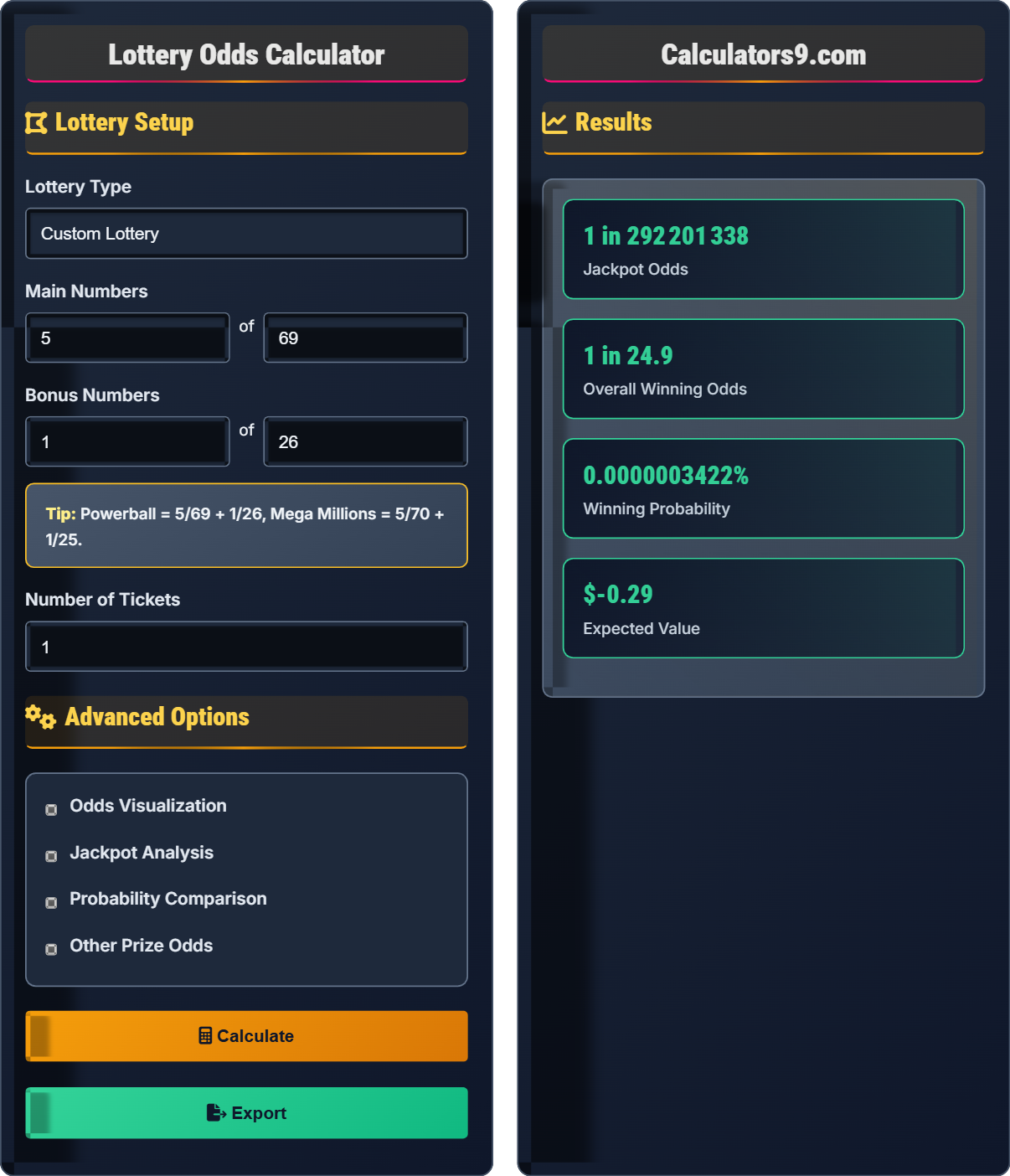
Example: Powerball (5/69 + 1/26):
\( C(69,5) = \frac{69!}{5!(69-5)!} = 11,238,513 \)
\( C(26,1) = 26 \)
Overall odds = 11,238,513 × 26 = 292,201,338
Thus, jackpot odds are 1 in 292,201,338.
Lottery Setup
Advanced Options
Results
Comprehensive Lottery Probability Guide
Lottery probability is the study of the mathematical likelihood of winning various prizes in lottery games. Unlike skill-based games, lotteries rely purely on chance, making probability calculations straightforward but often revealing extremely low winning odds. Understanding these probabilities helps players make informed decisions about participation.
The fundamental formula for lottery probability uses combinations:
Where:
- \(P(E)\) = Probability of winning
- \(C(n,r)\) = Combinations of n items taken r at a time
- \(n\) = Total number of balls
- \(r\) = Number of balls drawn
- Independent Events: Each draw is independent
- No Memory: Past results don't affect future draws
- Expected Value: Long-term average outcome
- Law of Large Numbers: Results converge to theoretical probability
- Multiple Draws: Buying more tickets increases chances
- Cost Analysis: Compare ticket cost to expected value
- Jackpot Threshold: Determine break-even point
- Frequency Fallacy: Avoid common misconceptions
- Pooling Resources: Group play strategies
- Alternative Games: Better odds options
Lottery Probability Fundamentals
Calculating likelihood of winning lottery prizes.
\( P(E) = \frac{1}{C(n,r)} \)
Where P=probability, C=combinations.
- Each draw is independent
- Past results don't matter
- Buying more tickets increases odds
Strategy Tips
Average return per ticket over time.
- Calculate total possible combinations
- Determine ticket price
- Find break-even jackpot
- Compare to actual jackpot
- Most lotteries have negative EV
- Only play with money you can afford to lose
- Consider taxes on winnings
Lottery Probability Learning Quiz
What is the probability of winning the Powerball jackpot?
The answer is B) 1 in 292,201,338. Powerball requires matching 5 numbers from 69 and 1 Powerball from 26. The calculation is C(69,5) × C(26,1) = 11,238,513 × 26 = 292,201,338. This means you have a 1 in 292,201,338 chance of winning the jackpot.
This demonstrates how lottery odds are calculated using combinations. The large numbers involved illustrate why lottery jackpots can grow so large - the odds are so low that winners are rare, allowing the prize to accumulate over time.
Combinations: Selection without regard to order
Powerball: 5/69 + 1/26 format
Independent Events: Past results don't affect future draws
• Each draw is independent
• Past results don't influence future draws
• Odds remain constant
• Remember: 5/69 + 1/26 for Powerball
• Use combination formula for calculations
• Confusing Powerball with other lotteries
Calculate the odds of winning a lottery that requires selecting 6 numbers from 49. Show your work using the combination formula C(n,r) = n!/(r!(n-r)!).
Using the combination formula: \(C(n,r) = \frac{n!}{r!(n-r)!}\)
For 6 numbers from 49:
\(C(49,6) = \frac{49!}{6!(49-6)!} = \frac{49!}{6! \times 43!}\)
Expanding the numerator:
\(C(49,6) = \frac{49 \times 48 \times 47 \times 46 \times 45 \times 44}{6 \times 5 \times 4 \times 3 \times 2 \times 1}\)
Calculating:
\(C(49,6) = \frac{10,068,347,520}{720} = 13,983,816\)
Therefore, the odds are 1 in 13,983,816.
This demonstrates how the combination formula calculates lottery odds. The factorial expressions simplify because most terms cancel out, leaving us with the product of the top numbers divided by the product of the bottom numbers. This is the basis for all lottery probability calculations.
Factorial (!): Product of all positive integers
Combination: Selection without order considerationPermutation: Selection with order consideration
• C(n,r) = n!/(r!(n-r)!)
• Order doesn't matter in lotteries
• Use combinations, not permutations
• Cancel factorials to simplify calculations
• Many calculators have combination functions
• Look for patterns in the numerator
• Using permutations instead of combinations
• Incorrect factorial calculations
• Forgetting to divide by denominator
If the odds of winning a lottery are 1 in 14,000,000, what are your chances of winning if you buy 100 tickets? Express as both odds and probability.
Step 1: Calculate probability of winning with 1 ticket
P(win with 1 ticket) = 1/14,000,000 = 0.0000000714
Step 2: Calculate probability of NOT winning with 1 ticket
P(not win with 1 ticket) = 1 - 1/14,000,000 = 13,999,999/14,000,000
Step 3: Calculate probability of NOT winning with 100 tickets
P(not win with 100 tickets) = (13,999,999/14,000,000)^100
Step 4: Calculate probability of winning with 100 tickets
P(win with 100 tickets) = 1 - (13,999,999/14,000,000)^100
Using approximation: P(win) ≈ 100/14,000,000 = 1/140,000
Therefore, with 100 tickets, your odds are approximately 1 in 140,000, or a probability of 0.000714%.
This demonstrates how buying multiple tickets increases your chances, but the improvement is proportional to the number of tickets purchased. Even with 100 tickets, the odds remain extremely low. The calculation uses the complement rule: P(win) = 1 - P(don't win).
Complement Rule: P(A) = 1 - P(not A)
Independent Events: Each ticket is independent
Approximation: For small probabilities
• Each ticket is independent
• P(at least one win) = 1 - P(no wins)
• For small p: P ≈ n × p
• Use complement rule for "at least one" problems
• Small probability approximation: np
• Each ticket increases odds proportionally
• Simply dividing odds by number of tickets
• Forgetting independence of tickets
• Incorrect probability calculations
A lottery has a jackpot of $50 million, costs $2 per ticket, and has odds of winning of 1 in 300 million. What is the expected value of purchasing one ticket? Is this a good investment?
Step 1: Calculate probability of winning
P(win) = 1/300,000,000
Step 2: Calculate probability of losing
P(lose) = 299,999,999/300,000,000
Step 3: Calculate expected value
EV = (P(win) × Win Amount) + (P(lose) × Lose Amount)
EV = (1/300,000,000 × $50,000,000) + (299,999,999/300,000,000 × -$2)
EV = $0.1667 + (-$1.999999993)
EV = -$1.83
Therefore, the expected value is -$1.83, meaning you lose $1.83 on average per ticket. This is not a good investment.
This demonstrates expected value calculation in lotteries. The expected value shows the average return per ticket over many plays. Most lotteries have negative expected values, meaning players lose money on average. This is how lotteries fund public programs.
Expected Value (EV): Average outcome over many trials
Positive EV: Profitable in long run
Negative EV: Losing in long run
• EV = Σ(probability × outcome)
• Most lotteries have negative EV
• Only play with money you can afford to lose
• Calculate EV before playing
• Consider taxes on winnings
• Remember: lottery is entertainment
• Forgetting to include ticket cost
• Not considering probability of losing
• Thinking lotteries are good investments
Which of the following statements about lottery probability is TRUE?
The answer is B) Each lottery draw is independent of previous draws. This is a fundamental principle of probability known as the independence of events. Each draw is a fresh opportunity with the same odds, regardless of past results. This is often confused with the gambler's fallacy - the mistaken belief that past events affect future probabilities.
This addresses a common misconception about probability called the gambler's fallacy. Each lottery draw is an independent event with identical probabilities. The lottery balls have no memory of previous draws, so the odds remain constant regardless of past results.
Independent Events: Events that don't affect each other
Gambler's Fallacy: Believing past results affect future odds
Randomness: Lack of pattern or predictability
• Each draw is independent
• Past results don't affect future draws
• All combinations have equal probability
• Remember: each draw starts fresh
• No pattern exists in truly random draws
• Every combination has equal chance
• Believing in "due" numbers
• Thinking certain combinations are luckier
• Looking for patterns in random events
FAQ
Q: How do I calculate lottery odds for a game with multiple prize tiers?
A: For multi-tier lotteries, calculate each prize tier separately:
For matching k numbers out of r drawn from n total:
\( P(k \text{ matches}) = \frac{C(r,k) \times C(n-r, r-k)}{C(n,r)} \)
For Powerball (match 5 of 5 main numbers):
\( P = \frac{C(5,5) \times C(64,0)}{C(69,5)} = \frac{1}{11,238,513} \)
But you must also match the Powerball (1 in 26), so:
\( P = \frac{1}{11,238,513} \times \frac{1}{26} = \frac{1}{292,201,338} \)
Q: Are some lottery numbers drawn more frequently than others?
A: In the long run, all numbers should appear with equal frequency in a fair lottery. Any apparent patterns in short-term results are due to randomness. Each draw is independent, so:
- Every number has equal probability of being drawn
- Previous draws don't influence future draws
- Long-term frequency approaches theoretical probability
This is guaranteed by the law of large numbers, which states that observed frequencies converge to theoretical probabilities over many trials.