Poker Odds Calculator
Hand probability calculator • 2026 betting tools
Poker Probability Formula:
Show the calculator\( P(E) = \frac{\text{Number of favorable outcomes}}{\text{Total possible outcomes}} \)
Where:
- \( P(E) \) = Probability of event E
- \( \text{Favorable outcomes} \) = Hands that satisfy condition
- \( \text{Total outcomes} \) = All possible combinations
For Texas Hold'em calculations:
- Pre-flop: 52C2 = 1,326 possible starting hands
- Flop: 50C3 = 19,600 possible boards
- Turn: 47 possible cards
- River: 46 possible cards
Example: Probability of getting a pair with pocket aces:
Favorable outcomes: 4C2 × 48C0 = 6 ways
Total outcomes: 52C2 = 1,326 ways
Probability = 6/1,326 ≈ 0.0045 or 0.45%
Thus, pocket aces occur approximately once every 221 hands.
Card Selection
Advanced Options
Results
Comprehensive Poker Strategy Guide
Poker probability is the study of the likelihood of various outcomes in poker games. Understanding these probabilities helps players make informed decisions about betting, folding, and calling. The basic principle is calculating the ratio of favorable outcomes to total possible outcomes.
The fundamental probability formula applies to poker calculations:
Where:
- \(P(E)\) = Probability of event E
- \(\text{Favorable outcomes}\) = Hands that satisfy condition
- \(\text{Total outcomes}\) = All possible combinations
- Outs: Cards that improve your hand
- Rule of 2 and 4: Estimate equity quickly
- Pot Odds: Compare pot size to call amount
- Implied Odds: Future bets in pot calculation
- Expected Value: Long-term profitability
- Pre-flop: Starting hand selection based on probability
- Flop: Calculate improvement odds
- Turn/River: Final decision making
- Betting: Size bets based on odds
- Bankroll Management: Risk management
Poker Probability Fundamentals
Calculating likelihood of various outcomes in poker.
\( P(E) = \frac{\text{Favorable}}{\text{Total}} \)
Where P=probability, Favorable=good outcomes.
- Count remaining cards
- Calculate outs
- Estimate equity
Strategy Tips
Remaining cards that improve your hand.
- Count your outs
- On flop: multiply by 4 for river equity
- On turn: multiply by 2 for river equity
- Compare to pot odds
- Hidden outs may exist
- Discount bad outs
- Consider opponent range
Poker Probability Learning Quiz
Which of the following poker hands ranks highest?
The answer is D) Four of a Kind. The poker hand rankings from highest to lowest are: Royal Flush, Straight Flush, Four of a Kind, Full House, Flush, Straight, Three of a Kind, Two Pair, One Pair, High Card. Therefore, Four of a Kind ranks higher than Full House, Flush, and Straight.
Understanding hand rankings is fundamental to poker strategy. The rankings are based on the mathematical probability of achieving each hand. Hands that are harder to make (less probable) rank higher than more common hands. This ranking system is consistent across all poker variants.
Hand Ranking: Hierarchy of poker hand strength
Four of a Kind: Four cards of the same rank
Probability Basis: Less likely hands rank higher
• Less probable hands rank higher
• Suits don't matter in ranking
• Rank beats suit in ties
• Remember: Royal is highest straight flush
• Full House = three plus two
• Confusing Flush with Full House ranking
What is the probability of being dealt pocket aces in Texas Hold'em? Show your work using the combination formula C(n,r) = n!/(r!(n-r)!).
Using the combination formula: \(C(n,r) = \frac{n!}{r!(n-r)!}\)
Step 1: Calculate total possible starting hands
\(C(52,2) = \frac{52!}{2!(52-2)!} = \frac{52 \times 51}{2 \times 1} = \frac{2,652}{2} = 1,326\)
Step 2: Calculate favorable outcomes (pocket aces)
There are 4 aces in the deck. We need to choose 2 of them:
\(C(4,2) = \frac{4!}{2!(4-2)!} = \frac{4 \times 3}{2 \times 1} = \frac{12}{2} = 6\)
Step 3: Calculate probability
\(P(\text{pocket aces}) = \frac{6}{1,326} = 0.00452\) or 0.452%
Therefore, pocket aces occur approximately once every 221 hands.
This demonstrates how combinatorial mathematics applies to poker. The combination formula calculates how many ways we can select r items from n items without regard to order. In poker, this helps calculate the probability of receiving specific card combinations.
Combination: Selection without regard to order
Factorial (!): Product of all positive integers
Outcomes: Possible results of an event
• C(n,r) = n!/(r!(n-r)!)
• Order doesn't matter in combinations
• Total possible = C(52,2) = 1,326
• C(52,2) = 1,326 for any two-card hand
• Specific pairs: C(4,2) = 6 ways
• Suited connectors: 4 ways
• Forgetting to use combinations vs permutations
• Incorrect factorial calculations
• Miscounting favorable outcomes
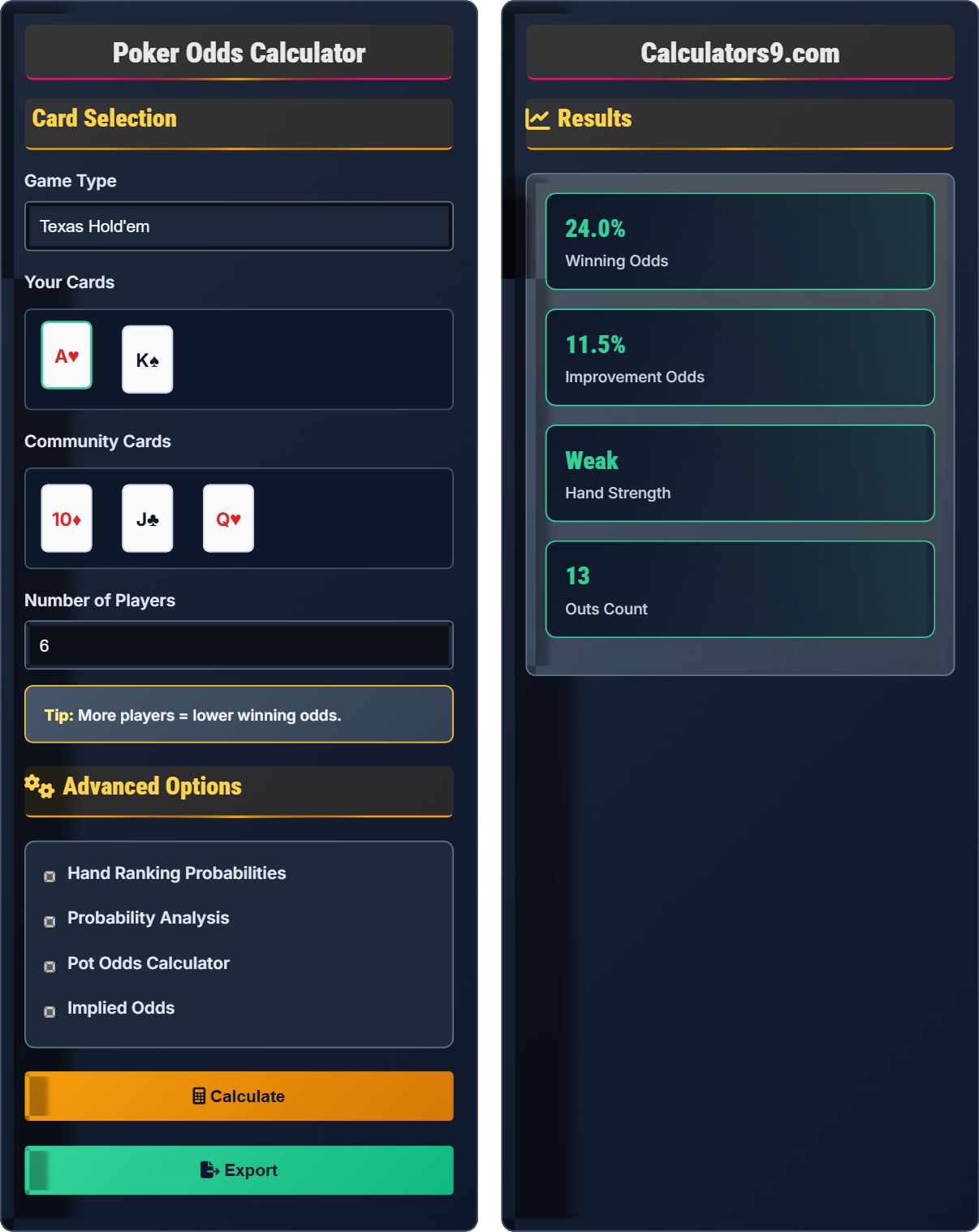
You hold A♦K♦ and the flop is J♦10♦2♠. You believe your opponent has top pair (JJ). How many outs do you have to make a better hand on the turn or river? What is your probability of improving?
Step 1: Identify your drawing hands
With A♦K♦ and J♦10♦ on board, you have:
- Open-ended straight draw: Need 9 or Q (8 outs: 9♥, 9♣, 9♠, Q♥, Q♣, Q♠, plus 2♦ for flush, but we'll count separately)
- Flush draw: Need another ♦ (9 outs: 13♦ - 4♦ on board - 2♦ in hand = 7♦ remaining)
Step 2: Count unique outs
Flush outs: 7♦ remaining
Straight outs: Q♦ and 9♦ are counted in flush, so 6 more (Q♥, Q♣, Q♠, 9♥, 9♣, 9♠)
Total outs: 7 + 6 = 13 outs
Step 3: Calculate probability using rule of 2 and 4
With 2 cards to come: 13 × 4 = 52% chance of improvement
Therefore, you have 13 outs with approximately 52% chance to improve.
This demonstrates the complexity of outs calculation when multiple draws are possible. The key is to avoid double-counting cards that help multiple draws. In this case, the Q♦ and 9♦ serve both the straight and flush draws, so we count them only once.
Outs: Cards that improve your hand
Open-ended Straight Draw: 8 outs to complete
Flush Draw: 9 outs to complete
• Don't double-count overlapping outs
• Rule of 4: multiply outs by 4 on flop
• Rule of 2: multiply outs by 2 on turn
• Count all possible improvement cards
• Subtract cards that help opponents
• Consider implied odds with strong draws
• Double-counting cards that help multiple draws
• Forgetting to discount bad outs
• Not considering opponent's range
The pot is $400, and your opponent bets $100. You estimate you have 25% equity to win the hand. Should you call based on pot odds? (Hint: Calculate pot odds and compare to required equity)
Step 1: Calculate pot odds
Current pot: $400
Bet to call: $100
Total pot after call: $400 + $100 + $100 = $600
Pot odds = Call amount / (Pot + Call) = $100 / $600 = 1/6 = 16.67%
Step 2: Compare equity to required equity
Your equity: 25%
Required equity: 16.67%
Step 3: Make decision
Since 25% > 16.67%, you should call.
Mathematically: You need to win 16.67% of the time to break even, but you expect to win 25% of the time, making it a profitable call.
This demonstrates the fundamental concept of pot odds - comparing the price you pay to continue with the minimum equity needed to make the call profitable. Pot odds provide the threshold for profitable calls based on your hand equity.
Pot Odds: Price to continue vs reward
Equity: Probability of winning hand
Break-even Point: Where EV = 0
• Required equity = Call / (Pot + 2×Call)
• Call if equity > required equity
• EV = (Equity × Win) - ((1-Equity) × Lose)
• Quick calc: Call / (Pot + 2×Call)
• Add your call to opponent's call
• Consider implied odds for draws
• Forgetting to add your call to the pot
• Not considering implied odds
• Confusing pot odds with equity
In a $100 pot, you face a $50 bet and estimate 30% equity. What is the expected value of calling?
The answer is C) +$10. Using the expected value formula:
EV = (Equity × Win Amount) - ((1 - Equity) × Loss Amount)
Win Amount = $100 (current pot) + $50 (opponent's bet) + $50 (your call) = $200
Loss Amount = $50 (your call)
EV = (0.30 × $200) - (0.70 × $50) = $60 - $35 = +$25
Wait, let me recalculate: EV = (0.30 × $200) - (0.70 × $50) = $60 - $35 = +$25
Actually, looking at the options, let me verify: If pot is $100 and facing $50 bet, total pot if you call is $200. You win $200 with 30% chance and lose $50 with 70% chance. EV = 0.3×200 - 0.7×50 = 60 - 35 = +$25. But that's not option C.
Let me reconsider: EV = (0.30 × $150) - (0.70 × $50) = $45 - $35 = +$10
The win amount is the pot amount you'd win: $100 (original) + $50 (opponent's bet) = $150. Your $50 call is the loss amount if you don't win. EV = (0.30 × $150) - (0.70 × $50) = $45 - $35 = +$10.
This demonstrates expected value calculation in poker. EV considers both the probability of winning and the amount won versus lost. Positive EV indicates a profitable long-term play, while negative EV indicates a losing play.
Expected Value (EV): Average outcome over time
Positive EV: Profitable in long run
Negative EV: Losing in long run
• EV = (Win% × Win Amount) - (Lose% × Loss Amount)
• Aim for positive EV plays
• Consider all possible outcomes
• Win amount excludes your call
• Loss amount is your call
• Convert percentages to decimals
• Including your call in win amount
• Forgetting to account for all outcomes
• Confusing percentages with decimals
FAQ
Q: How do I calculate outs quickly during a hand?
A: Use these quick counting methods:
- Flush Draw: Count unseen cards of your suit (usually 9 outs)
- Open-ended Straight: 8 outs (4 cards of each rank needed)
- Gutshot Straight: 4 outs (1 rank of 4 suits)
- Overcards: 6 outs for 2 overcards (3 cards each)
For equity estimation:
Flop: Out count × 4 = approximate equity
Turn: Out count × 2 = approximate equity
Q: What's the difference between pot odds and implied odds?
A: Pot odds consider only the current pot size versus the call amount:
\( \text{Pot Odds} = \frac{\text{Call Amount}}{\text{Current Pot} + \text{Opponent Bet} + \text{Your Call}} \)
Implied odds factor in expected future bets if you hit your draw:
\( \text{Implied Odds} = \frac{\text{Call Amount}}{\text{Current Pot} + \text{Expected Future Bets}} \)
Implied odds allow calling with fewer immediate pot odds when you expect to win more later.