DPS Calculator
Fast damage tracker • 2026 gaming systems
DPS Formula:
Show the calculator\( DPS = \frac{Damage \times (1 + Crit\_Chance \times Crit\_Multiplier)}{Attack\_Speed} \)
Where:
- \( DPS \) = Damage per second
- \( Damage \) = Base damage per attack
- \( Crit\_Chance \) = Critical hit chance (as decimal)
- \( Crit\_Multiplier \) = Critical hit damage multiplier
- \( Attack\_Speed \) = Time between attacks in seconds
This formula calculates the average damage output per second, accounting for critical hits and attack speed.
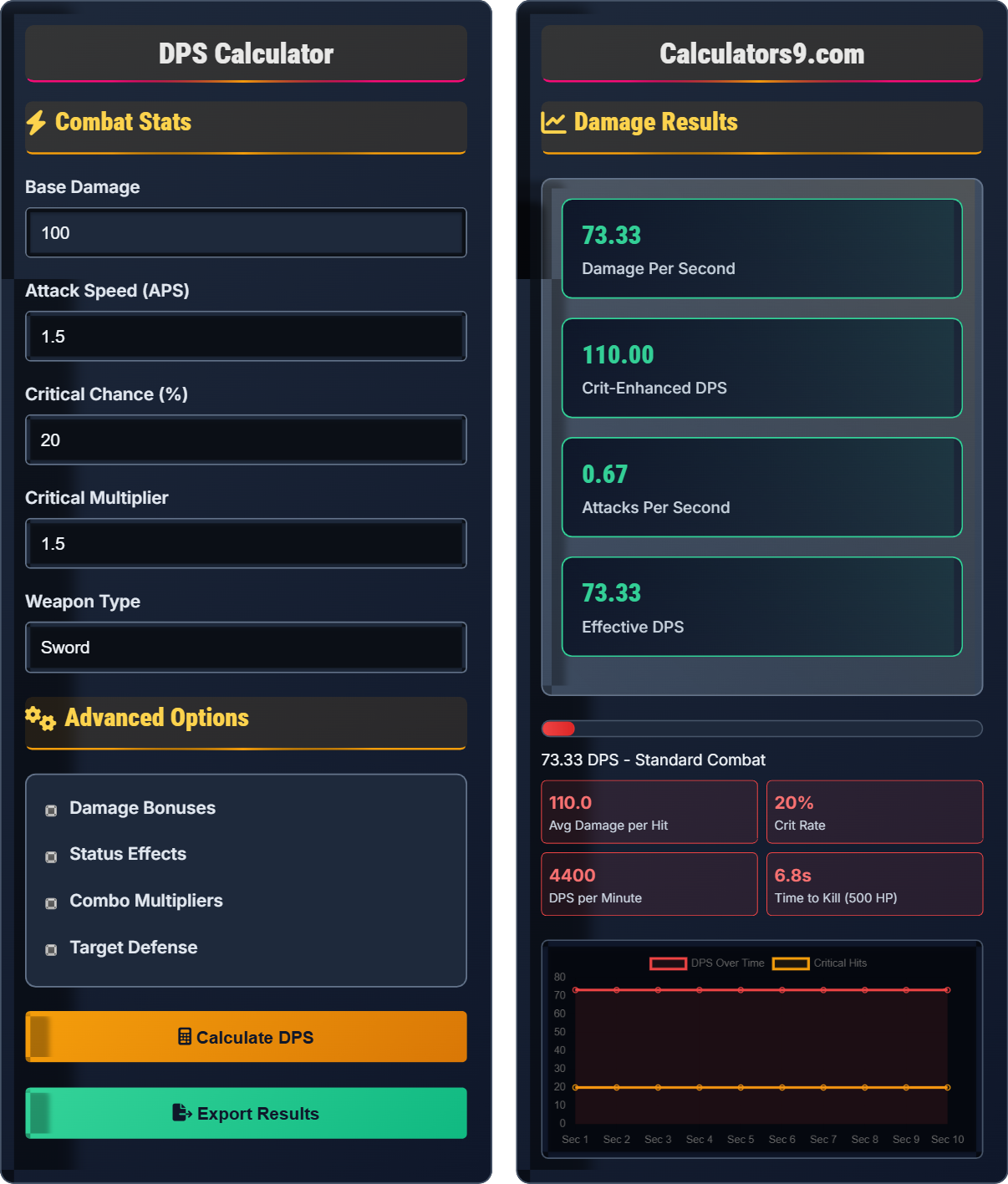
Example: For a weapon with 100 damage, 20% crit chance, 1.5x crit multiplier, and 1.5s attack speed:
\( DPS = \frac{100 \times (1 + 0.20 \times 1.5)}{1.5} \)
\( DPS = \frac{100 \times (1 + 0.30)}{1.5} \)
\( DPS = \frac{100 \times 1.30}{1.5} \)
\( DPS = \frac{130}{1.5} = 86.67 \)
Therefore, the weapon deals 86.67 damage per second on average.
Combat Stats
Advanced Options
Damage Results
| Weapon | DPS | Damage | Speed |
|---|
Combat Damage Mechanics Guide
Damage Per Second (DPS) measures the rate at which a character or weapon deals damage in combat. It's a crucial metric for evaluating combat effectiveness, comparing builds, and optimizing gear choices. DPS accounts for base damage, attack speed, critical hits, and other combat modifiers to provide a standardized measure of offensive capability.
The standard DPS calculation uses the following formula:
Where:
- \(DPS\) = Damage per second
- \(Damage\) = Base damage per attack
- \(Crit\_Chance\) = Critical hit chance (as decimal)
- \(Crit\_Multiplier\) = Critical hit damage multiplier
- \(Attack\_Speed\) = Time between attacks in seconds
Your DPS output depends on several interconnected factors:
- Equipment: Weapons, armor, and accessories with damage bonuses
- Skills/Abilities: Passive bonuses and active damage amplifiers
- Combos/Chains: Multiplier effects from skill combinations
- Target Defenses: Enemy resistance affecting damage taken
- Environmental Effects: Area-based damage modifiers
- Balance Approach: Optimize attack speed and damage together
- Crit Focusing: Maximize critical chance and multiplier
- Build Synergy: Choose equipment that enhances each other
- Context Awareness: Adapt builds to enemy types and situations
- Resource Management: Sustain DPS over extended combats
DPS Basics
Damage Per Second measures offensive capability and combat efficiency.
\(DPS = \frac{Damage \times (1 + Crit\_Chance \times Crit\_Multiplier)}{Attack\_Speed}\)
Where DPS=average damage per second, Damage=per hit, AS=attack speed.
- DPS balances damage and speed
- Crits increase average damage
- Higher attack speed increases frequency
Strategies
Damage output scales with multiple stats and synergies.
- Balance damage and attack speed
- Maximize critical hit potential
- Utilize status effects
- Exploit target weaknesses
- Trade-offs between damage and speed
- Diminishing returns on crit chance
- Build synergy importance
- Situational effectiveness
Combat Damage Learning Quiz
Which of the following statements about DPS is TRUE?
The answer is B) DPS accounts for attack speed and critical hits. DPS calculations incorporate multiple factors including base damage, attack speed (frequency), and critical hit potential to provide a comprehensive measure of damage output.
Understanding DPS as a composite metric is crucial for game optimization. It represents the interplay between different combat attributes rather than just raw damage numbers. This holistic view helps players make better equipment and build decisions.
DPS (Damage Per Second): Rate of damage output over time
Attack Speed: Frequency of attacks per second
Critical Hit: Chance to deal bonus damage
• DPS combines multiple combat factors
• Attack speed affects frequency of damage
• Critical hits increase average damage
• Consider the balance between damage and speed
• Critical hits provide exponential benefits
• Focusing only on base damage values
• Ignoring the impact of attack speed
Calculate the DPS for a weapon with 120 base damage, 25% critical chance, 2.0x critical multiplier, and 1.2 attack speed. Show your work.
Using the DPS formula: \(DPS = \frac{Damage \times (1 + Crit\_Chance \times Crit\_Multiplier)}{Attack\_Speed}\)
Given:
- Damage = 120
- Crit_Chance = 0.25
- Crit_Multiplier = 2.0
- Attack_Speed = 1.2
Step 1: Calculate crit factor = 1 + (0.25 × 2.0) = 1 + 0.5 = 1.5
Step 2: Calculate numerator = 120 × 1.5 = 180
Step 3: Calculate DPS = 180 ÷ 1.2 = 150
Therefore, the weapon deals 150 DPS on average.
This example demonstrates how critical hits significantly amplify damage output. The 25% crit chance with 2x multiplier adds 50% more damage on average, turning a 120 damage weapon into an effective 180 damage weapon before considering attack speed.
Critical Factor: Multiplier accounting for crit chance and damage
Attack Speed: Time between attacks in seconds
Effective Damage: Average damage accounting for crits
• Critical hits multiply base damage
• Higher attack speed increases DPS
• Remember: Crit factor = 1 + (Chance × Multiplier)
• Higher attack speed always increases DPS
• Forgetting to add 1 to the crit factor
• Confusing attack speed with attacks per second
Alex has two weapons: Weapon A (100 damage, 1.0 APS) and Weapon B (80 damage, 1.5 APS). Both have 20% crit chance and 1.5x crit multiplier. Which weapon has higher DPS?
Weapon A:
Crit factor = 1 + (0.20 × 1.5) = 1.3
DPS = (100 × 1.3) ÷ 1.0 = 130 DPS
Weapon B:
Crit factor = 1 + (0.20 × 1.5) = 1.3
DPS = (80 × 1.3) ÷ 1.5 = 69.33 DPS
Therefore, Weapon A (130 DPS) is better than Weapon B (69.33 DPS).
This example shows that raw damage values can be misleading. Despite Weapon B having higher attack speed, Weapon A's superior base damage more than compensates. This demonstrates the importance of calculating actual DPS rather than relying on individual stats.
Attacks Per Second (APS): Number of attacks per second
Attack Speed: Time in seconds between attacks
Stat Trade-offs: Balancing different combat attributes
• DPS calculations consider all factors together
• High attack speed doesn't always mean high DPS
• Base damage often has more impact than speed
• Always calculate total DPS, not individual stats
• Consider the relationship between damage and speed
• Assuming higher attack speed always means higher DPS
• Not accounting for critical hits in comparisons
Sam is deciding between two builds: Build X (100 damage, 10% crit chance, 2.0x crit multiplier) and Build Y (100 damage, 30% crit chance, 1.5x crit multiplier). Which build has higher DPS?
Build X:
Crit factor = 1 + (0.10 × 2.0) = 1.2
DPS = (100 × 1.2) ÷ 1.0 = 120 DPS
Build Y:
Crit factor = 1 + (0.30 × 1.5) = 1.45
DPS = (100 × 1.45) ÷ 1.0 = 145 DPS
Therefore, Build Y (145 DPS) is significantly better than Build X (120 DPS).
This demonstrates the exponential nature of critical hit optimization. Build Y's higher crit chance with decent multiplier creates a much larger crit factor than Build X's lower chance with higher multiplier. This shows that crit chance and multiplier have multiplicative effects.
Critical Optimization: Maximizing crit chance and multiplier together
Multiplicative Effects: Stats that compound with each other
Build Synergy: Stats that enhance each other
• Crit chance and multiplier compound
• Higher crit chance can be more valuable
• Balance both crit chance and multiplier
• Look for balanced crit chance/multiplier ratios
• Higher crit chance often provides better returns
• Focusing only on crit multiplier
• Not considering the compounding effect
Which statement about attack speed optimization is TRUE?
The answer is B) Attack speed is in the denominator of DPS formula. Looking at the formula \(DPS = \frac{Damage \times (1 + Crit\_Chance \times Crit\_Multiplier)}{Attack\_Speed}\), attack speed appears in the denominator. This means that lower attack speed values (faster attacks) increase DPS.
This is a crucial distinction in game mechanics. "Attack Speed" in the formula represents the time between attacks, not attacks per second. So a weapon with 0.5 attack speed (0.5 seconds between attacks) is faster than one with 1.0 attack speed (1 second between attacks). This often confuses players who think higher numbers are always better.
Attack Speed: Time in seconds between attacks
Attacks Per Second: Inverse of attack speed
Denominator Effect: Lower values increase the result
• Lower attack speed values mean faster attacks
• Attack speed is in denominator of formula
• Faster attacks increase DPS linearly
• Remember: Lower attack speed = Faster attacks
• Attacks per second = 1 ÷ Attack Speed
• Confusing attack speed with attacks per second
• Assuming higher numbers are always better
FAQ
Q: How do critical hits affect my overall DPS?
A: Critical hits multiply your average damage per hit. The formula includes: \( Crit\_Factor = 1 + (Crit\_Chance \times Crit\_Multiplier) \)
Example: 20% crit chance with 2x multiplier:
\( Crit\_Factor = 1 + (0.20 \times 2.0) = 1.4 \)
This increases your effective damage by 40%. So a 100 damage weapon becomes equivalent to 140 damage on average.
Q: Should I prioritize attack speed or damage for maximum DPS?
A: The optimal choice depends on your current stats. The DPS formula is:
\( DPS = \frac{Damage \times Crit\_Factor}{Attack\_Speed} \)
Generally, if you have high base damage, attack speed improvements provide linear gains. If your attack speed is already fast, increasing damage may be more effective. Use the calculator to test different scenarios.