Drop Rate Calculator
Fast probability tracker • 2026 gaming systems
Drop Probability Formula:
Show the calculator\( P(success) = 1 - (1 - p)^n \)
Where:
- \( P(success) \) = Probability of getting item at least once
- \( p \) = Individual drop rate (as decimal)
- \( n \) = Number of attempts
This formula calculates the cumulative probability of obtaining a desired item after multiple attempts, accounting for independent trials.
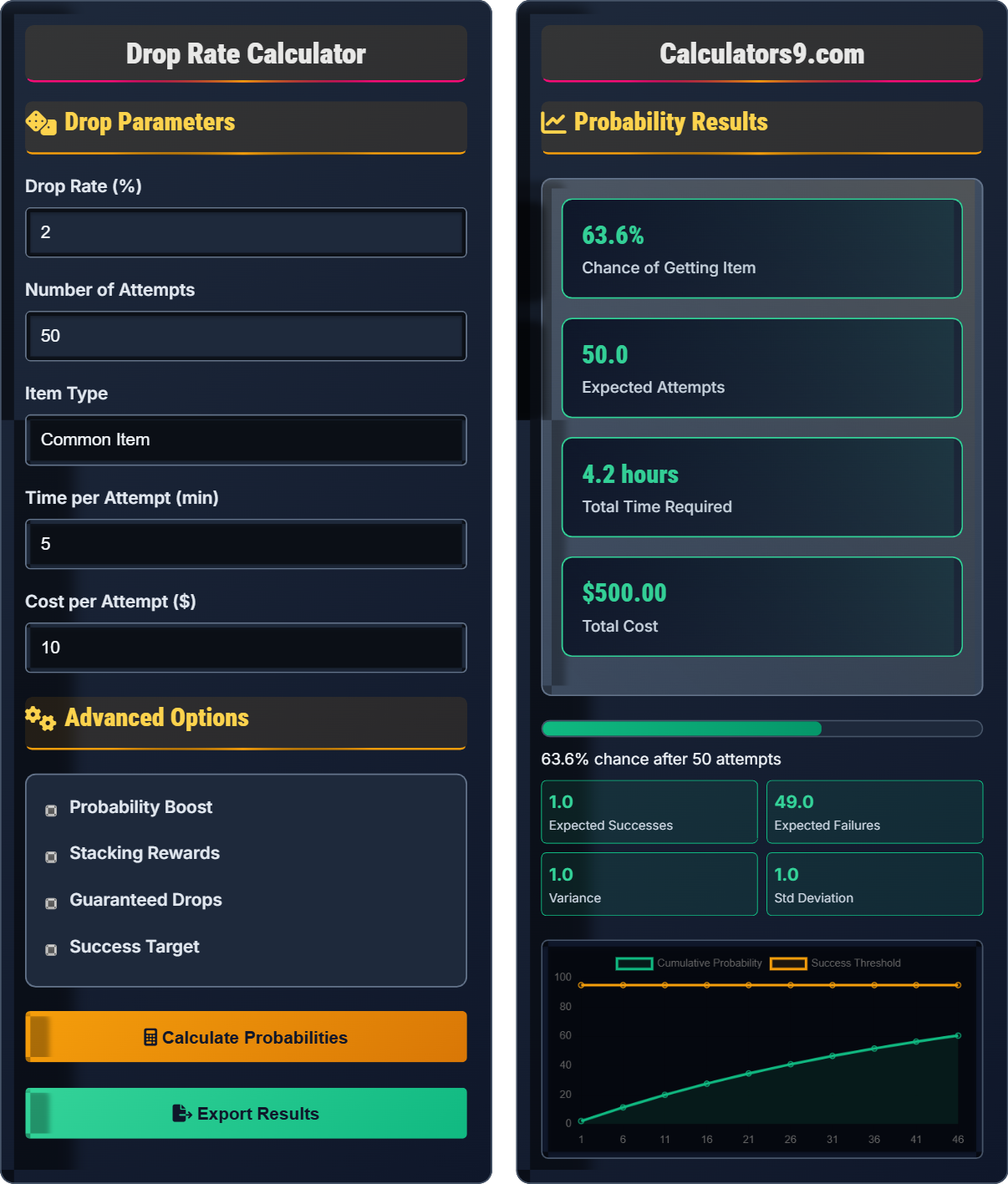
Example: For an item with 2% drop rate (0.02) after 50 attempts:
\( P(success) = 1 - (1 - 0.02)^{50} \)
\( P(success) = 1 - (0.98)^{50} \)
\( P(success) = 1 - 0.364 = 0.636 \)
Therefore, there's a 63.6% chance of getting the item at least once after 50 attempts.
Drop Parameters
Advanced Options
Probability Results
| Attempts | Success % | Time | Cost |
|---|
Gaming Drop Mechanics Guide
Drop rates represent the probability that a specific item will appear after completing an action in a game, such as defeating an enemy, opening a chest, or completing a quest. These rates are expressed as percentages and determine the rarity and accessibility of valuable items. Understanding drop rates helps players make informed decisions about time and resource investment.
The cumulative probability of obtaining an item after multiple attempts uses the following formula:
Where:
- \(P(success)\) = Probability of getting item at least once
- \(p\) = Individual drop rate (as decimal)
- \(n\) = Number of attempts
Your success rate depends on several factors:
- Base Rate: The inherent probability of the item
- Number of Attempts: More tries increase cumulative probability
- Boost Items: Potions, buffs, or equipment that enhance rates
- Game Events: Temporary bonuses during special events
- Player Level: Some games adjust rates based on character level
- Efficiency First: Maximize attempts per unit time
- Probability Boosting: Use items that increase drop rates
- Event Timing: Farm during bonus periods
- Resource Management: Balance cost with expected returns
- Patience Planning: Set realistic expectations for rare items
Drop Mechanics
Probability that a specific item appears after completing an action.
\(P(success) = 1 - (1 - p)^n\)
Where P=chance of getting item, p=individual rate, n=attempts.
- Each attempt is independent
- More attempts increase probability
- Low rates require many attempts
Strategies
Probability increases with more attempts but never reaches 100%.
- Maximize attempts per hour
- Use probability boosters
- Time farming with events
- Calculate cost-effectiveness
- Time vs. money trade-offs
- Expected value calculations
- Opportunity costs
- Diminishing returns
Drop Rate Learning Quiz
Which of the following statements about drop rates is TRUE?
The answer is C) Each individual attempt has the same probability. In standard independent drop systems, each attempt is a separate trial with identical probability. Previous outcomes do not affect future probabilities. This is known as the independence principle in probability theory.
This is a common misconception in gaming - the gambler's fallacy. Players often believe that after a series of failures, success becomes more likely. However, in truly random systems, each event is independent. This understanding is crucial for setting realistic expectations and avoiding excessive spending on rare item pursuits.
Independent Events: Outcomes that don't affect each other
Gambler's Fallacy: Belief that past events influence future probabilities
True Randomness: Each outcome equally likely regardless of history
• Each drop attempt is independent
• Past results don't affect future probabilities
• Low rates may require many attempts
• Don't expect compensation for bad luck
• Calculate expected attempts before starting
• Believing that failures make success more likely
• Expecting guaranteed success after a certain number of attempts
Calculate the probability of getting an item at least once after 100 attempts if its drop rate is 1%. Show your work.
Using the drop rate formula: \(P(success) = 1 - (1 - p)^n\)
Given:
- p = 1% = 0.01
- n = 100
Step 1: Calculate (1 - p) = 1 - 0.01 = 0.99
Step 2: Calculate (1 - p)^n = (0.99)^100 = 0.366
Step 3: Calculate P(success) = 1 - 0.366 = 0.634
Therefore, there's a 63.4% chance of getting the item at least once after 100 attempts.
This example shows how even with a 1% drop rate, after 100 attempts there's still a 36.6% chance of not getting the item. This demonstrates why rare items require patience and realistic expectations. The formula accounts for all possible combinations of outcomes.
Cumulative Probability: Chance of success over multiple attempts
Individual Rate: Probability per single attempt
At Least Once: Includes all possibilities except zero successes
• Use (1 - p)^n to find probability of all failures
• Subtract from 1 to get probability of at least one success
• Higher attempts exponentially increase success probability
• Remember: P(at least once) = 1 - P(all failures)
• Use calculators for large exponent calculations
• Multiplying rate by attempts (incorrect for low rates)
• Forgetting to subtract from 1
• Misapplying the formula for dependent events
Amy wants to farm a legendary item with a 0.5% drop rate. Each attempt takes 3 minutes and costs $2. If she plans to make 200 attempts, how much time and money will she invest, and what's her probability of success?
Step 1: Calculate total time = 200 × 3 minutes = 600 minutes = 10 hours
Step 2: Calculate total cost = 200 × $2 = $400
Step 3: Calculate success probability
Using P(success) = 1 - (1 - p)^n
P(success) = 1 - (1 - 0.005)^200 = 1 - (0.995)^200 = 1 - 0.367 = 0.633
Therefore, Amy will spend 10 hours and $400, with a 63.3% chance of getting the item.
This example demonstrates the economic aspect of farming rare items. Even with a 63% chance of success, there's still a 37% chance of failure after investing significant time and resources. This calculation helps players make informed decisions about whether the investment is worthwhile.
Expected Value: Probability-weighted average outcome
Cost-Benefit Analysis: Weighing investment against potential reward
Opportunity Cost: Alternative uses for time and money
• Total time = Attempts × Time per attempt
• Total cost = Attempts × Cost per attempt
• Success probability follows the cumulative formula
• Always calculate total investment before starting
• Consider the probability of failure
• Set limits to prevent overspending
• Underestimating total time investment
• Not considering the cost of failure
• Ignoring opportunity costs
Dave is farming an item with a base 1% drop rate. He can purchase a boost that increases his chance by 50% for $20. Without the boost, he plans 100 attempts. With the boost, he'll make 80 attempts (due to the cost). Which option gives him a better chance of success?
Option 1 (No Boost):
P(success) = 1 - (1 - 0.01)^100 = 1 - (0.99)^100 = 1 - 0.366 = 0.634 (63.4%)
Option 2 (With Boost):
Boosted rate = 1% × 1.5 = 1.5%
P(success) = 1 - (1 - 0.015)^80 = 1 - (0.985)^80 = 1 - 0.298 = 0.702 (70.2%)
Therefore, the boost option provides a 70.2% chance vs 63.4%, making it more effective despite fewer attempts.
This demonstrates that probability boosting can be more efficient than simply increasing attempts. The 50% rate increase compensated for the 20% reduction in attempts, resulting in a better overall success probability. This principle applies to many gaming scenarios where efficiency trumps raw quantity.
Efficiency: Success probability per unit of investment
Rate Boosting: Increasing probability per attempt
Attempt Reduction: Trading attempts for higher rates
• Higher rates per attempt can compensate for fewer attempts
• Calculate net effect on success probability
• Consider cost-effectiveness of boosts
• Compare success probabilities, not just attempt counts
• Factor in the cost of boosts
• Look for optimal rate/investment ratios
• Assuming more attempts always beats better rates
• Not considering the cost of boosts
• Misjudging the effectiveness of rate increases
Which statement best describes the expected number of attempts to get an item with a 2% drop rate?
The answer is B) On average, 50 attempts are needed. The expected number of attempts for a success with probability p is 1/p. For 2% (0.02), this is 1/0.02 = 50 attempts. This is an average - actual results will vary significantly due to randomness.
The expected value (1/p) represents the average number of attempts needed across many identical scenarios. However, individual outcomes can vary dramatically. In practice, some players may succeed in far fewer attempts, while others may need significantly more. This concept helps set reasonable expectations for farming activities.
Expected Value: Average outcome over many trials
Reciprocal Rule: Expected attempts = 1/p for success probability pVariance: How much individual results deviate from average
• Expected attempts = 1 ÷ drop rate
• Actual attempts vary significantly around the average
• Expected value is theoretical average across infinite trials
• Use 1/p to estimate average attempts needed
• Remember that individual results vary widely
• Plan for variance in your farming strategy
• Confusing expected value with guaranteed outcome
• Not accounting for variance in individual attempts
• Expecting exact results based on expected value
FAQ
Q: How do probability boosts affect my chances of getting rare items?
A: Probability boosts multiply your base drop rate. If an item has a 1% drop rate and you get a 50% boost, your effective rate becomes 1.5%.
For cumulative probability after \( n \) attempts: \( P_{boosted} = 1 - (1 - p \times (1 + B))^n \)
Where \( B \) is the boost percentage (0.5 for 50%).
Example: 1% rate with 50% boost after 100 attempts:
\( P = 1 - (1 - 0.015)^{100} = 1 - 0.221 = 0.779 \)
This increases your success chance from 63.4% to 77.9%.
Q: Should I keep farming if I haven't gotten the item after expected attempts?
A: Yes, because each attempt is independent. If the drop rate is 2% (expected 50 attempts), after 50 failures:
• The probability of success on the next attempt remains 2%
• You still need 50 more attempts on average
However, the cumulative probability after 100 total attempts is:
\( P = 1 - (0.98)^{100} = 1 - 0.133 = 0.867 \) or 86.7%
So persistence eventually pays off, but plan your resources accordingly.