Rank Progress Calculator
Fast rank tracker • 2026 gaming systems
Rank Progress Formula:
Show the calculator\( R_{final} = R_{initial} + W \times G_W - L \times G_L \)
Where:
- \( R_{final} \) = Final rank points
- \( R_{initial} \) = Starting rank points
- \( W \) = Number of wins
- \( G_W \) = Points gained per win
- \( L \) = Number of losses
- \( G_L \) = Points lost per loss
This formula calculates rank progression based on match outcomes, accounting for win/loss penalties.
Example: Starting at 1000 points with 10 wins (25 points each) and 5 losses (20 points each):
\( R_{final} = 1000 + 10 \times 25 - 5 \times 20 \)
\( R_{final} = 1000 + 250 - 100 \)
\( R_{final} = 1150 \)
Therefore, the final rank is 1150 points after 15 matches.
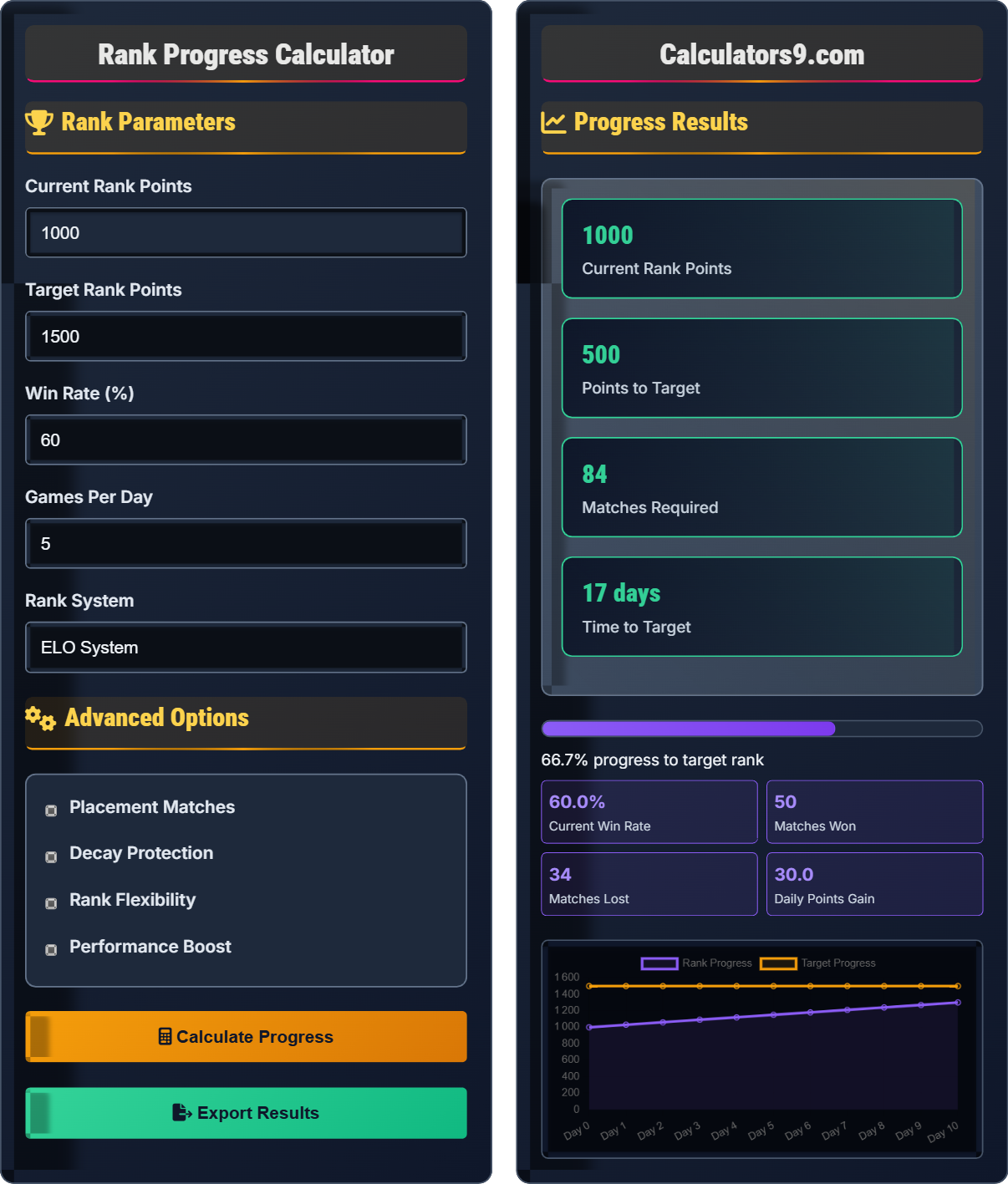
Rank Parameters
Advanced Options
Progress Results
| Day | Points | Change | Matches |
|---|
Competitive Ranking Guide
Competitive ranking systems measure player skill and progress in competitive gaming. These systems assign numeric values or tiers to represent skill level, adjusting based on match outcomes. Understanding rank progression helps players set realistic goals, optimize practice schedules, and track improvement over time.
The standard rank progression calculation uses the following formula:
Where:
- \(R_{final}\) = Final rank points
- \(R_{initial}\) = Starting rank points
- \(W\) = Number of wins
- \(G_W\) = Points gained per win
- \(L\) = Number of losses
- \(G_L\) = Points lost per loss
Your rank advancement depends on several interconnected factors:
- Win Rate: Primary driver of rank progression
- Match Frequency: More games accelerate progress
- Opponent Strength: Stronger opponents yield greater rewards
- Streaks: Consecutive wins may provide bonus points
- Seasonal Resets: Periodic adjustments to rankings
- Consistency First: Focus on sustainable win rates
- Peak Performance: Play during optimal times
- Meta Awareness: Adapt to current game balance
- Team Coordination: Improve communication and teamwork
- Continuous Improvement: Analyze replays and learn
Ranking Basics
Numeric system that measures and tracks player skill level in competitive gaming.
\(R_{final} = R_{initial} + W \times G_W - L \times G_L\)
Where R=rank points, W=wins, GW=points per win, L=losses, GL=points per loss.
- Win rate drives progression
- More matches accelerate progress
- Opponent strength affects gains
Strategies
Progression requires consistent performance and strategic planning.
- Maintain high win rate
- Play consistently
- Improve game knowledge
- Practice regularly
- Form affects performance
- Meta changes impact viability
- Rank decay considerations
- Placement match importance
Rank Progress Learning Quiz
Which of the following statements about competitive ranking is TRUE?
The answer is B) Higher-ranked opponents often provide more points. Many ranking systems adjust point gains based on opponent strength - winning against higher-ranked players yields more points, while losing to them results in fewer point losses.
This concept is fundamental to fair ranking systems. The adjustment based on opponent strength prevents players from gaming the system by only playing weaker opponents. It ensures that skill improvement is properly rewarded regardless of who you play against.
Opponent Adjustment: Point gains/losses modified by opponent rank
Self-Balancing: System that adjusts to reflect true skill
Rank Volatility: How much points fluctuate per match
• Opponent strength affects point changes
• Higher opponents = More points for wins
• Lower opponents = Fewer points for wins
• Challenge appropriately ranked opponents
• Don't avoid stronger players entirely
• Only playing significantly weaker opponents
• Expecting equal point rewards regardless of opponent
Calculate the final rank after starting at 1200 points, winning 8 matches (25 points each) and losing 3 matches (20 points each). Show your work.
Using the rank progress formula: \(R_{final} = R_{initial} + W \times G_W - L \times G_L\)
Given:
- R_initial = 1200
- W = 8
- G_W = 25
- L = 3
- G_L = 20
Step 1: Calculate points gained = 8 × 25 = 200
Step 2: Calculate points lost = 3 × 20 = 60
Step 3: Calculate final rank = 1200 + 200 - 60 = 1340
Therefore, the final rank is 1340 points.
This example demonstrates the simple arithmetic behind rank progression. The key insight is that each win adds points while each loss subtracts points, creating a net progression based on the difference between wins and losses.
Net Progression: Difference between gains and losses
Point Differential: Wins minus losses effect
Rank Arithmetic: Basic addition/subtraction of points
• Points gained from wins
• Points lost from losses
• Net result determines progression
• Track your point gains and losses
• Calculate expected progression before playing
• Forgetting to subtract losses
• Confusing point gains with losses
Emma needs 300 more rank points to reach her target rank. Her current win rate is 55%, gaining 25 points per win and losing 20 points per loss. She plays 4 matches per day. How many days will it take to reach her target?
Step 1: Calculate net points per match
Wins per match: 55% = 0.55
Losses per match: 45% = 0.45
Net points per match = (0.55 × 25) - (0.45 × 20) = 13.75 - 9 = 4.75
Step 2: Calculate matches needed = 300 ÷ 4.75 = 63.16 ≈ 64 matches
Step 3: Calculate days needed = 64 ÷ 4 = 16 days
Therefore, Emma will reach her target in approximately 16 days.
This example shows how to combine multiple factors to predict rank progression. It demonstrates the importance of considering both wins and losses in your progression calculations, as losses actually slow down your climb.
Net Points: Average points gained per match
Expected Value: Long-term average outcome
Progression Rate: Points gained per unit time
• Consider both wins and losses
• Calculate expected net gain
• Account for match frequency
• Track your actual net points per match
• Adjust expectations based on performance
• Only considering wins in calculations
• Not accounting for loss penalties
Daniel has a 50% win rate, gaining 20 points per win and losing 20 points per loss. He improves to a 60% win rate. How much faster will he progress now compared to before?
Before improvement:
Net points per match = (0.50 × 20) - (0.50 × 20) = 10 - 10 = 0
After improvement:
Net points per match = (0.60 × 20) - (0.40 × 20) = 12 - 8 = 4
The improvement from 50% to 60% win rate transforms Daniel from making no progress to gaining 4 points per match. This represents infinite improvement since he was previously making no progress.
This demonstrates the critical threshold effect in ranking systems. At exactly 50% win rate, there's no net progression. Any win rate above 50% results in positive progression, while below 50% causes decline. This makes improving from 50% extremely valuable.
Break-even Point: Win rate where progression stops
Threshold Effect: Critical point where outcomes change
Progression Acceleration: Increased rate of advancement
• 50% win rate = No progression
• Above 50% = Positive progression
• Below 50% = Negative progression
• Aim for above 50% win rate
• Small win rate improvements have large effects near 50%
• Playing at exactly 50% expecting progress
• Not understanding the break-even threshold
Which statement about match frequency and rank progression is TRUE?
The answer is D) Both B and C are correct. Match frequency directly affects how quickly you accumulate points over time (B), while quality (win rate) determines the net gain per match (C). Both factors are crucial for optimal progression.
This highlights the dual nature of rank progression: you need both a positive win rate (quality) and sufficient match volume (quantity) to achieve your goals efficiently. The optimal strategy balances both factors based on your available time and skill level.
Quality vs Quantity: Balancing skill and volume
Optimal Strategy: Best combination of factors
Efficiency: Points gained per unit time
• Frequency affects time to goal
• Win rate affects net gains
• Both factors matter for optimization
• Find your optimal balance of quality and quantity
• Track both win rate and match volume
• Focusing only on match quantity
• Ignoring the impact of win rate on progression
FAQ
Q: How does win rate affect my rank progression speed?
A: Win rate is the primary driver of net rank progression. The formula for net points per match is:
\( Net = (WR \times G_W) - ((1-WR) \times G_L) \)
Where WR is win rate, GW is points per win, and GL is points per loss.
Example: 60% win rate with 25 points per win and 20 per loss:
\( Net = (0.60 \times 25) - (0.40 \times 20) = 15 - 8 = 7 \) points per match
This means 7 points gained per match on average.
Q: Should I focus on playing more matches or improving my win rate?
A: Both matter, but the priority depends on your current situation:
• If your win rate is below 50%, focus on improving it first
• If your win rate is above 50%, increasing match volume helps
• At 50% win rate, you make no progress regardless of volume
The optimal strategy balances both: maintain a healthy win rate while playing enough matches to meet your timeline goals.