XP to Level Calculator
Fast progress tracker • 2026 gaming systems
Level Progression Formula:
Show the calculator\( XP_{required} = Base \times Level^{Exponent} \)
Where:
- \( XP_{required} \) = Total XP needed for next level
- \( Base \) = Base XP requirement (typically 100-500)
- \( Level \) = Current player level
- \( Exponent \) = Growth rate (typically 1.5-2.0)
This formula calculates the XP required to reach each level, with exponential growth making progression increasingly challenging.
Example: For a game with Base XP = 100 and Exponent = 1.5:
Level 1: \( 100 \times 1^{1.5} = 100 \) XP
Level 2: \( 100 \times 2^{1.5} = 283 \) XP
Level 3: \( 100 \times 3^{1.5} = 520 \) XP
Level 10: \( 100 \times 10^{1.5} = 3,162 \) XP
Thus, players face exponentially increasing XP requirements as they advance.
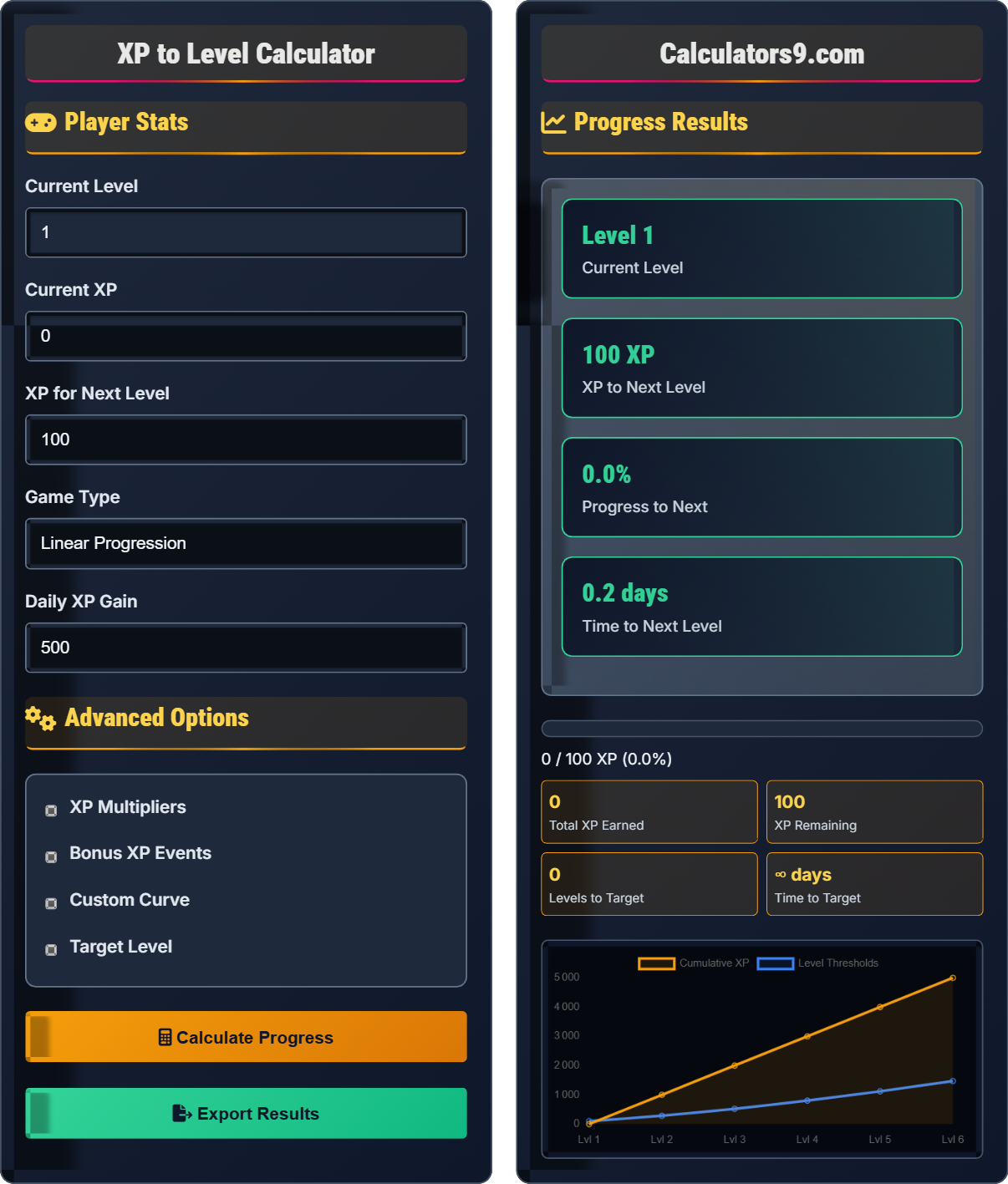
Player Stats
Advanced Options
Progress Results
| Level | XP Required | XP Gained | Progress |
|---|
Gaming Progression Guide
Experience Points (XP) progression systems are fundamental mechanics in gaming that reward player engagement and skill development. Players earn XP through various activities like completing quests, defeating enemies, or achieving objectives. As XP accumulates, players advance through levels, unlocking new abilities, items, or content. This creates a sense of achievement and progression that keeps players engaged.
The standard XP progression calculation uses the following formula:
Where:
- \(XP_{required}\) = Total XP needed for next level
- \(Base\) = Base XP requirement (typically 100-500)
- \(Level\) = Current player level
- \(Exponent\) = Growth rate (typically 1.5-2.0)
Your XP accumulation rate typically depends on several factors:
- Activity Difficulty: Harder challenges award more XP
- Time Investment: More playtime equals more opportunities
- Efficiency: Optimized strategies yield better XP/hour
- Bonuses: Multipliers, events, and special items boost gains
- Player Skill: Better performance leads to more efficient gains
- Focus Activities: Prioritize high-XP gain activities
- Time Bonuses: Play during XP multiplier events
- Efficient Routing: Plan optimal paths for maximum efficiency
- Team Play: Coordinate with others for bonus rewards
- Consistency: Regular daily play maintains momentum
XP Basics
Experience Points measure player progress and skill development.
\(XP_{required} = Base \times Level^{Exponent}\)
Where XP_req=next level requirement, Base=start amount, Exp=growth rate.
- XP calculated on remaining balance
- Early levels advance quickly
- Growth rate affects difficulty
Strategies
Early levels are easier, later levels require more focused effort.
- Use XP multipliers
- Focus on high-efficiency activities
- Play during bonus events
- Join active communities
- Balance progression with fun
- Consider diminishing returns
- Track your efficiency
- Set realistic goals
Gaming Progression Learning Quiz
Which of the following is NOT a common characteristic of XP progression systems?
The answer is C) All levels require the same amount of XP. In most gaming systems, XP requirements increase as players advance to higher levels, making progression increasingly challenging. This creates an exponential or accelerating curve rather than a linear one.
Understanding XP progression curves is crucial because they determine the pace of advancement in games. Linear XP requirements would make games too easy in the late stages, while exponential growth maintains challenge. The increasing requirements also mean that time investment grows significantly as players advance.
XP (Experience Points): Units that measure player progress
Progression Curve: The mathematical relationship between levels and XP requirements
Level Gate: Reaching a certain level to unlock content
• XP requirements typically increase exponentially
• Higher levels take disproportionately longer to achieve
• Focus on high-efficiency XP activities early
• Plan for longer time investments at higher levels
• Expecting consistent time requirements per level
• Not accounting for exponential progression curves
Calculate the XP required for Level 5 in a game where Base XP = 100 and Exponent = 1.5. Show your work.
Using the XP formula: \(XP_{required} = Base \times Level^{Exponent}\)
Given:
- Base = 100
- Level = 5
- Exponent = 1.5
Step 1: Calculate Level^Exponent = 5^1.5 = 11.18
Step 2: Calculate XP = 100 × 11.18 = 1,118 XP
Therefore, 1,118 total XP is required to reach Level 5.
This demonstrates how exponential progression works. Notice that Level 5 requires 11 times more XP than Level 1, showing how progression becomes significantly harder at higher levels. This system ensures that games remain challenging and rewarding over extended play sessions.
Exponential Growth: Values increase by a power function
Base XP: Starting requirement for Level 1
Exponent: Rate of progression acceleration
• Higher exponents create steeper progression curves
• Total XP is cumulative across all levels
• Exponential growth means rapidly increasing requirements
• Remember: XP^Exponent, not Exponent^XP
• Use calculators for complex exponent calculations
• Different games use different exponents for balance
• Confusing base and exponent in calculations
• Forgetting that XP is cumulative
• Misunderstanding exponential vs linear growth
Alice is currently at Level 3 with 450 XP. The next level requires 800 XP total. She averages 200 XP per day. How many days will it take Alice to reach Level 4, and what percentage of progress is she currently at?
Step 1: Calculate XP needed = 800 - 450 = 350 XP remaining
Step 2: Calculate time = 350 ÷ 200 = 1.75 days ≈ 2 days
Step 3: Calculate progress % = (450 ÷ 800) × 100 = 56.25%
Therefore, Alice needs 350 more XP, which will take about 2 days, and she's 56.25% of the way to Level 4.
This example shows how to calculate remaining progression in both absolute terms (XP needed) and time terms (days to completion). It also demonstrates how to calculate progress percentage, which is essential for goal-setting and motivation. These calculations help players plan their gaming sessions effectively.
Remaining XP: XP still needed to reach next level
XP Efficiency: XP gained per unit time
Progress Percentage: Current XP as % of level requirement
• Progress % = (Current XP ÷ Next Level XP) × 100
• Time = Remaining XP ÷ Daily XP Rate
• These calculations assume consistent XP rates
• Track your daily XP average for accurate planning
• Account for efficiency variations in your estimates
• Use these calculations to set realistic goals
• Forgetting to subtract current XP from requirement
• Not accounting for variable XP rates
• Confusing total XP with remaining XP
Bob is playing a game where he normally gains 150 XP per activity. During a bonus event, he gets a 50% XP multiplier. If he completes 10 activities during the event, how much additional XP does he earn compared to normal play?
Step 1: Normal XP for 10 activities = 150 × 10 = 1,500 XP
Step 2: Multiplied XP rate = 150 × 1.5 = 225 XP per activity
Step 3: Event XP for 10 activities = 225 × 10 = 2,250 XP
Step 4: Additional XP = 2,250 - 1,500 = 750 XP
Therefore, Bob earns 750 additional XP during the event, which is 50% more than normal.
This demonstrates how XP multipliers create significant advantages for players who participate in events. The 50% multiplier doubled Bob's effective XP rate, allowing him to advance much faster than usual. This is why timing participation around bonus events is strategically important in many games.
XP Multiplier: Factor that increases XP rewards
Bonus Event: Limited-time opportunity for enhanced rewards
Efficiency Gain: Increased XP per unit time
• Multiplier XP = Base XP × Multiplier
• Bonus events provide temporary efficiency boosts
• Multipliers compound with other bonuses
• Plan intensive play sessions during bonus events
• Stack multiple bonuses when possible
• Use multipliers to accelerate difficult progressions
• Adding instead of multiplying for percentage increases
• Not recognizing the compounding effect of bonuses
• Missing limited-time bonus opportunities
Which strategy is most effective for reaching high levels efficiently in an exponential progression system?
The answer is B) Balance high-efficiency early content with harder late-game content. In exponential progression systems, early levels advance quickly, but later levels require exponentially more XP. An effective strategy adapts to changing requirements by optimizing for the current level's efficiency while preparing for increased difficulty.
This question highlights the importance of adaptive strategy in progression systems. Early levels allow for rapid advancement with minimal investment, but later levels require increasingly sophisticated approaches. The most effective players adjust their strategies as the mathematical requirements change throughout the progression curve.
Progression Strategy: Approach to optimizing advancement
Efficiency Curve: Relationship between effort and XP gain
Adaptive Play: Adjusting strategy based on current requirements
• Early levels require less total investment
• Late levels demand more strategic resource allocation
• Effective strategies evolve with progression
• Track your XP efficiency at different levels
• Prepare for increased difficulty at higher levels
• Adapt your strategy as requirements change
• Applying early-game strategies to late-game progression
• Not accounting for exponential requirement increases
• Failing to adapt strategies as difficulty scales
FAQ
Q: How do XP multipliers save time in leveling?
A: XP multipliers directly increase the efficiency of your gameplay time. If a normal activity gives 100 XP, a 2x multiplier makes it worth 200 XP.
For example, if Level 5 requires 1,000 XP and you normally gain 200 XP per hour, it would take 5 hours. With a 2x multiplier, you gain 400 XP per hour, completing the level in just 2.5 hours.
Mathematically, if \( T_0 \) is time without multiplier and \( M \) is the multiplier:
\( T_{multiplied} = \frac{T_0}{M} \)
This formula shows that a 2x multiplier halves your time, while a 3x multiplier reduces it to one-third.
Q: Should I focus on early or late game content for fastest progression?
A: The optimal approach depends on the game's progression curve.
- Early game: Higher efficiency (XP/hour) but limited by level gates. Example: 500 XP/hour at Level 3.
- Late game: Lower efficiency but access to high-value content. Example: 300 XP/hour at Level 20.
In exponential systems, early levels advance quickly, so maximize efficiency before moving to harder content. The key is balancing speed with sustainability across the entire progression curve.