Plant Spacing Calculator
Garden planning tool • 2026 plant growth
Plant Spacing Formula:
Show the calculator\( \text{Plant Density} = \frac{\text{Area}}{\text{Spacing}^2} \)
Where:
- \( \text{Area} \) = Garden area in square feet or meters
- \( \text{Spacing} \) = Distance between plants
For rectangular spacing:
\( \text{Plants per Row} = \frac{\text{Row Length}}{\text{Spacing}} \)
\( \text{Rows per Area} = \frac{\text{Area Width}}{\text{Spacing}} \)
For triangular spacing (hexagonal pattern):
\( \text{Plant Density} = \frac{\text{Area}}{\text{Spacing}^2 \times 0.866} \)
Example: For 100 sq ft garden with 12-inch (1 ft) spacing:
Plants = 100 ÷ (1 × 1) = 100 plants
With triangular spacing: 100 ÷ (1 × 1 × 0.866) = 115 plants
Thus, rectangular spacing yields 100 plants, triangular yields 115 plants.
Garden Information
Advanced Options
Results
Comprehensive Plant Spacing Guide
Proper plant spacing is crucial for healthy plant growth and optimal yields. Correct spacing ensures adequate access to sunlight, water, and nutrients while preventing overcrowding that can lead to disease, poor air circulation, and competition for resources. Strategic spacing also facilitates garden maintenance and harvesting.
The fundamental plant spacing formula is:
For rectangular patterns:
- Plants per Row: \( \frac{\text{Row Length}}{\text{Spacing}} \)
- Number of Rows: \( \frac{\text{Garden Width}}{\text{Spacing}} \)
- Total Plants: Plants per Row × Number of Rows
- Rectangular: Simple grid, easy to navigate
- Triangular: Higher density, efficient use of space
- Staggered: Alternating rows for better coverage
- Block: Square clusters for intensive planting
- Single Row: Along borders or walkways
- Air Circulation: Prevents fungal diseases
- Light Penetration: Ensures all plants receive sun
- Root Development: Adequate space for root growth
- Maintenance: Easy access for watering and weeding
- Harvesting: Unimpeded access to mature plants
Plant Spacing Fundamentals
Distance between plants for optimal growth.
\( \text{Density} = \frac{\text{Area}}{\text{Spacing}^2} \)
Where Area=square footage, Spacing=distance.
- More space = healthier plants
- Consider mature size
- Allow for air circulation
Planting Tips
Strategic arrangement for optimal growth.
- Measure garden area
- Research plant spacing
- Calculate plant count
- Mark positions
- Plant mature size
- Root spread
- Air circulation
Plant Spacing Learning Quiz
What is the primary benefit of proper plant spacing?
The answer is B) Prevents competition for resources. Proper plant spacing prevents plants from competing for essential resources like water, nutrients, and sunlight. When plants are too close together, they compete for these limited resources, leading to weaker growth and lower yields.
This highlights the fundamental ecological principle of resource competition. Plants need adequate space to develop their root systems and canopy without interference from neighboring plants. Proper spacing ensures each plant has access to sufficient resources for optimal growth.
Resource Competition: Struggle for limited resources
Root System: Underground part absorbing nutrients
Canopy: Above-ground foliage area
• Adequate spacing prevents competition
• Plants need room for roots and leaves
• Competition leads to weaker plants
• Research mature plant size
• Consider root spread
• Plan for full growth
• Planting too close together
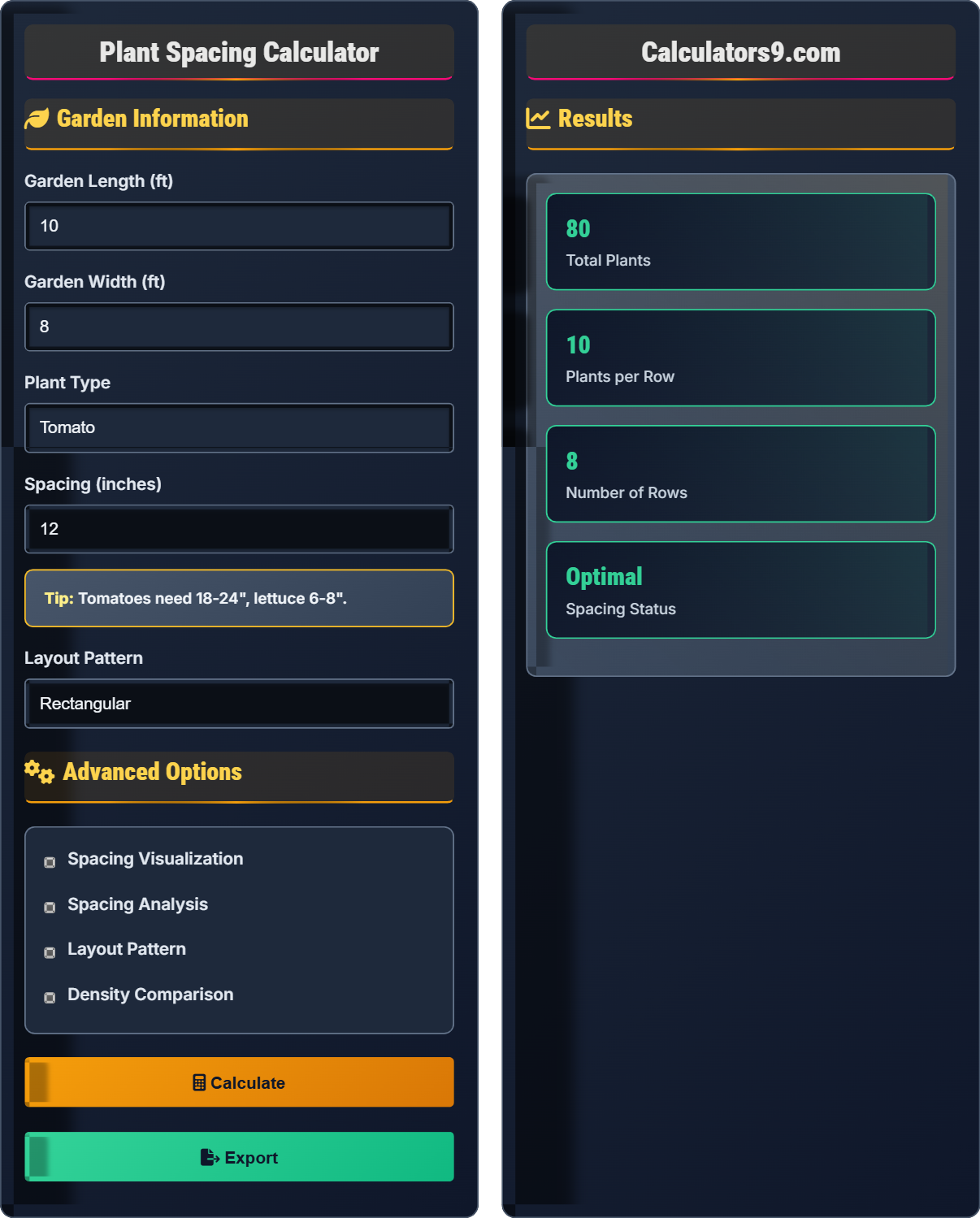
Calculate the number of plants that can fit in a 10 ft × 8 ft garden bed with 12-inch (1 ft) spacing using rectangular layout. Show your work.
Using the spacing formula: \( \text{Plant Density} = \frac{\text{Area}}{\text{Spacing}^2} \)
Step 1: Calculate garden area
Area = Length × Width = 10 ft × 8 ft = 80 sq ft
Step 2: Calculate plants per row
Plants per row = \( \frac{\text{Row Length}}{\text{Spacing}} = \frac{10 \text{ ft}}{1 \text{ ft}} = 10 \) plants
Step 3: Calculate number of rows
Number of rows = \( \frac{\text{Garden Width}}{\text{Spacing}} = \frac{8 \text{ ft}}{1 \text{ ft}} = 8 \) rows
Step 4: Calculate total plants
Total plants = Plants per row × Number of rows = 10 × 8 = 80 plants
Therefore, 80 plants can fit in the garden bed.
This demonstrates the mathematical approach to garden planning. The rectangular layout is the simplest to calculate, allowing for easy navigation and maintenance. The formula ensures efficient use of space while maintaining proper plant spacing.
Rectangular Layout: Grid pattern arrangement
Plant Density: Number of plants per unit area
Garden Bed: Prepared planting area
• Area = Length × Width
• Plants per row = Length ÷ Spacing
• Total plants = Per row × Number of rows
• Convert all measurements to same unit
• Plan for pathways between rows
• Account for irregular bed shapes
• Using different measurement units
• Forgetting pathway space
• Not rounding down for partial plants
A gardener has a 20 ft × 15 ft plot. If they plant tomatoes with 24-inch (2 ft) spacing, how many more plants can they fit using triangular (hexagonal) spacing compared to rectangular spacing?
Step 1: Calculate garden area
Area = 20 ft × 15 ft = 300 sq ft
Step 2: Calculate rectangular spacing
Plants per row = 20 ÷ 2 = 10 plants
Number of rows = 15 ÷ 2 = 7.5 → 7 rows
Total rectangular = 10 × 7 = 70 plants
Step 3: Calculate triangular spacing
Triangular density = \( \frac{\text{Area}}{\text{Spacing}^2 \times 0.866} \)
Triangular plants = \( \frac{300}{2^2 \times 0.866} = \frac{300}{4 \times 0.866} = \frac{300}{3.464} = 86.6 \) → 86 plants
Step 4: Calculate difference
Difference = 86 - 70 = 16 more plants
Therefore, triangular spacing allows 16 more tomato plants.
This demonstrates the efficiency advantage of triangular spacing. The 0.866 factor accounts for the hexagonal packing efficiency, which allows more plants in the same area. This pattern is particularly beneficial for maximizing plant density.
Triangular Spacing: Hexagonal pattern arrangement
Hexagonal Packing: Most efficient circular arrangement
Space Efficiency: Maximizing plants per area
• Triangular: ÷ (spacing² × 0.866)
• Rectangular: ÷ spacing²
• Triangular allows more plants
• Triangular = 15% more plants
• Consider maintenance access
• Some plants prefer rectangular
• Forgetting the 0.866 factor
• Not accounting for partial rows
• Assuming all plants benefit equally
A gardener wants to plant carrots (2-inch spacing) and onions (4-inch spacing) in alternating rows in a 10 ft × 8 ft bed. How should they arrange the plants for optimal growth, and how many of each can they fit?
Step 1: Convert measurements to feet
Carrot spacing: 2 inches = 0.167 ft
Onion spacing: 4 inches = 0.333 ft
Step 2: Plan alternating rows
Row 1: Carrots (every 0.167 ft)
Row 2: Onions (every 0.333 ft)
Step 3: Calculate plants per row
Carrots per row = 10 ÷ 0.167 = 60 plants
Onions per row = 10 ÷ 0.333 = 30 plants
Step 4: Calculate number of rows
Allow 6 inches (0.5 ft) between carrot and onion rows
Row spacing = max(carrot, onion) + buffer = 0.5 ft
Number of row pairs = 8 ÷ 1.0 = 8 pairs
Step 5: Calculate totals
Carrots: 8 rows × 60 plants = 480 plants
Onions: 8 rows × 30 plants = 240 plants
Therefore, plant in alternating rows with 480 carrots and 240 onions.
This demonstrates companion planting considerations. Different plants have different spacing requirements, so alternating rows allows each to grow optimally. The buffer between rows ensures adequate space for both root systems and maintenance.
Companion Planting: Growing compatible plants together
Alternating Rows: Different crops in adjacent rows
Buffer Space: Extra space between plant types
• Different plants need different spacing
• Allow buffer between plant types
• Consider growth compatibility
• Research companion benefits
• Plan for mature plant sizes
• Consider root depth differences
• Using same spacing for all plants
• Not considering compatibility
• Forgetting buffer zones
Which of the following is NOT a factor to consider when determining plant spacing?
The answer is C) Soil pH level. While soil pH is important for plant health and nutrient uptake, it does not directly affect the physical spacing requirements between plants. The other factors directly impact how much space each plant needs to grow properly.
This distinguishes between spatial requirements and soil chemistry. Spacing considerations focus on physical space needs for growth, while soil pH relates to chemical conditions necessary for nutrient availability. Both are important but address different aspects of plant cultivation.
Plant Spacing: Physical distance requirements
Soil pH: Acidity/alkalinity level
Spatial Requirements: Physical space needs
• Spacing = physical space
• pH = chemical condition
• Both important but different
• Consider both space and soil
• Spacing affects growth directly
• pH affects nutrient uptake
• Confusing spatial with chemical factors
• Thinking pH affects spacing
• Not distinguishing requirements
FAQ
Q: How do I know if I've planted my vegetables too close together?
A: Signs of overcrowding include:
- Leggy growth: Plants stretching for light
- Yellowing leaves: Competition for nutrients
- Smaller fruits/vegetables: Limited resources
- Disease problems: Poor air circulation
- Root competition: Stunted growth
Prevention: Research mature plant sizes and space accordingly. It's better to start with more space than to crowd plants.
Q: What's the difference between triangular and rectangular plant spacing?
A: The two main spacing patterns differ in efficiency and accessibility:
- Rectangular: Simple grid pattern, easy to navigate, good for maintenance
- Triangular: Hexagonal pattern, 15% more plants per area, better light distribution
Mathematically, triangular spacing uses the formula: \( \text{Plants} = \frac{\text{Area}}{\text{Spacing}^2 \times 0.866} \)
Rectangular uses: \( \text{Plants} = \frac{\text{Area}}{\text{Spacing}^2} \)
Triangular is more efficient but may complicate maintenance.