BTU Calculator
HVAC & heat load calculator • 2026 standards
BTU Calculation Formulas:
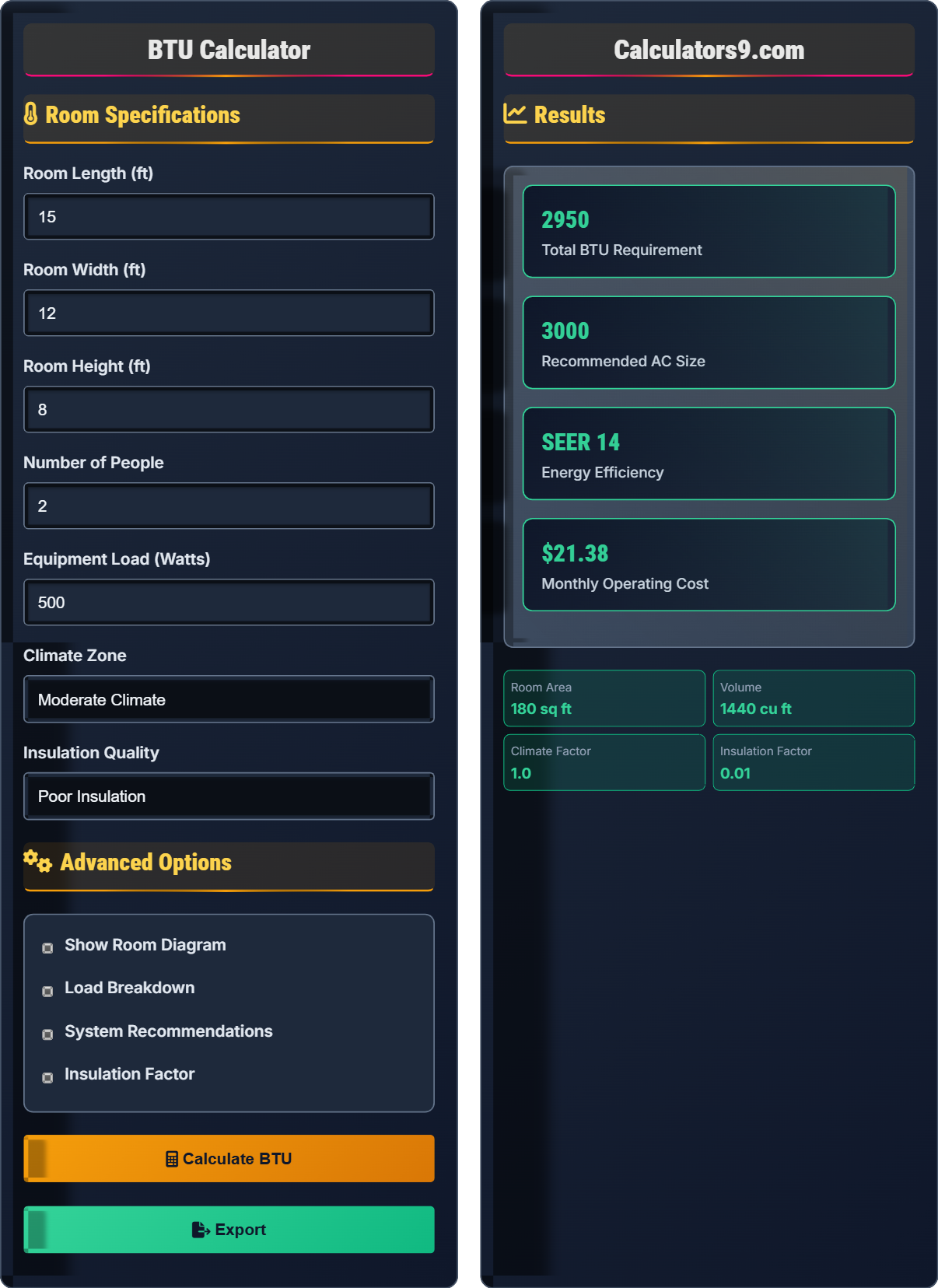
Show the calculator\( \text{Basic BTU} = \text{Area (sq ft)} \times 20 \)
\( \text{Adjusted BTU} = \text{Basic BTU} \times \text{Insulation Factor} \times \text{Climate Factor} \)
\( \text{Window BTU} = \text{Window Area} \times 100 \)
\( \text{Occupancy BTU} = \text{People} \times 600 \)
\( \text{Equipment BTU} = \text{Watts} \times 3.413 \)
These formulas calculate the cooling/heating requirements for a space. The basic calculation assumes 20 BTUs per square foot, with adjustments for insulation, climate, windows, occupancy, and equipment heat loads.
Example: For a 500 sq ft room with good insulation (0.8 factor), moderate climate (1.0 factor), 2 people, and 500W equipment:
Basic BTU = 500 × 20 = 10,000 BTU
Adjusted BTU = 10,000 × 0.8 × 1.0 = 8,000 BTU
Occupancy = 2 × 600 = 1,200 BTU
Equipment = 500 × 3.413 = 1,707 BTU
Total = 8,000 + 1,200 + 1,707 = 10,907 BTU
Room Specifications
Advanced Options
Results
HVAC Fundamentals
British Thermal Unit (BTU) is a unit of heat energy. One BTU is the amount of heat required to raise the temperature of one pound of water by one degree Fahrenheit. In HVAC, BTU measures the cooling or heating capacity of equipment.
Standard BTU calculation approaches:
- Rule of thumb: 20 BTU per sq ft
- Manual J calculation: Detailed load analysis
- Online calculators: Simplified estimation
- Size equipment properly
- Consider all heat sources
- Account for insulation
- Factor in climate zone
- Add safety margin
System Selection
Common HVAC systems include split systems, mini-splits, packaged units, and ductless systems. Each has specific applications and efficiency ratings.
Key factors in system selection:
- Room size
- Insulation quality
- Climate conditions
- Occupancy
- Equipment loads
- 100-150 sq ft: 5,000-6,000 BTU
- 150-250 sq ft: 6,000-8,000 BTU
- 250-350 sq ft: 8,000-10,000 BTU
- 350-450 sq ft: 10,000-12,000 BTU
- 450-550 sq ft: 12,000-14,000 BTU
HVAC Engineering Learning Quiz
What does BTU stand for?
The correct answer is A) British Thermal Unit. BTU stands for British Thermal Unit, which is a traditional unit of heat defined as the amount of heat required to raise the temperature of one pound of water by one degree Fahrenheit.
BTU is a fundamental unit in HVAC calculations. Understanding its definition helps in comprehending how heating and cooling capacities are measured and compared across different systems.
BTU: British Thermal Unit, a unit of heat energy
Heat Capacity: Amount of heat needed to change temperature
Traditional Unit: Historical measurement system
• 1 BTU = heat to raise 1 lb water 1°F
• Used to rate HVAC equipment capacity
• Higher BTU = more capacity
• Remember: British Thermal Unit
• Used in equipment specifications
• Compare equipment using BTUs
• Confusing BTU with other acronyms
• Forgetting it measures capacity
• Not understanding the definition
Calculate the basic BTU requirement for a 300 square foot room using the rule of thumb method (20 BTU per square foot).
Step 1: Apply the rule of thumb formula
BTU = Area × 20
Step 2: Substitute values
BTU = 300 × 20
Step 3: Calculate
BTU = 6,000
The basic BTU requirement is 6,000 BTU.
The 20 BTU per square foot rule is a simplified method for estimating cooling needs. It's a starting point that gets refined with additional factors like insulation, climate, and occupancy.
Rule of Thumb: Simplified estimation method
Basic Calculation: Starting point for load estimation
Cooling Load: Heat removal requirement
• Basic rule: 20 BTU per sq ft
• Refine with additional factors
• Consider all heat sources
• 100 sq ft = 2,000 BTU
• 150 sq ft = 3,000 BTU
• Always add safety margin
• Using wrong multiplier
• Forgetting to consider other factors
• Not adding safety margin
Calculate the additional BTU requirement for a room occupied by 3 people, where each person generates approximately 600 BTUs of heat.
Step 1: Calculate heat generated per person
Heat per person = 600 BTU
Step 2: Calculate total occupancy load
Occupancy BTU = Number of people × BTU per person
Step 3: Substitute values
Occupancy BTU = 3 × 600
Step 4: Calculate
Occupancy BTU = 1,800 BTU
The additional BTU requirement for occupancy is 1,800 BTU.
People generate heat through metabolism, contributing to the cooling load. Each person typically adds 600 BTUs to the space, which must be accounted for in the total load calculation.
Occupancy Load: Heat generated by people in space
Metabolic Heat: Heat produced by human bodies
Internal Load: Heat generated inside conditioned space
• Each person = 600 BTU
• Add to total cooling load
• Consider activity level
• Active people generate more heat
• Add 600 BTU per person
• Consider peak occupancy
• Forgetting occupancy load
• Using wrong BTU per person
• Not considering peak occupancy
Convert 800 watts of electrical equipment to BTUs. (1 watt = 3.413 BTU/hr)
Step 1: Apply the conversion factor
BTU/hr = Watts × 3.413
Step 2: Substitute values
BTU/hr = 800 × 3.413
Step 3: Calculate
BTU/hr = 2,730.4 BTU/hr
The equipment generates 2,730.4 BTU/hr of heat.
Electrical equipment converts energy to heat, contributing to the cooling load. The conversion factor of 3.413 BTU per watt-hour is a standard value used in HVAC calculations.
Equipment Load: Heat generated by electrical devices
Watt-Hour: Unit of energy consumption
Heat Gain: Internal heat added to space
• 1 watt = 3.413 BTU/hr
• Add to total cooling load
• Consider continuous operation
• Convert watts to BTU using 3.413
• Consider standby power
• Account for heat-producing appliances
• Forgetting equipment heat gain
• Using wrong conversion factor
• Not considering standby power
Which climate zone typically requires the highest BTU per square foot?
The correct answer is C) Hot Climate. Hot climates typically require 25-30 BTU per square foot due to high solar gain and outdoor temperatures, compared to 20 BTU for moderate climates.
Climate zones affect cooling requirements significantly. Hot climates require more cooling capacity due to higher outdoor temperatures and increased solar heat gain through walls and windows.
Climate Zone: Geographic area with similar weather patterns
Solar Gain: Heat from sun penetration
Outdoor Design Conditions: Extreme weather for equipment sizing
• Hot climates: 25-30 BTU/sq ft
• Moderate: 20 BTU/sq ft
• Mild: 15-20 BTU/sq ft
• Adjust for local climate
• Consider humidity effects
• Check local design conditions
• Using same BTU per sq ft for all climates
• Not considering humidity
• Forgetting solar orientation
FAQ
Q: How do I calculate BTU for multiple rooms?
A: For multiple rooms, calculate each room separately and sum the loads:
For example, if you have two rooms:
Room 1: 150 sq ft × 20 = 3,000 BTU
Room 2: 200 sq ft × 20 = 4,000 BTU
Total: 3,000 + 4,000 = 7,000 BTU
However, for whole-house calculations, you should perform a Manual J load calculation, which considers heat transfer between rooms, ductwork losses, and other factors that simple addition doesn't account for.
Q: What's the difference between SEER and BTU?
A: SEER and BTU measure different things:
- BTU: Measures cooling capacity (how much heat can be removed)
- SEER: Seasonal Energy Efficiency Ratio (how efficiently energy is used)
Mathematically:
SEER = Cooling Output (BTU) ÷ Energy Input (Watt-hours)
For example, a 12,000 BTU unit using 1,000 Wh would have a SEER of 12.
Higher SEER = more efficient operation, but capacity is still measured in BTUs.