Electricity Calculator
Power, Energy, Current, Voltage Calculator • 2026
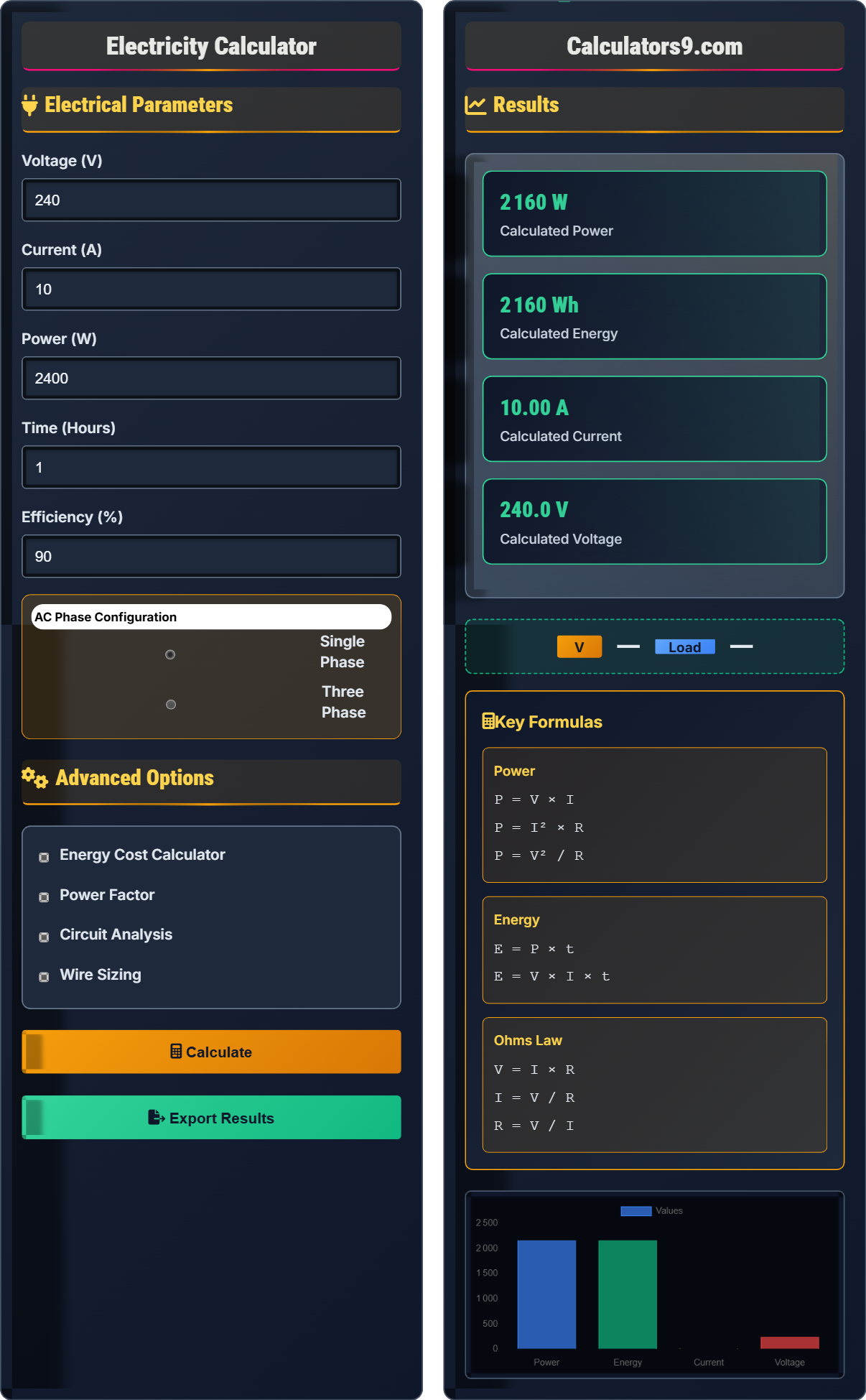
Electricity Formulas:
Show CalculatorPower: \( P = V \times I = I^2 \times R = \frac{V^2}{R} \)
Energy: \( E = P \times t \)
Apparent Power: \( S = V \times I \)
Reactive Power: \( Q = \sqrt{S^2 - P^2} \)
Where:
- \( P \) = Real Power (Watts)
- \( V \) = Voltage (Volts)
- \( I \) = Current (Amperes)
- \( R \) = Resistance (Ohms)
- \( E \) = Energy (Watt-hours)
- \( t \) = Time (hours)
Electricity calculations are fundamental for electrical engineering, construction projects, and energy management. These formulas help determine power requirements, energy consumption, and system efficiency.
Example: A device consuming 1000W for 5 hours uses \( E = 1000W \times 5h = 5000Wh = 5kWh \) of energy.
Electrical Parameters
Advanced Options
Results
| Parameter | Value | Unit | Description |
|---|
| Energy Parameter | Value | Unit | Conversion |
|---|
| Cost Parameter | Value | Unit | Description |
|---|
Electricity Fundamentals
Electricity is the flow of electric charge, typically carried by electrons in a conductor such as a wire. It is a fundamental form of energy that powers our homes, businesses, and industries. The movement of electrons creates electric current, which can be harnessed to perform work, generate light, heat, and mechanical motion.
Voltage (V): Electrical pressure that drives current flow, measured in volts
Current (I): Flow of electric charge, measured in amperes
Resistance (R): Opposition to current flow, measured in ohms
Power (P): Rate of energy transfer, measured in watts
Energy (E): Capacity to do work, measured in watt-hours
- Power = Voltage × Current (P = V × I)
- Energy = Power × Time (E = P × t)
- Voltage is measured in Volts (V)
- Current is measured in Amperes (A)
- Power is measured in Watts (W)
- Energy is measured in Watt-hours (Wh)
Applications
Electricity calculations are essential for determining electrical loads in construction projects, sizing electrical panels, selecting appropriate wire gauges, and ensuring safety in electrical installations. Proper calculations prevent overloading and ensure efficient energy usage.
- Residential electrical panel sizing
- Commercial lighting calculations
- Industrial equipment load analysis
- Energy consumption monitoring
- Utility bill estimation
- Always account for safety margins
- Consider derating factors
- Follow electrical codes and standards
- Verify calculations with qualified professionals
Electricity Learning Quiz
A 120V circuit supplies 15A of current to a load. What is the power consumed by the load?
The answer is C) 1,800W. Using the power formula P = V × I, where P is power in watts, V is voltage in volts, and I is current in amperes: P = 120V × 15A = 1,800W. This is the real power consumed by the load.
This question tests the fundamental power calculation in electrical circuits. The relationship P = V × I is fundamental in electrical engineering and is used to determine the power consumption of electrical devices. Understanding this relationship is crucial for sizing electrical systems and calculating energy usage.
Real Power: Actual power consumed by a circuit, measured in watts (W)
Apparent Power: Product of voltage and current, measured in volt-amperes (VA)
Power Factor: Ratio of real power to apparent power
• Power = Voltage × Current (P = V × I)
• Units must be consistent (volts, amperes, watts)
• This formula gives real power when voltage and current are in phase
• Remember: P = V × I (Power equals Voltage times Current)
• Check units: volts × amperes = watts
• For AC circuits, consider power factor for real power
• Confusing real power (W) with apparent power (VA)
• Forgetting to consider power factor in AC circuits
• Mixing up voltage and current values
A 2kW electric heater runs for 4 hours each day. Calculate the daily energy consumption, monthly energy consumption (30 days), and the cost if electricity costs $0.15 per kWh.
Step 1: Calculate daily energy consumption
E_daily = Power × Time = 2kW × 4h = 8kWh
Step 2: Calculate monthly energy consumption
E_monthly = E_daily × 30 days = 8kWh × 30 = 240kWh
Step 3: Calculate monthly cost
Cost = E_monthly × Rate = 240kWh × $0.15/kWh = $36
Therefore, the heater consumes 8kWh daily, 240kWh monthly, and costs $36 per month to operate.
This problem demonstrates the practical application of energy calculations, which are essential for utility billing, energy management, and cost estimation. The relationship E = P × t shows how power consumption over time translates to energy usage, which is what utilities charge for.
Energy: Capacity to do work, measured in kilowatt-hours (kWh)
Energy: Capacity to do work, measured in kilowatt-hours (kWh)
Power: Rate of energy consumption, measured in kilowatts (kW)
kWh: Kilowatt-hour, the standard unit for electrical energy billing
• Energy = Power × Time (E = P × t)
• 1kWh = 1kW × 1h
• Utilities bill based on energy consumption in kWh
• Convert power to kW when calculating kWh
• Multiply daily consumption by 30 for monthly estimate
• Always check units: kW × h = kWh
• Forgetting to convert W to kW for kWh calculations
• Confusing power (kW) with energy (kWh)
• Not considering actual usage time vs. rated power
An electrician needs to install a circuit for a 5kW electric oven that operates at 240V. What size circuit breaker should be installed, and what wire gauge is recommended? Assume a safety factor of 125% for continuous loads.
Step 1: Calculate operating current
I = P/V = 5000W / 240V = 20.83A
Step 2: Apply safety factor for continuous load
I_safety = 20.83A × 1.25 = 26.04A
Step 3: Select circuit breaker size
Standard breaker size: 30A (next standard size above 26.04A)
Step 4: Select wire gauge
For 30A circuit, use 10 AWG copper wire (rated for 30A)
Therefore, install a 30A circuit breaker with 10 AWG copper wire.
This problem represents a real-world electrical installation scenario. It demonstrates the importance of proper circuit protection and wire sizing to prevent overheating and ensure safety. The 125% rule for continuous loads is a standard electrical code requirement.
Continuous Load: Load expected to operate for 3 hours or more
Derating: Reducing capacity to account for safety margins
AWG: American Wire Gauge standard for wire sizing
• Continuous loads require 125% of calculated current
• Wire ampacity must match or exceed circuit breaker rating
• Follow National Electrical Code (NEC) standards
• Always use standard breaker sizes (15, 20, 30, 40, etc.)
• Consider voltage drop for long runs
• Consult NEC tables for wire ampacity
• Forgetting to apply safety factors for continuous loads
• Using wire that's too small for the circuit breaker
• Not consulting electrical codes for proper sizing
A factory has a 100kW load with a power factor of 0.7. Calculate the apparent power (kVA), reactive power (kVAR), and the kVAR needed to correct the power factor to 0.95.
Step 1: Calculate apparent power at current power factor
S_current = P / PF = 100kW / 0.7 = 142.86 kVA
Step 2: Calculate reactive power at current power factor
Q_current = √(S² - P²) = √(142.86² - 100²) = √(20,408 - 10,000) = 102.02 kVAR
Step 3: Calculate apparent power at desired power factor
S_desired = P / PF_desired = 100kW / 0.95 = 105.26 kVA
Step 4: Calculate reactive power at desired power factor
Q_desired = √(S_desired² - P²) = √(105.26² - 100²) = √(11,079 - 10,000) = 32.85 kVAR
Step 5: Calculate required correction
Q_correction = Q_current - Q_desired = 102.02 - 32.85 = 69.17 kVAR
Therefore, 69.17 kVAR of capacitive correction is needed.
This problem introduces power factor correction, which is important in industrial applications. Low power factor results in higher current draw and increased losses. Power factor correction reduces reactive power, improving efficiency and reducing utility penalties.
Power Factor: Ratio of real power to apparent power
Apparent Power: Vector sum of real and reactive power (kVA)
Reactive Power: Power that oscillates between source and load (kVAR)
• S² = P² + Q² (Power triangle relationship)
• PF = P/S (Power factor definition)
• Capacitors provide leading reactive power to correct lagging loads
• Power factor correction improves efficiency and reduces costs
• Industrial facilities often face penalties for low power factor
• Capacitors are typically used for power factor correction
• Confusing real, reactive, and apparent power
• Forgetting the power triangle relationship
• Not considering utility penalties for poor power factor
For a balanced three-phase system with line voltage of 480V and line current of 20A, what is the total power if the power factor is 0.8?
The answer is C) 16,628W. For three-phase power: P = √3 × VL × IL × PF, where VL is line voltage, IL is line current, and PF is power factor. P = √3 × 480V × 20A × 0.8 = 1.732 × 480 × 20 × 0.8 = 16,628W.
The √3 factor accounts for the phase relationship in three-phase systems.
This question tests knowledge of three-phase power calculations, which are common in industrial and commercial applications. Three-phase systems are more efficient than single-phase systems for transmitting power over long distances and driving large motors.
Three-Phase Power: Power system with three alternating currents
Line Voltage: Voltage between two phases
Line Current: Current in each phase conductor
• Three-phase power: P = √3 × VL × IL × PF
• Single-phase power: P = VL × IL × PF
• √3 ≈ 1.732 is the phase relationship factor
• Remember √3 factor for three-phase calculations
• Three-phase systems are more efficient for large loads
• Check if system is single-phase or three-phase before calculating
• Forgetting the √3 factor in three-phase calculations
• Using single-phase formula for three-phase systems
• Confusing line and phase voltages/currents
FAQ
Q: How do I calculate the wire size needed for an electrical circuit?
A: Wire sizing depends on current capacity and voltage drop. First, calculate the circuit current: \( I = \frac{P}{V \times \text{PF}} \). Then apply the NEC 125% rule for continuous loads: \( I_{\text{breaker}} = I \times 1.25 \).
For example, a 5kW load at 240V with 0.9 PF: \( I = \frac{5000}{240 \times 0.9} = 23.15A \). With 125% rule: \( I_{\text{breaker}} = 23.15 \times 1.25 = 28.94A \). Use a 30A breaker with 10 AWG copper wire rated for 30A.
Also consider voltage drop: \( V_{\text{drop}} = \frac{2 \times L \times I \times R}{1000} \), where L is length in feet and R is resistance per 1000 feet.
Q: What's the difference between kW and kWh?
A: kW (kilowatt) measures power - the rate of energy consumption at a moment in time. kWh (kilowatt-hour) measures energy - the total amount of energy consumed over time.
Think of kW as your car's speedometer (instantaneous speed) and kWh as your odometer (total distance traveled). A 1kW device running for 1 hour uses 1kWh of energy. A 2kW device running for 3 hours uses 6kWh.
Utilities charge based on kWh consumed, not kW demand (though large users may pay demand charges).