Engine Horsepower Calculator
Automotive power analysis • 2026 standards
Engine Power Formulas:
Show the calculator\( \text{HP} = \frac{\text{Torque (lb-ft)} \times \text{RPM}}{5252} \)
\( \text{Torque (lb-ft)} = \frac{\text{HP} \times 5252}{\text{RPM}} \)
\( \text{BMEP} = \frac{\text{HP} \times 792,000}{\text{Displacement (cu in)} \times \text{RPM}} \)
\( \text{Volumetric Efficiency} = \frac{\text{Actual CFM}}{\text{Theoretical CFM}} \times 100 \)
\( \text{Theoretical CFM} = \frac{\text{CID} \times \text{RPM}}{3456} \)
These formulas calculate engine performance metrics. BMEP (Brake Mean Effective Pressure) measures the average pressure in cylinders. Volumetric efficiency indicates how well an engine fills its cylinders with air/fuel mixture.
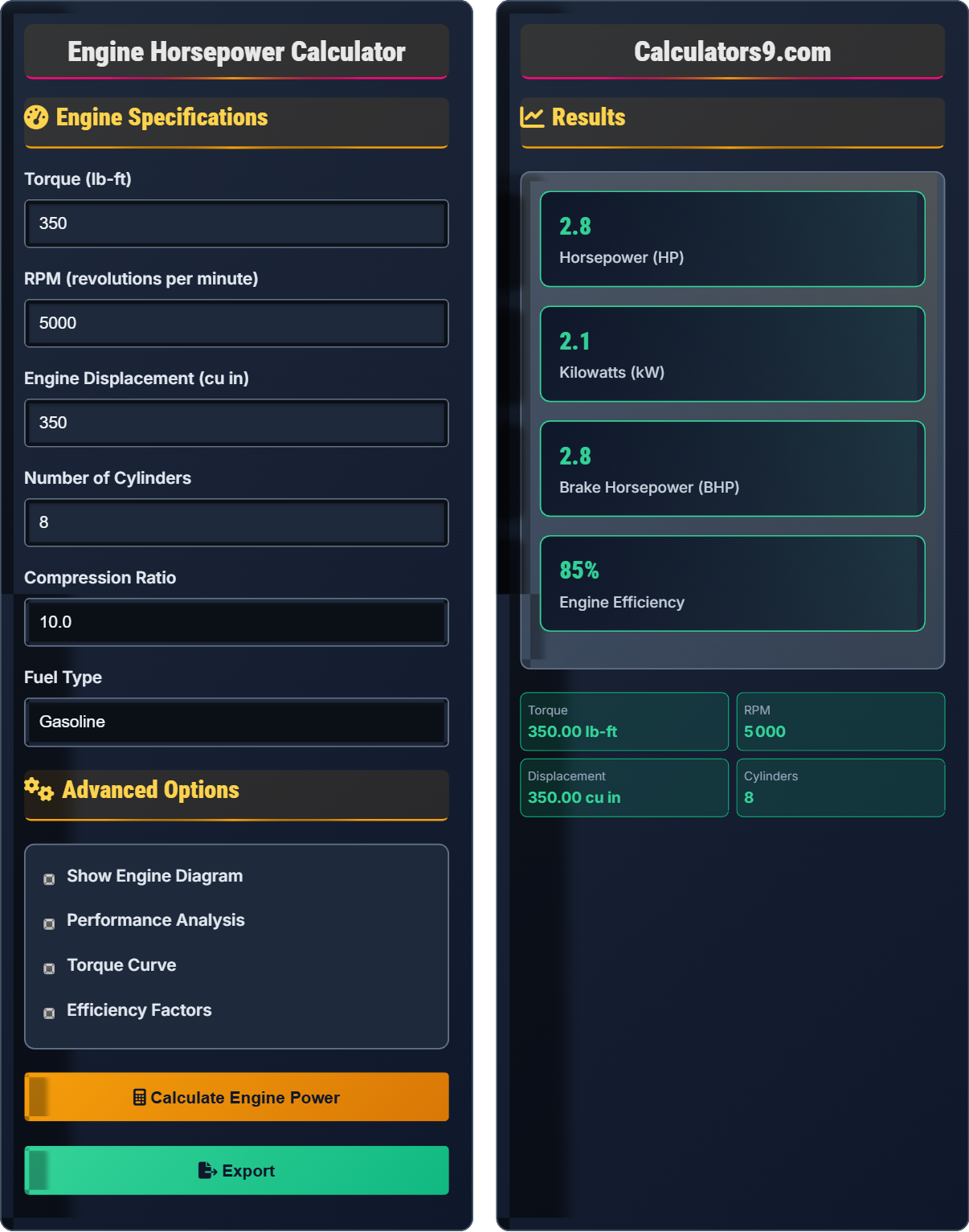
Example: For an engine producing 350 lb-ft of torque at 5000 RPM:
HP = (350 × 5000) ÷ 5252 = 333.2 HP
For a 350 cubic inch engine at 6000 RPM producing 400 HP:
BMEP = (400 × 792,000) ÷ (350 × 6000) = 150.9 PSI
Engine Specifications
Advanced Options
Results
Engine Power Fundamentals
Brake horsepower (BHP) is the power output of an engine measured at the crankshaft, before losses from auxiliary components like alternator, water pump, and transmission. It represents the engine's actual power production capability.
Standard engine power formulas:
- BHP = (Torque × RPM) ÷ 5252
- BMEP = (HP × 792,000) ÷ (CID × RPM)
- CFM = (CID × RPM) ÷ 3456
- Power Density = HP ÷ CID
- 1 HP = 550 ft-lbs/sec
- 1 HP = 745.7 watts
- At 5252 RPM, HP = Torque
- Higher compression = more power
- Efficiency varies by engine type
Performance Metrics
BMEP (Brake Mean Effective Pressure) measures the average pressure in engine cylinders. It's a key indicator of engine efficiency and performance. Higher BMEP indicates better volumetric efficiency.
Key performance metrics:
- Power density (HP per cubic inch)
- Specific fuel consumption
- Thermal efficiency
- Volumetric efficiency
- Street engines: 80-120 PSI BMEP
- Race engines: 200+ PSI BMEP
- Gas engines: 30-35% efficiency
- Diesel engines: 40-45% efficiency
Automotive Engineering Learning Quiz
What does BMEP stand for in engine terminology?
The correct answer is A) Brake Mean Effective Pressure. BMEP is a theoretical pressure that would produce the same power output as the actual varying pressure in the cylinder during the engine cycle.
BMEP is a critical metric for comparing engine performance across different sizes and configurations. It represents the average pressure acting on the piston during the power stroke, providing insight into the engine's efficiency and breathing capability.
BMEP: Brake Mean Effective Pressure - average pressure in cylinders
Power Stroke: Phase of engine cycle producing power
Volumetric Efficiency: How well engine fills cylinders
• Higher BMEP = better efficiency
• BMEP = (HP × 792,000) ÷ (CID × RPM)
• Measures breathing capability
• Supercharged engines have higher BMEP
• Compare engines using BMEP
• Higher BMEP = more efficient
• Confusing BMEP with compression ratio
• Not understanding the pressure concept
• Forgetting the formula
Calculate the brake horsepower of an engine producing 400 lb-ft of torque at 6000 RPM.
Step 1: Apply the brake horsepower formula
BHP = (Torque × RPM) ÷ 5252
Step 2: Substitute values
BHP = (400 × 6000) ÷ 5252
Step 3: Calculate
BHP = 2,400,000 ÷ 5252 = 457.0 HP
The engine produces 457.0 brake horsepower.
This calculation demonstrates the fundamental relationship between torque and horsepower. At any given RPM, increasing torque increases horsepower proportionally. The constant 5252 represents the conversion factor between these units.
Brake Horsepower (BHP): Power measured at crankshaft
Torque: Rotational force measurement
RPM: Revolutions per minute
• BHP = (Torque × RPM) ÷ 5252
• At 5252 RPM, BHP = Torque
• Direct relationship at constant RPM
• At 5252 RPM, numbers are equal
• Higher RPM = more BHP
• Higher torque = more BHP
• Forgetting the division by 5252
• Using wrong torque units
• Not checking units consistency
Calculate the BMEP for a 350 cubic inch engine producing 400 HP at 6000 RPM. Use the formula: BMEP = (HP × 792,000) ÷ (CID × RPM).
Step 1: Apply the BMEP formula
BMEP = (HP × 792,000) ÷ (CID × RPM)
Step 2: Substitute values
BMEP = (400 × 792,000) ÷ (350 × 6000)
Step 3: Calculate numerator
400 × 792,000 = 316,800,000
Step 4: Calculate denominator
350 × 6000 = 2,100,000
Step 5: Calculate BMEP
BMEP = 316,800,000 ÷ 2,100,000 = 150.9 PSI
The engine's BMEP is 150.9 PSI.
BMEP calculation helps evaluate engine efficiency. A BMEP of 150.9 PSI indicates a well-performing street engine. Race engines can achieve 200+ PSI, while stock engines typically range from 80-120 PSI.
BMEP: Brake Mean Effective Pressure in PSI
CID: Cubic Inch Displacement
PSI: Pounds per square inch
• BMEP = (HP × 792,000) ÷ (CID × RPM)
• Higher BMEP = more efficient
• Measures engine breathing capability
• Stock engines: 80-120 PSI
• Modified engines: 120-180 PSI
• Race engines: 200+ PSI
• Forgetting the constant 792,000
• Using wrong displacement units
• Not checking units consistency
Calculate the power density of a 350 cubic inch engine producing 350 HP. Power density is measured in HP per cubic inch.
Step 1: Apply the power density formula
Power Density = HP ÷ CID
Step 2: Substitute values
Power Density = 350 ÷ 350
Step 3: Calculate
Power Density = 1.0 HP per cubic inch
The engine's power density is 1.0 HP per cubic inch.
Power density indicates how efficiently an engine converts displacement to power. A power density of 1.0 HP/cu in is typical for a naturally aspirated street engine. Turbocharged engines can achieve 2.0+ HP/cu in.
Power Density: HP per cubic inch of displacement
Efficiency Metric: Power output per unit volume
Displacement: Total volume of all cylinders
• Power Density = HP ÷ CID
• Higher = more efficient
• Measures power concentration
• Street engines: 0.8-1.2 HP/cu in
• Race engines: 1.5+ HP/cu in
• Turbo engines: 2.0+ HP/cu in
• Dividing displacement by HP instead
• Using wrong units
• Not understanding the concept
Which type of engine typically has the highest thermal efficiency?
The correct answer is C) Diesel engine. Diesel engines typically achieve 40-45% thermal efficiency compared to 30-35% for gasoline engines. This is due to higher compression ratios and leaner air-fuel mixtures.
Diesel engines operate at higher compression ratios (14:1 to 23:1) compared to gasoline engines (8:1 to 12:1). The higher compression ratio leads to higher thermal efficiency and better fuel economy, though diesel engines typically produce more torque at lower RPM.
Thermal Efficiency: How efficiently fuel energy is converted to work
Compression Ratio: Ratio of cylinder volumes
Thermal Efficiency: Energy conversion effectiveness
• Diesel: 40-45% thermal efficiency
• Gasoline: 30-35% thermal efficiency
• Higher compression = higher efficiency
• Diesel engines are more efficient
• Higher compression = more power
• Turbocharging increases efficiency
• Assuming all engines have same efficiency
• Forgetting compression ratio effects
• Not considering fuel type
FAQ
Q: What's the difference between horsepower and brake horsepower?
A: The difference lies in where power is measured:
- Horsepower: Generic term for power output
- Brake Horsepower (BHP): Power measured at crankshaft
Mathematically: BHP = (Torque × RPM) ÷ 5252
At the wheels, you lose power to drivetrain losses. For example, if an engine produces 400 BHP, the wheels might receive 350-370 HP after losses. BHP represents the engine's actual power output before drivetrain losses.
Q: How do I calculate BMEP for my racing engine?
A: Use the BMEP formula: BMEP = (HP × 792,000) ÷ (CID × RPM)
For example, if your 302 cubic inch engine produces 450 HP at 7000 RPM:
BMEP = (450 × 792,000) ÷ (302 × 7000)
BMEP = 356,400,000 ÷ 2,114,000 = 168.6 PSI
A BMEP of 168.6 PSI indicates a high-performance racing engine. Race engines typically achieve 180-250+ PSI, showing exceptional breathing and efficiency.