Gravel Calculator
Driveway & pathway calculator • 2026 standards
Gravel Calculation Formulas:
Show the calculator\( \text{Area} = \text{Length} \times \text{Width} \)
\( \text{Volume} = \frac{\text{Area} \times \text{Depth}}{12} \)
\( \text{Cubic Yards} = \frac{\text{Volume in Cubic Feet}}{27} \)
\( \text{Tons} = \frac{\text{Cubic Yards} \times \text{Density}}{2000} \)
\( \text{Coverage Factor} = \frac{\text{Area}}{\text{Volume}} \)
These formulas calculate the amount of gravel needed for a given area at a specific depth. Density varies by gravel type, affecting weight and volume calculations. Compaction factors must be considered for accurate estimates.
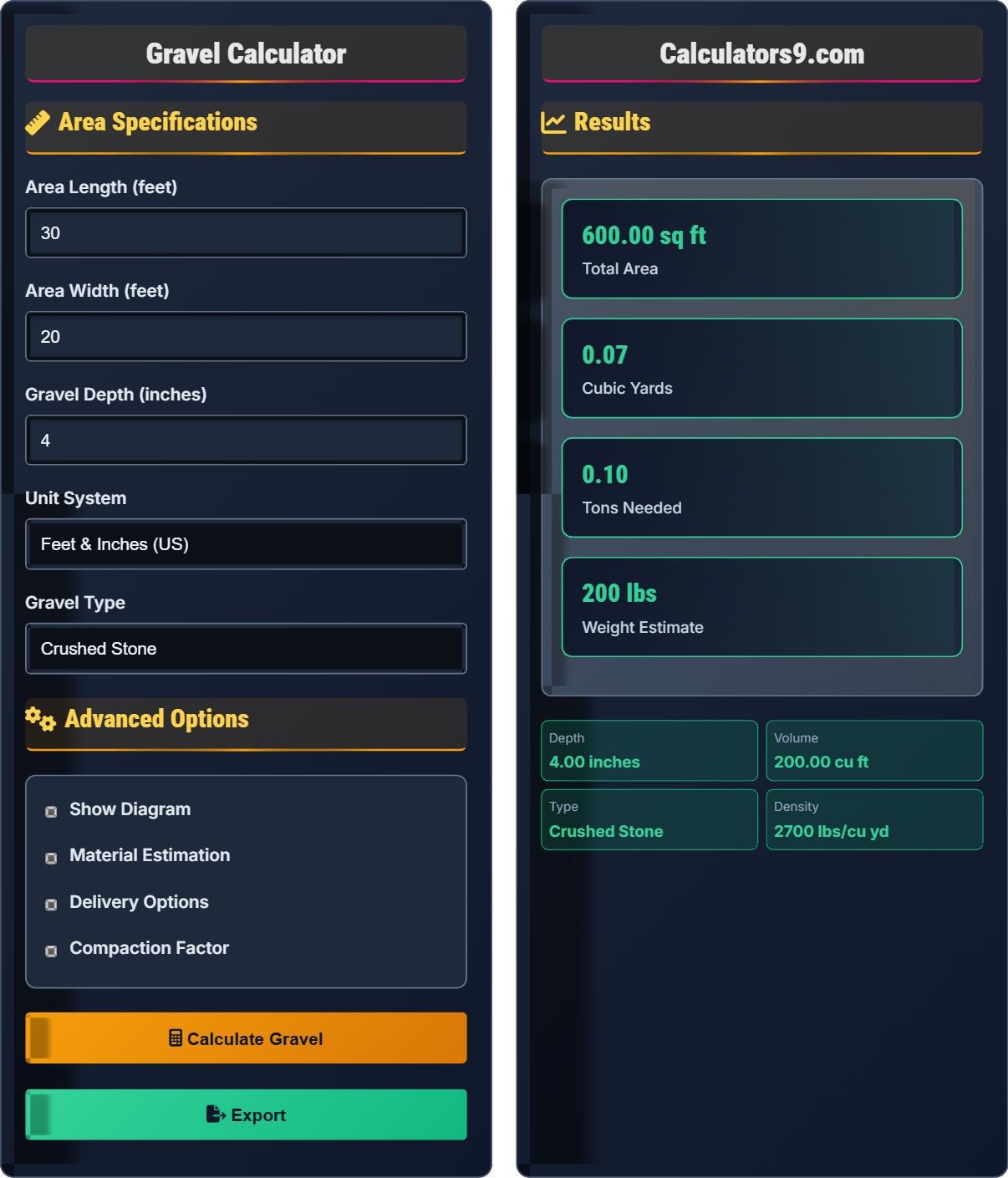
Example: For an area 30 ft × 20 ft at 4 inches deep:
Area = 30 × 20 = 600 sq ft
Volume = 600 × (4/12) = 200 cubic ft
Cubic Yards = 200 ÷ 27 = 7.41 cubic yards
For 2,700 lbs/cu yd: 7.41 × 2,700 ÷ 2,000 = 10.0 tons
Area Specifications
Advanced Options
Results
Gravel Installation Fundamentals
Gravel provides excellent drainage, durability, and versatility. It's used for driveways, pathways, drainage systems, and construction foundations. Proper gravel installation ensures long-lasting performance and stability.
Key steps in gravel installation:
- Prepare the area
- Install edging
- Add base layer
- Spread gravel
- Compact properly
- Maintain regularly
- Use proper depth (4-6 inches)
- Install base layer first
- Compact in layers
- Consider drainage
- Choose appropriate size
Gravel Types
Popular gravel types include crushed stone, river rock, pea gravel, limestone, granite, and asphalt gravel. Each type has specific characteristics and applications for different construction needs.
Choosing gravel type:
- Consider application
- Evaluate drainage needs
- Assess durability
- Plan maintenance
- Crushed Stone: Excellent drainage, strong
- River Rock: Decorative, smooth
- Pea Gravel: Comfortable walking surface
- Limestone: Good compaction, affordable
- Granite: Very durable, long-lasting
- Asphalt: Recycled, cost-effective
Gravel Installation Learning Quiz
How many cubic feet of gravel are needed to cover an area 25 feet by 15 feet at a depth of 3 inches?
The correct answer is B) 93.75 cubic feet. First convert depth to feet: 3 inches = 0.25 feet. Then calculate volume: Area × Depth = 25 × 15 × 0.25 = 93.75 cubic feet.
This calculation demonstrates the relationship between area, depth, and volume for material estimation. When calculating gravel needs, it's essential to convert all measurements to the same unit. In this case, inches are converted to feet to match the area measurement in square feet.
Volume: The amount of three-dimensional space occupied
Cubic Feet: Volume measurement using feet as the unit
Unit Conversion: Changing from one unit of measurement to another
• Volume = Area × Depth
• Convert depth to same units as area
• 12 inches = 1 foot
• Convert inches to feet by dividing by 12
• Always double-check unit consistency
• Round up for safety margin
• Not converting units to match
• Forgetting to convert inches to feet
• Using wrong formula for volume
Convert 8 cubic yards of crushed stone to tons. Crushed stone typically weighs 2,700 pounds per cubic yard.
Step 1: Calculate total weight in pounds
Total weight = Cubic yards × Weight per cubic yard
Total weight = 8 × 2,700 = 21,600 pounds
Step 2: Convert pounds to tons
Tons = Total weight ÷ 2,000 = 21,600 ÷ 2,000 = 10.8 tons
8 cubic yards of crushed stone equals 10.8 tons.
This conversion is essential for purchasing gravel, which is often sold by the ton. Understanding the relationship between volume and weight helps in accurate material estimation and cost calculation.
Ton: Unit of weight equal to 2,000 pounds
Density: Weight per unit volume of a material
Weight Conversion: Changing from one unit of weight to another
• 1 ton = 2,000 pounds
• Tons = (Cubic yards × Density) ÷ 2,000
• Density varies by material type
• Crushed stone: ~2,700 lbs/cu yd
• River rock: ~2,500 lbs/cu yd
• Pea gravel: ~2,400 lbs/cu yd
• Using wrong density for material
• Confusing tons with cubic yards
• Not confirming supplier units
A contractor needs 15 tons of gravel. If dump trucks can carry 10 tons per load, how many truck loads are required?
Step 1: Calculate number of loads needed
Number of loads = Total tons needed ÷ Capacity per truck
Number of loads = 15 ÷ 10 = 1.5
Step 2: Round up to whole loads
Since partial loads aren't possible, round up to 2 truck loads
The contractor needs 2 truck loads of gravel.
This calculation demonstrates how to plan deliveries when materials are transported in discrete loads. Since you can't order a partial truck load, you must always round up to ensure sufficient material is delivered.
Truck Load: The amount of material a truck can carry in one trip
Discrete Quantities: Items that must be counted in whole units
Delivery Planning: Organizing material transport efficiently
• Always round up for partial loads
• Truck capacity varies by type
• Consider access limitations
• Confirm truck capacity with supplier
• Check site access for large trucks
• Plan delivery schedule
• Not rounding up partial loads
• Forgetting truck capacity limits
• Not considering delivery logistics
A homeowner has 12 cubic yards of gravel and wants to spread it evenly over an area of 300 square feet. What will be the depth of the gravel layer in inches?
Step 1: Convert cubic yards to cubic feet
Volume = 12 cubic yards × 27 cubic feet per yard = 324 cubic feet
Step 2: Calculate depth in feet
Depth = Volume ÷ Area = 324 cubic feet ÷ 300 square feet = 1.08 feet
Step 3: Convert depth to inches
Depth in inches = 1.08 feet × 12 inches per foot = 12.96 inches
The gravel will be approximately 13 inches deep.
This calculation is useful when you have a specific amount of gravel and want to determine the coverage depth. The formula rearranges the standard volume calculation to solve for depth, demonstrating the mathematical relationship between volume, area, and depth.
Depth Calculation: Finding the third dimension when area and volume are known
Reverse Calculation: Solving for an unknown dimension
Volume Relationship: How dimensions relate in three-dimensional space
• Depth = Volume ÷ Area
• Convert feet to inches by multiplying by 12
• 4-6 inches is optimal for driveways
• Optimal driveway depth: 4-6 inches
• Pathways: 2-4 inches
• Consider settling in calculations
• Calculating incorrect depth
• Going too deep (>6 inches)
• Not considering settling
Which gravel type typically has the highest density (weight per cubic yard)?
The correct answer is C) Crushed Stone. Crushed stone typically has the highest density at about 2,700 pounds per cubic yard, followed by limestone (~2,600 lbs/cu yd), river rock (~2,500 lbs/cu yd), and pea gravel (~2,400 lbs/cu yd).
Different gravel types have varying densities due to their mineral composition and particle shape. Denser materials like crushed stone provide more stability but weigh more, affecting transportation costs and structural load calculations.
Density: How tightly packed a material is
Mineral Composition: The chemical makeup affecting weight
Particle Shape: How individual pieces fit together
• Crushed stone: ~2,700 lbs/cu yd
• Limestone: ~2,600 lbs/cu yd
• Density affects cost and transport
• Heavier materials provide better stability
• Transportation costs increase with density
• Check supplier specifications
• Assuming all gravel types weigh the same
• Not checking density specifications
• Ignoring weight impact on vehicles
FAQ
Q: How do I calculate gravel needed for an irregular shaped area?
A: For irregular shapes, divide the area into simpler geometric shapes (rectangles, triangles, circles). Calculate each section separately and sum the results.
For example, if you have an L-shaped area:
Section 1: 20 ft × 10 ft = 200 sq ft
Section 2: 15 ft × 8 ft = 120 sq ft
Total: 200 + 120 = 320 sq ft
Then calculate gravel: 320 × (4/12) = 106.67 cubic feet
106.67 ÷ 27 = 3.95 cubic yards
Q: What's the difference between cubic yards and tons?
A: Cubic yards measure volume, while tons measure weight:
- Cubic yards: 3D space measurement (yard × yard × yard)
- Tons: Weight measurement (2,000 pounds)
Mathematically, for crushed stone (2,700 lbs/cu yd):
1 cubic yard = 2,700 lbs = 1.35 tons
So: Tons = (Cubic yards × 2,700) ÷ 2,000
Some suppliers sell by volume (cubic yards), others by weight (tons).