Horsepower Calculator
Power & torque calculator • 2026 standards
Horsepower Formulas:
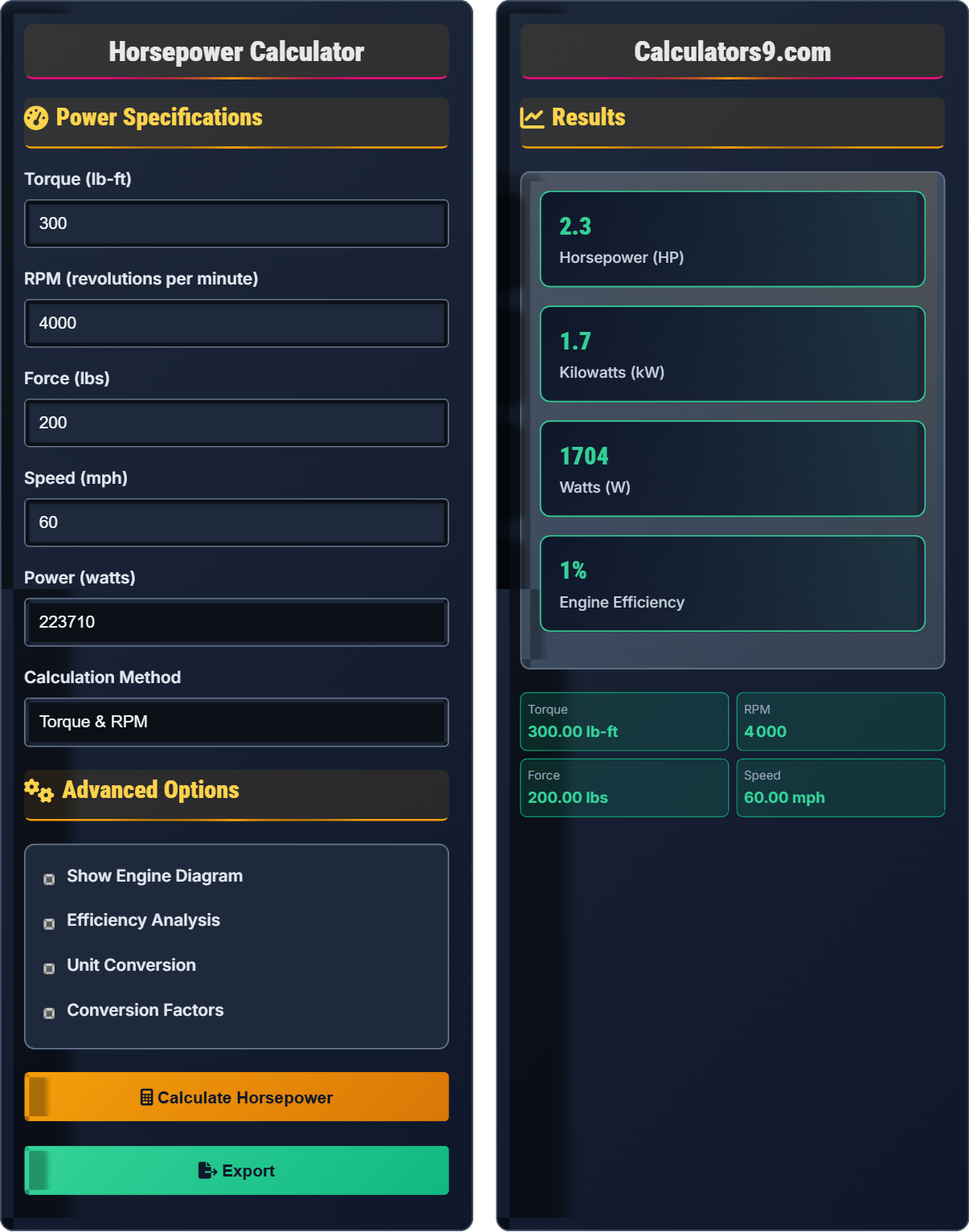
Show the calculator\( \text{HP} = \frac{\text{Torque (lb-ft)} \times \text{RPM}}{5252} \)
\( \text{Torque (lb-ft)} = \frac{\text{HP} \times 5252}{\text{RPM}} \)
\( \text{HP} = \frac{\text{Force (lbs)} \times \text{Speed (mph)}}{375} \)
\( \text{HP} = \frac{\text{Power (watts)}}{745.7} \)
\( \text{Mechanical Advantage} = \frac{\text{Output Force}}{\text{Input Force}} \)
These formulas calculate mechanical power in various contexts. Horsepower measures the rate of doing work. One horsepower equals 550 foot-pounds per second or 745.7 watts. RPM is revolutions per minute.
Example: For an engine producing 300 lb-ft of torque at 4000 RPM:
HP = (300 × 4000) ÷ 5252 = 228.5 HP
For a vehicle traveling at 60 mph with 200 lbs of force:
HP = (200 × 60) ÷ 375 = 32 HP
Power Specifications
Advanced Options
Results
Power Fundamentals
Horsepower (HP) is a unit of power that measures the rate of doing work. One horsepower equals 550 foot-pounds per second or 745.7 watts. It was originally defined by James Watt to compare steam engines to draft horses.
Standard horsepower formulas:
- HP = (Torque × RPM) ÷ 5252
- HP = (Force × Speed) ÷ 375
- HP = Watts ÷ 745.7
- HP = (Work × Time) ÷ 550
- 1 HP = 745.7 watts
- 1 HP = 550 ft-lbs/sec
- 1 HP = 2,545 BTU/hr
- 1 HP = 0.746 kW
- 5252 RPM = equal HP and torque
Torque & Performance
Torque is rotational force measured in pound-feet (lb-ft). It's the turning force that causes rotation. Horsepower is torque applied over time (RPM). Engines produce different torque curves affecting performance.
Relationship between torque and horsepower:
- HP = (Torque × RPM) ÷ 5252
- At 5252 RPM, HP = Torque numerically
- Below 5252 RPM, Torque > HP
- Above 5252 RPM, HP > Torque
- Low-end torque = Acceleration
- High-end HP = Top speed
- Peak torque = Best pulling power
- Wide torque curve = Flexible powerband
Mechanical Engineering Learning Quiz
One horsepower is equal to how many foot-pounds per second?
The correct answer is B) 550 foot-pounds per second. One horsepower is defined as 550 foot-pounds of work done per second, based on James Watt's observations of draft horse performance.
This fundamental definition establishes the basis for all horsepower calculations. Understanding this definition helps comprehend how power is measured and compared across different mechanical systems.
Horsepower: Unit of power measuring work rate
Foot-pound: Unit of work (force × distance)
James Watt: Scottish engineer who defined horsepower
• 1 HP = 550 ft-lbs/sec
• 1 HP = 745.7 watts
• 1 HP = 2,545 BTU/hr
• Remember: 550 ft-lbs/sec
• Used in engine specifications
• Compare different power systems
• Confusing with other power units
• Forgetting the exact definition
• Mixing up force and power
Calculate the horsepower of an engine producing 250 lb-ft of torque at 3000 RPM.
Step 1: Apply the horsepower formula
HP = (Torque × RPM) ÷ 5252
Step 2: Substitute values
HP = (250 × 3000) ÷ 5252
Step 3: Calculate
HP = 750,000 ÷ 5252 = 142.8 HP
The engine produces 142.8 horsepower.
This calculation demonstrates the relationship between torque and horsepower. At any given RPM, increasing torque increases horsepower proportionally. The constant 5252 represents the conversion factor between these units.
Torque: Rotational force measurement
RPM: Revolutions per minute
Power: Work done over time
• HP = (Torque × RPM) ÷ 5252
• At 5252 RPM, HP = Torque
• Direct relationship at constant RPM
• At 5252 RPM, numbers are equal
• Higher RPM = more HP
• Higher torque = more HP
• Forgetting the division by 5252
• Using wrong torque units
• Not checking units consistency
A car traveling at 70 mph requires 150 lbs of force to overcome air resistance and friction. Calculate the horsepower needed to maintain this speed.
Step 1: Apply the force-speed horsepower formula
HP = (Force × Speed) ÷ 375
Step 2: Substitute values
HP = (150 × 70) ÷ 375
Step 3: Calculate
HP = 10,500 ÷ 375 = 28 HP
The car needs 28 horsepower to maintain 70 mph.
This calculation shows how to determine power requirements for steady-state motion. The formula relates the force needed to overcome resistance to the speed at which that force is applied.
Air Resistance: Force opposing forward motion
Friction: Force resisting motion
Steady-State: Constant velocity condition
• HP = (Force × Speed) ÷ 375
• Force in pounds, speed in mph
• 375 is the conversion constant
• Air resistance increases with speed²
• Higher speeds require more power
• Consider aerodynamic efficiency
• Forgetting the division by 375
• Using wrong speed units
• Not accounting for all resistances
Convert 50,000 watts of electrical power to horsepower.
Step 1: Apply the watt-to-horsepower conversion
HP = Watts ÷ 745.7
Step 2: Substitute values
HP = 50,000 ÷ 745.7
Step 3: Calculate
HP = 67.1 HP
50,000 watts equals 67.1 horsepower.
This conversion is important when comparing electrical motors to mechanical power. The conversion factor of 745.7 watts per horsepower allows direct comparison between electrical and mechanical power systems.
Watt: SI unit of power
Electrical Power: Power in electrical systems
Mechanical Power: Power in mechanical systems
• 1 HP = 745.7 watts
• HP = Watts ÷ 745.7
• Watts = HP × 745.7
• Remember: 745.7 for conversion
• Useful for motor sizing
• Compare electrical and mechanical
• Using wrong conversion factor
• Confusing with other power units
• Forgetting the division
At what RPM do horsepower and torque values become numerically equal?
The correct answer is C) 5252 RPM. At 5252 RPM, the horsepower and torque values are numerically equal due to the mathematical relationship in the formula: HP = (Torque × RPM) ÷ 5252.
This unique point occurs because the formula HP = (Torque × RPM) ÷ 5252 creates a direct relationship. When RPM equals 5252, the equation becomes HP = Torque, making the values numerically identical.
Numerically Equal: Same numerical value
Mathematical Relationship: Proportional connection
Engine Curve: Graph of power vs RPM
• At 5252 RPM: HP = Torque numerically
• Below 5252: Torque > HP
• Above 5252: HP > Torque
• Remember 5252 as the crossover point
• Helps interpret engine curves
• Useful for performance analysis
• Forgetting the special relationship
• Not understanding the math
• Confusing with other RPM values
FAQ
Q: What's the difference between torque and horsepower?
A: Torque and horsepower are related but distinct concepts:
- Torque: Rotational force (lb-ft) - "turning power"
- Horsepower: Rate of doing work over time
Mathematically: HP = (Torque × RPM) ÷ 5252
Torque is what gets you moving from a stop, while horsepower determines how fast you can go. A vehicle with high torque at low RPM feels strong in acceleration, while high horsepower at high RPM enables high top speeds.
Q: How do I calculate power for an electric motor?
A: For electric motors, you can calculate power multiple ways:
From electrical input: Power (watts) = Voltage × Current × Power Factor
From mechanical output: Power (watts) = Torque (Nm) × Angular Velocity (rad/s)
Convert to horsepower: HP = Watts ÷ 745.7
For example, if a motor draws 10A at 240V with 0.85 power factor:
Power = 240 × 10 × 0.85 = 2,040W
HP = 2,040 ÷ 745.7 = 2.74 HP