Mulch Calculator
Yard & garden mulching calculator • 2026 standards
Mulch Calculation Formulas:
Show the calculator\( \text{Area} = \text{Length} \times \text{Width} \)
\( \text{Volume} = \frac{\text{Area} \times \text{Depth}}{12} \)
\( \text{Cubic Yards} = \frac{\text{Volume in Cubic Feet}}{27} \)
\( \text{Bags Needed} = \frac{\text{Cubic Yards} \times 27}{\text{Bag Volume}} \)
\( \text{Coverage} = \frac{\text{Material Volume}}{\text{Desired Depth}} \)
These formulas calculate the amount of mulch needed for a given area at a specific depth. The volume calculation converts area and depth to cubic feet, then cubic yards for purchasing purposes. Different mulch types have varying coverage rates.
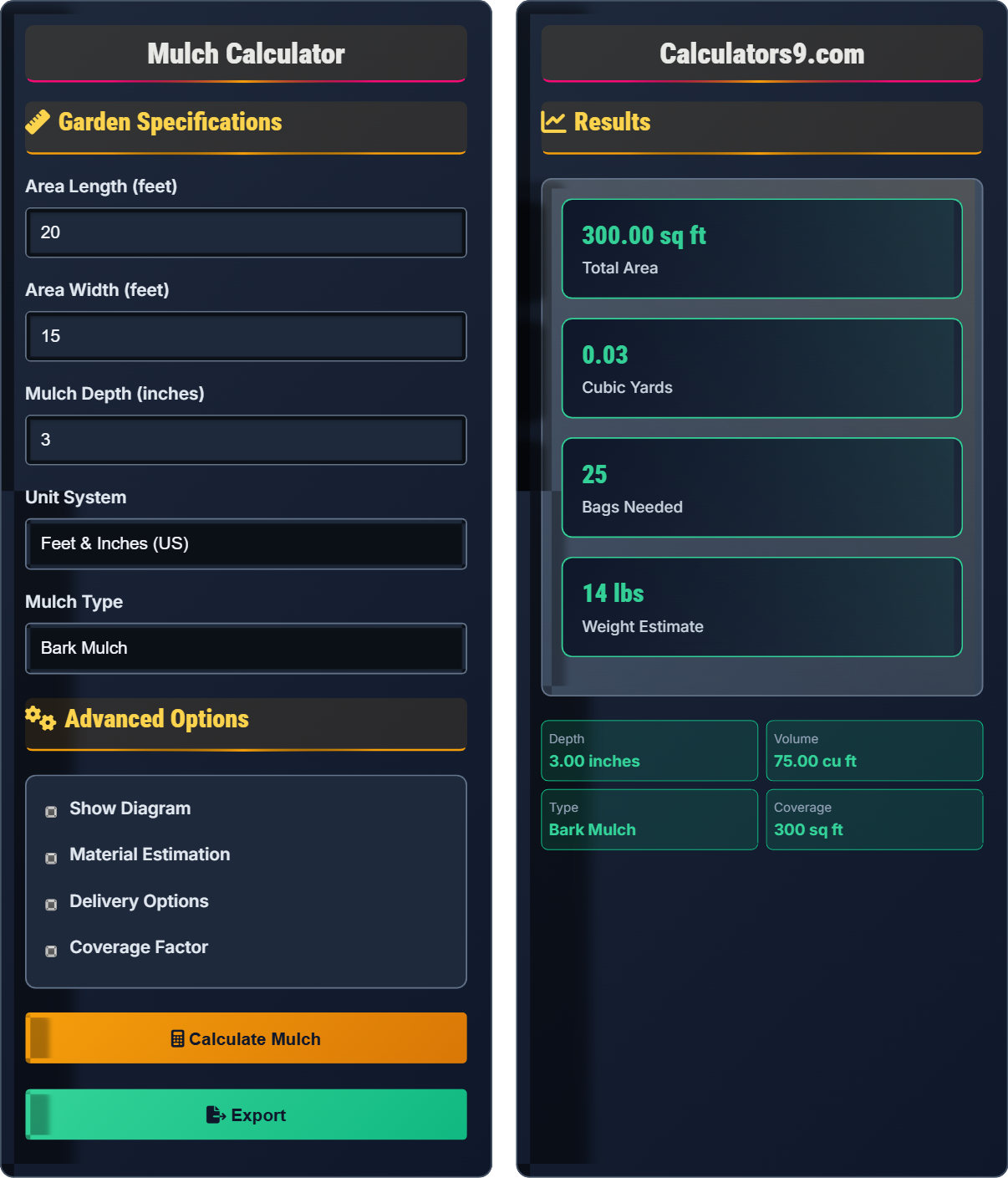
Example: For an area 20 ft × 15 ft at 3 inches deep:
Area = 20 × 15 = 300 sq ft
Volume = 300 × (3/12) = 75 cubic ft
Cubic Yards = 75 ÷ 27 = 2.78 cubic yards
For 3 cu ft bags: 75 ÷ 3 = 25 bags
Garden Specifications
Advanced Options
Results
Mulch Installation Fundamentals
Mulch is a protective layer applied to soil surfaces. It conserves moisture, suppresses weeds, regulates soil temperature, and improves soil health. Proper mulching enhances plant growth and reduces maintenance.
Key steps in mulching:
- Prepare the area
- Remove weeds
- Apply 2-4 inches depth
- Keep away from stems
- Replenish annually
- Apply 2-4 inches deep
- Don't pile against plants
- Refresh annually
- Leave stem space
- Choose appropriate type
Mulch Types
Popular mulch types include bark mulch, wood chips, straw, pine needles, cocoa hulls, and rubber mulch. Each type has specific characteristics and benefits for different applications.
Choosing mulch type:
- Consider plant needs
- Evaluate aesthetics
- Assess durability
- Plan maintenance
- Bark: Decorative, long-lasting
- Wood chips: Natural look, decomposes
- Straw: Light, good for vegetables
- Pine needles: Acidic, good for acid-loving plants
- Cocoa: Fragrant, lightweight
- Rubber: Long-lasting, playground-safe
Mulch Installation Learning Quiz
How many cubic feet of mulch are needed to cover an area 12 feet by 10 feet at a depth of 3 inches?
The correct answer is B) 30 cubic feet. First convert depth to feet: 3 inches = 0.25 feet. Then calculate volume: Area × Depth = 12 × 10 × 0.25 = 30 cubic feet.
This calculation demonstrates the relationship between area, depth, and volume. When calculating mulch needs, it's essential to convert all measurements to the same unit. In this case, inches are converted to feet to match the area measurement in square feet.
Volume: The amount of three-dimensional space occupied
Cubic Feet: Volume measurement using feet as the unit
Unit Conversion: Changing from one unit of measurement to another
• Volume = Area × Depth
• Convert depth to same units as area
• 12 inches = 1 foot
• Convert inches to feet by dividing by 12
• Always double-check unit consistency
• Round up for safety margin
• Not converting units to match
• Forgetting to convert inches to feet
• Using wrong formula for volume
Convert 54 cubic feet of mulch to cubic yards. How many cubic yards is this?
Step 1: Understand the conversion factor
1 cubic yard = 27 cubic feet (since 1 yard = 3 feet, and 3³ = 27)
Step 2: Apply the conversion
Cubic yards = Cubic feet ÷ 27 = 54 ÷ 27 = 2 cubic yards
54 cubic feet equals 2 cubic yards.
This conversion is essential for purchasing bulk mulch, which is typically sold by the cubic yard. Understanding that 1 cubic yard equals 27 cubic feet (3×3×3) is fundamental to accurate material estimation.
Cubic Yard: Volume measurement equal to 27 cubic feet
Bulk Material: Materials sold by volume rather than weight
Conversion Factor: Number used to change from one unit to another
• 1 cubic yard = 27 cubic feet
• Cubic yards = Cubic feet ÷ 27
• Bulk mulch sold by cubic yards
• Remember: 3×3×3=27
• Check supplier units before ordering
• Round up when buying in bulk
• Confusing cubic feet with cubic yards
• Using wrong conversion factor
• Not confirming supplier units
A gardener needs 4 cubic yards of mulch. If mulch is available in 3 cubic foot bags, how many bags should be purchased?
Step 1: Convert cubic yards to cubic feet
4 cubic yards × 27 cubic feet per yard = 108 cubic feet
Step 2: Calculate number of bags needed
Number of bags = Total cubic feet ÷ Cubic feet per bag
Number of bags = 108 ÷ 3 = 36 bags
The gardener should purchase 36 bags of mulch.
This problem demonstrates how to plan purchases when mulch is sold in bags rather than bulk. The calculation requires converting between cubic yards (for planning) and cubic feet (per bag) to determine the exact number of bags needed.
Bulk Purchase: Buying material in large quantities
Bagged Material: Material packaged in individual containers
Unit Pricing: Cost per specific unit of measurement
• Convert all units to match
• Cubic feet ÷ Bag size = Number of bags
• Round up for safety
• Compare bulk vs bagged costs
• Consider storage limitations
• Buy extra for settling
• Not converting units properly
• Forgetting to round up
• Not accounting for settling
A homeowner has 18 cubic feet of mulch and wants to spread it evenly over an area of 120 square feet. What will be the depth of the mulch layer in inches?
Step 1: Calculate depth in feet
Depth = Volume ÷ Area = 18 cubic feet ÷ 120 square feet = 0.15 feet
Step 2: Convert depth to inches
Depth in inches = 0.15 feet × 12 inches per foot = 1.8 inches
The mulch will be approximately 1.8 inches deep.
This calculation is useful when you have a specific amount of mulch and want to determine the coverage depth. The formula rearranges the standard volume calculation to solve for depth, demonstrating the mathematical relationship between volume, area, and depth.
Depth Calculation: Finding the third dimension when area and volume are known
Reverse Calculation: Solving for an unknown dimension
Volume Relationship: How dimensions relate in three-dimensional space
• Depth = Volume ÷ Area
• Convert feet to inches by multiplying by 12
• 2-4 inches is optimal for mulching
• Optimal mulch depth: 2-4 inches
• Too shallow: ineffective
• Too deep: harmful to plants
• Calculating incorrect depth
• Going too deep (>4 inches)
• Not considering settling
Which mulch type typically covers the largest area per cubic yard when applied at 3 inches deep?
The correct answer is C) Straw. Straw is lighter and fluffier than other mulch types, allowing it to spread further per cubic yard. At 3 inches deep, straw typically covers about 100 square feet per cubic yard, compared to 80-90 sq ft for bark mulch.
Different mulch types have varying densities and coverage rates. Lighter, fluffier materials like straw cover more area per unit volume, while denser materials like bark mulch cover less area but may last longer and provide better weed suppression.
Density: How tightly packed a material is
Coverage Rate: Area covered per unit volume
Material Properties: Characteristics affecting performance
• Lighter materials cover more area
• Denser materials last longer
• Coverage varies by material type
• Consider purpose when selecting mulch
• Balance coverage with longevity
• Check supplier specifications
• Assuming all mulch types cover equally
• Not checking coverage specifications
• Ignoring material properties
FAQ
Q: How do I calculate mulch needed for irregular shaped areas?
A: For irregular shapes, divide the area into simpler geometric shapes (rectangles, triangles, circles). Calculate each section separately and sum the results.
For example, if you have an L-shaped area:
Section 1: 10 ft × 8 ft = 80 sq ft
Section 2: 6 ft × 4 ft = 24 sq ft
Total: 80 + 24 = 104 sq ft
Then calculate mulch: 104 × (3/12) = 26 cubic feet
26 ÷ 27 = 0.96 cubic yards
Q: What's the difference between bulk and bagged mulch?
A: The choice depends on volume needed and delivery preferences:
- Bulk mulch: Delivered by truck, typically 1-3 cubic yards minimum
- Bagged mulch: 1-3 cubic feet per bag, easier to transport
Mathematically, for 5 cubic yards:
Bulk: 5 cubic yards (delivered)
Bagged (3 cu ft bags): (5 × 27) ÷ 3 = 45 bags
Bulk is typically more economical for large projects, while bags are better for small areas or where delivery access is limited.