Roofing Calculator
Pitch & material calculator • 2026 standards
Roofing Formulas:
Show the calculator\( \text{Roof Pitch} = \frac{\text{Rise}}{\text{Run}} \text{ (typically expressed as X:12)} \)
\( \text{Slope Factor} = \sqrt{1 + \left(\frac{\text{Rise}}{\text{Run}}\right)^2} \)
\( \text{Roof Area} = \text{Ground Area} \times \text{Slope Factor} \)
\( \text{Shingles Needed} = \frac{\text{Roof Area}}{100} \times \text{Waste Factor} \)
\( \text{Angle} = \arctan\left(\frac{\text{Rise}}{\text{Run}}\right) \)
These formulas calculate roof dimensions, material needs, and slope factors. Roof pitch affects drainage, snow load capacity, and material requirements. The slope factor accounts for the increased surface area of sloped roofs compared to ground footprint.
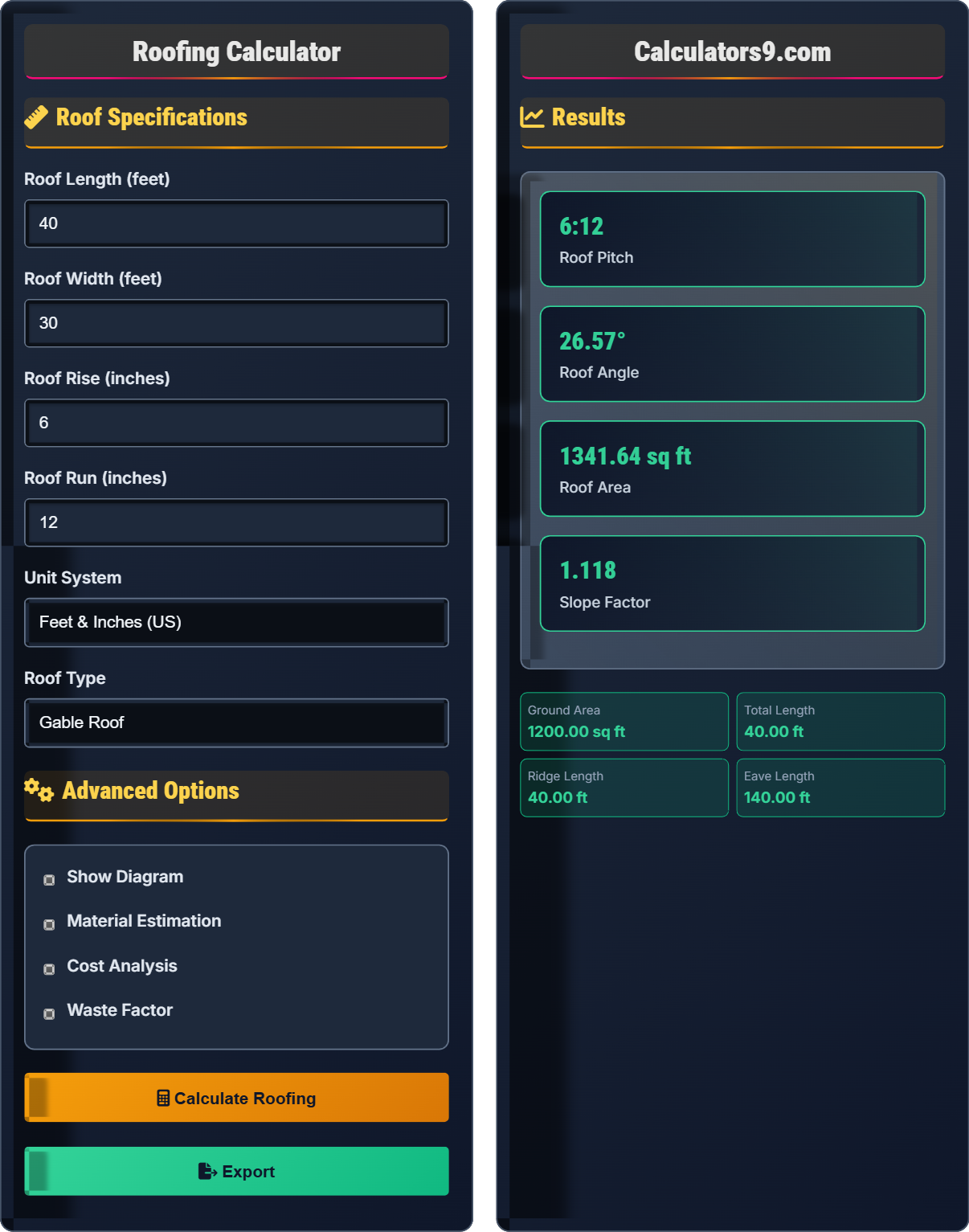
Example: For a roof with 6:12 pitch (rise of 6 inches per 12 inches of run):
Slope Factor = √(1 + (6/12)²) = √(1 + 0.25) = √1.25 = 1.118
If ground area is 1200 sq ft:
Roof Area = 1200 × 1.118 = 1,341.6 sq ft
Shingles needed (with 10% waste): 1,341.6 × 1.1 = 1,475.8 sq ft
Roof Specifications
Advanced Options
Results
Roofing Fundamentals
Roof pitch is the measure of the steepness of a roof, expressed as the ratio of vertical rise to horizontal run, typically in inches per foot. For example, a 6:12 pitch means the roof rises 6 inches for every 12 inches of horizontal distance.
Common roof pitch classifications:
- Low slope: 2:12 or less
- Gentle slope: 3:12 to 6:12
- Moderate slope: 7:12 to 9:12
- Steep slope: 10:12 or more
- Pitch affects drainage efficiency
- Steeper roofs shed water faster
- Higher pitch requires more materials
- Local codes may restrict pitch ranges
Material Requirements
Common roofing materials include asphalt shingles, metal roofing, tile, slate, and wood shakes. Each material has specific installation requirements and cost considerations.
Calculating materials:
- Calculate roof area
- Determine material coverage
- Add waste factor
- Include accessories
- Asphalt shingles: 3 tabs per sq ft
- Underlayment: 1 sq per 100 sq ft
- Flashing: 10% of perimeter length
- Nails: 4 per shingle
Roofing Learning Quiz
If a roof rises 8 inches for every 12 inches of horizontal distance, what is the roof pitch?
The correct answer is A) 8:12. Roof pitch is expressed as the ratio of vertical rise to horizontal run. If the roof rises 8 inches for every 12 inches of horizontal distance, the pitch is 8:12.
Roof pitch is a critical measurement that determines the steepness of a roof. It's expressed as a ratio where the first number represents the vertical rise in inches for every 12 inches of horizontal run. This standardization allows for consistent communication about roof slopes across the industry.
Roof Pitch: The ratio of vertical rise to horizontal run, expressed as X:12
Rise: The vertical distance the roof travels
Run: The horizontal distance measured (standardized to 12 inches)
• Pitch is always expressed as rise:12
• Higher numbers indicate steeper roofs
• Standard run is 12 inches
• Steeper roofs shed water better
• Higher pitch costs more in materials
• Local codes may restrict pitch ranges
• Reversing rise and run numbers
• Not using standard 12-inch run
• Confusing pitch with angle
Calculate the slope factor for a roof with a 6:12 pitch. What is the result?
The slope factor is calculated using the formula: √(1 + (rise/run)²)
Step 1: Calculate rise/run ratio
6:12 = 6/12 = 0.5
Step 2: Apply the formula
Slope Factor = √(1 + (0.5)²) = √(1 + 0.25) = √1.25 = 1.118
The slope factor for a 6:12 pitch is 1.118.
The slope factor accounts for the increased surface area of a sloped roof compared to its ground footprint. This is important for material calculations since the actual roof surface area is larger than the area seen from above. The Pythagorean theorem is applied to calculate this factor.
Slope Factor: The multiplier used to convert ground area to actual roof surface area
Pythagorean Theorem: a² + b² = c², used to calculate the hypotenuse of a right triangle
Surface Area: The actual area of the roof surface, not the projection below
• Slope Factor = √(1 + (rise/run)²)
• Always greater than 1.0
• Increases with steeper pitches
• Higher pitches require larger slope factors
• Use factor to calculate material needs
• Factor increases exponentially with pitch
• Forgetting to square the ratio
• Not taking the square root
• Using incorrect rise/run ratio
A house has a ground area of 1,500 square feet with a roof pitch of 8:12. Calculate the actual roof area. If the contractor wants to include a 15% waste factor, how many square feet of shingles are needed?
Step 1: Calculate the slope factor for 8:12 pitch
Slope Factor = √(1 + (8/12)²) = √(1 + 0.444) = √1.444 = 1.202
Step 2: Calculate actual roof area
Roof Area = Ground Area × Slope Factor = 1,500 × 1.202 = 1,803 sq ft
Step 3: Calculate material with waste factor
Shingles Needed = 1,803 × 1.15 = 2,073.45 sq ft
The contractor needs approximately 2,073.45 square feet of shingles.
This problem demonstrates the practical application of slope factors in material estimation. The calculation shows how a seemingly small change in roof area (from 1,500 to 1,803 sq ft) can significantly impact material needs when accounting for the roof's slope. Adding a waste factor ensures sufficient materials for cuts and mistakes.
Waste Factor: Additional material ordered to account for cuts, damage, and installation errors
Ground Area: The area of the building footprint
Actual Roof Area: The true surface area of the roof accounting for slope
• Actual Area = Ground Area × Slope Factor
• Add waste factor to final calculation
• Standard waste factor: 10-15%
• Round up to nearest bundle quantity
• Consider pattern complexity for waste
• Verify manufacturer recommendations
• Not applying slope factor
• Forgetting waste factor
• Using ground area directly
Calculate the roof angle in degrees for a 12:12 pitch roof. (Use arctan function: angle = arctan(rise/run))
Step 1: Apply the arctangent formula
Angle = arctan(rise/run) = arctan(12/12) = arctan(1)
Step 2: Calculate the angle
Angle = arctan(1) = 45 degrees
A 12:12 pitch roof has an angle of 45 degrees.
This calculation connects roof pitch ratios to actual angles in degrees, which is useful for construction planning and material selection. A 12:12 pitch represents a 45-degree angle, which is considered quite steep and requires special installation techniques and safety measures.
Arctangent (arctan): The inverse tangent function that converts a ratio to an angle
Roof Angle: The actual angle of the roof surface from horizontal, measured in degrees
Trigonometry: Branch of mathematics dealing with triangles and angles
• Angle = arctan(rise/run)
• 12:12 = 45 degrees
• Steeper angles require special care
• Memorize common angles (4:12=18.4°, 6:12=26.6°, 12:12=45°)
• Steeper roofs need special fasteners
• Safety equipment required for steep roofs
• Confusing pitch with angle
• Using wrong trigonometric function
• Not converting to degrees if needed
How many squares of shingles are needed to cover a roof area of 2,400 square feet?
The correct answer is A) 24 squares. In roofing, one "square" equals 100 square feet. Therefore: 2,400 sq ft ÷ 100 = 24 squares.
The roofing industry uses a standard unit called a "square" to measure roofing materials. One square equals exactly 100 square feet of roof area. This standardization simplifies material ordering and pricing calculations in the roofing trade.
Square: A unit of measurement in roofing equal to 100 square feet
Roofing Unit: Standard measurement for ordering materials
Material Coverage: The area that a particular material will cover
• 1 square = 100 sq ft
• Squares = Total sq ft ÷ 100
• Shingles sold by squares
• Convert roof area to squares for material orders
• Add waste factor to square calculation
• Verify package coverage
• Forgetting the 100 sq ft definition
• Multiplying instead of dividing
• Confusing squares with bundles
FAQ
Q: How does roof pitch affect material costs?
A: Roof pitch significantly affects material costs through the slope factor. For example, a 6:12 pitch roof requires about 12% more materials than its ground footprint suggests, while a 12:12 pitch roof requires about 41% more.
Mathematically, for a 1000 sq ft ground area:
6:12 pitch: 1000 × 1.118 = 1,118 sq ft (11.18 squares)
12:12 pitch: 1000 × 1.414 = 1,414 sq ft (14.14 squares)
That's a 26% increase in material requirements, directly impacting costs.
Q: What waste factor should I use for different roof types?
A: Waste factors vary by roof complexity:
- Simple gable roof: 10% waste factor
- Complex hip roof: 15% waste factor
- Roof with dormers: 20% waste factor
- Patterned installation: Add 5-10% more
The waste factor accounts for cuts at valleys, ridges, hips, and around penetrations like chimneys and vents. More complex rooflines require more cuts and therefore more waste.